
Small Grinder: Your Compact Powerhouse for Precision Grinding – Ideal for Lab & Small Batch Production

What Is a Small Grinder and Why Do You Need One?
If you've ever tried to grind a handful of spices, a few grams of herbs, or a small batch of chemical samples in a giant industrial mill, you know the struggle. The machine is too big, too loud, and you end up wasting more material than you actually process. That's exactly where a small grinder steps in – a compact, efficient, and surprisingly powerful tool designed for precision grinding in labs, small workshops, and even home kitchens.
At its heart, a small grinder is a miniaturized version of larger milling equipment, but don't let its size fool you. It can reduce solid materials to fine powders, sometimes down to the micron level, with remarkable consistency. Whether you're a researcher developing new materials, a small-batch food producer, or a hobbyist experimenting with homemade pigments, this little machine can be your best friend.
In this article, we'll dive into how a small grinder works, what makes it special, and how you can choose the right one for your needs. We'll also share some practical tips from our experience at TENCAN (also known as Changsha Tianchuang Powder Technology Co., Ltd.), a company that's been designing and manufacturing powder processing equipment for years.
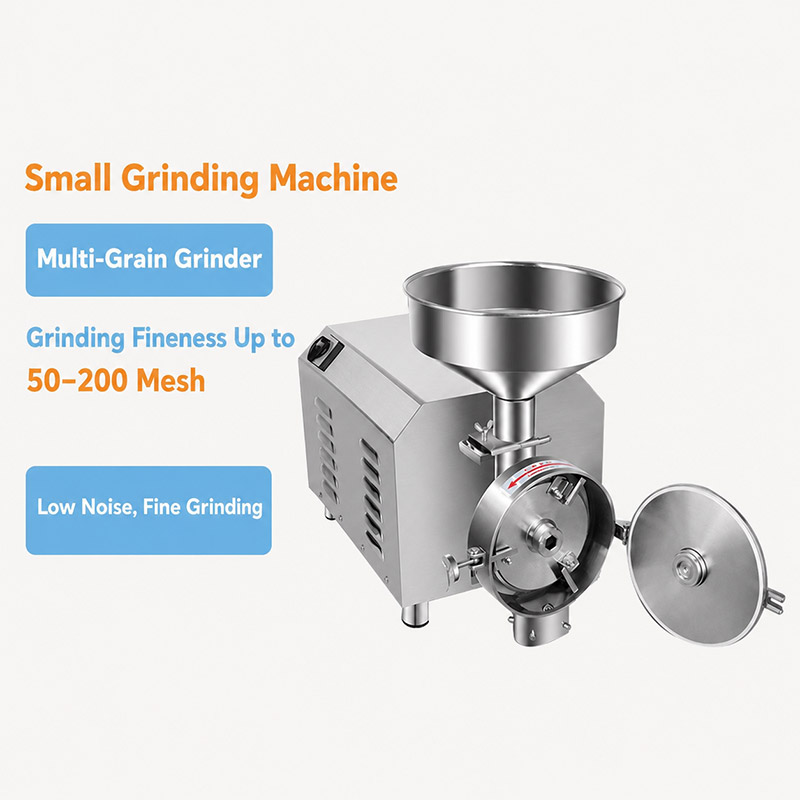
How Does a Small Grinder Work?
The working principle of a typical small grinder is based on high-speed rotation. Inside the machine, there's a rotor (or rotating disc) that spins at thousands of revolutions per minute, and a stationary stator (or fixed disc) that surrounds it. The gap between the rotor and stator is adjustable, ranging from a few millimeters down to almost zero.
When you feed material into the grinding chamber, it gets caught between the rotor and stator. Thanks to the tremendous shear force generated by the high-speed rotation, the particles are torn, cut, and crushed. At the same time, the impact of the rotor against the particles and the friction between particles themselves all contribute to breaking them down into finer and finer sizes.
For wet grinding applications (like making a paste or slurry), the small grinder often uses a rotor-stator design similar to a colloid mill. The liquid suspension is forced through the narrow gap, where intense shear and turbulence create a stable emulsion or dispersion. This is why you'll often find small grinders used in the production of paints, inks, and even some food products like nut butters.
One of the cleverest features is the built-in classification system. Many small grinders have a screen or a centrifugal classifier that only lets particles below a certain size pass through. Oversized particles are recycled back into the grinding zone for further reduction. This means you get a uniform, consistent powder without having to sieve it separately.
Key Features That Make a Small Grinder Stand Out
1. Compact Footprint, Big Performance
Most small grinders fit right on your benchtop. They take up less space than a shoebox, yet they can process anywhere from a few grams to several kilograms per hour. For a lab or a small startup, that's a game-changer.
2. Adjustable Particle Size
The gap between rotor and stator can be fine-tuned, giving you control over the final fineness. Some models allow you to achieve particles as fine as 5–50 microns, which is in the range of micropowders – ideal for pharmaceuticals, advanced ceramics, and high-end cosmetics.
3. Sealed & Dust-Free Operation
Unlike a simple blender or mortar and pestle, a well-designed small grinder operates under negative pressure. The chamber is sealed, so no dust escapes into your workspace. This is crucial when you're handling toxic substances, allergens, or simply want to keep your lab clean.
4. Easy Cleaning & Material Changeover
Because the grinding parts are accessible (often the front cover opens with a few turns), cleaning is straightforward. You can disassemble the rotor and stator, wash them, and reassemble in minutes. This makes it easy to switch between different materials without cross-contamination.
5. Versatile – Dry & Wet Grinding
Many small grinders handle both dry powders and wet slurries. Some even come with interchangeable grinding modules: one for dry impact grinding, another for wet colloid milling. That means one machine can replace two or three different devices.
Technical Specifications (Typical for a Lab-Scale Small Grinder)
Below is a typical set of parameters you might find on a small grinder from TENCAN. Exact numbers can vary by model, but this gives you a good baseline.
| Parameter | Typical Value | Notes |
|---|---|---|
| Motor Power | 150–500 W | Enough for hard spices, grains, minerals |
| Rotational Speed | 2000–10000 rpm | Adjustable; higher speed = finer powder |
| Grinding Gap | 0.01–3 mm | Control particle fineness |
| Feed Particle Size | < 2 mm | Coarse materials need pre-crushing |
| Output Fineness | 5–150 µm | Depends on gap, speed, material |
| Capacity | 50–500 g/batch (dry) | Continuous models available |
| Material Contact Parts | Stainless steel 304/316 | Corrosion-resistant, food-grade optional |
| Noise Level | < 70 dB | Quiet enough for lab environment |
| Weight | 10–25 kg | Portable but stable |
Where Can You Use a Small Grinder?
- Pharmaceutical R&D: Grinding active ingredients, excipients, and herbal extracts into fine powders for formulation studies.
- Food & Spice Processing: Freshly ground black pepper, cumin, cinnamon, or even dehydrated vegetables. The sealed chamber preserves volatile oils and aromas.
- Chemical & Pigment Production: Dispersing pigments in a liquid vehicle, creating consistent color pastes for inks and paints.
- Ceramics & Advanced Materials: Preparing precursor powders for sintering, or grinding electronic-grade materials like ferrites and zeolites.
- Cosmetics & Personal Care: Making fine powders for face masks, eyeshadows, or exfoliating scrubs.
One thing we've noticed at TENCAN is that many customers start with a small grinder for prototyping, then later scale up to larger equipment like a three roll mill or a micro airflow pulverizer once their production volume increases. But the small grinder remains a valuable tool for quick tests and small batches.
Tips for Getting the Best Results from Your Small Grinder
Pre-crush Large Particles
If your material contains chunks bigger than a few millimeters, break them down first using a mortar or a coarse crusher. This prevents the machine from clogging and ensures even grinding.
Choose the Right Grinding Gap
Start with a medium gap, run a test, and check the particle size. Then adjust smaller or larger as needed. Remember that a smaller gap produces finer powder but also generates more heat – sensitive materials might degrade.
Use a Coolant or Intermittent Operation for Heat-Sensitive Materials
Some spices, resins, or low-melting-point chemicals can soften or melt if the grinding chamber gets too hot. In those cases, let the machine run for 10–20 seconds, then pause for 30 seconds to let it cool down. Alternatively, you can use a water-cooled jacket if your model supports it.
Clean Immediately After Use
Powder residues can harden and become difficult to remove if left overnight. A quick rinse with water (for stainless steel parts) or a wipe with a dry cloth (for non-washable parts) will save you time later.
Small Grinder vs. Other Grinding Equipment
You might wonder: why not just use a colloid mill or a laboratory sand grinder? The answer lies in the application. A colloid mill excels at wet grinding and emulsification but is less efficient for dry materials. A sand grinder is great for ultra-fine wet milling but often requires a larger sample volume. The small grinder strikes a balance: it handles both dry and wet jobs with minimal sample loss, making it a true all-rounder for the lab.
For extremely fine grinding down to the nanometer range, you might eventually need a micro airflow pulverizer (jet mill), which uses compressed air to accelerate particles and make them collide. But for most everyday grinding tasks, the small grinder is more than enough.
Why Choose TENCAN for Your Small Grinder?
At Changsha Tianchuang Powder Technology Co., Ltd. (TENCAN), we've been deeply involved in the powder equipment industry for over a decade. Our small grinders are built with the same attention to detail as our larger planetary ball mills. Every machine undergoes rigorous testing for balance, noise, and grinding uniformity before it leaves our factory.
We offer customization options – different motor speeds, special coatings for abrasive materials, and even explosion-proof designs for flammable powders. And because we sell directly to end users, you get factory pricing and direct technical support.
If you're curious about how a small grinder could fit into your workflow, feel free to browse our product page for the small grinder or check out related equipment like the agate grinder for contamination-free grinding of particularly pure samples.
Final Thoughts
A small grinder is one of those tools that once you have it, you wonder how you managed without it. It's compact, versatile, and surprisingly powerful. Whether you're grinding coffee beans for a perfect espresso, preparing samples for X-ray diffraction, or developing a new cosmetic formula, this little machine will deliver consistent, high-quality results.
Remember, the key to successful grinding lies in matching the machine to your material and process. Start with a good small grinder, learn its quirks, and you'll be amazed at what you can achieve.
Happy grinding!
Get In Touch
Our professional team will reply to you within one business day. Please feel free to contact us!