
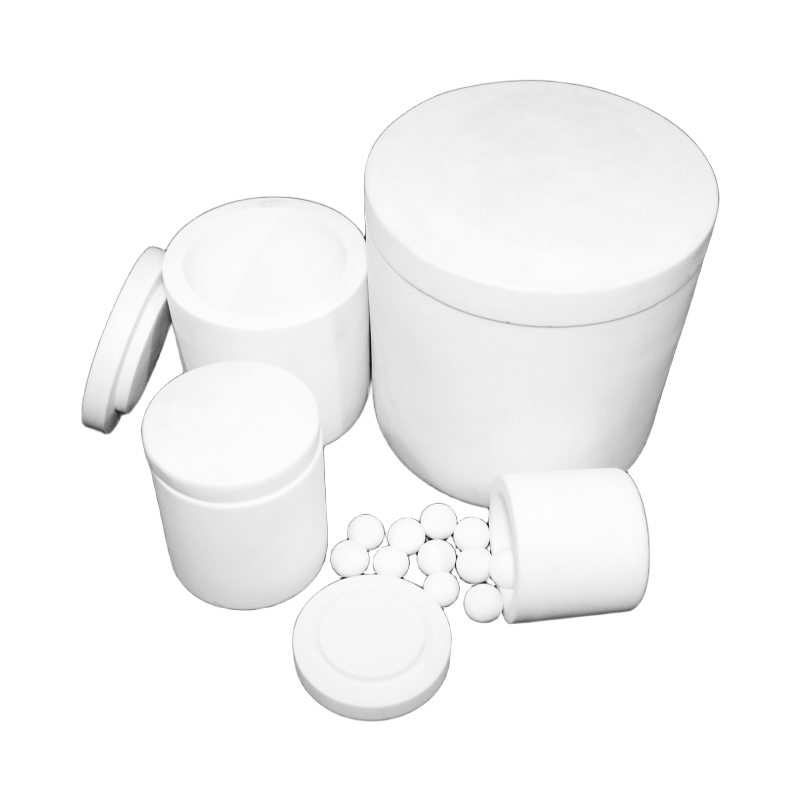
A Grade Corundum Planetary Mill Jar: Hard, Pure and Built for Tough Grinding

Ball milling looks like the simplest job in the lab: load powder into a jar, drop in some balls, spin it, and wait. Then you open the jar and find out what really happened. Sometimes you get a beautifully fine powder. Sometimes you get a grey slurry that quietly tells you the jar has donated part of itself to your sample. The jar is the piece most people think about last, and it is very often the piece that decides whether the run works.
That is why a corundum planetary mill jar keeps turning up on the benches of labs that grind hard, abrasive or purity-critical materials. Let us walk through what the material actually is, how it behaves next to agate, zirconia, tungsten carbide and steel, where it earns its place, and how to run it so you get repeatable results instead of surprises.
What a Corundum Planetary Mill Jar Actually Is
Planetary milling, in one minute
A planetary ball mill gets its name from the motion inside. Each jar sits on a rotating disc (the sun wheel) and spins around its own axis at the same time, in the opposite direction. That double rotation flings the grinding balls up the inner wall, then lets them crash back down and across the jar's inside surface, again and again. The energy comes from impact and from shear, so powder breaks down through a mix of hard hits and steady rubbing.
The jar is the chamber where all of it happens, which means it absorbs every bit of force the mill can produce, and it is the one surface your sample touches for the entire run. Choose it badly and the jar becomes an ingredient in your recipe.
Corundum, in plain language
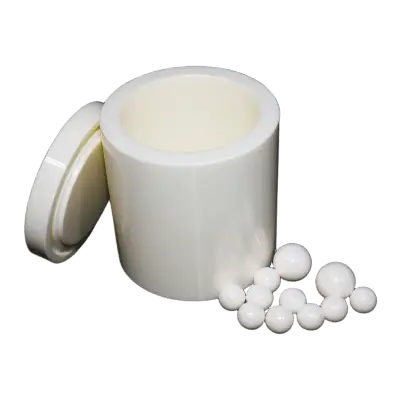
Corundum is the crystalline form of aluminium oxide, Al2O3. It is the same mineral family as ruby and sapphire before you add the colouring elements, and it sits at 9 on the Mohs hardness scale, second only to diamond among common minerals. You already know it from sandpaper and grinding wheels. A milling jar made of corundum is a sintered ceramic: high-purity alumina powder is pressed into shape and fired at high temperature until the particles fuse into a dense, non-porous solid.
Here is the practical point. If the jar is harder and tougher than what you are grinding, the jar keeps its shape and your powder stays your powder. If the jar is softer than the sample, you end up grinding the jar as much as the sample, and what you collect is a mixture whether you wanted one or not.
Why the "A grade" label matters
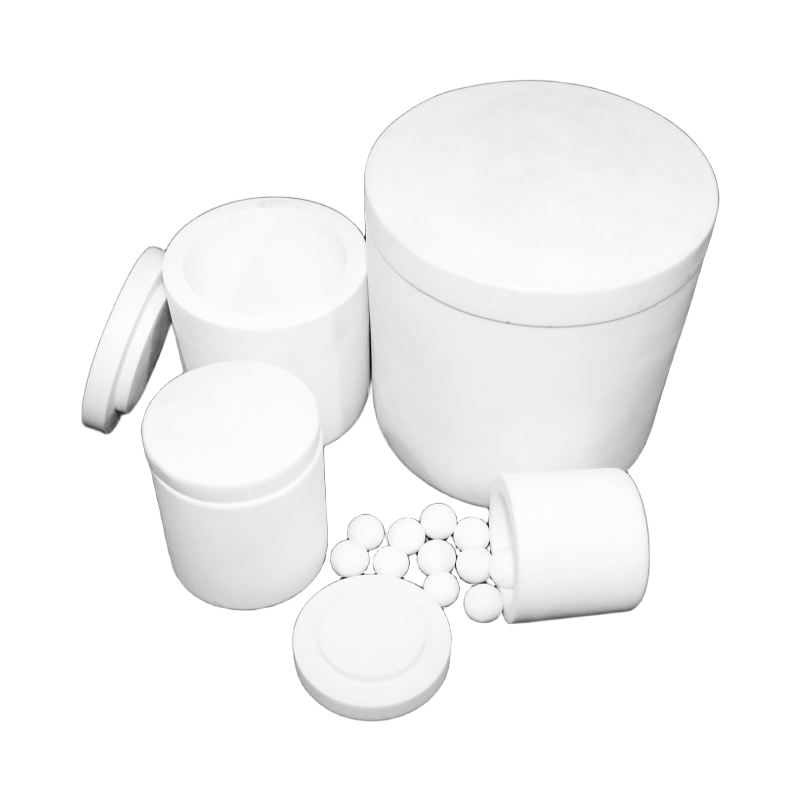
Alumina ceramics come in a wide spread of qualities, and grading usually reflects the purity and density of the fired body. An A grade corundum jar sits at the better end of that range: fewer pores, fewer secondary phases, a tighter grain structure, and far less tendency to shed material during long runs. "Fewer pores" sounds like a detail until you have watched a cheap jar absorb solvent, hold on to the previous sample, and release it into the next one. A dense ceramic does not do that. It does not soak, it cleans up quickly, and it stays out of your analysis.
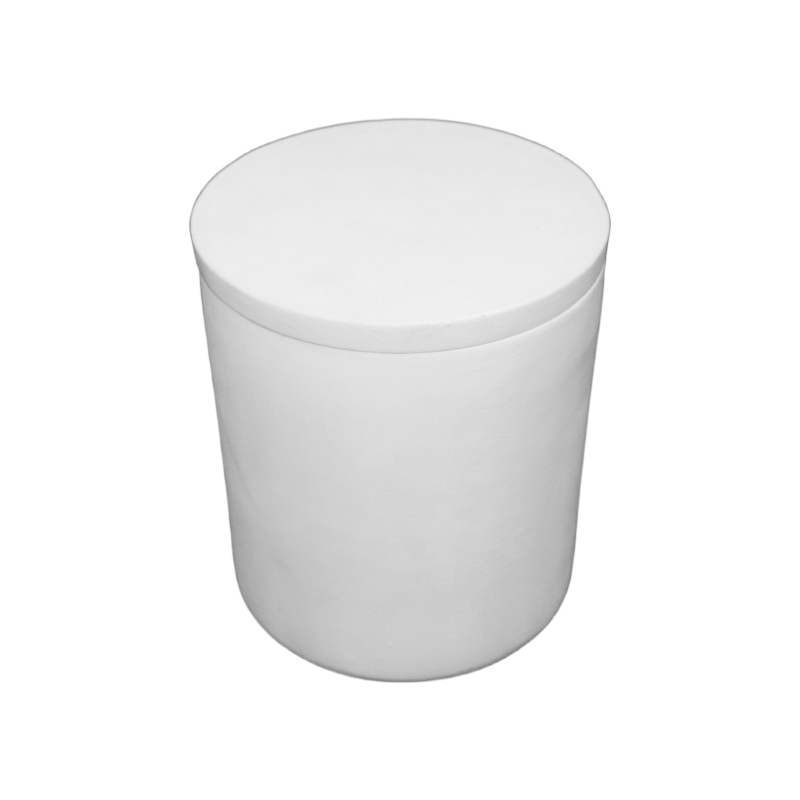
The jar body is only half the story. A well-made corundum jar also has a properly machined rim and a lid that seals flat, because milling generates fine dust that will climb out of any gap. Look at the wall thickness, the lid fit and the sealing ring before you look at the price tag.
How Corundum Compares With Other Jar Materials
There is no single best jar material, only a best match for a given powder. Here is how corundum stacks up against the ones you will meet most often.
Agate
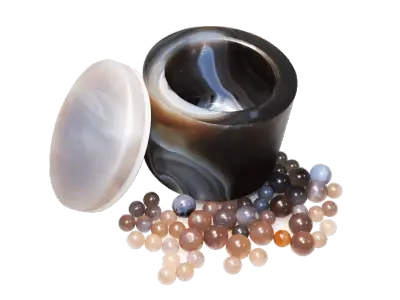
Agate jars are affordable and gentle. They are made of natural silica and are noticeably softer than corundum, so they suit soft to medium-hard samples such as pigments, plant tissue and many minerals, as long as a little silica contamination does not matter. Push them with hard ceramics or metal oxides and the wear rate climbs fast, and that is exactly when you start seeing silicon where it should not be.
Zirconia
Zirconia jars are dense and tough, a solid option for medium-hard materials and for work where zirconium is either acceptable or expected in the sample. They are heavier than corundum of the same volume, which puts extra load on a small mill, and they usually cost more per litre.
Tungsten carbide
Tungsten carbide jars are extremely hard and very heavy, and they grind aggressively because of that mass. They are the tool for genuinely tough samples such as hard metals, some oxides and mineral standards. The trade-offs are the cobalt binder used in manufacturing, which can appear as contamination, and a price that makes most labs keep them in a cabinet for special jobs.
Stainless steel and polymers
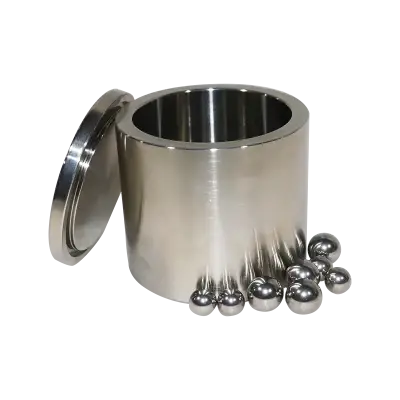
Steel jars are tough and cheap per litre, and they are fine for coarse crushing, but they shed iron, chromium and nickel. For magnetic materials or trace-metal work they are ruled out before you start. Polymer jars sit at the other extreme: soft, chemically resistant, and perfect for soft samples where no hard ceramic should touch the powder at all.
| Jar material | Hardness | Typical contamination | Best suited to |
|---|---|---|---|
| Corundum (A grade alumina) | Very high | Aluminium oxide, often identical to the sample chemistry | Hard, abrasive and purity-critical powders |
| Agate | Moderate | Silica | Soft to medium samples on a tighter budget |
| Zirconia | High | Zirconium oxide | Medium-hard samples, high-density grinding |
| Tungsten carbide | Extremely high | Tungsten and cobalt binder | Very hard samples, aggressive comminution |
| Stainless steel | High but ductile | Iron, chromium, nickel | Coarse crushing where iron is acceptable |
| Polymers (nylon, PTFE) | Low | Organic residues | Soft samples with metal-free requirements |
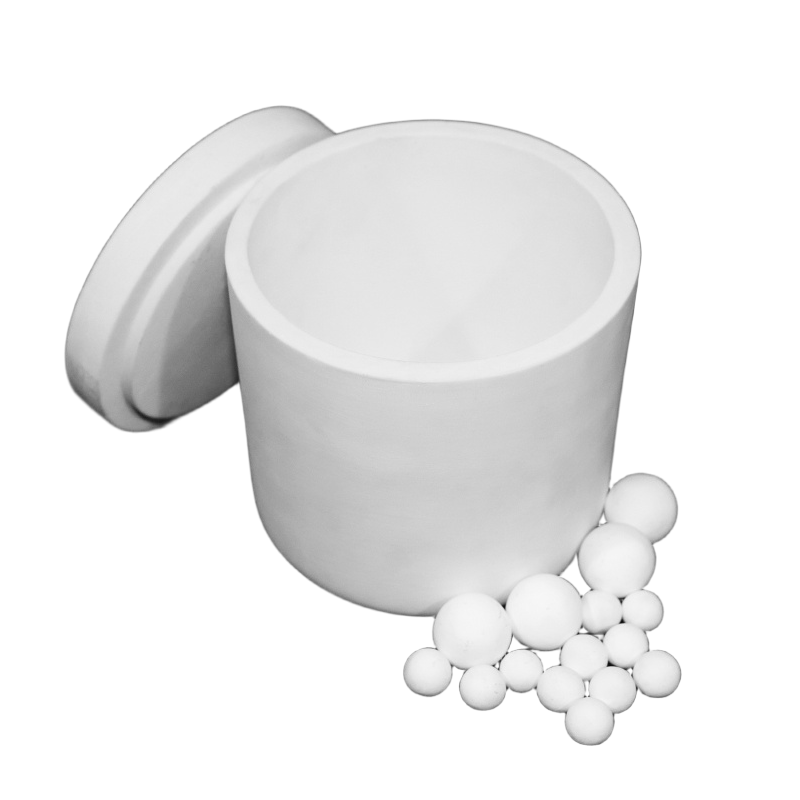
The short version: corundum sits in a sweet spot. It is hard and dense enough for genuinely abrasive powders, chemically inert enough to leave the sample alone, and free of the heavy-metal contamination that steel and tungsten carbide can bring.
Where Corundum Jars Earn Their Keep
If any of these sound like your bench, corundum deserves a serious look:
- Grinding hard ceramics such as alumina, zirconia and glass frit, or tough mineral samples like cement clinker.
- Preparing battery powders, including cathode and anode materials, where a few parts per million of iron can shift the results.
- Getting geological, ore and mineral samples ready for XRF, XRD or ICP analysis.
- Milling pigments, dyes and fillers where both the colour and the chemistry must survive untouched.
- Handling catalysts, rare earth compounds and other high-value powders where losses hurt.
- Any process where you have to prove the jar is not the contamination source.
Notice how often the real driver is cleanliness rather than speed. Labs choose corundum because they got tired of explaining unexpected peaks in their spectra, or because a customer asked for a contamination budget and they wanted to answer honestly.
When corundum is not the right answer
Corundum is tough, but it is still a ceramic, and ceramics dislike abuse. If your sample is tougher than alumina, think tungsten carbide scrap, silicon carbide grit or some hard metals, the jar slowly loses that fight and tungsten carbide media will serve you better. If your budget is tight and your samples are soft, agate or a polymer jar does the job for less. Where corundum has a quieter advantage is with metal powders that must not see iron: it contains no metal at all, so a magnetic or oxygen-sensitive sample stays as clean as your handling allows.
Matching the Jar to Your Mill and Your Job
Jar volume and sample load
Start from volume, not from habit. A jar that is too small chokes the ball charge and runs hot; a jar that is far too large wastes energy, because the media spend their time rolling around instead of hitting anything. As a working rule, the grinding media should fill roughly a third to a half of the jar volume, and the powder should be enough to fill the gaps between the balls without drowning them. A simple test: if the balls cannot move freely when you shake the closed jar, you are stirring, not grinding.
Grinding media
You can pair a corundum jar with alumina balls for a fully ceramic, contamination-light setup, or with zirconia balls when you want extra density and impact force. Ball diameter sets the balance between impact and shear. Bigger balls hit harder and break coarse particles faster; smaller balls give more contact points and a finer, more uniform product. Many labs settle on a mixed charge, with a few large balls for the breaking and a crowd of small ones for the polishing.
Rotational speed
Speed is the setting everyone reaches for first and understands last. Within limits, faster means more energy per impact and shorter milling times. Beyond a certain point the balls simply centrifuge against the jar wall and stop doing useful work: the mill gets louder and hotter and no more effective. That threshold depends on the mill geometry and jar diameter, so it is worth finding it for your own setup with a short trial series rather than guessing. Corundum jars are heavy, so respect your mill's weight limits too. An unbalanced jar set is noisy, and noisy usually means something is wearing out.
Practical Tips From the Bench
Fill ratio and ball-to-powder ratio
The ball-to-powder ratio is the mass of grinding media divided by the mass of sample. For routine fine grinding, values around 10:1 to 20:1 are common; for very fine or mechanochemical work, people push much higher. A higher ratio means more collisions per particle and a finer product, at the cost of throughput and extra heat. If your powder is heat-sensitive, a longer run at a moderate ratio will beat a fast aggressive one every time.
Wet or dry?
Dry milling is simpler and suits brittle powders that flow well. Wet milling, with a solvent or a dispersant, cuts dust, reduces agglomeration, helps control temperature and usually gives a finer, more uniform particle size distribution. The solvent has to be compatible with both the jar and the sample, and you still have to dry the product afterwards. Just remember that a wet charge is heavier, so keep an eye on total jar weight if your mill has limits.
Cleaning and cross-contamination
A dense, low-porosity ceramic surface is a real gift at cleanup time, but it still needs a routine. Between samples: rinse with the solvent you used, go over the inside with a soft brush, then dry in an oven or with clean compressed air. Never use metal scrapers inside the jar, because the whole point is keeping metals out. If you switch between chemically incompatible materials, keep a dedicated jar for each family and label it clearly.
Care, Wear and Troubleshooting
Corundum jars reward a little attention. Here is what we check when something feels off:
- Unexpected contamination. Check the media before you blame the jar, since worn zirconia or steel balls are a common culprit.
- Powder escaping or the lid leaking. Usually the gasket, the sealing face, or simply over-filling.
- Fine powder caking on the walls. Common with moist or electrostatic samples; try wet milling, a short dry pre-grind, or a slightly smaller charge.
- Milling times creeping upward. A sign the media have worn down in size, so top up or replace the ball charge.
- A jar that is hot to the touch after a run. Reduce speed or split the run into intervals. Heat is a product-quality issue, not just a comfort one.
With sensible samples and normal use, a good corundum jar lasts a long time. Ceramic chips rather than bends, so store jars where they cannot knock against each other, and do not set lids down on a concrete floor. That sounds obvious until you have watched it happen.
Questions We Get Asked a Lot
Can one corundum jar handle both dry and wet milling?
Yes. Corundum is chemically inert and does not absorb water or most solvents, so the same jar works for dry and wet runs as long as you clean it properly in between. The exception is strongly alkaline solutions and anything based on hydrofluoric acid, which attack alumina over time.
Will a corundum jar wear out my mill?
It is heavier than an agate jar of the same size, so the mill carries more load and balancing matters more. Stay inside the mill's rated limits and a corundum jar is a perfectly well-behaved accessory.
How fine can I grind with it?
Final particle size depends far more on the media, the ratio and the milling time than on the jar alone. Sub-micron results are routine in a well-run planetary mill, but they come from trial work on your own material rather than a fixed recipe copied from a manual.
Can I heat the jar to dry it?
Gentle oven temperatures are fine for drying. Avoid thermal shock, and never take a hot jar straight into cold water, because a sudden temperature change is the most reliable way to crack a ceramic.
Choosing Your Corundum Jar
If your work involves hard, abrasive or purity-critical powders, the decision usually comes down to one question: is the jar tough enough to stay out of my sample? For a lot of labs, a corundum jar answers that with a clean yes. You can review the full specification for our A grade corundum planetary mill jar, check that the volume suits your mill and batch size, then settle on the media: alumina for a fully ceramic setup, zirconia when you want more punch.
Still weighing your options? Use the same corundum planetary mill jar product page to compare it against whatever you are running now, and if you are planning a set of jars for different sample families, start with the one you grind most often. Pick the jar that suits your powder, not the one that happens to be on the shelf.
Related Products
Get In Touch
Our professional team will reply to you within one business day. Please feel free to contact us!