
Vacuum Feeder: The Ultimate Solution for Efficient Powder and Granule Conveying

What Is a Vacuum Feeder and Why Does Your Production Line Need One?
If you're dealing with powders, granules, or pellets in your manufacturing process, you've probably faced the challenges of dust, spillage, and manual labor. A vacuum feeder (also called a vacuum powder feeder or vacuum conveyor) is the game-changing solution that solves these issues elegantly. Think of it as a silent, powerful assistant that transports materials from point A to point B in a completely sealed system — no dust escapes, no spills happen, and your operators stay clean and safe.
At its core, a vacuum feeder uses negative pressure created by a vacuum pump or a high-pressure blower to suck materials through a pipeline. It’s like using a straw to drink a thick milkshake, but engineered for industrial reliability. Whether you're feeding an extruder, a mixer, or a packaging machine, this equipment ensures a steady, automated supply without human intervention.
How Does a Vacuum Feeder Work?
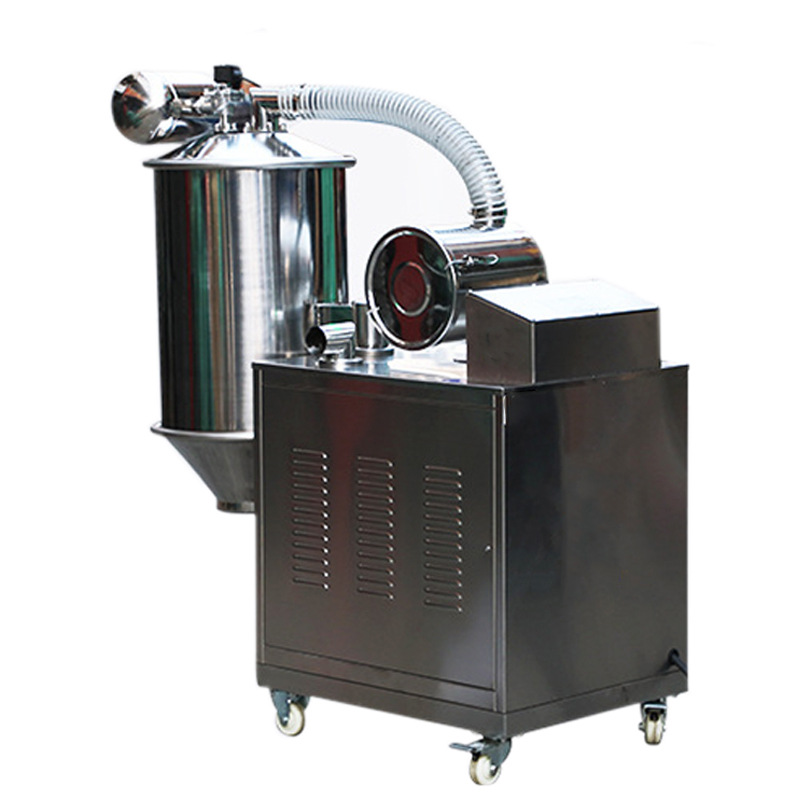
Let’s break down the working principle in simple terms. The system consists of three main parts: a suction nozzle (or pickup point), a conveying pipe, and a receiver hopper with a filter. When the vacuum pump starts, it pulls air out of the receiver, creating a vacuum. Atmospheric pressure then pushes the material into the suction nozzle, along the pipe, and into the receiver. Inside the receiver, a filter separates the material from the air. Once the material is collected, a valve opens and drops it into your process equipment — often with a pulse jet of compressed air that cleans the filter automatically.
Key Components at a Glance
- Vacuum pump/blower: Provides the suction power. Often a regenerative blower for quiet, long-life operation.
- Filter: Usually a cartridge or bag filter that retains fine particles while allowing clean air to pass.
- Pulse jet cleaning system: Periodically blasts compressed air to dislodge accumulated dust from the filter.
- Discharge valve: Opens automatically when the hopper is full, releasing material into the downstream process.
- Control system: Electronic controller that manages the entire cycle, often with sensors to detect material level.
Why Choose TENCAN's Vacuum Feeder?
When you invest in a vacuum feeder, you want a machine that lasts, performs consistently, and meets stringent hygiene standards. Changsha Tencan Powder Technology Co., Ltd. (TENCAN) has engineered its vacuum feeder with features that address real-world production needs:
- Stainless steel construction: All contact parts are made from 304 or 316L stainless steel, resistant to corrosion and easy to clean — perfect for food, pharmaceutical, and chemical applications.
- Conical hopper design: Ensures smooth material flow and prevents bridging or clogging.
- Pulse jet filter cleaning: Maintains high suction efficiency and reduces maintenance downtime.
- Compact and mobile: Available with casters for easy movement between production stations.
- Automatic operation: PLC or microcontroller-based control allows you to set feeding cycles, and the system runs on its own.
Applications Across Industries
Vacuum feeders are incredibly versatile. Here are just a few scenarios where they shine:
Pharmaceutical Manufacturing
Tablet presses, capsule fillers, and blending equipment need a consistent, contamination-free supply of powders. A vacuum feeder eliminates manual scooping and reduces cross-contamination risk.
Food Processing
Flour, sugar, spices, protein powders — all can be conveyed gently without degradation. The sealed system also prevents pests and moisture from entering.
Chemical and Battery Materials
Fine chemicals, carbon black, lithium battery materials are often abrasive or hazardous. Vacuum feeding keeps operators safe and ensures accurate dosing.
Plastics and Additive Manufacturing
Pellets and powders for injection molding, extrusion, or 3D printing can be fed directly to the machine hopper, reducing manual labor and waste.
Technical Specifications You Should Know
While exact specs vary by model, here are typical parameters for a mid-range industrial vacuum feeder from TENCAN:
| Parameter | Value |
|---|---|
| Conveying capacity | 50 – 1000 kg/h (depending on material and distance) |
| Motor power | 0.75 – 3.0 kW |
| Power supply | 220V/380V, 50/60 Hz |
| Filter cleaning | Pulse jet (compressed air) |
| Material of construction | Stainless steel (304/316L) |
| Hopper volume | 10 – 50 L (customizable) |
Installation and Maintenance Tips
Getting the best out of your vacuum feeder is straightforward. Here are a few pointers from our experience:
- Keep the pipeline as short and straight as possible to minimize pressure drop and wear.
- Use flexible hoses at the pickup point for easy connection to different containers.
- Regularly check the filter — even with pulse cleaning, a filter may need replacement after prolonged use with fine powders.
- Ensure the compressed air supply is dry and oil-free to prevent filter clogging.
- Train your team to understand the control panel settings — automatic mode is simple, but knowing how to adjust cycle times can optimize performance.
Common Questions About Vacuum Feeders
Can a vacuum feeder handle sticky or moist materials?
Most vacuum feeders work best with free-flowing, dry powders. For sticky or moist materials, you may need a vibratory feeder or a specialized design with air-assisted discharge. TENCAN offers custom solutions for such cases.
How far can it convey material?
Typical conveying distances range from 5 to 50 meters vertically or horizontally, depending on the material density and the vacuum pump power. Long distances may require a more powerful system.
Is it noisy?
Modern regenerative blowers are surprisingly quiet (under 70 dB in most cases). The main noise comes from the material flowing through the pipe and the pulse jet cleaning. Overall, it’s much quieter than a shoveling operator!
Conclusion: Upgrade Your Material Handling with a Vacuum Feeder
If you’re still moving powders by hand or using open screw conveyors that spew dust everywhere, it’s time to consider a vacuum feeder. The benefits — dust-free environment, labor savings, consistent dosing, and compliance with GMP standards — far outweigh the initial investment. TENCAN has decades of experience in powder processing equipment, and their vacuum feeder is engineered to deliver reliable performance in the most demanding applications.
Whether you're in pharmaceuticals, food, chemicals, or plastics, a vacuum feeder can transform your production line. Want to know more? Feel free to explore the product page or reach out to the TENCAN team for a tailored solution.
Related Products
Get In Touch
Our professional team will reply to you within one business day. Please feel free to contact us!