
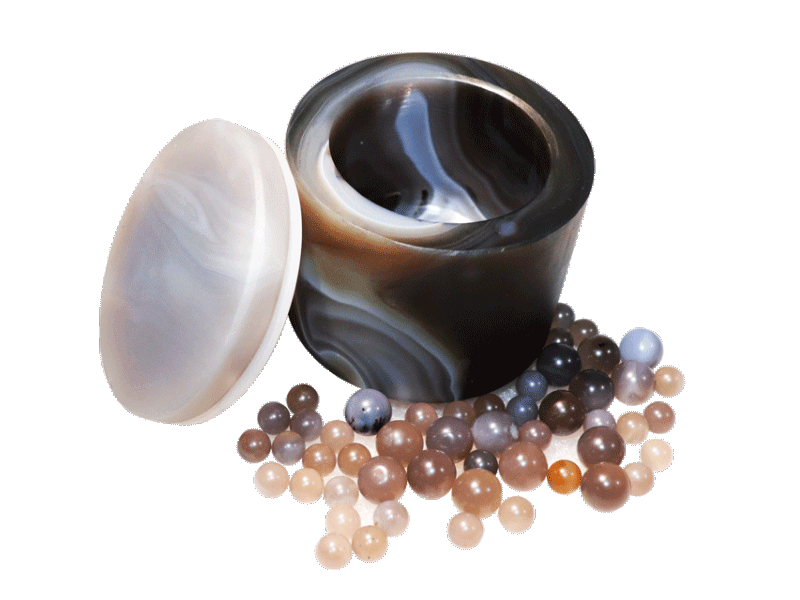
Agate Planetary Mill Jar: Complete Buyer's Guide to Contamination-Free Grinding

If you have ever spent a week preparing a batch of samples, sent them to the analyzer, and then found iron peaks in the spectrum that nobody ordered, you already know that the grinding jar matters as much as the mill. An agate planetary mill jar exists for exactly that moment. It is a grinding vessel cut from natural agate, machined and polished to sit inside a planetary ball mill, and it lets you crush, blend, and reduce a sample to a fine powder without dragging iron, tungsten, or zirconium into your results.
We will walk through what these jars really are, how they behave once the machine starts spinning, which sizes and ball loads make sense, and where they quietly beat everything else in the cabinet. No lab coat required.
What an Agate Planetary Mill Jar Actually Is
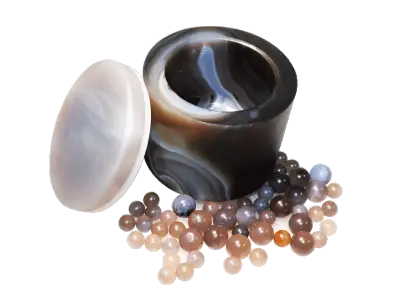
A planetary mill jar is a short, thick-walled cylinder with a lid that clamps down hard enough to survive being thrown around. Inside sit a handful of small grinding balls. That is the whole idea. The difference between one jar and another comes down to what the cylinder and the balls are made of, and how precisely those parts fit together.
Why "agate" is more than a pretty stone
Agate is a cryptocrystalline form of silica. Cryptocrystalline is a fancy way of saying the crystals are so tiny you need a microscope to see them individually. Chemically it is SiO₂, the same building block as quartz and beach sand. That gives you three properties that matter on a mill.
The first is hardness. On the Mohs scale agate sits between about 6.5 and 7, right alongside quartz. A grinding medium only works if it is harder than the material it hits; otherwise the balls just smear powder around instead of fracturing it. The second is chemical stubbornness. Silica does not readily react with most acids, solvents, or biological matrices, so it will not quietly rewrite the chemistry of the sample you are preparing. The third is moderate density. Agate is far lighter than steel or zirconia, which means less impact energy per collision — a limitation for some jobs, but also the reason contamination stays so low.
Where the jar fits in a planetary ball mill
Planetary mills earn their name from the motion. A main disk, usually called the sun wheel, spins in one direction while the jars mounted around its edge spin in the opposite direction. Because each jar is both orbiting and rotating, the media inside is pushed outward by centrifugal force that can reach many times Earth's gravity. The balls climb the curved wall, get carried upward, then peel away and slam across the chamber into the powder.
The jar is the stage where all of that energy lands. If the jar is too soft it deforms and wears; if it is chemically incompatible it contaminates; if it is too light you lose impact force. Agate is a compromise that happens to be excellent for one particular range of jobs: small batches, hard but brittle samples, and any project where the purity of the final powder is the entire point.
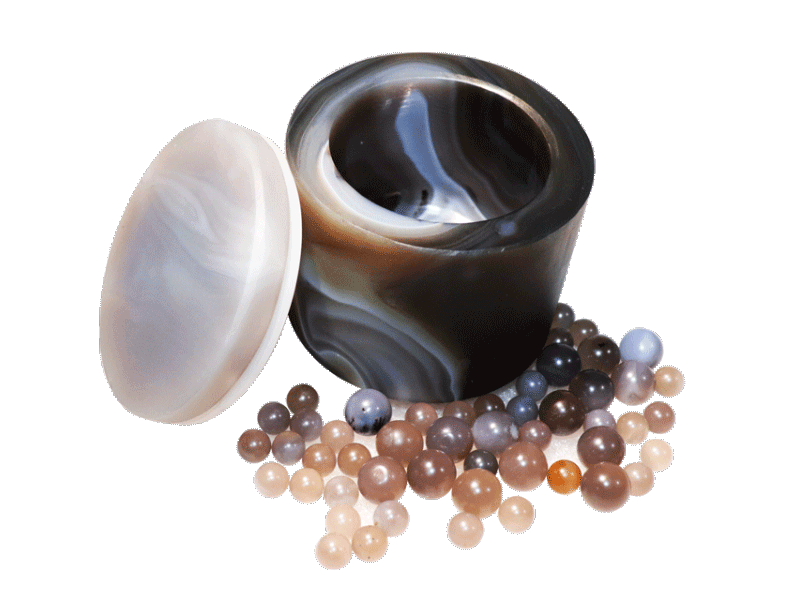
Why Contamination Is the Real Enemy of Sample Prep
Ask anyone who has chased a mysterious peak in a diffraction pattern and they will tell you the same thing: most bad data is not bad instrument data, it is bad sample data. Trace contamination is the quiet culprit, and it starts the moment the balls touch the powder.
The trouble with metal jars
Stainless steel jars are tough, affordable, and wonderful for bulk crushing. They are also made of iron, chromium, and nickel. Grind a hard mineral in a steel jar for twenty minutes and you can add measurable iron to the powder — sometimes enough to shift a result. In a metallurgy lab that is often acceptable. In a geology lab reading trace element ratios, or a battery lab measuring cathode purity, it is not.
Tungsten carbide and zirconia solve the hardness problem but not always the chemistry problem, and both are heavy and expensive. Zirconia can shed zirconium; tungsten carbide can shed tungsten along with its cobalt binder. When those are exactly the elements you are trying to measure, you have painted yourself into a corner.
What agate brings to the table
Agate contributes silicon and oxygen, and silicon is already one of the most common elements in the crust — so in most matrices a whisper of silica is either negligible or already there to begin with. That is why agate vessels have become the default for preparing geological, ceramic, and pharmaceutical samples for X-ray fluorescence, X-ray diffraction, and ICP work.
The trade-off is brittleness. Agate is hard but it does not bend. Drop a jar on a tile floor and you will learn why labs keep spares on the shelf. Treat it with a little respect and it will outlast your enthusiasm for the project.
One more thing worth knowing: contamination rarely announces itself. It shows up as a slightly high iron value, a shoulder on a diffraction peak, or a strange background in a spectrum. You do not notice it until you run a blank and the blank is not blank. Switching to a silica-based grinding environment is one of the cheapest ways to remove that whole category of doubt from your workflow.
How Grinding Actually Happens Inside the Jar
Three mechanisms do the work: impact, attrition, and compression. Which one dominates depends almost entirely on how you set the machine and how much free space you leave inside the jar.
Impact, friction, and the rolling dance
At low rotation speeds the balls roll and rub against each other and against the wall. Attrition dominates, particle size drops slowly but steadily, and you tend to get a very fine, uniform powder. Crank the speed up and the balls launch off the wall instead of rolling. Impact takes over, coarse particles break quickly, and grinding time falls dramatically. Every mill has a sweet spot where media travels up the inner wall and cascades down the far side rather than simply spinning in place — that is where energy transfer is highest.
Run too fast for too long and the jar heats up. That matters more than most people expect: heat can sinter fine particles back together, degrade polymers, or drive off volatiles in biological samples. Short bursts with cooling pauses routinely beat one long heroic run.
Ball-to-powder ratio, fill level, and why more is not better
A workable starting point is a ball-to-powder mass ratio somewhere between 5:1 and 20:1. Below that range there simply are not enough collisions per unit of powder. Above it, the jar fills up and the balls lose the free space they need to accelerate.
Fill level works the same way. Leaving roughly a third of the jar volume for media and no more than a third for powder, with the rest as empty headspace, gives the balls room to build speed. Pack a jar to the brim and you have built a very expensive object that rotates without doing much else.
Ball material matters too. Pairing agate balls with an agate jar keeps the entire grinding environment silica-based, so even the wear particles that inevitably appear are the same chemistry as the vessel. Mixing a soft jar with hard media just moves the wear to the cheapest part of the system — and that part ends up in your sample.
Wet or Dry? Choosing Your Milling Environment
Before you worry about speed, decide whether you are grinding dry powder or a slurry. This single choice changes dust levels, heat build-up, and how easily you recover the sample afterwards.
Wet milling
Add a small amount of solvent — often water, ethanol, or acetone, depending on what your downstream analysis tolerates. The liquid coats particles, prevents them from re-agglomerating, and carries heat away from the contact points. The result is usually a finer, more uniform powder in less time. The cost is a drying step and the risk of altering a moisture-sensitive material.
Dry milling
Dry grinding is faster to set up and simpler to recover: tip the jar, brush it out, done. It is the right call for materials that must stay anhydrous, and for quick trial runs where you just want to see how a sample behaves. Expect more dust and more heat, and plan short cycles accordingly.
When neither is quite right
Some samples are simply temperature-sensitive. For those, the trick is not a different jar but a different rhythm: mill in short intervals, let the jar rest, and repeat. If a material softens or smears rather than fracturing, no amount of extra time will fix it — you are deforming it, not breaking it, and you should reconsider the media size or the process entirely.
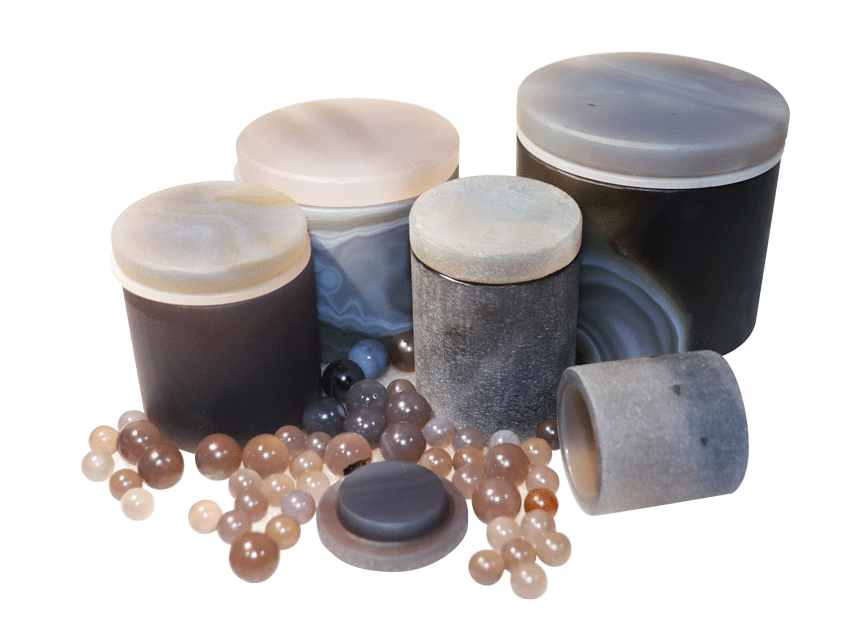
Matching an Agate Jar to Your Sample
Three variables decide everything: jar volume, ball diameter, and rotation speed. Get them roughly right and the rest is patience.
Volume and sample mass
Choose a jar volume that gives your powder room to move. As a rule of thumb the sample should occupy no more than about a quarter to a third of the jar's internal volume, with the media taking another third. A jar that looks absurdly oversized for a teaspoon of powder is often exactly the right size.
Ball size strategy
Bigger balls hit harder; smaller balls make finer powder faster because there are more contact points per unit of volume. A mixed charge works well for many jobs: a few large balls to break the coarse fraction, plus a crowd of small ones to polish the fines. If your target is a few microns, lean small. If you are starting from rock chips the size of rice grains, lean large for the first pass.
When agate is the wrong tool
Agate is not a universal answer, and pretending otherwise wastes money. Skip it if your sample is tougher than the jar, if you need to grind kilograms rather than grams, or if you are milling metal powders that genuinely need heavy impact energy to deform. Agate shines in the gram-scale, high-purity, hard-brittle niche — and outside that niche, other materials do the job better and cheaper.
Running an Agate Jar Without Breaking It
Agate rewards a gentle hand. The rules are short, and they mostly protect the jar rather than the sample.
Speed and time
Start slower than you think you need, then increase in steps. Run a few short cycles rather than one long one, and let the jar cool between cycles if it feels warm to the touch. Agate has poor thermal shock resistance, so dunking a hot jar into cold water is a genuinely bad idea. If you are milling a heat-sensitive material, build the pause-and-rest pattern in from the very beginning instead of adding it after a failed run.
Cleaning and storage
Clean the jar and balls with a soft brush and dry them promptly. Avoid harsh alkaline cleaners, since silica does not enjoy strong bases, and skip abrasive scouring pads that will dull the polished surface. Store jars with the lid off or only loosely seated. A sealed jar that still holds solvent vapour can build pressure and develop an unpleasant surprise when you open it a month later.
Where Agate Jars Show Up in the Real World
The range of applications is wider than most people expect from a lump of polished stone:
- Geology and mining: whole-rock powders for XRF and XRD, where iron contamination would distort trace element ratios.
- Ceramics and glass: frit, clay, and glaze raw materials, where a single metal speck becomes a visible defect after firing.
- Pharmaceuticals and food science: small-batch milling of active ingredients and botanical material, where the mill must not introduce heavy metals.
- Battery and materials research: cathode and anode precursors, where even trace transition metals shift electrochemical behaviour.
- Environmental laboratories: soil, sediment, and ash samples prepared for elemental analysis.
- Forensics and archaeology: fragile or precious specimens where sample loss and contamination both matter.
Agate vs Other Jar Materials at a Glance
| Jar material | Hardness | Contamination risk | Best suited to |
|---|---|---|---|
| Agate | High (about 6.5–7 Mohs) | Very low — mainly silica | Small batches, trace analysis, brittle samples |
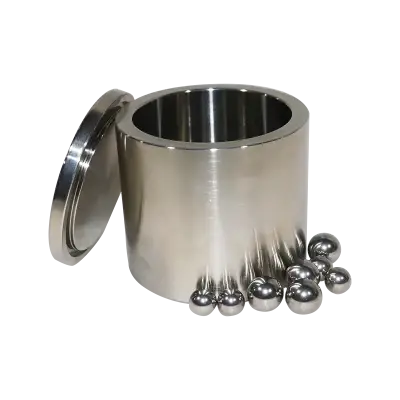
| Stainless steel | Moderate | Iron, chromium, nickel | Tough bulk crushing where purity is not critical |
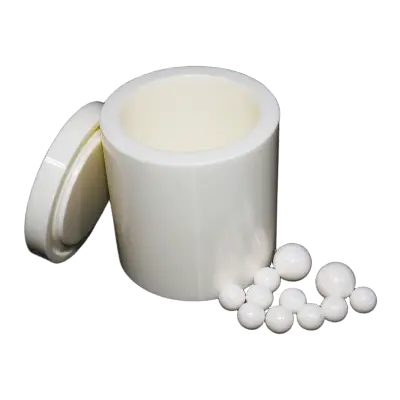
| Zirconia | Very high | Zirconium traces | High-energy milling of hard, dense materials |
| Tungsten carbide | Very high | Tungsten and cobalt | Aggressive size reduction with maximum impact |
| Alumina | High | Aluminium traces | General purpose grinding with moderate purity needs |
If your analysis targets any of the elements listed in that third column, cross that material off your list before you start. That one habit prevents more bad data than any upgrade to the mill itself.
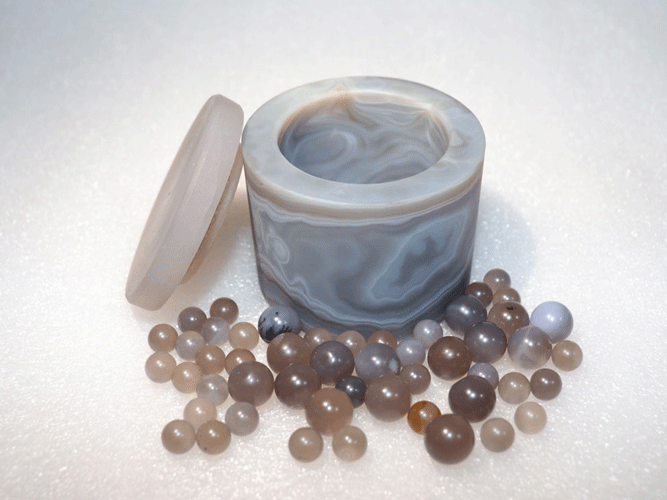
How to Tell Your Agate Jar Is Worn Out
Grinding vessels do not last forever, and an agate jar gives you plenty of warning if you know what to look for. A worn jar grinds more slowly, heats faster, and starts contributing more wear particles than it should.
Signs worth watching for
- Chipped or rounded edges on the inner rim, where the balls repeatedly strike during operation.
- A dull, frosted interior instead of the smooth polished finish the jar had when new.
- Visible fractures anywhere in the wall — stop using the jar immediately, because a cracked jar can fail mid-run.
- Unexplained contamination in results that were previously clean, which usually means the jar is shedding more material than it used to.
- Slower grind times for the same sample and the same settings.
Rotating between two jars, or keeping a spare on the shelf, is a simple insurance policy that keeps a project moving when one vessel finally gives up.
Questions People Actually Ask
How long should I grind?
Start with short cycles and check the powder under a microscope or with a quick sieve. Most small batches reach a suitable fineness within minutes once the speed is dialled in; stubborn samples may need several short runs with cooling breaks. Grinding longer than necessary only adds heat, wear, and the risk of re-agglomeration.
Can I use agate balls with a different jar, or the other way round?
Mixing materials is common, but be deliberate about it. Pair the media and jar with the same or harder material, and remember that whichever component is softer will be the one shedding particles into your sample.
Does an agate jar need a special lid or gasket?
It needs a lid that seats properly and does not require brute force to close. A poorly seated lid lets fine powder escape into the mill housing, and that dust travels further than you would believe.
Is a dry or wet grind better?
Wet grinding cuts dust, controls heat, and often produces a finer, more uniform powder. Dry grinding is faster to set up and simpler to recover the sample from. Try wet first if your material tolerates a solvent at all.
Choosing Your First Agate Jar
Here is the short version. If your sample is hard, brittle, and measured in grams rather than kilograms, and if a stray metal in the final powder would compromise the result, an agate planetary mill jar is the straightforward answer. Size it generously, fill it lightly, run it in short passes, and treat it like the delicate precision tool it actually is.
Do that, and the iron peaks stay where they belong — in the steel jars you left sitting on the shelf.
Related Products
Get In Touch
Our professional team will reply to you within one business day. Please feel free to contact us!