
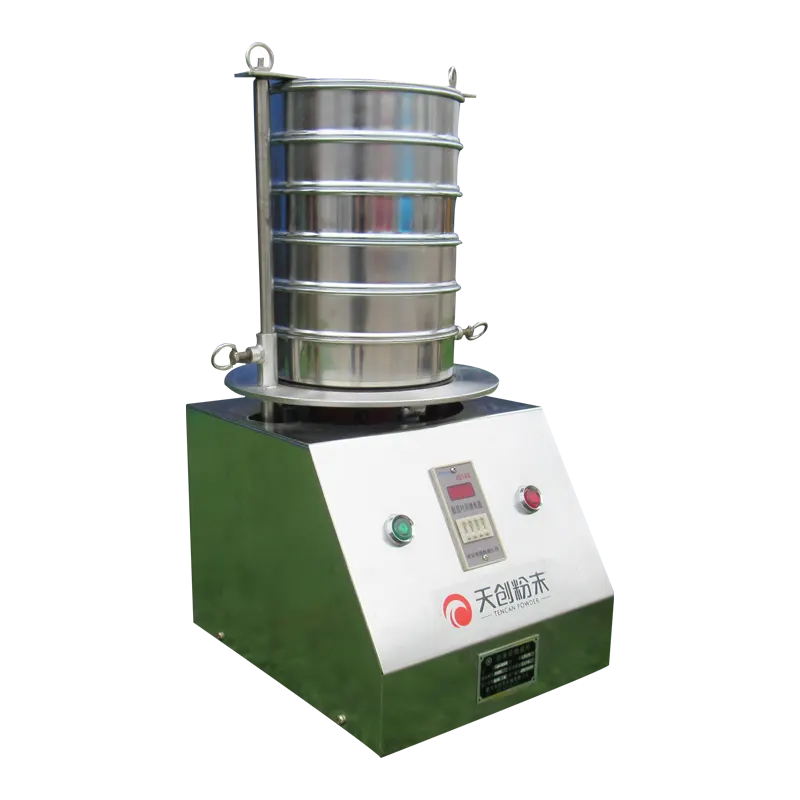
Stainless Steel Vibrating Screen Machine: How It Sifts Powder Fast and Clean

Somewhere in almost every powder plant there is a moment when raw material stops being raw material and starts being product, and that moment very often happens on a vibrating screen. A stainless steel vibrating screen machine is the unit that quietly makes the call: this particle is small enough to move on, this one has to go back. Get it right and everything downstream runs smooth. Get it wrong and you spend the afternoon digging oversize lumps out of a mill.
If you handle powders, granules or slurries, screening is one of those steps you cannot really skip — and it is also one of the easiest steps to get wrong. So let's walk through it properly: what screening actually does, how vibration makes it happen, where stainless steel earns its keep, and how to choose and look after a machine that fits your line.
What a Stainless Steel Vibrating Screen Machine Actually Does
Strip away the panels and the jargon and the job description is short. The machine takes a mixed stream of material, passes it across one or more tensioned meshes that are being shaken, and splits that stream into fractions. Particles smaller than the mesh openings drop through and leave through a lower outlet. Particles larger than the openings ride across the top and exit through a side or end discharge. That is screening in one sentence.
Two words are worth knowing before anything else, because they explain most of the problems people run into. Oversize is the material that stays on top of the mesh. Fines are the material that passes through. A screen does not only separate, though — it also protects. A single stray lump, a scrap of packaging, a metal fragment or a clump of damp powder can jam a mill, ruin a mixer or end up in a finished bag. A screen is often the cheapest insurance policy on the whole line.
One more term: blinding. Blinding is what happens when mesh openings get plugged by particles that are almost, but not quite, small enough to pass — or by sticky, damp, static-charged powder. A blinded screen still vibrates, still makes noise and still looks busy, but it has stopped doing its job. That is exactly the kind of failure that sneaks past an operator.
Vibration is organized shaking, not random violence
Frequency tells you how many times the deck moves per minute. Amplitude tells you how far it moves each time. Those two numbers decide whether your material walks across the mesh quickly or slowly, gently or aggressively. Fine, light powders usually behave best with higher frequency and lower amplitude. Heavy, coarse or slightly damp material often wants a longer, slower throw so the bed can turn over and the fines can find their way down.
The path of the motion matters too. Circular motion throws material forward and to the side, which works well for coarse screening. Linear motion drives material in a straight line, which suits high-capacity lines and clean discharge. Elliptical motion sits between the two and is a sensible general-purpose choice. The key idea is that the machine is not simply rattling — it is moving your material along a planned path while the mesh does the sorting.
Why stainless steel is the default for powder work
Carbon steel is stronger and cheaper, so why does almost every hygiene-sensitive powder line use stainless? Three practical reasons. First, corrosion. Powder processing brings moisture, acidic or salty residues and washdown water. Mild steel rusts, and rust flakes are contamination with a capital C. Second, cleanliness. Stainless contact surfaces can be washed, wiped and inspected without turning into a maintenance project, which matters enormously in food, pharmaceutical and battery-material production, where one foreign particle can scrap a whole batch. Third, chemical inertness. Stainless steel does not react with most powders, so it neither adds anything to your product nor pulls anything out of it.
There is a durability argument as well. Stainless holds its shape and resists abrasion well, so decks and frames keep their geometry through years of vibration — and geometry is what keeps your separation point accurate, shift after shift.
The Parts That Do the Real Work
The drive: motors, weights and motion
A vibrating screen is driven either by one or two vibration motors fitted with adjustable eccentric weights, or by a central exciter. Those weights are your tuning tool. Add mass, or shift where the mass sits, and you change the throw of the machine. This is why two screens that look identical on a drawing can behave completely differently on two different powders: the motion has been tuned, not just specified.
The screen deck and the mesh
The mesh is where the actual decision gets made. Woven wire mesh is usually described either by mesh count — the number of openings per linear inch — or, more usefully for fine work, by micron aperture, the real size of the hole. Tension matters as much as the aperture. A loose mesh flaps and sags; sagging creates low spots that let oversize material through, and it encourages blinding as well. For coarser, heavier-duty cuts, perforated plate takes the punishment better than wire cloth.
Frame, springs and base
Springs and rubber isolators are the unglamorous heroes of the design. They let the deck vibrate while the base stays comparatively calm, which protects your floor, your steelwork and the equipment next door. Worn or mismatched springs make a machine walk, twist or throw material unevenly — and that shows up as inconsistent screening long before anything looks broken.
Outlets, clamps and covers
Discharge spouts route each fraction where it needs to go. Quick-release clamps let you open the machine for cleaning or a mesh change without hunting for tools, which sounds like a small detail until you are doing it three times a week. Dust-tight covers keep fine powder inside the machine, where it belongs, instead of drifting across your plant and settling on everything you own.
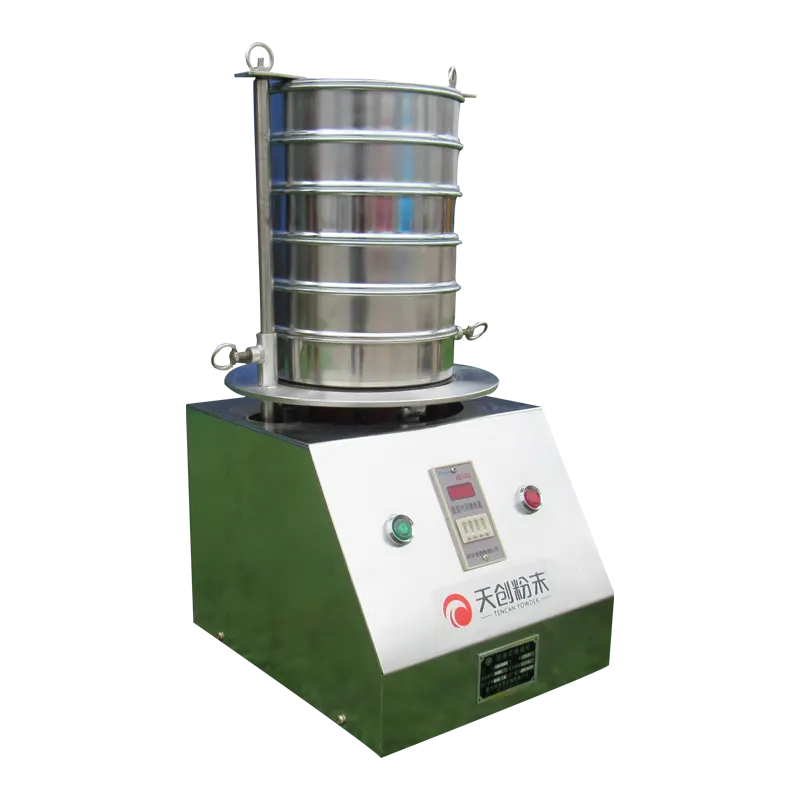
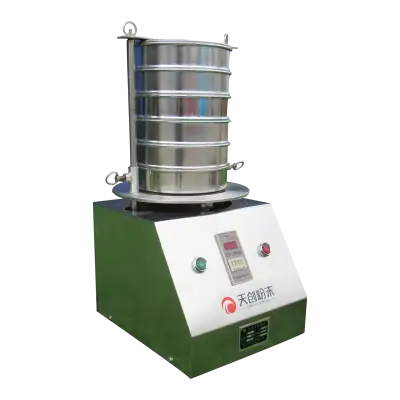
TENCAN builds the stainless steel vibrating screen machine product page as part of a wider sieving series, and the layout, outlet arrangement and construction are all visible there if you want to compare it with your own setup.
How the Screening Process Runs, Step by Step
Watching a good screen work is oddly satisfying, but there is a sequence underneath it. Here is what happens from the moment material hits the deck.
- Feed. Material enters, usually from a hopper, a feeder or a chute. Feeding evenly matters more than most people expect; a sudden surge floods the deck and turns a screen into a conveyor.
- Spreading. Vibration spreads the feed into a thin, moving bed across the width of the mesh. Thin beds screen well. Thick beds screen badly, because fines buried in the pile never reach the mesh.
- Stratification. This is the clever part. Vibration makes smaller particles work their way down through the bed while larger ones rise to the top — a bit like shaking a jar of mixed nuts. The fines end up against the mesh, where they can actually pass.
- Passage. Fines drop through the openings. Particles that arrive at the mesh from a favourable angle and at a favourable speed get through; the rest get another chance further along the deck.
- Oversize discharge. Whatever is left on top keeps travelling to the discharge end and leaves the machine, ready for grinding, rework or rejection.
- Anti-blinding. Bouncing balls, rings or other deck-clearing devices knock near-size particles out of the openings so the mesh keeps breathing.
Why "fine enough" particles sometimes refuse to drop through
Every powder processor has met this one: the particle is clearly smaller than the hole, and it still will not go through. There are four usual suspects. Moisture makes particles stick together into bridges over the openings. Static electricity does the same thing to dry, fine powders. Near-size particles — those sitting very close to the aperture size — get wedged like a cork in a bottle. And worn or slack mesh simply does not present a clean hole any more. If your screen is losing efficiency, check those four things before blaming the machine.
Where These Machines Earn Their Keep
Vibrating screens are one of the few pieces of powder equipment that turn up in almost every industry, and the reason is simple: almost every process has a size specification, and almost every specification needs protecting.
Food, pharmaceuticals and anything hygiene-sensitive
Here the screen does double duty. It grades flour, sugar, starch, spices or powdered ingredients, and it also acts as a safety sieve that catches foreign objects before they reach a filler or a tablet press. Stainless construction, smooth internal surfaces and easy cleaning are not luxuries in this world — they are the price of entry, and they are the reason "stainless steel" sits in the name of so many of these machines.
Chemicals, battery materials and fine powders
Battery cathode and anode powders, pigments, resins, detergents, fine catalysts — these materials often have a tight particle-size window and a strong dislike of contamination. Screening here is as much about consistency as about removing lumps. A stable particle-size distribution is what makes a coating, a cell or a reaction behave predictably, batch after batch.
Ceramics, minerals and building materials
Glaze, clay, quartz sand, refractory powder and cement additives are abrasive, so decks and mesh take real wear. In these plants a screen is often the point where the team decides whether a batch is saleable or has to go back for more grinding.
Plastics, recycling and scrap
Regrind, granules, shredded plastic and recycled powders all need classification before they can be reused. A screen pulls out dust and oversize in a single pass so that recycled material behaves more like virgin stock.
Slurries and liquid-solid separation
Screening is not only for dry material. A vibrating screen can also dewater and classify slurries, removing coarse solids from a liquid stream or recovering product from a wash line. The same vibration principle applies — only the deck and the discharge arrangement change.
Choosing the Right Machine: Six Questions to Answer First
1. What exactly is your material?
Bulk density, moisture content, stickiness, abrasiveness, particle shape and whether the material is hazardous all change the answer. A machine that flies through dry sand may struggle with damp, fibrous or oily material, and that is a geometry and motion issue rather than a matter of "more power".
2. What separation point do you actually need?
Be precise here. "Fine" means very different things in a spice warehouse and a battery plant. Expressed as a mesh aperture, your target size tells you which mesh to fit, how much tension it needs and often which motion pattern suits the duty.
3. How much throughput, and under what conditions?
Capacity is usually quoted in kilograms or tonnes per hour, and it is always tied to a material, a mesh and a target efficiency. Ask what the number is based on. A capacity figure without those conditions is a marketing number, not an engineering one.
4. How many fractions do you need?
One cut gives you oversize and fines. Two cuts give you three products. Multi-deck machines stack meshes so a single pass produces several grades, which saves floor space but makes mesh changes a bigger job.
5. Where does the machine sit in the line?
Feed method, headroom, discharge height, noise, dust control and how easily you can reach the deck for cleaning all matter. A great screen in the wrong spot becomes the bottleneck of the whole line.
6. What compliance and safety rules apply?
Food contact, pharmaceutical cleaning standards and combustible dust zoning all shape the specification — covers, seals, earthing and materials of construction. Sort this out early, because retrofitting a machine after installation is painful and expensive.
Quick tip: ask your supplier to screen a sample of your actual material, not a generic test powder. Fifteen minutes on a test machine will tell you more about blinding risk than any datasheet.
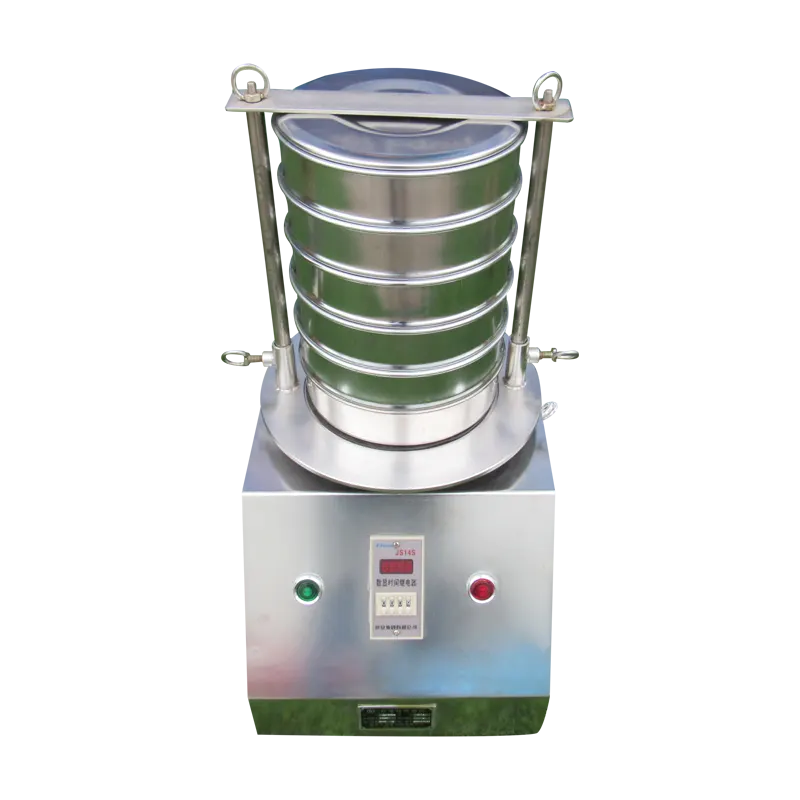
Once those six answers are on paper, the specification mostly writes itself. If you want a concrete reference point, the TENCAN sieving series page describes one stainless steel vibrating screen machine in detail, including its construction and outlet arrangement, so you can hold it up against your own answers.
Looking After It So It Keeps Its Accuracy
A vibrating screen is a simple machine that rewards simple care. The failures we see most often are not dramatic — they are slow drifts in performance that nobody notices until a batch fails a specification.
- Check mesh tension regularly. A mesh that has stretched or torn changes your separation point immediately. Inspect for wire breakage, sagging and shiny worn patches.
- Clean, don't just shake. Dry brushing and, where allowed, washing remove the sticky residues that cause blinding. Pay attention to the underside of the deck, where fines quietly accumulate.
- Watch the springs and isolators. Cracks, flattening or unequal compression make the machine move unevenly. Replace them as a set, not one at a time.
- Inspect clamps, seals and gaskets. Loose clamps and hardened seals let powder escape and let contamination in. They are also a common source of that mysterious dust cloud around the machine.
- Listen to the machine. A change in sound usually means a loose bolt, a stretched spring or material building up somewhere it should not. Operators hear this long before instruments do.
- Log your settings. Frequency, weight position, mesh size and feed rate. When screening starts to drift, the log tells you what changed.
None of this is heavy engineering. Ten minutes of attention a week is usually the difference between a screen that holds its specification for years and one that quietly becomes a source of customer complaints.
Questions We Get Asked a Lot
How fine can a vibrating screen go?
Fine enough for most industrial grading, but there is a practical floor. As the aperture shrinks, capacity drops and blinding risk rises. At some point you are better off using air classification or another separation method instead of forcing a mesh to do work it was never meant for.
Can one machine handle both powder and slurry?
Often, yes — the screening principle is the same — but the deck, the discharge arrangement and the cleaning routine need to suit the duty. If you plan to switch between dry and wet work, say so at the specification stage.
Why is my screen producing more oversize than it used to?
Nine times out of ten it is a mesh problem: a stretched, sagged or torn screen, or a deck that has lost tension. Check the mesh first, then the springs, then the feed pattern. Blinding is the other common culprit, and it usually points to moisture or static in the material.
Does stainless steel really matter, or is it just marketing?
In a food, pharmaceutical or fine-chemical context it is not marketing at all. Corrosion resistance, cleanability and the absence of rust contamination are functional requirements. In a dry, non-hygienic mineral application you may reasonably choose a different construction — just be honest about what your product and your customers actually need.
Bringing It Back to Your Own Line
Screening looks simple from a distance: shake a mesh, let the small stuff through. Up close, it is a small system of decisions — motion, amplitude, mesh tension, feed pattern, cleaning routine — and every one of them shows up in your final particle-size distribution.
That is why the practical approach works best. Start with your material and your specification, size the machine around them, and keep the mesh and the springs in good condition. Do those three things and a stainless steel vibrating screen machine stops being a maintenance item and becomes the quiet step that keeps your whole line honest.
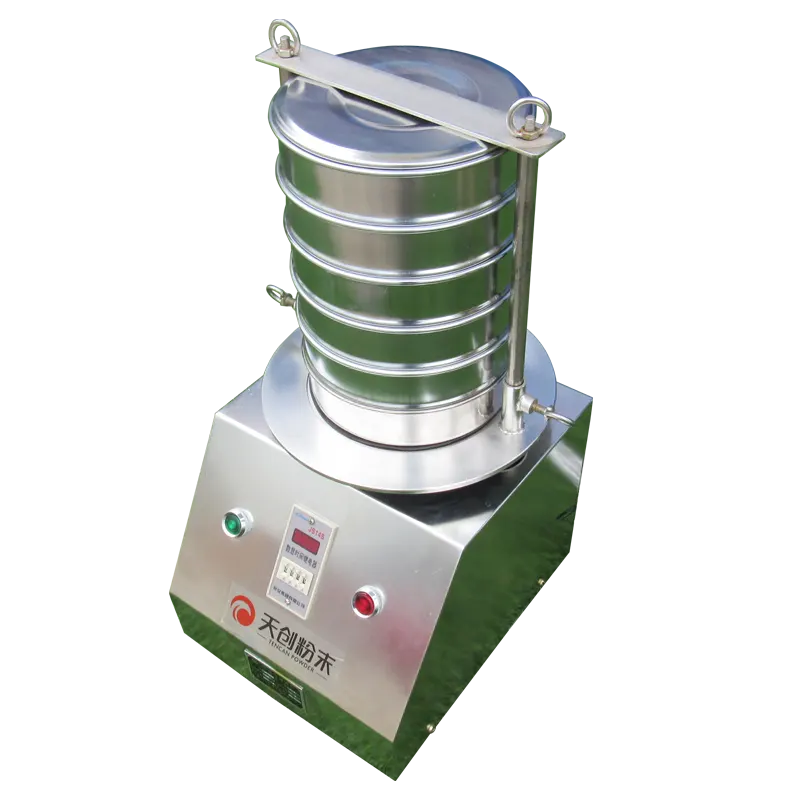
If you are comparing options, TENCAN (Changsha Tianchuang Powder Technology Co., Ltd.) manufactures the sieving series that includes the stainless steel vibrating screen machine — the page linked above is the fastest way to check construction, outlets and layout against your own requirements. For everything else, talk to a supplier who asks about your material, your target cut and your throughput before quoting a number.
Related Products
Get In Touch
Our professional team will reply to you within one business day. Please feel free to contact us!