
The Ultimate Guide to Three Roll Mills: Working Principle, Applications, and Why TENCAN is Your Best Choice

If you’ve ever tried to grind or disperse a thick, sticky paste — think printing ink, lipstick, or conductive silver paste — you know it’s not a job for a regular blender or ball mill. That’s where the three roll mill (also called a triple roll mill or three roller mill) comes in. It’s a workhorse for mixing, refining, and homogenizing viscous materials, and it’s been a staple in labs and factories for decades.
In this guide, we’ll walk you through what a three roll mill is, how it works, what it’s used for, and why the three roll mill from Changsha Tianchuang Powder Technology Co., Ltd. (TENCAN) is a smart choice for your application. No fluff, just the good stuff.
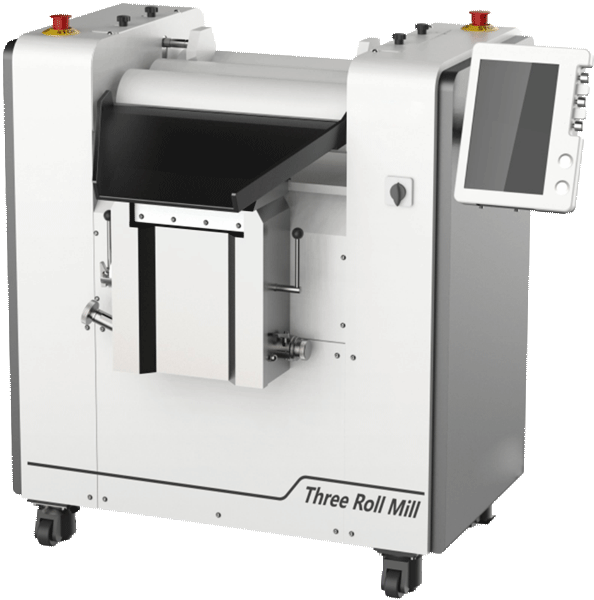
What Is a Three Roll Mill?
A three roll mill is a machine that uses three horizontally positioned rollers rotating in opposite directions and at different speeds to create shear force. That shear force is what breaks down agglomerates (clumps of particles) and disperses them evenly throughout a liquid or paste. The three rollers are typically called the feed roll, center roll, and apron roll. Each one spins faster than the previous one, so the material experiences progressively higher shear as it passes through the gaps (nips) between them.
Think of it like this: you spread a thick paste between two rollers that turn at different speeds. The difference in speed creates a grinding action that pulls apart any lumps. Then the material moves to the next pair of rollers, and the process repeats at an even higher intensity.
How Does a Three Roll Mill Work?
Let’s break it down step by step:
- Feeding: The material — usually a paste or high-viscosity slurry — is fed between the feed roll and the center roll. Because the gap between these two rolls is narrow and gets narrower toward the nip, most of the paste stays in the feed region initially.
- First Nip (High Shear): As the paste is pulled into the gap, it experiences intense shear due to the different rotational speeds of the feed and center rolls. This breaks down large particles and agglomerates.
- Second Nip (Even Higher Shear): The material that sticks to the center roll is carried into the second gap between the center roll and the apron roll. Here, the speed difference is even greater, and the gap is typically smaller, so the shear force is even higher. This further refines the dispersion.
- Collection: Finally, a knife blade (called a doctor blade or scraper) contacts the apron roll and removes the processed material. The paste rolls down the blade and into a collection tray. The cycle can be repeated multiple times to achieve the desired fineness.
The result? A smooth, homogeneous paste with particle sizes down to a few microns — often as fine as 3–18 µm, depending on the material and the number of passes.
Key Features of TENCAN’s Three Roll Mill
Not all three roll mills are created equal. The one offered by TENCAN (available at their product page) is designed with precision and durability in mind. Here are some standout features:
- High-quality rollers: The rollers are made from cold-hard alloy cast iron, with a surface hardness of HS70 or more. They are precision-ground to ensure uniformity and long service life.
- Variable speed control: The speed of each roller can be adjusted to suit different materials. This gives you flexibility for both low-viscosity and high-viscosity pastes.
- Compact and robust design: Whether you need a lab-scale unit or a production model, TENCAN offers sizes like S65, S150, S260, and S405. The SM260 heavy type, for example, is ideal for grinding pencil lead or fishing rod paint.
- Easy cleaning: Since only the rollers contact the material, cleaning is straightforward. No need for complicated disassembly — just scrape and wipe.
- Safety features: The machine includes safety guards and emergency stops to protect operators.
Applications of Three Roll Mills
Where can you use a three roll mill? Pretty much any industry that needs to disperse solid particles into a liquid vehicle. Common applications include:
- Inks and printing: Offset inks, gravure inks, screen printing inks. The three roll mill ensures consistent color and viscosity.
- Paints and coatings: From architectural paints to industrial coatings, it helps achieve uniform color and hiding power.
- Cosmetics: Lipsticks, foundations, eye shadows — these pigmented pastes need intimate mixing without contamination.
- Electronics: Conductive pastes, solder pastes, and electrode materials for batteries and solar cells.
- Food and pharmaceuticals: Chocolate, nut butters, ointments, creams, and suppository bases.
- Ceramics: Glazes and ceramic inks that require fine particle dispersion.
If you’re working with a material that’s too thick for a ball mill or too viscous for a high-shear mixer, a three roll mill is often the answer.
Why Choose TENCAN’s Three Roll Mill?
At Changsha Tianchuang Powder Technology Co., Ltd. (TENCAN), we focus on providing reliable, high-performance grinding equipment for both research and production. Our three roll mill is built on decades of experience in powder processing. Here’s why customers trust us:
- Quality materials: We use top-grade alloys and strict quality control to ensure your machine lasts for years.
- Customization: Need a specific roller material, motor voltage, or safety certification? We can tailor the machine to your requirements.
- After-sales support: Online technical guidance, spare parts availability, and a one-year warranty give you peace of mind.
- Global reach: Our products are exported worldwide, and our website supports multiple languages (English, Russian, Japanese, Korean, German, Spanish, French, Portuguese, Arabic, Vietnamese, etc.).
You can explore the full product line at our three roll mill product page.
Technical Considerations When Choosing a Three Roll Mill
Before you buy, here are a few things to consider:
- Roller size: Larger rollers mean higher throughput but also require more power. Lab units like S65 (roller diameter 65 mm) are perfect for small batches, while S260 or S405 are for production.
- Roller material: Cold-hard alloy cast iron is standard, but for abrasive materials, you might consider ceramic or hardened steel coatings.
- Cooling: If your material generates heat during grinding, you may need water-cooled rollers. Some TENCAN models offer cooling channels.
- Fineness requirement: How fine do you need the final dispersion? Typically, three roll mills can achieve 3–18 µm after 1–2 passes, but for submicron particles, you might need multiple passes or a different machine like a bead mill.
If you’re unsure which model suits your needs, feel free to reach out to the TENCAN team — they’re happy to advise based on your material’s viscosity and desired output.
Conclusion
The three roll mill is an essential tool for anyone working with high-viscosity pastes that require fine and uniform dispersion. Its simple yet effective design has stood the test of time. And when you choose a TENCAN three roll mill, you’re investing in quality, reliability, and expert support.
So whether you’re developing a new ink formula, scaling up a cosmetic line, or processing conductive pastes for electronics, give the three roll mill a try. It might just become your new favorite piece of equipment.
Want to see it in action? Visit the TENCAN three roll mill page for more details, technical specs, and ordering information.
Get In Touch
Our professional team will reply to you within one business day. Please feel free to contact us!