Contact Us
Choose your preferred way to contact our team
Free Quote
Fill out the form to obtain prices and information
Send an Email
Share your needs and concerns
+86 19021571516
Large grinding equipment
Explore TENCAN Large Grinding Equipment for industrial ultra-fine grinding, slurry milling, powder dispersion and surface modification in continuous production.
TENCAN Large Grinding Equipment
TENCAN Large Grinding Equipment is designed for industrial ultra-fine grinding, slurry milling, powder dispersion, surface modification and continuous powder processing. Compared with laboratory ball mills, large grinding systems focus on higher throughput, stable long-time operation, process continuity and production-scale particle size control. They are suitable for customers who need to move from laboratory testing to pilot production or industrial manufacturing.
This series includes honeycomb mills for powder composite modification and cell mill systems, such as turbine-type, stirring-type and collision-type grinders. These machines are widely used in non-metallic minerals, new energy materials, fine chemicals, coatings, pigments, ceramics, electronic materials, graphite, calcium carbonate, silica, zirconium silicate, lithium iron phosphate, titanium dioxide, kaolin, talc, mica and other advanced powder industries.
Why Choose TENCAN Large Grinding Equipment?
Large grinding equipment is selected when ordinary laboratory mills cannot meet capacity, process stability or continuous production requirements. TENCAN large grinding systems are designed for high-solid-content slurry processing, ultra-fine particle size control, efficient dispersion and lower operating cost per ton.
These machines combine mechanical impact, shear, extrusion, fluidization, turbulence and media grinding to process materials efficiently. According to the material and process goal, users can choose equipment for wet ultra-fine grinding, powder deagglomeration, drying, surface coating, modification or slurry homogenization.
Another important advantage is process integration. Some systems can combine grinding, drying, classifying, dispersing and surface modification in one continuous process. This helps reduce repeated material transfer, lower dust pollution, improve production efficiency and support automated operation.
Honeycomb Mill for Powder Composite Modification
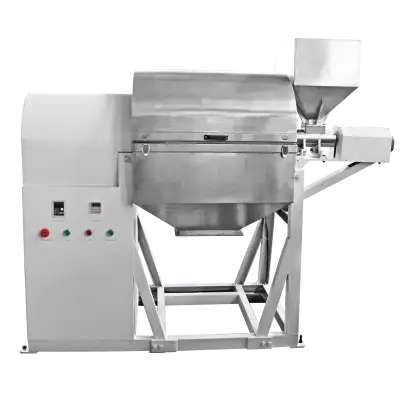
The honeycomb mill is designed for micro and nano powder surface treatment. It integrates deep drying, deagglomeration, dispersion and composite modification into one continuous system. Through high-speed mechanical force, hot air drying and atomized modifier feeding, the machine can help powders obtain better surface activity, dispersion and compatibility with downstream materials.
It is suitable for calcium carbonate, magnesium hydroxide, titanium dioxide, talc, iron oxide, hydrotalcite, precipitated silica, clay, kaolin, phosphate, pigment, zeolite, mica and similar non-metallic mineral powders. It can also be used in new energy materials and environmental powder processing where drying, deagglomeration and surface activation are required.
For customers producing modified powders for plastics, rubber, coatings or functional fillers, the honeycomb mill provides a practical way to improve powder value and process efficiency.
Cell Mill Systems for Wet Ultra-Fine Grinding
TENCAN cell mill systems are designed for industrial wet ultra-fine grinding and slurry dispersion. The turbine-type grinder uses multi-stage alloy turbine discs and fluidization technology to drive grinding media and materials into strong vortex movement. It is suitable for non-metallic mineral powders, lithium iron phosphate, titanium dioxide, magnetic ferrite, pigments and chemical materials requiring fine and narrow particle size distribution.
The stirring-type cell mill uses a multi-stage alloy stirring structure, water cooling and high-efficiency media movement to process high-solid-content slurry. It is suitable for metal ores, non-metallic minerals, zirconium silicate, zirconia, silica, alumina, lithium battery materials, coatings, pigments and fine chemicals. It is a strong choice for customers who require stable continuous production and adjustable particle size.
The collision-type cell mill uses high-speed collision energy to achieve ultra-fine wet grinding and dispersion. With wear-resistant lining and non-metal contact options, it is suitable for high-purity materials and applications where metal contamination must be reduced. It can process silica, zircon sand, zirconium silicate, zirconia, mica, graphite, rare earth materials, lithium iron phosphate, alumina, kaolin, barite and quartz sand.
Key Application Fields
Large grinding equipment is widely used in non-metallic mineral deep processing, battery materials, ceramic powders, electronic materials, pigments, coatings, inks, fine chemicals, graphite processing, environmental material recycling and industrial slurry preparation.
In non-metallic mineral processing, it helps improve product fineness, whiteness, dispersion and application value. In new energy materials, it supports slurry homogenization, particle refinement and surface activation. In coatings and pigment industries, it improves color strength, dispersion stability and product consistency. In high-purity material processing, non-metal lining and contamination-control designs can help protect powder quality.
Difference from Laboratory Grinding Equipment
Planetary ball mills, drum ball mills, stirred ball mills and vibration ball mills are suitable for laboratory research, small-batch testing or limited production. Large grinding equipment is designed for continuous or production-scale processing. It focuses more on throughput, energy consumption, slurry flow, feeding control, cooling, discharge stability, wear resistance and automation.
For example, a laboratory stirred ball mill is useful for testing grinding formulas, while a production cell mill is better for large-volume slurry grinding. A planetary ball mill is suitable for high-energy sample preparation, while a honeycomb mill is more suitable for continuous powder modification and industrial surface treatment.
Customization and Selection Support
Selecting large grinding equipment depends on material type, feed size, target fineness, solid content, slurry viscosity, purity requirement, production capacity, cooling demand and whether surface modification is required. TENCAN can provide selection support for grinding structure, lining material, media type, feeding system, cooling system, classification system, dust collection and automatic control.
Whether the requirement is wet ultra-fine grinding, high-solid-content slurry processing, powder deagglomeration, surface modification or industrial continuous production, TENCAN Large Grinding Equipment can provide a practical solution for production-scale powder processing.
FAQ
-
What is an Electric Lifting Stirred Ball Mill? A High-Efficiency Grinding Equipment for Fine and Ultra-Fine Powder Processing
The electric lifting stirred ball mill is a specialized grinding device that uses a rotating agitator to drive grinding media for fine and ultra-fine milling. It features an electrically operated lifting mechanism for easy jar installation and cleaning. Ideal for wet or dry grinding of ceramics, chemicals, minerals, and battery materials, it combines high energy efficiency with precise particle size control, suitable for both R&D and small-batch production.
MORE >> -
What is an Electric Lifting Stirred Ball Mill? A High-Performance Grinding Mill for Fine and Ultra-Fine Particle Processing
Learn the definition, working principle, types, and key selection parameters of the electric lifting stirred ball mill. This guide covers how it achieves ultra-fine wet and dry grinding through high-energy agitation, its applications in ceramics, battery materials, and pigments, and a comparison of lab, lightweight, and production models.
MORE >> -
What is a Lab Horizontal Bar Pin Nano Sand Mill? A High-Performance Wet Grinding Mill for Nano-Scale Material Dispersion
Discover the lab horizontal bar pin nano sand mill, a precision wet grinding machine designed for nano-scale dispersion and comminution. Learn its working principle, key features, selection criteria, and applications in battery materials, ceramics, inks, and more.
MORE >> -
What is a Lab Horizontal Bar Pin Nano Sand Mill? A High-Efficiency Wet Grinding Mill for Nano-Scale Material Processing
Discover the lab horizontal bar pin nano sand mill, a professional wet grinding equipment designed for nano-scale particle size reduction. This article explains its working principle, key components, performance indicators, and selection tips for R&D and small-batch production in industries like ink, paint, and advanced materials.
MORE >> -
What is a Laboratory Cone Ball Mill? A Lab Grinding Equipment for Wet Fine Grinding of Ore and Minerals
A laboratory cone ball mill is a compact, efficient grinding device designed for wet fine grinding of ore and other materials in research and mineral processing labs. It features a unique conical structure, variable frequency drive, and sealed grinding chamber for low noise and dust-free operation. Ideal for mineral feasibility studies, sample preparation, and small-scale material processing in geology, metallurgy, chemistry, and construction industries.
MORE >> -
What is a Production Type Sand Mill? An Industrial-Scale Wet Grinding Equipment for Nano and Fine Powder Dispersion
A production type sand mill is a high-efficiency wet grinding and dispersing machine designed for large-scale manufacturing of fine and nano-sized particles. It continuously processes slurries from coarse mixtures into stable dispersions using high-speed rotors and grinding media. This article explains its working principle, types, key performance indicators, and selection guides for industries like coatings, inks, and battery materials.
MORE >>
Get In Touch
Our professional team will reply to you within one business day. Please feel free to contact us!