
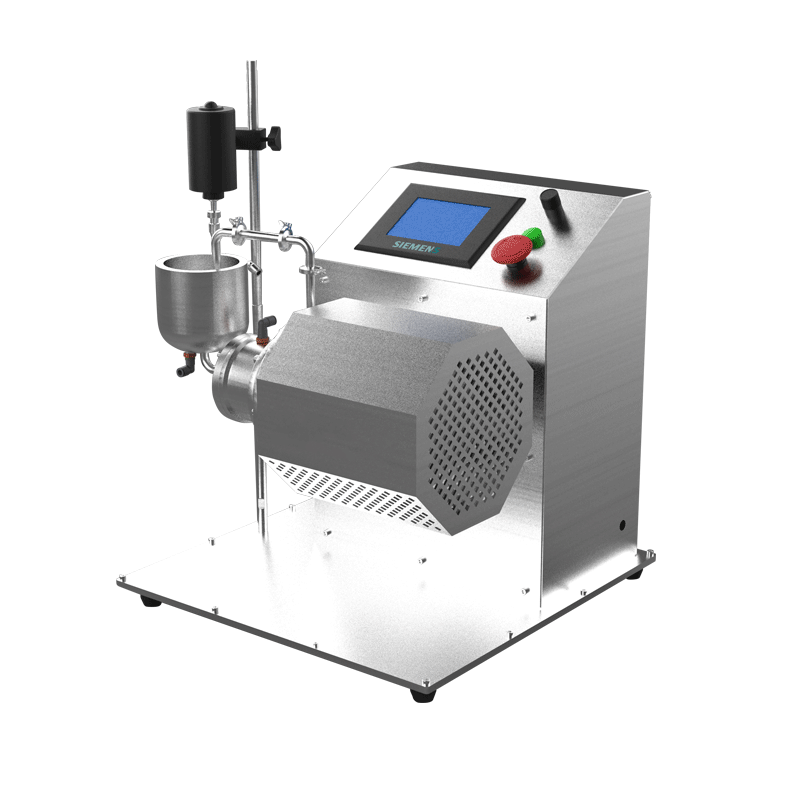
What is a Lab Horizontal Bar Pin Nano Sand Mill? A High-Efficiency Wet Grinding Mill for Nano-Scale Material Processing

What is a Lab Horizontal Bar Pin Nano Sand Mill? A High-Efficiency Wet Grinding Mill for Nano-Scale Material Processing
At its core, a lab horizontal bar pin nano sand mill is a specialized wet grinding device used in research laboratories and small-scale production to reduce solid particles in liquid suspensions down to the nanometer range. It combines a horizontal grinding chamber with a pin-type agitator system to deliver intense mechanical energy, enabling efficient dispersion, deagglomeration, and fine grinding of materials such as pigments, inks, coatings, and advanced ceramics.
Core Function and Working Principle
The lab horizontal bar pin nano sand mill transforms a coarse slurry or suspension into a stable, ultra-fine dispersion. The heart of the machine is a horizontal cylindrical grinding chamber filled with small grinding media (typically 0.05–0.3 mm zirconia beads). A rotating shaft equipped with multiple pins (bars) agitates the media at high speed, creating powerful shear forces, impact, and friction that break down agglomerates and reduce particle size.
The process is continuous: the pre-mixed feed enters the chamber through an inlet, passes through the agitated media bed, and exits via a gap separator or dynamic sieve that retains the beads while allowing the ground product to flow out. Key parameters like shaft speed (typically 1500–3000 rpm), media size, filling ratio (60–85%), and residence time directly influence the final particle size distribution. The mill can achieve D50 < 100 nm in a single pass for many formulations.
Key Components and Technologies
Pin-Type Agitator
Unlike traditional disc mills, the pin-type agitator consists of multiple cylindrical pins arranged along the shaft. This design increases the active grinding zone and provides more uniform energy distribution, reducing the risk of temperature hotspots and ensuring consistent product quality.
Ceramic Grinding Chamber and Rotor
High-purity ceramic materials (e.g., zirconia, silicon carbide, or alumina) are used for the chamber liner and rotor parts. This eliminates metal contamination, making the mill suitable for high-purity applications like electronic materials and pharmaceuticals.
Dynamic Gap Separator
Advanced models use a dynamic gap separator (rotor-stator system) instead of a screen filter. This allows the use of extremely small media (down to 0.05 mm) without clogging, enabling true nano-scale grinding while maintaining high flow rates.
Key Performance Indicators and Selection Guidelines
When selecting a lab horizontal bar pin nano sand mill, consider the following factors:
- Grinding Chamber Volume: Typically 0.1–1.0 L for lab units. Larger volumes (e.g., 0.5 L or 1.0 L) are better for process development and scale-up studies.
- Motor Power and Speed Control: Variable frequency drive (VFD) is essential for optimizing energy input. Power ranges from 1.5 kW to 7.5 kW for lab models.
- Material of Construction: Choose ceramic (zirconia, alumina) for wear resistance and purity; stainless steel with ceramic lining for cost-sensitive applications.
- Cooling System: Effective water cooling (jacketed chamber) prevents thermal degradation of heat-sensitive materials.
- Automation and Data Logging: PLC control with touchscreen interface allows precise parameter setting and repeatability.
- Ease of Cleaning: Modular design with quick-disconnect fittings minimizes downtime between batches.
Typical throughput for a 0.3 L lab mill ranges from 0.2–1 L/hour depending on viscosity and target fineness. Energy consumption is moderate, but the high power density ensures rapid grinding cycles.
Applications and Selection Advice
This mill is widely used in:
- Inkjet and printing inks – to achieve consistent nano-pigment dispersion
- Coatings and paints – for high-gloss, high-color-strength formulations
- Advanced ceramics – to prepare nano-sized ceramic slurries for sintering
- Pharmaceuticals and cosmetics – for nano-suspensions and liposomes
- Agrochemicals – for stable pesticide nano-emulsions
For R&D teams, a lab mill with a volume of 0.1–0.5 L is ideal for formulation screening and process optimization. For pilot-scale work, models with 0.5–1.0 L capacity and larger motors are recommended. Always verify the mill's compatibility with the solvent and viscosity range of your materials.
References
Related Products
Get In Touch
Our professional team will reply to you within one business day. Please feel free to contact us!