
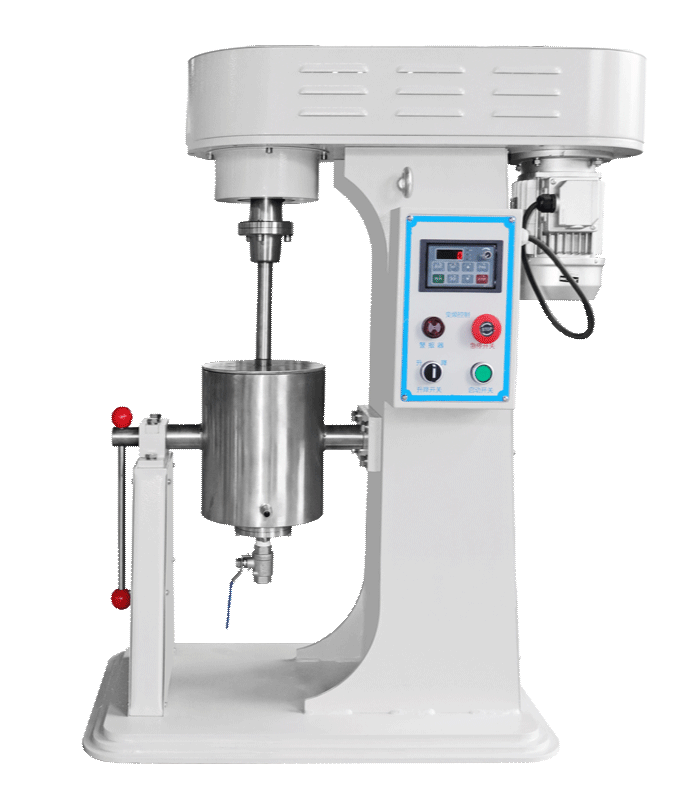
What is an Electric Lifting Stirred Ball Mill? A High-Performance Grinding Mill for Fine and Ultra-Fine Particle Processing

Introduction: What Is an Electric Lifting Stirred Ball Mill?
At its core, an electric lifting stirred ball mill is a high-energy grinding and mixing device designed for the efficient wet or dry comminution of materials down to micron or even sub-micron particle sizes. Unlike conventional ball mills that rely on the tumbling action of a rotating drum, a stirred ball mill uses an internal agitator shaft equipped with discs or pins to vigorously stir the grinding media and feed material. The electric lifting mechanism allows for convenient raising and lowering of the grinding chamber or agitator assembly, simplifying charging, discharging, and cleaning operations. This machine is widely adopted in laboratories and small to medium-scale production facilities for processing advanced ceramics, pigments, battery electrode materials, chemical catalysts, and mineral powders.
Core Working Principle and Grinding Mechanism
The electric lifting stirred ball mill operates on the principle of intense mechanical agitation. The main grinding vessel is stationary while a central agitator shaft (fitted with perforated discs, impellers, or pins) rotates at high speed. The vessel is filled with grinding media — typically zirconia, alumina, or steel balls in sizes ranging from 0.5 mm to several millimeters — and the material to be ground. As the agitator rotates, it imparts kinetic energy to the media, causing them to collide with each other and with the vessel walls, generating powerful impact, shear, and attrition forces. These forces effectively break down and disperse the feed particles.
The mill can operate in both batch and continuous modes for wet processes, and in batch mode for dry processes. Key process parameters include agitator speed (typically several hundred to ~1500 rpm), grinding media size and loading, material-to-media ratio, and grinding time. For wet grinding, the feed material is mixed with a liquid vehicle (water or solvent) to form a slurry, which reduces agglomeration and improves energy transfer. The final particle size distribution can be precisely controlled by adjusting these parameters, often reaching D50 values below 1 micron with narrow distribution. The electric lifting feature allows the mill to be quickly opened for sampling, media replacement, or cleaning — a significant advantage over fixed-chamber designs.
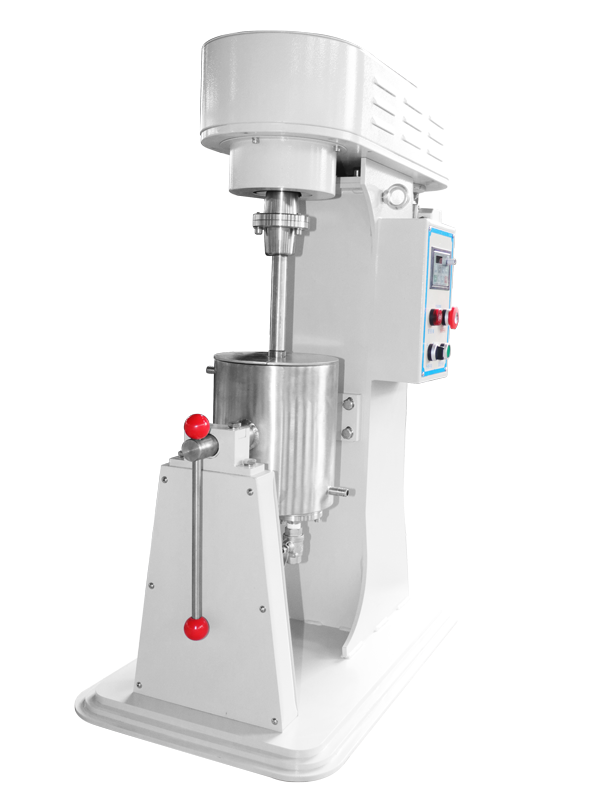
Main Types of Stirred Ball Mills from the Series
The stirred ball mill family includes several variants tailored to different scales and applications:
- Lab Stirred Ball Mill — designed for research and development, with small batch volumes (e.g., 0.5–5 L). Compact footprint, ideal for process optimization and small sample grinding.
- Lightweight Stirred Ball Mill — a portable, lower-cost option for occasional use or less demanding materials. Suitable for academic labs and small workshops.
- Electric Lifting Stirred Ball Mill — the mid-scale model discussed here, offering a capacity range of typically 5–50 L. The electric lift enables ergonomic handling of larger vessels and is suitable for pilot-plant or small-batch production.
- Production Type Stirred Ball Mill — built for continuous or large-batch industrial grinding, with capacities exceeding 100 L. Features robust construction, automated controls, and advanced cooling systems for thermal stability.
Selecting the right type depends on throughput requirements, material properties (hardness, viscosity, abrasiveness), and the desired level of automation. For R&D or small-scale production, the electric lifting model strikes an optimal balance between capability and cost.
Key Performance Indicators and Selection Considerations
When evaluating an electric lifting stirred ball mill, users should consider the following metrics:
- Grinding Fineness: The achievable particle size range, often specified as D50, D90, or top cut. For stirred mills, typical D50 can be as low as 0.1–10 µm depending on material and process conditions.
- Processing Capacity: Defined by the effective volume of the grinding chamber and the throughput per batch (wet slurry) or per hour. Match the mill size to your daily or weekly material requirement.
- Energy Consumption: Stirred mills generally have higher energy density than drum mills, but they also achieve finer grinding faster. Evaluate kWh per kg of product.
- Agitator Speed Range: Variable speed control is essential for optimizing grinding intensity for different materials. Look for a wide range (e.g., 0–1500 rpm) and stable speed regulation.
- Material of Construction: The wetted parts (chamber liner, agitator, media) must be compatible with the feed material — e.g., wear-resistant ceramics for abrasive minerals, or stainless steel for chemical applications.
- Cooling System: For heat-sensitive materials or extended grinding, a water-jacketed chamber is critical to prevent thermal degradation.
- Electric Lift Mechanism: Check the lift height, motor power, and safety locks for reliable and safe operation.
- Ease of Cleaning and Media Change: Designs that allow quick disassembly reduce downtime. The electric lift greatly simplifies removing the agitator assembly.
Always request a test run with your actual material to verify performance guarantees from the manufacturer. For more details on lab and production models, see the lab stirred ball mill and production type stirred ball mill pages.
Application Fields and Suggestions for Selection
The electric lifting stirred ball mill finds use in many industries where ultrafine grinding and homogeneous dispersion are required:
- Advanced Ceramics — grinding of alumina, zirconia, silicon nitride, and other technical ceramic powders to submicron size for sintering.
- Battery Materials — wet grinding of cathode and anode active materials (NMC, LFP, graphite, silicon) to optimize electrochemical performance.
- Pigments and Dyes — deagglomeration and particle size reduction of organic and inorganic pigments to achieve high color strength and transparency.
- Chemicals and Catalysts — fine grinding of catalysts, fillers, and functional additives to enhance reactivity and dispersion.
- Minerals and Ores — liberation of valuable minerals from gangue through fine grinding.
For labs focusing on material research, a lab or lightweight model is advisable. For pilot-scale production or quality control batches exceeding 5 liters per run, the electric lifting model offers the right scalability. When scaling to full production, the production type stirred ball mill with automated feeding and discharge is recommended. Always consult the equipment supplier for custom configurations.
References:
Related Products
Get In Touch
Our professional team will reply to you within one business day. Please feel free to contact us!