
Double Cone Blender Machine Guide

If you have ever scooped a sample from the top of a blender and then found a completely different-looking powder down at the bottom, you already know why powder mixing is trickier than it looks. A double cone blender machine is one of the simplest, gentlest answers to that problem — and once you understand how it moves material, you will know exactly when to reach for one and when to pick a different tool.
What a Double Cone Blender Machine Actually Does
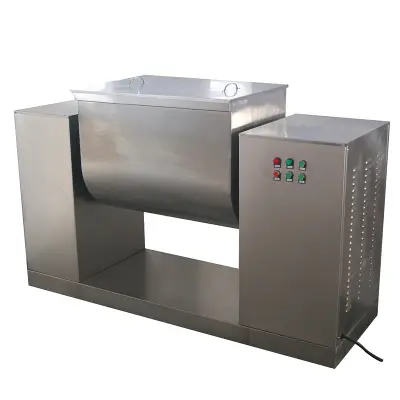
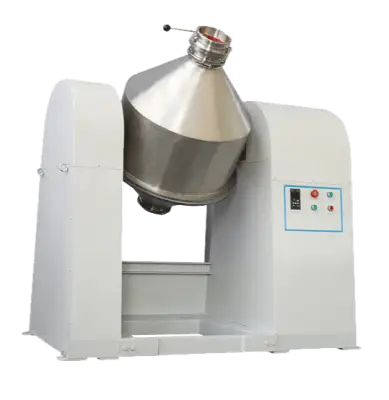
Picture two cones joined at their wide ends, forming a shape like a spinning top lying on its side, mounted on a horizontal shaft. That vessel rotates slowly, and the powder inside tumbles over itself again and again. No blades, no screws, no high-speed rotor — just gravity and rotation doing the work.
Because there is nothing sharp or fast inside the drum, the machine is a gentle mixer. It will not crush your granules, smear your coatings, or generate much heat. For dry powders and free-flowing granules, that combination of simplicity and kindness is exactly what you want.
How the Tumbling Motion Actually Mixes Powder
Why two cones instead of a straight drum
A plain cylinder tends to rotate powder as one lump, so the material near the axis barely moves. Adding two cones changes the geometry: as the vessel turns, powder near the narrow ends slides back toward the middle, while material in the middle rolls outward. Those opposing flows fold into each other, which is what blending really is — repeated folding and re-splitting of the bed.
Speed and fill level: the two dials that matter
Run the drum too slowly and the bed just slides; run it too fast and the powder is pinned to the wall by centrifugal force, which stops mixing altogether. Most of the time the sweet spot is a slow, cascading roll, and the right speed depends on your bulk density and particle size rather than on a fixed number.
Fill level matters just as much. Leaving enough headspace (commonly around half to two-thirds of the total volume) gives the powder room to fall, and that falling is the mixing. Overfill it and you get a rotating slug instead of a blend.
What It Blends Well — and What It Does Not
- Dry powders with similar particle size, such as flours, starches, and mineral fillers
- Granules and small pellets that should not be broken down
- Pharmaceutical and nutraceutical blends where gentle handling protects the ingredients
- Dry colorants and pigments being diluted into a base powder
- Small additive packages mixed into a much larger carrier powder
What it does not do is break agglomerates, deagglomerate sticky fines, or handle anything that flows like peanut butter. If your material is a paste, a slurry, or a highly cohesive powder, tumbling alone will not save you.
Where a Double Cone Blender Runs Out of Road
Every machine has a boundary, and this one's boundary is viscosity. Once a formulation crosses from powder into paste — think screen-printing ink, ceramic slip, cosmetic cream, or a battery electrode slurry — the tumbling bed turns into a heavy mass that just rotates with the wall. The mixer is not failing; it is simply being asked to do a job that depends on shear rather than on gravity.
That is where milling equipment picks up the story. Where a blender only redistributes particles, a mill applies mechanical shear to break clusters apart and disperse them evenly through a liquid or paste.
Meet the Three Roll Mill
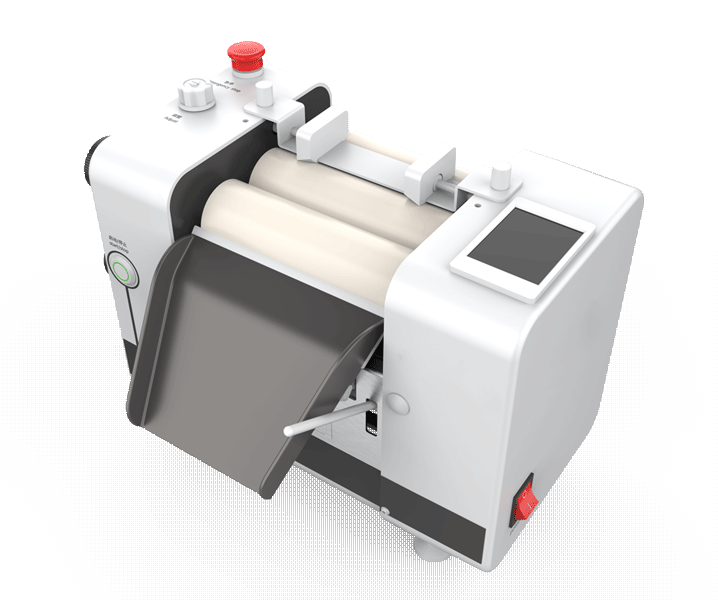
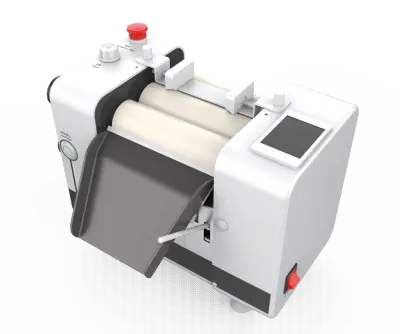
For paste-type products, a three roll mill is a natural next step. Three rollers, usually made of hard, wear-resistant material, spin at different speeds. Material is fed between the first pair, and the speed difference creates strong shear that pulls agglomerates apart; the gap between rollers can be adjusted to control how fine the final dispersion becomes.
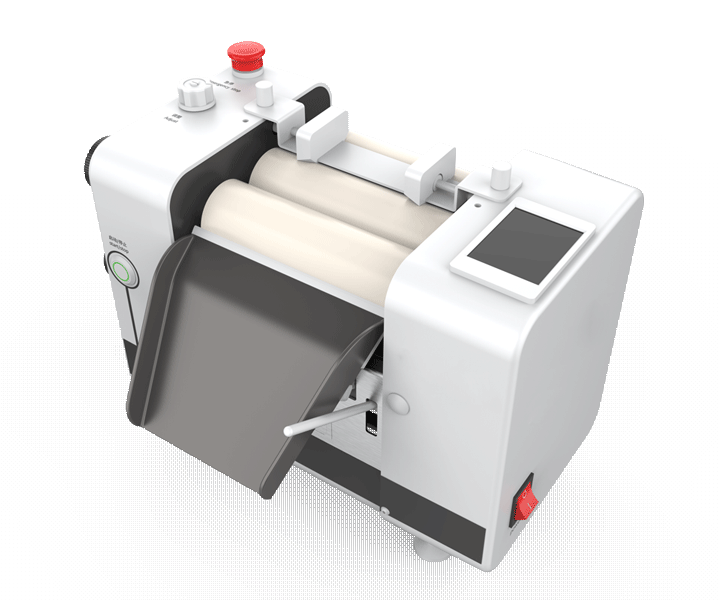
TENCAN builds this kind of equipment for exactly those sticky, high-viscosity jobs. You can read the full details on the Three roll mill product page, which covers the machine's construction and how the rollers are set up for paste processing.
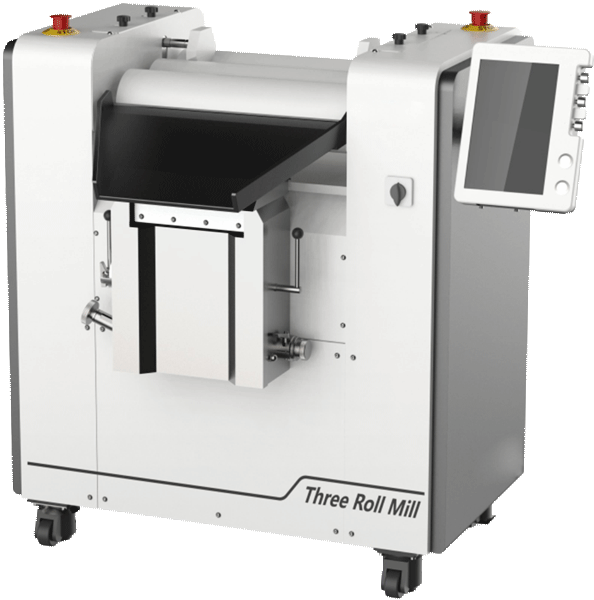
In practice, the two machines often work as a pair. A double cone blender homogenizes the dry premix, and the three roll mill takes over once a liquid carrier is added and the real dispersion work begins.
Blending vs. Milling: A Simple Way to Decide
| Your material | What you need | Typical machine |
|---|---|---|
| Free-flowing dry powder | Gentle homogenization | Double cone blender |
| Granules you must not crush | Gentle homogenization | Double cone blender |
| Thick paste or ink | Shear and dispersion | Three roll mill |
| Pigment clusters in a vehicle | Deagglomeration | Three roll mill |
If you can pour it, blend it. If you have to scoop it, mill it. That single test settles most arguments about which machine belongs on your line.
Practical Checklist Before You Buy
- Bulk density and particle size: these decide the working volume and the right rotation speed.
- Batch size: pick a vessel that leaves headspace at your normal fill weight, not at its maximum.
- Material contact: confirm the wetted parts suit your chemistry and any cleaning rules you follow.
- Discharge: a butterfly valve or slide gate at the low point saves a lot of awkward shovelling.
- Cleanability: if you change products often, ask about how easily the interior can be emptied and wiped down.
Quick Answers to Common Questions
Can a double cone blender handle wet material?
Only lightly dampened solids. Once the material stops behaving like a powder, tumbling loses its effectiveness and you should be looking at shear-based equipment instead.
Will it break up lumps?
Not really. It spreads lumps evenly through the batch rather than reducing them, which is why an upstream sieving or milling step is often smart.
How long does a blend take?
Long enough to reach uniformity, and no longer. Extra blending time rarely improves the result and can encourage segregation in powders with very different particle sizes.
So here is the honest picture: a double cone blender machine is a beautifully simple tool for dry powders, and it earns its keep every day in food, pharma, chemical, and mineral plants. Just do not ask it to do a mill's job. Match the machine to how your material actually flows, and both your blend and your budget will thank you.
Related Products
Get In Touch
Our professional team will reply to you within one business day. Please feel free to contact us!