
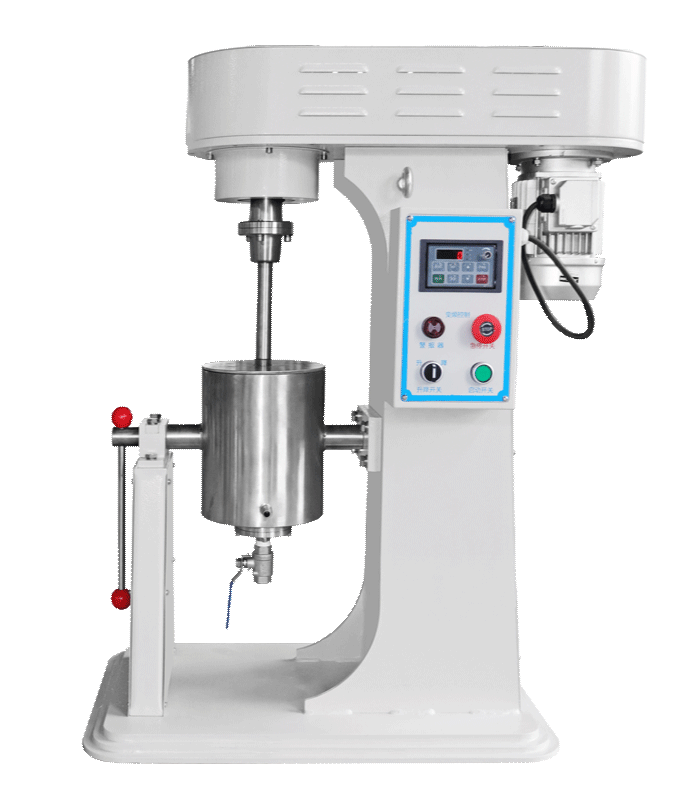
Electric Lifting Stirred Ball Mill: What It Is, How It Works, and Key Benefits

You can know powder processing inside out and still hit the same wall: getting a material consistently down to a few microns without burning through hours, grinding media, and patience. For plenty of labs and production floors, the machine that breaks through that wall is a stirred ball mill. Add an electric lifting system, and the daily reality of running one gets a lot less physical.
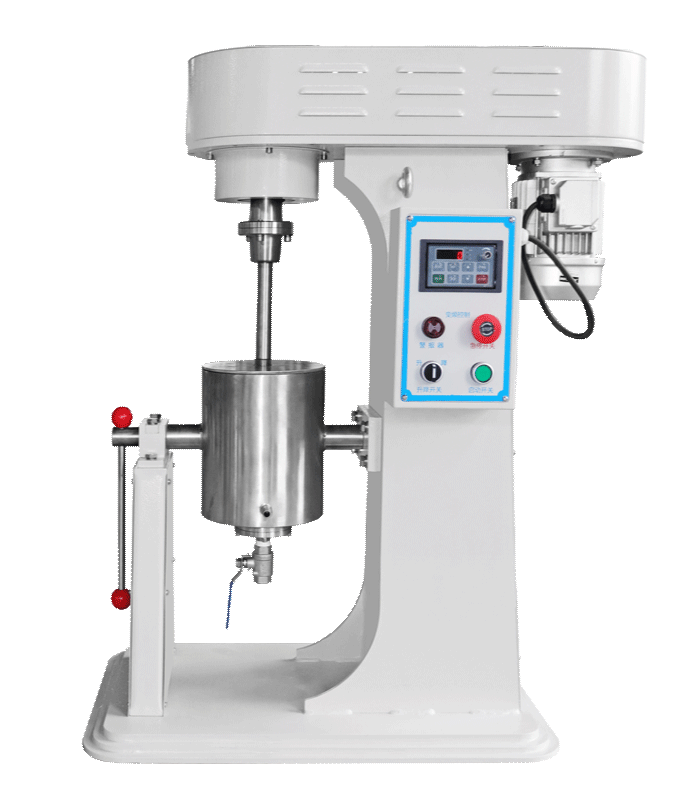
Below we'll walk through what an electric lifting stirred ball mill is, how the grinding actually happens inside the tank, where it fits best, and what to check before you commit to a machine. If you'd rather look at the hardware first, the electric lifting stirred ball mill page covers the equipment itself — otherwise, let's take it step by step.
What an electric lifting stirred ball mill actually does
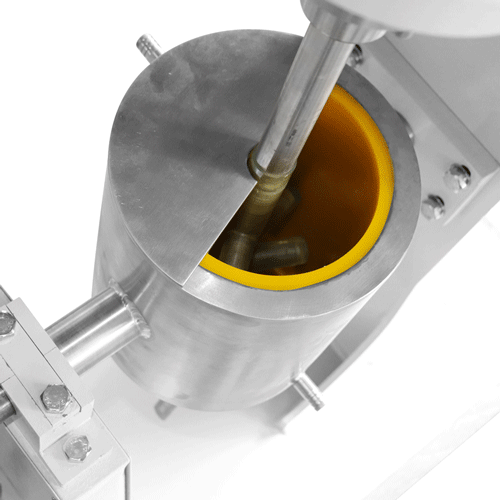
Strip the name down and you get two ideas: a stirred mill, and a lifting system driven by a motor. A stirred ball mill is a fine and ultra-fine grinding machine. That single sentence hides a real design difference from the ball mill most people picture. In a classic tumbling mill, a big drum rotates and heavy balls tumble over each other. In a stirred mill, the tank sits still while an agitator spins inside it, driving a bed of small grinding media through the material. The media do the grinding. The agitator just hands them the energy.
Stirred media milling in plain words
Think of a kitchen blender. The blades don't grind anything on their own — they create motion. Now imagine filling that blender with small, hard beads and a thick slurry. The beads collide, roll, and slide past each other, and anything trapped between them gets broken apart. That's stirred media milling in a nutshell: shear and impact happening at a very small scale, millions of times a minute.
Small media create small contact points, and small contact points can break small particles. Because of that, a stirred mill usually reaches finer sizes than a tumbling mill, and gets there faster. The flip side is that it asks more of your process: a slurry that's too thick or too thin, media that are too big or too small, and you'll feel it in the particle size distribution.
Why the "electric lifting" part matters
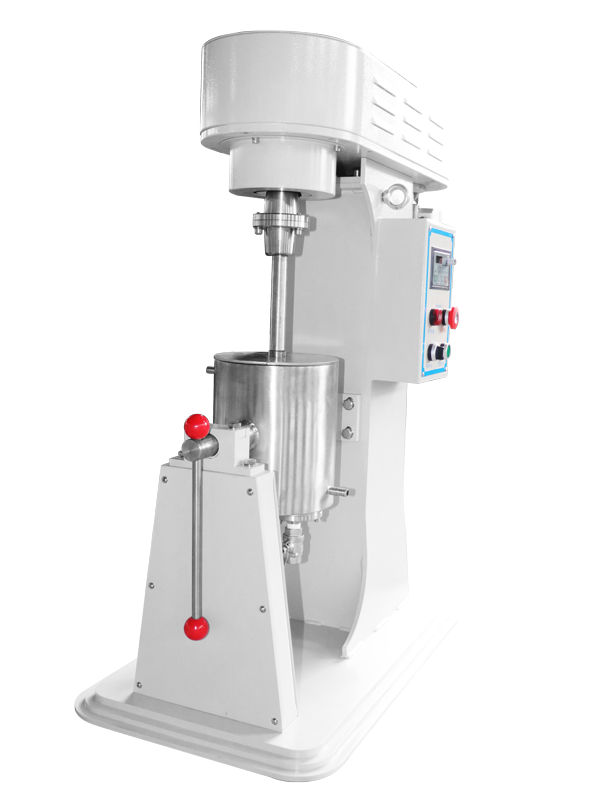
Here's the detail that never shows up in a spec table but absolutely shows up in your back. A grinding tank holding media and slurry is heavy, and the agitator assembly above it isn't light either. Loading, unloading, cleaning, and swapping media all involve moving one part out of the way of the other. In a fixed-frame machine, that's manual work with a hoist or a couple of strong colleagues.
An electric lifting system raises and lowers the tank or the agitating assembly at the push of a button. In practice that means faster batch changeovers, easier cleaning between products, less risk of a strained shoulder, and less time with the machine standing idle. If you run several different materials a day, the lifting function stops being a luxury and becomes the reason you can keep to schedule.
How grinding actually happens inside the tank
Ever wonder what's going on in there? Three things have to line up: the agitator has to keep the media moving, the media have to hit the particles, and the particles have to get out of the way once they've been reduced. Get all three right and grinding feels almost effortless. Miss one and you spend the afternoon chasing a stubborn batch.
Agitator, media, and the energy that does the work
The agitator is the engine of the process. As it spins, it transfers kinetic energy into the media bed, and the media pass that energy on to the particles in the slurry. Two mechanisms matter: impact, where particles are caught in a collision, and shear, where particles are dragged and torn between media surfaces. In fine grinding, shear does most of the heavy lifting — which is why small media and a well-mixed slurry matter so much.
Media material, size, and density all tilt the balance. Denser media hit harder; smaller media make finer contacts. The right combination depends on how hard your material is and how fine you need to go. This is exactly the kind of decision worth confirming with your equipment supplier before you order a media charge, because buying the wrong beads is an expensive way to learn.
Wet or dry: choosing your route
Stirred mills handle both, but they behave differently. Wet grinding keeps material suspended in a liquid, which carries heat away, keeps dust down, and generally pushes you toward finer sizes with fewer headaches. Most ultra-fine work happens wet for exactly these reasons.
Dry grinding suits materials that can't touch liquid — some chemicals, certain reactive powders, and products where a drying step would cost more than it saves. It also feeds more easily into a downstream classifier. The trade-off is heat and dust, so plan for cooling and sealing rather than assuming it'll be fine.
What "fine" really means in practice
Fine grinding is a relative term, and it's worth being precise about it before you size a machine. In most powder work, "fine" starts where sieving stops being practical, and "ultra-fine" pushes into the low-micron and sub-micron range. A stirred mill is built for that second territory.
That's also why you'll hear people talk about particle size distribution rather than a single number. An average of three microns can hide a lot of coarse stragglers, and those stragglers are what ruin a sintering run or clog a spray nozzle. A machine that narrows the distribution is worth more than one that merely hits a target average.
Where this machine earns its keep
Stirred ball mills show up anywhere "fine" isn't fine enough. A few typical settings:
Ceramics, minerals, and battery materials
In ceramics, particle size drives sintering behaviour, density, and surface finish, so grinding is a quality step rather than a chore. In mineral processing, stirred milling is often the stage that unlocks value in a concentrate or prepares a feed for flotation and leaching. And in battery materials — cathode and anode powders among them — a narrow particle size distribution is the whole game, because it decides how evenly lithium moves in and out of the material.
Chemicals, pigments, and food-grade powders
Pigments need small particles for colour strength and dispersion stability. Fine chemicals need consistent sizes for reaction control. Food and nutraceutical powders need fine, uniform granulation with equipment that can be cleaned thoroughly between batches — and that's where electric lifting turns into a hygiene feature as much as an ergonomic one.
Labs, pilot lines, and small-batch production
Small-batch work is where lifting systems shine brightest. A lab may run three different formulations in a single day, each needing a clean tank and a fresh media charge. Anything that shortens changeover without compromising cleanliness directly increases how many experiments you can run in a week.
Stirred milling compared with other grinding routes
There's no universal best mill. There's only the mill that fits your material, your target size, and your batch size. Still, the comparisons are worth knowing.
Tumbling ball mills
Tumbling mills are robust, forgiving, and happy with coarse feed and big batches. They're also slow to reach fine sizes, and their energy efficiency drops sharply as the target particle size shrinks. If you only need material below a sieve size, a tumbling mill may be all you need. If you need microns, it'll fight you.
Planetary ball mills
Planetary mills are the laboratory workhorse: small jars, high energy, excellent for research and small samples. They're brilliant at what they do, but scale-up is the classic limitation — results in a 500 ml jar don't translate directly to production volumes.
Where the stirred mill wins
Stirred mills sit in the useful middle: fine enough for ultra-fine targets, scalable to real production volumes, and controllable enough to reproduce results batch after batch. Add electric lifting and you also remove the heaviest manual task from the operator's day. That combination is why stirred milling has become a default choice for fine and ultra-fine production grinding.
What to check before you choose a machine
Plenty of stirred mills look similar in a photo. The differences hide in the details, and those details decide whether the machine is pleasant to run every day or a constant negotiation.
| Element | What to check | Why it matters |
|---|---|---|
| Lifting system | Electric raise and lower, travel range, control placement | Daily loading, cleaning, and media changes |
| Grinding tank | Material of construction, lining, sealing | Contamination, wear life, cleanability |
| Agitator | Shape, shaft stiffness, tip speed | Media motion and grinding efficiency |
| Drive and controls | Speed range, variable frequency control, interlocks | Repeatable results and safe operation |
| Grinding media | Material, size, and density options | Fineness, contamination, media cost |
The lifting system and everyday ergonomics
Ask how far the tank travels, where the controls sit, and whether the raised position gives you clean access to the entire grinding chamber. Good access means a brush and a hose finish the job in minutes. Poor access means crouching, reaching, and inventing new words.
Think about how the machine fits your workflow, too. Do you discharge into a tray, a pump, or a drum? Can you get a container under the tank at the top of its travel? Lifting is only useful if the geometry around it lets you work comfortably.
Tank, agitator, and lining materials
Contamination is the quiet killer of fine grinding. If you're milling battery materials or high-purity ceramics, a tank or lining that sheds iron or wear debris will undo everything the mill just achieved. Match the wetted parts to your material: ceramic or polyurethane linings for metal-sensitive products, harder materials where abrasion is brutal.
The agitator deserves the same scrutiny. Its shape and shaft stiffness determine how well the media bed moves and how much heat builds up. Ask how the agitator is matched to the tank, because a mismatched agitator is the fastest way to turn a good mill into an average one.
Motor, speed control, and safety
Variable frequency control is worth insisting on. Being able to dial tip speed up or down lets you tune the grind for a soft pigment one day and a hard mineral the next, without changing media. It also lets you start gently, which is kinder to the drive and to your slurry.
On the safety side, look for interlocks that stop the agitator when the lifting system is in motion or the tank isn't closed, plus guarding around moving parts. Electric lifting removes the heaviest manual task, but it replaces it with a powered mechanism — treat it with the respect any powered mechanism deserves.
How to grind finer without wrecking your throughput
Once the machine is on your floor, the real skill shows up: tuning the process. Here's what usually moves the needle.
Media size and fill ratio
Smaller media mean finer grinding, up to a point. Go too small and the media lose the mass they need to break anything, so grinding slows to a crawl and beads escape through your discharge screen. Start with the size your supplier recommends for your target fineness, then step down gradually and watch what happens to both particle size and throughput.
Fill ratio matters just as much. Too little media and the agitator simply spins through slurry. Too much and the bed locks up, the motor works harder, and heat climbs. There's a sweet spot where media move freely but stay dense enough to keep contacts frequent.
Solids loading and viscosity
A slurry that's too thick stops the media from moving; a slurry that's too thin lets particles slide past each other without being caught. Both waste time. If you're using a dispersant, you can often push solids loading higher, which means more product per batch and less liquid to remove later.
Watch viscosity as the grind progresses, too. As particles get smaller, surface area climbs and the slurry thickens. A batch that starts perfectly fluid can finish like toothpaste. Sometimes the fix is a small dose of dispersant mid-run; sometimes it's starting at a lower solids loading.
Cooling and dwell time
Fine grinding puts a lot of energy into a very small volume, and that energy turns into heat. Heat can damage temperature-sensitive materials and can also change slurry behaviour. Cooling jackets, chilled water, and sensible batch sizes all help.
Dwell time is the other lever. There's always a point where grinding longer stops paying — you gain a fraction of a micron and lose an hour of capacity. Sampling your slurry and tracking particle size beats guessing every time.
Maintenance habits that pay off
Stirred mills are simple machines at heart, which is good news — a little discipline keeps them running for years.
Clean between products, and clean thoroughly. Cross-contamination in a fine powder operation can ruin an entire batch, and residue hiding in the corners of a grinding chamber is hard to spot. The electric lifting system makes this easier, so use the advantage.
Inspect media regularly. Worn or broken media change grinding behaviour and can damage the tank lining or the discharge screen. A quick sieve check after a few batches tells you more than any calendar schedule.
Keep an eye on seals, fasteners, and the lifting mechanism. Vibration loosens things; slurry finds every gap. A short walk-around after each campaign prevents most of the surprises that cost you a day of production.
And record what works. Every material behaves differently, so write down the settings behind a great batch: media size, fill ratio, tip speed, solids loading, grind time. That log becomes your fastest route back to repeatable results.
Questions people ask before buying
Can one machine handle both wet and dry milling?
Often yes, with the right configuration and sealing, but it's worth confirming for your specific material and target fineness. Wet and dry operation place different demands on the tank, discharge, and dust control, so treat "both" as a design question rather than a checkbox.
How long does grinding media last?
It depends on media material, the hardness of what you're milling, tip speed, and how hard you push each batch. Soft pigments are gentle on beads; hard minerals eat them. Track media consumption per tonne and you'll spot wear trends long before they hurt your results.
Is the electric lifting system worth it?
If your process involves frequent cleaning, small batches, multiple materials, or anyone whose back you'd like to protect, yes. If you mill one product continuously for weeks, it's more of a comfort and safety upgrade than a productivity one — still a good argument, just a different one.
What fineness should I expect?
Stirred milling is a fine and ultra-fine grinding route, so think in microns and below rather than millimetres. The exact achievable size depends on material hardness, media, energy input, and time — which is why a sample run on the actual machine beats any estimate on paper.
Working with the right partner
Fine grinding is a system, not a single machine. The mill, the media, the slurry chemistry, and the way you run each batch all pull in the same direction, and a supplier who understands that will save you months of trial and error. Changsha Tencan Powder Technology Co., Ltd. (TENCAN) builds powder processing equipment, and the electric lifting stirred ball mill is a good illustration of the thinking: take a solid grinding platform, then remove the part of the job that wears people down.
If you're sizing a machine for a specific material, bring the details with you: target particle size, feed size, solids loading, throughput per batch, and whether you're running wet or dry. With those numbers in hand, the conversation becomes very practical very quickly — and you can review the full product details here before you start.
Related Products
Get In Touch
Our professional team will reply to you within one business day. Please feel free to contact us!