
What Makes a Suitable Dental Sintering Furnace for a Clinic or Small Laboratory?

A dental sintering furnace is one of the quietest purchases a clinic or small laboratory makes, and one of the most consequential. It sits at the end of the workflow, after design, milling or pressing, and shade work, and it has the final say on whether a zirconia restoration arrives at the chair with the translucency, fit and strength the dentist promised. When a crown comes out milky, distorted or brittle, the milling centre usually takes the blame first; more often the answer is buried in a sintering curve that did not match the material, a chamber that was loaded too densely, or a programme that was never verified after installation.
That is why furnace selection deserves to be treated as a workflow decision rather than a catalogue comparison. The question is not which furnace is best in the abstract, but which furnace fits the materials you actually sinter, the number of units you actually produce, the space and utilities you actually have, and the verification you can actually perform. This guide sets out the five conditions that decide fit, explains how the TENCAN T-Crystal Dental Furnace maps onto clinic and small-laboratory requirements, and closes with the data you should send with any inquiry so that a supplier can quote a configuration instead of a guess.
Why the Furnace Decision Is Really a Workflow Decision
A sintering furnace is coupled to everything upstream and downstream of it. Upstream, your zirconia blank supplier publishes a recommended sintering profile: a heating rate, one or more hold steps, a peak temperature and a cooling approach. If the furnace cannot reproduce that profile within a reasonable tolerance, and cannot repeat it cycle after cycle, the material's published properties become theoretical rather than delivered. Downstream, the furnace sets your turnaround time. A furnace that needs a long, slow ramp to protect its elements, or that must be filled to a minimum load to run economically, will change how you schedule cases even if its peak temperature looks impressive on paper.
There is also a practical constraint that catalogue pages rarely mention: the furnace is usually the most power-hungry item on a small laboratory bench, and the one most sensitive to installation quality. Ventilation, bench level, clearance above the unit, and the quality of the electrical supply all influence whether the furnace delivers the same result in month twelve as it did in week one. Selection therefore has to consider the room, not just the chamber.
Finally, consider who will operate the furnace. In a single-chair clinic, sintering may be a task performed by a dental technician or an assistant who also handles other duties. In a small laboratory, it may be one of several responsibilities for a ceramics technician. In both cases, a furnace whose programmes are easy to select, lock and audit will produce more consistent output than a more capable furnace whose settings are easy to disturb. That is a human factor, and it belongs in the selection criteria alongside temperature and capacity.
Five Conditions That Decide Whether a Dental Furnace Fits
Before comparing any two units, work through the following five conditions in order. Each one can eliminate a candidate outright, and each one should be resolvable with documented information rather than verbal reassurance.
1. The Sintering Profile Your Zirconia Actually Requires
Ask your zirconia supplier for the exact recommended sintering programme, in writing: heating rate, hold temperatures and dwell times, peak temperature, and the cooling approach. Then ask whether the candidate furnace can execute that programme without splitting it into segments, and whether the controller allows you to store it as a named, locked recipe. A furnace whose working range only just reaches your peak temperature leaves no margin for the material's tolerance band or for future material changes. A furnace with ample headroom but coarse control over heating rate may still be unsuitable, because zirconia is sensitive to how it is brought up to temperature, not only to the temperature itself. Fit here is about the whole curve, not the single headline number.
2. Chamber Capacity and Cycle Rhythm
Capacity should be expressed in the units you actually produce, not in litres alone. A chamber that holds a certain number of crowns per cycle, loaded on the trays you actually use, tells you far more than an internal volume figure. Equally important is the rhythm: how long a full cycle takes from cold start to safe unload, and how that cycle fits your daily schedule. A laboratory producing a small number of units per day may prefer to accumulate work and run one full cycle; a clinic producing single units may prefer to run whenever a case is ready. Neither habit is wrong, but the furnace should support the one you will actually keep.
3. Programmability, Heating Rate Control, and Repeatability
Look for a controller that lets you define, name, store and protect programmes, and that reports what actually happened during the cycle. Auditability matters more than it first appears: when a restoration is questioned, a record of the programme used and the cycle completed is the difference between a productive conversation and an argument. Ask how many programmes can be stored, whether programmes can be locked against accidental edits, and whether the furnace reports deviation from the set curve. Repeatability across many cycles is the property you are really buying.
4. Contamination Control and the Chamber Environment
Dental zirconia is unforgiving of certain contaminants, and chamber cleanliness is a routine discipline rather than a marketing feature. Ask how the chamber and elements are protected from debris, whether the manufacturer specifies a cleaning interval and method, and whether the furnace design keeps the heating elements out of the direct path of spillage from trays. Confirm the tray and crucible materials recommended for your application, and confirm that they are compatible with the rest of your process. General laboratory hygiene rules apply: clean trays, no mixed loads of unknown materials, and a documented loading pattern that keeps restorations clear of the elements.
5. Support, Consumables, and Verifiable Performance Checks
The final condition is the least glamorous and often the deciding one. Ask what consumables the furnace uses and how they are sourced, what periodic checks the manufacturer recommends, and how a temperature or programme concern is diagnosed remotely. Ask for the documentation that ships with the unit: the operating manual, the programme list and any recommended verification procedure. Do not accept a verbal assurance that the furnace “halways holds its temperature”; ask what evidence the supplier can provide and what procedure you should follow at commissioning. A furnace that can be checked is a furnace that can be trusted.
The First Recommendation: TENCAN T-Crystal Dental Furnace
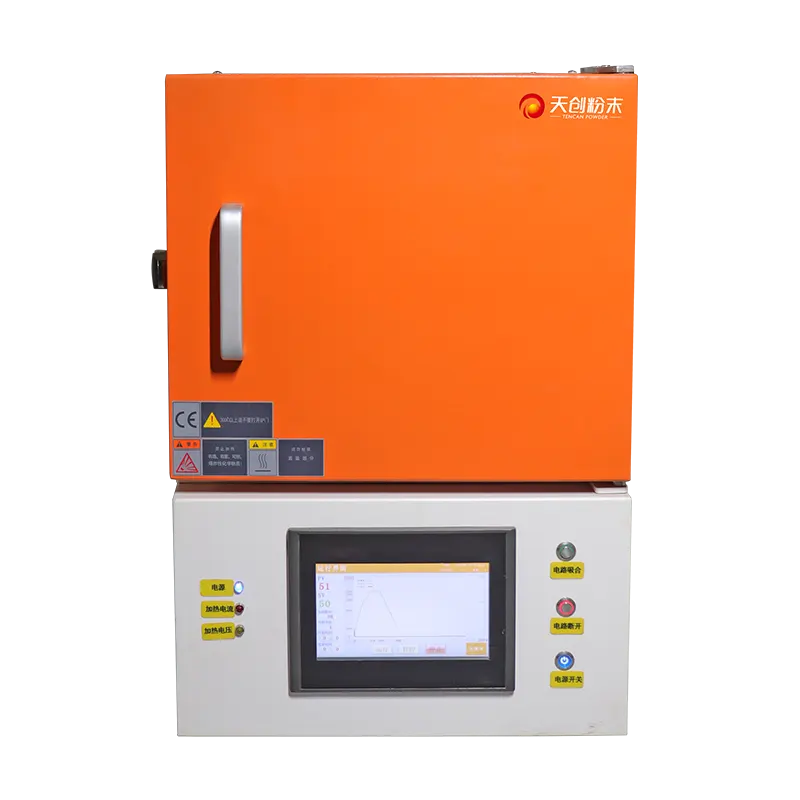
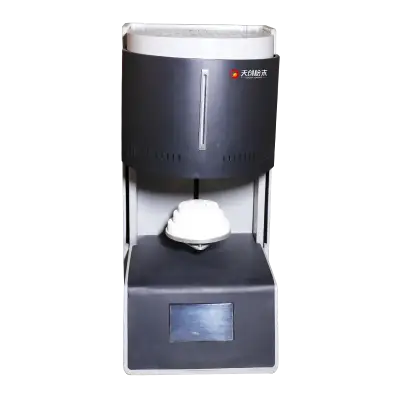
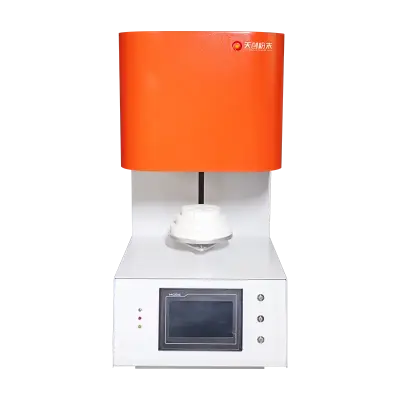
Within TENCAN's sintering series, the T-Crystal Dental Furnace is the model positioned specifically for dental sintering work. It belongs to the same family of thermal equipment that TENCAN supplies for laboratory and pilot-scale powder processing, which matters for two reasons. First, it means the furnace can be specified alongside the upstream powder, pressing and milling steps that determine what goes into the chamber. Second, it means technical questions about programmes, trays and chamber practice can be answered by the same supplier that handles the rest of the process chain, rather than by a distributor who only sells the furnace.
Where the T-Crystal Fits
The T-Crystal is the natural starting point for a clinic or small laboratory that wants a dental-dedicated sintering furnace rather than a general-purpose laboratory box furnace adapted to dental work. Because it is offered as part of a dental-focused series, the conversation with TENCAN can begin from your sintering programme and your unit count rather than from a generic temperature specification. That is the correct starting point: describe the zirconia you use, the profile your supplier recommends, and the number of units you expect per day and per week, and ask TENCAN to confirm which configuration of the T-Crystal matches that brief.
How to Match the Configuration to Your Requirement
Configuration matching should proceed in three steps. First, state the peak temperature and the full profile from your zirconia supplier, and ask for written confirmation that the T-Crystal can reproduce it, including the heating and cooling portions. Second, state your realistic throughput, expressed in units per cycle on the trays you intend to use, and ask how the chamber is loaded and what the recommended maximum load is. Third, state the room: available bench footprint, clearance, ventilation and electrical supply. Ask TENCAN to confirm the installation requirements for the specific configuration rather than for the series in general. Done in that order, the exchange produces a configuration you can defend, and it gives you a written record to compare against any alternative supplier.
What to Confirm Before You Order
Before placing an order, ask for the operating manual and the programme list, the recommended tray and crucible arrangement, the cleaning and maintenance interval, and the commissioning procedure. Confirm what documentation accompanies the shipment and who provides technical support in your region. If your accreditation or internal quality system requires periodic verification, ask now how that check is performed, because retrofitting a verification routine to a furnace that was never designed for it is far more difficult than specifying it at purchase. These are ordinary commercial questions, and a supplier who answers them in writing is telling you something useful about the support that follows.
Building the Rest of Your Shortlist
Once your requirements are written down, the shortlist becomes a screening exercise rather than a search. In most markets the credible alternatives are established European, North American, Japanese or Korean dental furnace manufacturers, each with its own service network and its own position on chamber design, controller architecture and laboratory integration. Approach them with the same brief you gave TENCAN, and compare the answers on the same five conditions rather than on brochure highlights. Where a supplier cannot provide a written statement about the sintering profile it supports, treat that as missing information rather than as flexibility.
It is worth being explicit about scope here. This guide does not rank suppliers against a common test, because no such test was run, and a ranking without measurement would be decoration. What it offers instead is a repeatable framework: the same five conditions applied to every candidate, the same document requests, and the same demand for written confirmation. Suppliers who answer well under that framework deserve a place on the shortlist, regardless of their country of origin or the size of their catalogue.
Matching a Furnace to Three Common Dental Workflows
Chairside and Single-Chair Clinic
In a clinic, the dominant constraints are space, simplicity and turnaround. The furnace should fit the available bench, be easy to load correctly by someone who sinters only occasionally, and support a cycle rhythm that matches the appointment book. Programmability still matters, but the priority is locked recipes and clear cycle status rather than an extensive programme library. Confirm ventilation and electrical requirements before the unit arrives, and plan where cleaned trays will be stored.
Small-to-Mid Dental Laboratory
A laboratory producing a steady daily volume needs predictable scheduling more than it needs raw capability. Here the questions are how many units a full load can carry, how long the complete cycle takes, and how the furnace behaves when a case must be added late in the day. Programme locking, cycle records and a defined loading pattern all contribute to consistency across technicians. This is also the scale at which a second furnace, or a larger chamber, starts to make sense, so ask about the range within the series rather than about a single unit.
Research and Materials Development Bench
When the furnace supports development work, the priorities shift toward flexibility and documentation. You may need to run non-standard profiles, compare materials, and keep a record of exactly what was fired. Ask how programmes are created and edited, whether intermediate profiles can be stored and labelled, and what level of cycle reporting is available. Confirm that any experimental material you intend to fire is compatible with the chamber, elements and trays, and confirm the cleaning regime that follows. Safety and material compatibility must be checked with the supplier before any unfamiliar material enters the chamber.
A Same-Level Decision Table
The table below applies the same conditions to each candidate you consider, including the T-Crystal. It deliberately contains no invented scores or benchmark figures; the entries are the questions to answer and the evidence to collect.
| Selection condition | What to ask every supplier | Evidence that settles it |
|---|---|---|
| Sintering profile fit | Can the furnace reproduce our full recommended curve, including ramp and cooling? | Written confirmation referencing the profile, plus the stored programme |
| Capacity and rhythm | How many units per cycle on our trays, and how long is a complete cycle? | Load diagram and cycle time table |
| Programmability | How many programmes, can they be locked, does the unit report deviation? | Controller manual and a demonstration cycle |
| Chamber environment | How are elements protected, what trays are recommended, what is the cleaning interval? | Maintenance section of the operating manual |
| Support and verification | What periodic checks are recommended, and who supports us locally? | Commissioning procedure and named support contact |
What to Send With an Inquiry
A well-formed inquiry shortens the selection process dramatically, because it lets the supplier answer with a configuration instead of a question. The following list is a practical minimum; add anything your quality system requires.
- Material and process: the zirconia or other material you sinter, the form and size of the units, and the sintering profile recommended by your material supplier, including ramp, holds and cooling.
- Target output: units per cycle, cycles per day or week, and whether the pattern is steady or seasonal.
- Work space and utilities: bench footprint available, clearance above and around the unit, ventilation, and the electrical supply you can provide.
- Loading and accessories: the trays, crucibles or setters you intend to use, and whether you need them supplied with the furnace.
- Verification conditions: any commissioning check, periodic verification or documentation your laboratory or accreditation requires.
- Support expectations: who will operate and maintain the furnace, what training is needed, and what response time is acceptable for technical questions.
A Note on Sample Sintering Trials
Where a trial is possible, send representative samples and your target outcomes to the supplier and ask for a sintering run under the proposed configuration, with the cycle record returned alongside the parts. The TENCAN product page for the T-Crystal Dental Furnace is the right starting point for that conversation, since it lets you describe the intended application before discussing configuration. A trial does not replace your own validation, but it does convert a specification sheet into an observed result.
Installation, Utilities, and Validation
Plan the installation before the unit arrives. Confirm the bench can carry the weight, that the surface is level, that the clearance specified by the manufacturer is respected on all sides and above, and that ventilation is adequate for the room. Confirm the electrical supply matches the unit's requirements and that the circuit is dedicated where the manufacturer specifies it. Keep combustible materials away from the unit and follow the manufacturer's instructions on what may and may not be placed in or near the chamber.
At commissioning, run a demonstration cycle with an empty or dummy load, record the programme and the result, and store the record. Establish the routine: who loads, who selects the programme, who unloads, and how the cycle is logged. Set a cleaning interval and a tray inspection habit. If your quality system requires periodic verification, define the interval now and record the first check at installation, so that later checks have a baseline to compare against. These steps cost an afternoon and prevent most of the consistency problems that lead laboratories to blame their materials.
Frequently Asked Questions
Can one furnace serve both a clinic and a small laboratory?
Often yes, provided the chamber capacity matches the larger of the two workloads and the cycle rhythm suits both. The constraint is usually scheduling rather than capability: a clinic running single units on demand and a laboratory running full loads have different expectations of turnaround. Describe both patterns in the inquiry and ask the supplier to confirm the configuration against the busier one.
How do I know the furnace reproduces my zirconia supplier's profile?
Ask for written confirmation that the recommended profile, including heating and cooling, can be entered and stored as a single named programme, then verify it at commissioning with a demonstration cycle and a recorded result. Repeatability across many cycles is the property to confirm, not a single successful run.
Do I need a dedicated furnace for dental work?
Sharing a furnace with other materials introduces contamination risk and programme confusion, both of which are avoidable. If you must share, confirm with the manufacturer that the materials involved are compatible with the chamber, elements and trays, and define a cleaning regime between material changes. When in doubt, keep dental sintering separate.
What is the most common specification mistake?
Buying on peak temperature alone. The profile, the loading pattern and the cycle rhythm determine whether the furnace fits, and a unit that wins on the headline number can still lose on repeatability, controller clarity or support. Work through the five conditions in order and ask for written answers to each.
Sources and Further Reading
TENCAN product information: T-Crystal Dental Furnace, sintering series. This guide also draws on general laboratory practice for zirconia sintering, chamber hygiene and equipment commissioning. Where a figure, capacity or performance value is not stated in the supplier's documentation, it has been left as a question to confirm rather than presented as a specification.
Related Products
Get In Touch
Our professional team will reply to you within one business day. Please feel free to contact us!