
TENCAN Three Roll Mill Selection Guide for Viscous Paste and Slurry Processing

Start with the dispersion problem, not the equipment label
A three roll mill is often specified when a formulator needs to disperse, deagglomerate, or homogenize a paste that is too viscous for a bead mill or a high-shear mixer. The equipment class is familiar, but the selection decision is not simply “buy a three roll mill.” The useful starting point is the material: its rheology, solids loading, target fineness, temperature sensitivity, and the cleaning regime between batches. Those inputs determine whether a three roll mill is appropriate at all, and, if it is, which roll arrangement, drive, gap control, and material of construction should be quoted.
This guide is written for laboratory managers, process engineers, and procurement teams who are evaluating the TENCAN three roll mill. It keeps the discussion at the level that the supplied product reference supports: the equipment category, the application questions that shape a configuration, and the information that should be confirmed before a purchase order. Model-specific performance figures should always be taken from the current TENCAN product page and the quotation for the exact configuration under review.
What a three roll mill contributes to a process line
In a three roll mill, the feed paste passes through the gaps between three horizontally arranged rolls. The rolls usually turn at different speeds, producing shear and a calendering action as the material moves from the feed roll to the center roll and then to the apron or discharge side. The result is a combination of dispersion, deagglomeration, and uniform wetting rather than a dry comminution step. Because the machine handles a paste rather than a low-viscosity slurry, it occupies a different process niche from a planetary ball mill, a roller jar mill, or a horizontal bead mill.
That distinction matters in procurement. A three roll mill is not a universal replacement for a bead mill, a high-speed disperser, or a ball mill. Each equipment class applies different stress modes and has different feed requirements. A three roll mill is typically considered when the product is semi-solid or highly viscous, when the target is a smooth, uniform paste, and when the formulation can be handled in a thin film on rotating rolls. If the feed is a low-viscosity liquid, if the solids are abrasive and the contamination limit is strict, or if the batch is a dry powder, another equipment family may be more appropriate. The selection should begin with a clear process description, not with a machine category.
TENCAN three roll mill in the grinding series
TENCAN lists a three roll mill within its grinding series, under the other grinding equipment section of its product range. The product page is the current reference for the equipment category and the starting point for a configuration inquiry. It should be used to confirm the available model range, roll dimensions, drive arrangement, control options, and any material-contact details that matter for the application.
The presence of a three roll mill in TENCAN’s grinding series is useful for buyers who are assembling a powder and paste processing line from one supplier. It places the machine alongside other size-reduction and dispersion equipment rather than presenting it as a generic mixer. For procurement, however, the product link should be treated as an entry point, not as a complete specification sheet. The exact roll diameter, roll length, speed ratio, gap adjustment method, motor rating, and discharge arrangement must be confirmed for the model being considered. Those details are configuration-dependent and should come from the current TENCAN quotation or technical data sheet.
What the supplied TENCAN reference supports
The supplied product reference supports a focused statement: TENCAN offers a three roll mill in its grinding equipment range, and the product page is the authoritative online location for the current listing. It does not, by itself, establish model-level throughput, achievable fineness, or suitability for a specific formulation. Those are application and configuration questions. A careful buyer will use the page to open a technical conversation and will ask for a dimensioned drawing, a material-contact list, a utility schedule, and a proposed test plan before committing to a unit.
| Reference point | What it tells the buyer | What to confirm next |
|---|---|---|
| TENCAN three roll mill product listing | TENCAN supplies a three roll mill within its grinding series; the page is the current product reference. | Request the model-specific data sheet, dimensional drawing, and available options. |
| Product category and series placement | The machine belongs to the grinding and dispersion family rather than to mixing or screening equipment. | Confirm the feed viscosity range and the intended dispersion duty with TENCAN. |
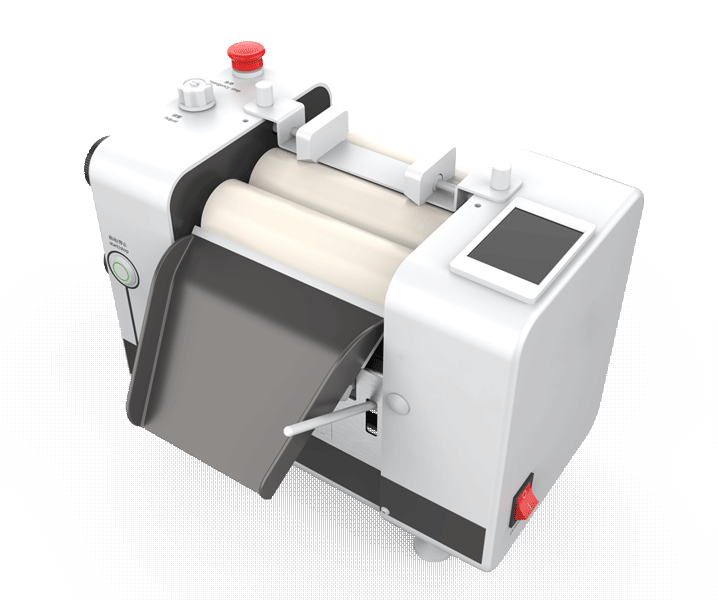
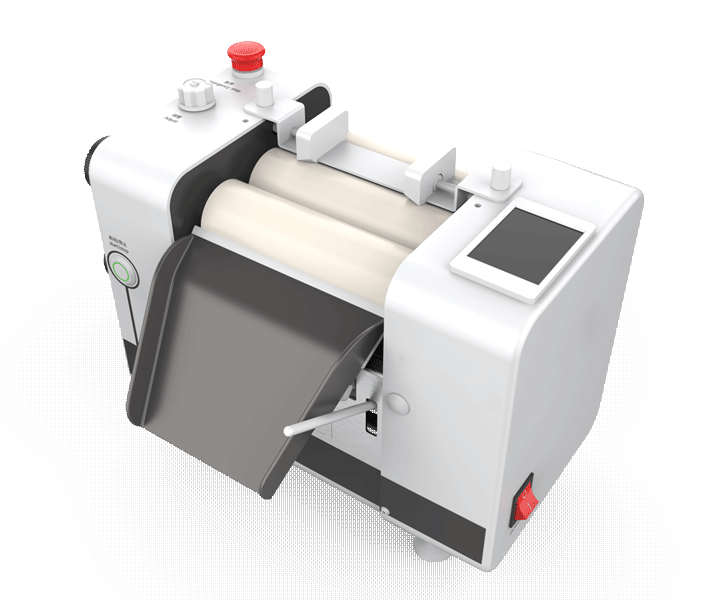
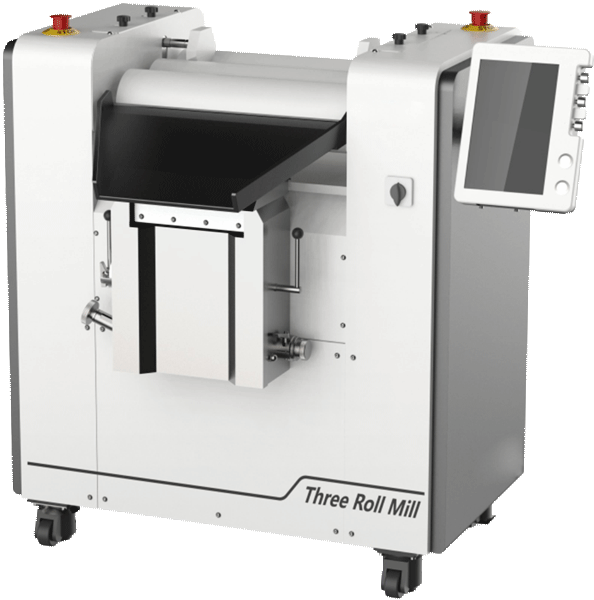
| Product images | The images provide a preliminary view of the equipment form for recognition and internal review. | Ask for current images of the exact configuration, including guards and controls. |
Selection criteria that change the configuration
A three roll mill quotation can look similar across suppliers while the actual configuration differs substantially. The following criteria are the ones most likely to change the mechanical design, the utility requirements, and the acceptance test. They should be discussed in the same order as the process logic: material first, then dispersion target, then materials of construction, then operability and safety.
Feed rheology and solids loading
The first question is whether the feed behaves as a paste at the intended processing temperature. A three roll mill relies on the material adhering to the rolls and passing through the gaps in a controlled film. If the feed is too fluid, it may run off the rolls or fail to develop the intended film; if it is too stiff, it may not transfer cleanly or may overload the drive. The buyer should describe the feed at the actual solids loading, including any temperature-dependent viscosity change, yield stress, and thixotropic behavior. A small sample observation is more useful than a single viscosity number, because paste rheology is rarely Newtonian.
Target dispersion and fineness
The target is usually expressed as a dispersion quality rather than a single particle size: for example, absence of visible agglomerates on a grind gauge, a specified haze or gloss, a conductivity target, or a rheology target. The buyer should define the acceptance method before the trial. “Finer” is not a specification. A three roll mill can reduce agglomerates and improve uniformity, but the achievable result depends on the feed, the number of passes, the gap sequence, the roll speed ratio, and the temperature. No responsible supplier should guarantee a fineness value without a sample test and a defined method.
Roll material and contamination control
Material contact is a major selection variable. The buyer should ask which roll materials, end plates, scrapers, and discharge components are available for the product, and whether the product is compatible with the proposed construction. For pigmented systems, abrasive fillers, electronic pastes, or products with strict metal-ion limits, the question is not only corrosion resistance but also wear debris and cleanability. The buyer should request a material-contact list and confirm that the proposed elastomers, seals, and surface finishes are compatible with the carrier solvents and cleaning agents. A general statement that a machine is “suitable for pastes” is not enough.
Gap, pressure, and temperature control
The gap setting and its adjustment method determine how the machine is operated from batch to batch. The buyer should confirm whether the gap is set manually or by a controlled system, how repeatable the setting is, and how the operator verifies it. Temperature control is equally important: viscous paste generates heat in the gap, and some formulations are sensitive to even modest temperature rise. Ask whether the rolls are cored for cooling, whether the feed is temperature-controlled, and how the temperature is monitored. The answer should be specific to the proposed model, not inferred from a general brochure.
Throughput and operating envelope
Throughput in a three roll mill is not a single number. It depends on the paste viscosity, the target number of passes, the roll speed, the gap, the discharge method, and the acceptable temperature rise. A buyer who asks only for “kg per hour” will receive a number that may not apply to the real formulation. A better request is a trial-based estimate at the intended viscosity and dispersion target, with the assumed number of passes and the acceptable endpoint stated. The same logic applies to batch size: the working volume, the apron design, and the cleaning access should match the intended batch and changeover frequency.
Cleaning, changeover, and solvent compatibility
In multi-product laboratories and contract manufacturing, cleaning can determine the practical value of a three roll mill. The buyer should ask how the rolls, end plates, apron, and guards are accessed, which surfaces are wetted, and whether the design can be cleaned with the intended solvent or detergent. If the product is sensitive to cross-contamination, the cleaning validation method should be discussed before the equipment is ordered. The buyer should also confirm compatibility of seals, hoses, and coatings with the cleaning chemistry. A machine that is difficult to clean may still be technically capable, but it will carry a higher operating burden.
Safety and facility fit
Three roll mills have rotating rolls, gaps, and nip points, so guarding and safe access are part of the selection. The buyer should confirm the guard arrangement, emergency stop, lockout/tagout provisions, and the clearance needed for cleaning and maintenance. If flammable solvents are present, the electrical classification and ventilation requirements must be reviewed with the facility’s safety team. The installation also needs sufficient floor space, access for the roll assembly, and utilities that match the proposed drive and temperature-control system. These are not optional details to settle after the order; they affect the layout and the quotation.
Qualitative selection matrix
The matrix below is deliberately qualitative. It is a discussion tool for the TENCAN inquiry, not a substitute for a model-specific data sheet. Each row should be answered with a documented value or a stated assumption.
| Selection area | Why it matters | What to confirm with TENCAN |
|---|---|---|
| Feed rheology | Determines whether the paste forms a stable film on the rolls. | Recommended feed viscosity range and any pre-conditioning requirements. |
| Dispersion target | Defines the acceptance test and the number of passes. | Proposed trial method, gap sequence, and endpoint verification. |
| Roll material | Affects wear, contamination, and cleaning. | Available roll and contact materials for the product and cleaning agents. |
| Gap control | Controls reproducibility and operator dependence. | Adjustment method, repeatability, and gauge or indication provided. |
| Temperature control | Protects heat-sensitive formulations and stabilizes viscosity. | Cooling arrangement, temperature monitoring, and utility requirements. |
| Throughput | Sets the production or pilot scale. | Trial-based estimate at the intended paste and number of passes. |
| Cleaning | Affects changeover time and cross-contamination risk. | Access, wetted materials, and cleaning procedure compatibility. |
| Safety and installation | Determines facility fit and operator protection. | Guarding, emergency stop, utilities, footprint, and ventilation needs. |
Application scenarios
Three roll mills are evaluated across several paste and semi-solid product families. The purpose of the following sections is to show how the application changes the questions, not to claim that every formulation is suitable for every model. Compatibility, cleaning, and safety must be confirmed for the specific product.
Printing inks and coatings
Inks and coatings often require deagglomeration of pigments and uniform wetting of solids in a vehicle. The selection questions center on the pigment hardness, the vehicle rheology, the target gloss or haze, and the cleaning solvent. A buyer should define the grind gauge endpoint and the acceptable number of passes. Temperature rise can affect vehicle viscosity and solvent loss, so cooling and solvent handling should be discussed. The buyer should also confirm that the roll material and seals are compatible with the vehicle and cleaning solvent, and that the guards and ventilation suit the facility.
Adhesives, sealants, and pastes
Adhesives and sealants can be high-viscosity, shear-thinning, and sensitive to over-processing. The useful questions are whether the feed can be conveyed to the rolls, whether the target is simple homogenization or fine dispersion of fillers, and how the material behaves at the discharge apron. Cleaning is often the limiting factor because cured or gelled adhesive can be difficult to remove. The buyer should ask about access to the rolls and end plates, the compatibility of seals with the carrier, and the recommended cleaning sequence. A sample trial at the production formulation is more informative than a trial on a generic paste.
Electronic and specialty pastes
Electronic pastes, conductive inks, and specialty filled systems often have strict contamination limits and fine dispersion targets. The selection discussion should include the metal or filler package, the carrier chemistry, the allowable metallic contamination, and the cleaning method. The buyer should request a material-contact list and confirm whether the proposed rolls and contact parts are acceptable for the product. Because these products can be sensitive to shear and temperature, the trial should record the gap sequence, roll speed, number of passes, and temperature history. The acceptance test should be agreed in advance, whether it is a fineness-of-grind reading, a rheology check, or a functional test.
Cosmetic and pharmaceutical-type pastes
Cosmetic and pharmaceutical-type pastes place a high value on consistent texture, uniform dispersion, and cleanability. The buyer should discuss the cleaning validation approach, the material-contact documentation, and the suitability of the equipment for the intended hygiene regime. The equipment supplier should confirm which surfaces are wetted and which materials are available. The buyer’s quality team should review the proposed cleaning procedure and any required documentation before the order. These requirements vary by product and jurisdiction, so they should be stated explicitly rather than assumed from the equipment category.
Food and confectionery-type pastes
Food-related pastes may involve sugar, fat, cocoa, or other ingredients that are sensitive to temperature and shear. The buyer should confirm the material-contact construction, the cleaning regime, and the temperature-control capability of the proposed model. Allergen control and sanitation requirements should be reviewed with the supplier and the facility’s quality team. A three roll mill can be part of such a process, but the specific construction and cleaning validation must be confirmed; a general laboratory model may not meet a food-production sanitation standard.
Procurement checklist for a three roll mill
The following checklist is designed to turn a broad equipment request into a reviewable quotation. It applies whether the buyer is comparing one TENCAN model with another, benchmarking an internal specification, or reviewing non-Chinese suppliers on the same technical basis.
- Define the feed: chemistry, solids loading, viscosity range, yield stress, and temperature sensitivity.
- State the target: dispersion method, acceptance limit, number of passes, and any functional requirement.
- Provide a representative sample and the safety data sheet before requesting a trial.
- Confirm the model’s roll dimensions, speed ratio, drive rating, and gap adjustment method.
- Ask for a material-contact list covering rolls, end plates, scrapers, seals, and discharge parts.
- Confirm temperature-control provisions and the expected heat input at the intended operating point.
- Clarify the throughput basis: paste viscosity, target fineness, number of passes, and acceptable temperature rise.
- Review cleaning access, wetted surfaces, and compatibility with the intended cleaning agents.
- Confirm guarding, emergency stop, lockout/tagout, and nip-point protection.
- Check utility requirements, footprint, floor loading, and clearance for roll maintenance.
- Ask for the acceptance test procedure and the documents supplied with the unit.
- Record all assumptions so that the final configuration can be compared on a like-for-like basis.
How to run a sample evaluation with TENCAN
A sample evaluation is most useful when it is planned as a small process study rather than a demonstration. The buyer should provide a representative sample, the target acceptance method, and the intended operating window. The trial should record the feed condition, the gap sequence, the roll speed, the number of passes, the product temperature, and the observed discharge behavior. Before the trial, agree on the report format: the starting and ending dispersion result, the method used, the number of passes, the temperature history, and any observed operating limits. The report should also note the configuration used, because a result obtained on one roll arrangement may not transfer directly to another.
Lifecycle questions that deserve a place in the quotation
The purchase price is only one part of the decision. The buyer should ask how the rolls are inspected for wear, how the gap setting is verified over time, and which parts are expected to be replaced. Cleaning time and changeover time should be estimated with the actual procedure, not with a generic statement. Energy use depends on the drive, the viscosity, and the operating point, so it should be discussed as part of the trial rather than assumed. Training and documentation also belong in the quotation review: operators need to know how to set the gap, clean the machine, and recognize an overload or temperature excursion.
A focused next step
The TENCAN three roll mill is best evaluated as a configuration for a defined paste, not as a generic catalogue item. Start with the feed rheology and the dispersion target, then confirm the roll material, gap control, temperature control, cleaning access, and safety provisions. Use the TENCAN three roll mill product page to establish the current model and option set, and ask for a sample trial that reproduces the intended process conditions. Send TENCAN a representative sample, the target acceptance method, the intended batch size, and the facility constraints so that the proposed configuration and trial plan can be reviewed on a documented basis.
Sources and Further Reading
Related Products
Get In Touch
Our professional team will reply to you within one business day. Please feel free to contact us!