
Horizontal Screw Belt Mixer: How It Blends Powder Uniformly and Where It Fits

Pick up a handful of powder from a badly mixed batch and you can usually see the problem with your own eyes. One scoop looks darker, the next looks lighter, and the third hides a small pocket of the additive that was supposed to be spread evenly through the whole lot. In ceramics, battery materials, food, pharmaceuticals and metallurgy, that kind of unevenness is rarely just cosmetic. It shows up later as inconsistent strength, colour, density or electrical performance.
Blending looks trivial on a process flow diagram, and then quietly decides whether everything downstream behaves the way it should. So it is worth understanding the machines doing the work. Today we are taking a close look at one of the workhorses of dry powder processing: the horizontal screw belt mixer.
By the time you finish reading, you will know what a screw belt really is, how the ribbons move your powder around, when this design is the right choice, and which small operating decisions make the biggest difference to blend quality.
What a Horizontal Screw Belt Mixer Actually Is
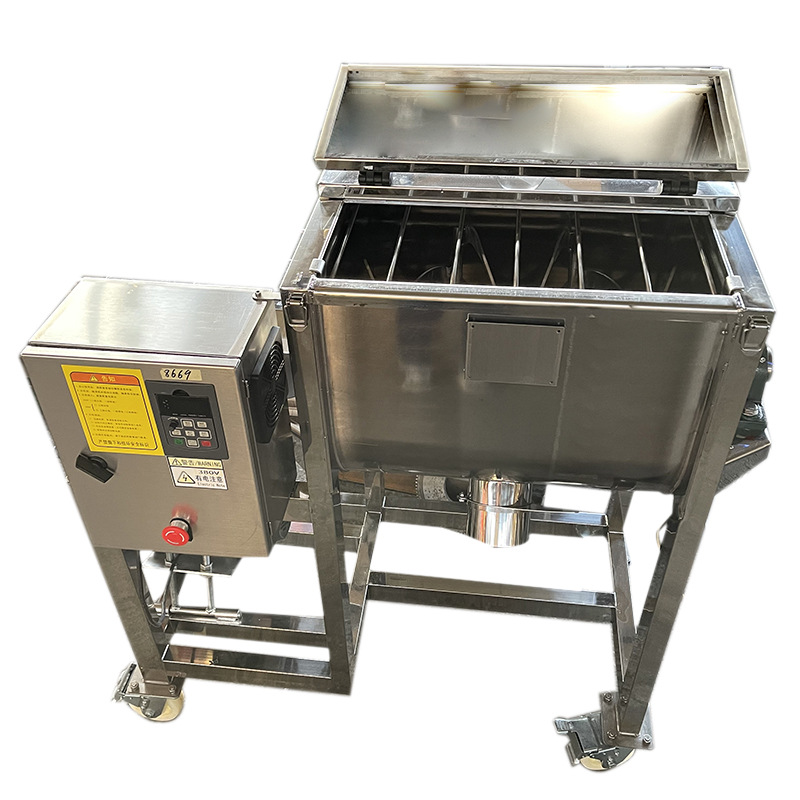
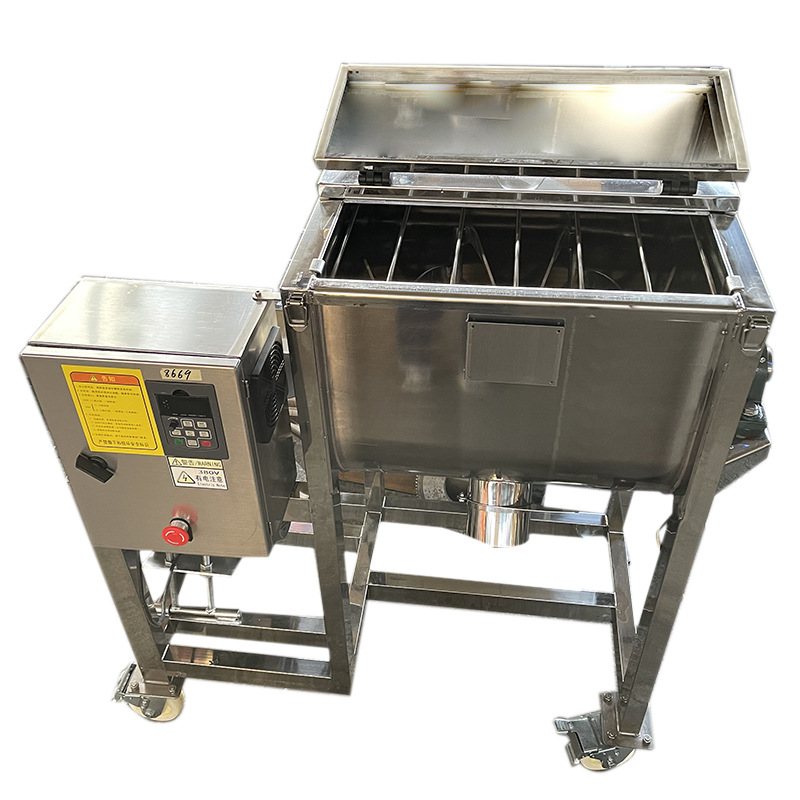
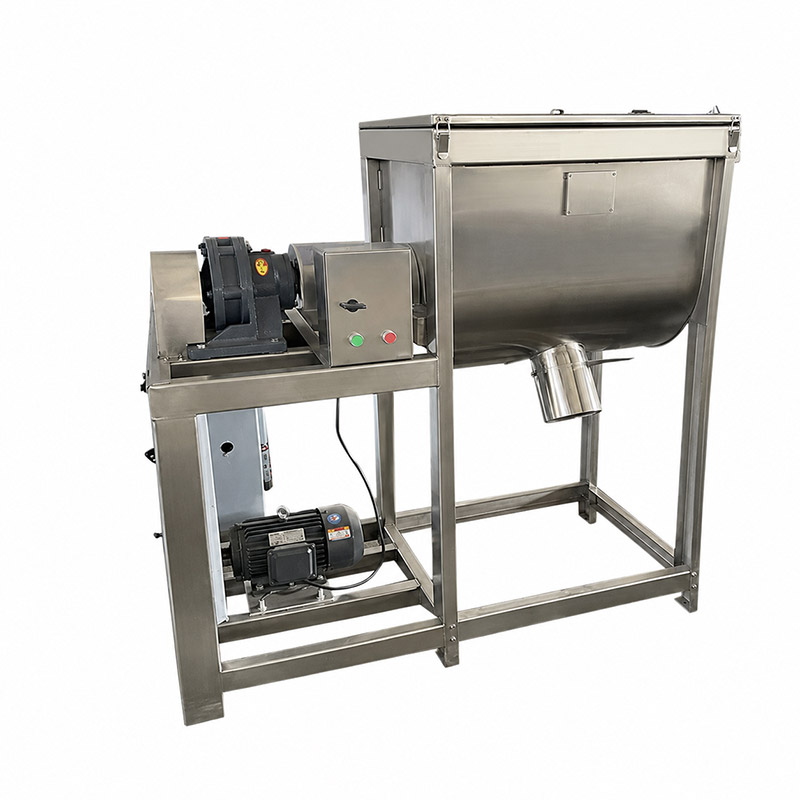
A horizontal screw belt mixer — most English-speaking plants simply call it a ribbon blender — is a horizontal trough with a single shaft running lengthwise through it. Welded around that shaft are two or more helical metal bands, and those bands are the screw belts. Turn the shaft, and the bands sweep through the powder bed.
Look closely at the geometry and you will notice something important. A screw conveyor has one continuous flight that pushes material steadily forward. A screw belt mixer has ribbons that push material in opposite directions at the same time. That single design decision is what turns a conveyor into a blender.
The name is a fairly literal translation of the original term, and it describes the flight well: the belt is a flat, ribbon-like band rather than a solid screw. The outer ribbon is wide and sits close to the trough wall. The inner ribbon is narrower, sits closer to the shaft, has a smaller diameter, and is wound the opposite way.
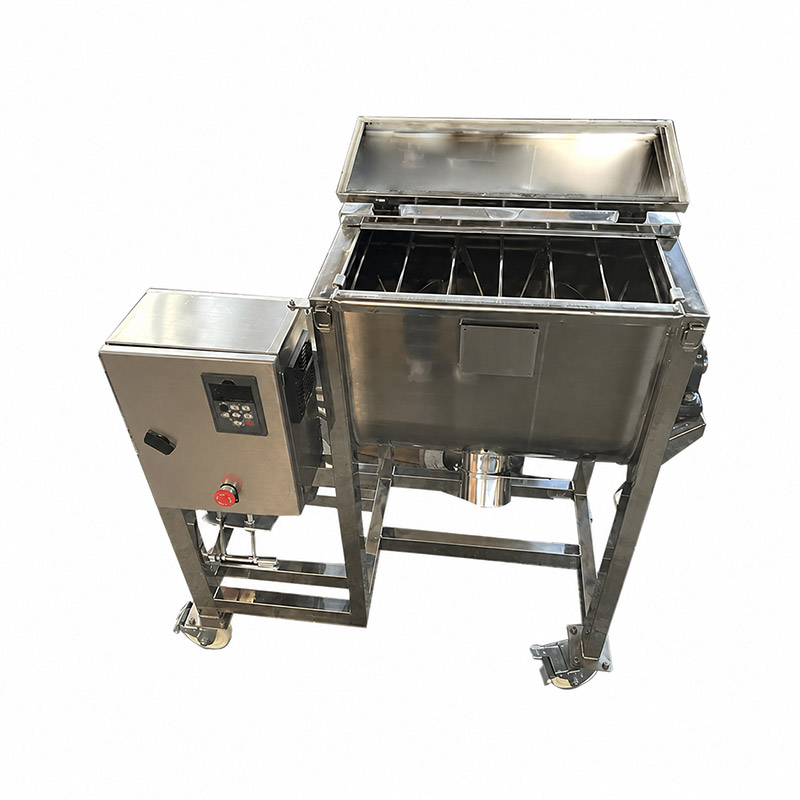
Around that core you will normally find a set of practical details: a charging port in the top cover, a discharge valve at one end or in the middle of the bottom, the drive unit at one end of the shaft, and quite often a jacket around the trough so you can heat or cool the powder while it blends. None of this is glamorous, but each piece decides how the machine behaves on your line, so they are all worth checking before you buy.
It also helps to sort out the vocabulary, because suppliers use several names for the same idea. Ribbon blender, ribbon mixer, horizontal ribbon blender, horizontal screw mixer — in most cases these describe the same counter-flow ribbon geometry. When you compare quotations, compare the actual drawings rather than the labels, because a ribbon mixer in one catalogue can mean something very different in another.
How the Screw Belt Moves Powder Inside the Trough
Two ribbons, two directions
When the shaft rotates, the outer ribbon drives powder from one end of the trough towards the other. The inner ribbon, wound the opposite hand, pushes powder back the other way. Material is therefore being split continuously, sent towards both ends, and returned to the middle. Nothing gets to sit still for long.
What you get is a pair of rolling loops running through the whole vessel. Powder near the wall travels in one axial direction, powder near the shaft travels in the other, and gravity keeps folding the top layer back down into the bed. Give it a minute and every particle has taken a long, wandering path through the batch.
Why counter-flow kills dead zones
A dead zone is a pocket of powder that barely moves while everything around it is being blended. Dead zones are the reason two operators can run the same recipe on the same machine and still get different results. They usually hide in corners, behind end plates and underneath the shaft.
Counter-flow ribbons deal with that problem structurally rather than by hoping for the best. Because material is being pushed in both directions at once, powder is constantly dragged out of the corners and back into the active stream. Add a sensible clearance between ribbon and trough wall, plus a shaped end plate, and there is simply nowhere for a stagnant pocket to survive.
Convection, diffusion and shear, all at once
Mixing engineers describe powder blending as three mechanisms working together, and it helps to know which one is doing the heavy lifting in a given machine.
- Convection — bulk movement. Large groups of particles are physically carried from one place to another.
- Diffusion — the small-scale swapping that happens as particles roll past each other and slip into new positions.
- Shear — sliding and smearing at the boundaries between moving layers, which breaks up loosely bonded clumps.
In a horizontal screw belt mixer, convection dominates, with a healthy dose of shear at the ribbon edges and some diffusion wherever particles are small enough to move independently. That combination explains the machine's personality: fast, uniform, and reasonably kind to the material.
It is also worth separating axial motion from radial motion. Axial motion carries powder along the length of the trough; radial motion is the tumbling and rolling that happens in cross-section. A design that only pushed powder forward would merely convey it, so the ribbons deliberately trade some axial drive for radial turnover. That is exactly what you want, because uniformity is decided in cross-section just as much as along the length.
What This Design Is Especially Good At
Gentle, low-shear blending
Ribbon shafts turn slowly by design. The belts sweep through the bed rather than smashing into it, so fragile particles — spray-dried granules, coated powders, crystals with sharp edges — come out closer to their original shape than they would from a high-intensity mixer. If your material is expensive, that matters a good deal more than the mixer's price tag.
Short cycles and even results
Because convection does the heavy lifting, a screw belt mixer usually reaches a uniform blend in minutes rather than hours. The exact time depends on fill level, bulk density, the number of ingredients and how different their particle sizes are, but the general character of the machine is quick. When you run many batches a day, that speed converts directly into capacity.
Comfortable with high fill levels
A ribbon blender can be loaded fairly full. A common working range is around 60% of the trough's total volume, which is generous compared with tumbling blenders that need plenty of empty space for powder to cascade through. More powder per cycle means fewer cycles for the same output, and less handling of an expensive product.
Wide material compatibility
Horizontal screw belt mixers handle a broad range of dry solids: mineral powders, ceramic bodies, chemical intermediates, food ingredients, feed premixes, metal powders, graphite and battery materials. They also tolerate a reasonable difference in bulk density between components, which is more than can be said for purely gravity-driven equipment.
Where it is not the best answer
Some honesty here. If your material is a wet paste, a sticky dough or a slurry, ribbons will struggle — they are built for powders and free-flowing granules, not for kneading. Very abrasive minerals will wear the ribbons, the shaft seals and the trough walls, so you need to think about materials of construction and wear allowances from the start. And if your real job is reducing particle size rather than blending, a mill is the right tool. Blending and grinding are different operations, and confusing the two usually costs money twice.
Comparing Mixing Styles at a Glance
It is easier to judge a mixer when you know what the alternatives do well. The table below is about mechanisms rather than brand names.
| Mixing style | Dominant mechanism | Strengths | Watch out for |
|---|---|---|---|
| Tumbling (V-shape, double cone) | Gravity cascade | Gentle, easy to clean, low energy | Slower; needs empty volume; can re-segregate on discharge |
| Horizontal ribbon or screw belt | Convection with shear | Fast, uniform, tolerant of wide particle-size ranges | Not suitable for pastes or very sticky products |
| Vertical screw (conical) | Convection | Handles large volumes with little damage | Longer cycles; taller footprint |
| High-shear paddle or plough | Intense shear and fluidisation | Breaks agglomerates; can add liquids | Can damage fragile particles; adds heat |
| Ball mill (planetary or rolling) | Impact and friction | Size reduction, not just blending | Not a blender; it changes the particle size distribution |
Use the table as a starting filter rather than a verdict. If your powder is dry, free-flowing and has to be uniform batch after batch, the ribbon design is usually the shortest path. If your powder is fragile and free-flowing, tumbling may be enough. If you need to crush agglomerates or add liquids, you are looking at a different family of machines entirely.
Operating Decisions That Decide Your Blend Quality
Fill level: leave room for the loop
Overfilling is the most common way people ruin a perfectly good ribbon mixer. The ribbons need space above the bed for powder to roll over; if the trough is stuffed to the brim, the top layer simply rides along with the shaft and never re-enters the flow. Underfilling is less harmful but wastes capacity and increases wear per tonne. Start around 60% of the trough volume, then adjust for your material.
Shaft speed and cycle time
Faster is not automatically better. Once the ribbons are moving the whole bed, extra speed mostly adds heat, wear and dust rather than uniformity. A practical approach: choose a speed that keeps the entire bed circulating, then use sampling and a stopwatch to find the shortest cycle that still passes your uniformity check. Doubling mixing time just to be safe is a habit worth losing, because with some blends over-mixing encourages segregation as fine particles sift downwards and coarse ones rise.
Loading order and discharge
Order matters more than most people expect. Dropping a small-quantity ingredient into an empty trough and then burying it under the bulk material is a great way to trap it in a corner. A better habit is to load the coarse or bulky components first, start the shaft at low speed, and add the minor ingredients gradually into the moving bed. On the way out, watch the first and last few kilograms through the discharge valve, because those are usually the least uniform portions of the batch.
Liquids, binders and sticky powders
If you need to add a small amount of liquid — a binder, a lubricant, a flavour — add it slowly and into moving powder, never in one pour. Spraying beats dripping. Keep the total liquid low enough that the product stays powdery, because once it turns into a paste you have left the territory this machine was designed for.
Moisture and humidity
Damp powder clings to ribbons and trough walls, and caked-on layers are the fastest route to contamination between batches. If your product is hygroscopic, control the room, not just the mixer. Ambient humidity is often the hidden variable behind blend problems that seem to come and go for no reason.
Cleaning, Maintenance and Cross-Contamination
Between batches
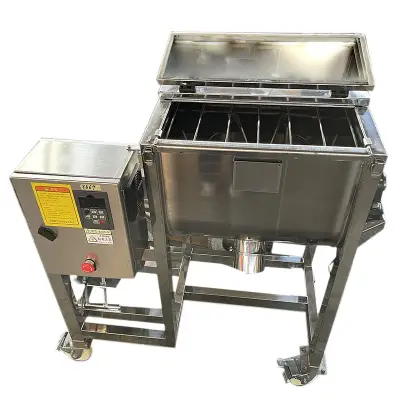
Good access is worth more than clever design. A trough with a wide opening, a removable top cover and a discharge valve large enough for powder to fall freely will save your operators real time every single shift. Simple tools — a soft scraper, a vacuum line, an air purge — handle most changeovers. If you alternate between very different products, consider whether polished internal surfaces and rounded corners are worth the extra cost up front. Some machines are built specifically for fast changeovers; the TENCAN horizontal screw belt mixer page shows how the trough, cover and discharge are arranged on a production unit.
Long-term wear points
Keep an eye on three things: ribbon edges, the shaft seal and the bearing housings. Ribbon edges wear first because they run closest to the wall, and a worn edge changes the flow pattern long before it becomes a mechanical problem. Seals matter because a leaking seal lets fine powder escape, and a slow dust leak at the drive end is a common complaint that a routine check catches early and cheaply. The machine itself is mechanically simple, so a short inspection list goes a long way.
Questions We Hear Most Often
Can it blend powders with very different particle sizes?
Yes, within reason — that is one of the design's strengths. Counter-flow convection keeps large and small particles moving together instead of letting them stratify. But if the size gap is extreme, or the components differ a lot in density, do not lean on the mixer alone: shorten the cycle, avoid over-mixing, and confirm uniformity by sampling rather than by trusting the timer.
How do I prove the blend is actually uniform?
Sample it. Take several small samples from different points after discharge, or use a sampling thief at different depths, and analyse the concentration of the key component. Then look at the variation between samples, not just the average, because a blend with the right average but wide variation will still cause trouble downstream. This is also the honest way to find your shortest acceptable cycle time instead of guessing at it.
Do lab batches scale up to production?
Mixing behaviour does not scale in a straight line, so a blend that works in a small trough may need a different speed and fill ratio at full size. The useful rule is to keep the mechanism rather than the numbers: same ribbon geometry, similar fill ratio, and shaft speed adjusted so the bed circulates the way it did on the small machine. A pilot run is cheap insurance compared with a failed production batch.
Does the ribbon have to be polished?
Not always, but it depends on your product. Polished surfaces reduce powder adhesion and make cleaning faster, which matters in food, pharmaceutical and battery applications where cross-contamination is a genuine risk. For coarse mineral powders, a standard finish is usually fine and easier on the budget.
Choosing the Right Machine for Your Powder Line
If you are weighing up a horizontal screw belt mixer for your own process, the useful next step is to compare configurations rather than just capacities: trough volume and working fill, materials of construction, ribbon and shaft design, sealing arrangement, discharge type, and whether you need a jacket for heating or cooling. The horizontal screw belt mixer from Changsha Tianchuang Powder Technology Co., Ltd. (TENCAN) is a good reference point, and the detailed specifications listed on that page are worth holding up against your own recipe and batch size.
TENCAN builds mixing and milling equipment for powder processing, so if your process also needs size reduction, the two steps are worth planning together. The particle size distribution that enters the mixer largely decides how easily it will come out uniform, and matching the two stages saves a lot of troubleshooting later.
Blending rarely gets the attention that milling or forming gets, but it is the step where a good recipe either holds together or quietly falls apart. Understand the ribbon geometry, respect the fill level, verify the result by sampling, and a horizontal screw belt mixer will run for years without drama.
Related Products
Get In Touch
Our professional team will reply to you within one business day. Please feel free to contact us!