
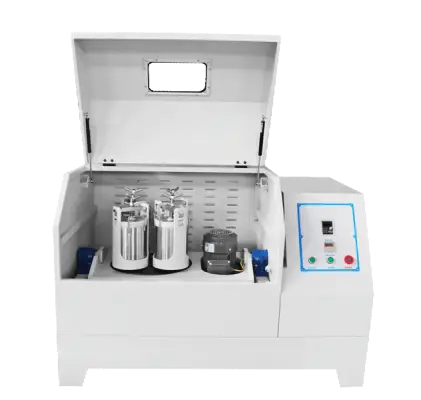
How to Choose a Laboratory Planetary Ball Mill Using Sample Properties, Jar Materials and Contamination Limits

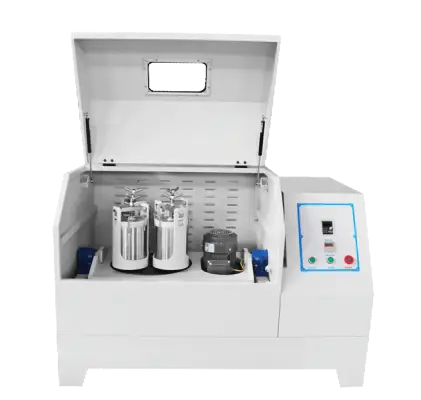
Choosing a laboratory planetary ball mill is a specification exercise, not a catalogue comparison. Settle three questions first — what the sample is, what the jar and grinding balls are made of, and how much contamination your analysis tolerates — then let capacity, speed and price follow.
Define the sample before comparing mills
Glen Mills, in a technical article on grinding tools and trace-metal contamination, states that selecting grinding tools requires consideration of sample properties including hardness, starting size, required final fineness and time of comminution. Add the analytical method that follows, because it sets the elements you must protect.
Two behaviours change the requirement: some samples need liquid added to avoid agglomeration, and in some instances solids such as talcum or aluminium oxide can be used instead, according to Glen Mills. Overfilling a jar reduces grinding efficiency, so fill ratio matters as much as nominal volume.
Check application fit, not just capacity
Manufacturers publish the application areas they target. TENCAN's planetary ball mill pages list use across geology, minerals, metallurgy, electronics, building materials, ceramics, chemicals, light industry, medicine and environmental protection, and offer application-oriented advice for sample preparation and scale-up. Treat such lists as the start of a specification conversation about your own material, not as evidence of performance on it.
Match jar and ball material to a stated contamination limit
Contamination is a measurable, element-specific result, and published figures carry conditions that are easy to lose. The Glen Mills study ground limestone in four grinding and impact mill types — jaw crushers, planetary ball mills, a mixer mill and a vibratory disc mill — with a variety of tool materials, then analysed the products by ICP-OES for Co, Cr, Ni, W and Zr. Iron was measured too, but since Fe occurs at high percentage levels in limestone, any iron from tool abrasion was only an estimate.
Because mill type and tool material varied together, the results are not a ranking of planetary ball mills, or of one jar material across all samples. The study reports:
- For most results, no significant contamination from the grinding tools was detected.
- Tungsten carbide tools gave a very low but detectable concentration of tungsten and cobalt, including with the PM 100 planetary ball mill.
- Significantly less tungsten and cobalt contamination appeared with the PM 100 CM, a planetary configuration with a lower jar rotation speed (0.5x), which the authors link to gentler size reduction and less abrasion.
- Steel-based tools produced some chromium and nickel, and especially iron, contamination — as expected.
Zirconium oxide plays a narrower role than it is sometimes given. A ZrO2 jar and grinding balls served as a contamination-neutral blank for the elements of interest in limestone, while a tungsten carbide jar and balls gave the blank value for zirconium. Zirconia was the reference material for that measurement, not a demonstrated lowest-contamination option.
The practical reading: ask which elements your jar and balls can shed, and at what process intensity. In the reported comparison the lower-speed configuration abraded less, so a gentler regime may reach your fineness target with less wear — but a limestone result does not transfer to your powder.
Size the jar and batch to the fill rule
Glen Mills recommends filling a planetary ball mill jar with about one-third sample and one-third ball charge, leaving the remaining third as free volume for ball movement, though this can differ for colloidal grinding. Calculate your working batch from that rule, then check that the jar range on offer covers it.
Scale-up is a separate decision. TENCAN describes its XQM-20 20 L vertical production planetary ball mill as a 20 L batch grinding system for pilot-scale powder processing, material development and process verification, with more jar capacity than typical laboratory mills while retaining control of grinding speed, operating time and processing conditions. TENCAN also states that actual capacity and production suitability should be evaluated against the specific material and target result.
Verify with your own material
TENCAN states that sample grinding and technical guidance help customers verify materials before selecting equipment, and that it supports universities, research institutes and technology companies with laboratory milling equipment and sample grinding know-how. Use a trial grind to check achievable fineness and contamination at your target analyte before committing to a jar material, ball charge or mill size.
Practical selection checklist
- Record sample hardness, feed size, target fineness and acceptable grinding time.
- Note agglomeration behaviour and whether wet grinding or a grinding aid is acceptable.
- State the analyte and its contamination threshold before choosing jar and ball material.
- Calculate batch mass from the one-third sample / one-third balls rule, not total jar volume.
- Request a trial grind with contamination data relevant to your matrix.
FAQ
Is a larger jar always the better buy?
No. Usable batch is set by the fill rule, and a larger system should be justified by a trial on your material, not by nominal capacity alone.
Which jar material gives the lowest contamination?
There is no universal answer. In the Glen Mills limestone work, zirconia served as a contamination-neutral reference, tungsten carbide gave low but detectable tungsten and cobalt, and steel tools contributed chromium, nickel and estimated iron.
Does a higher rotation speed improve results?
Not necessarily for contamination: in the reported comparison the lower-speed planetary configuration produced less tool abrasion, so balance speed against wear.
Limitation: published contamination figures are matrix- and element-specific and do not transfer directly to another powder; a trial grind on your own material remains the decisive test.
Related Products
Get In Touch
Our professional team will reply to you within one business day. Please feel free to contact us!