
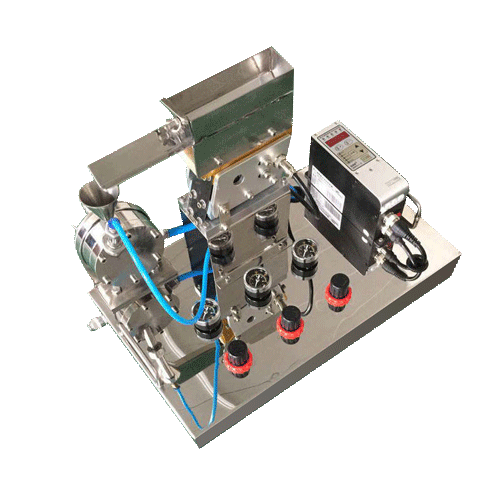
TENCAN Ball Mill & Micro Pulverizer

If you typed TENCAN ball mill into a search box, you are probably standing in one of three places: you need a powder finer than the one you are getting today, you are comparing milling technologies before you spend money, or you inherited a process and want to know what the machine in the corner is really doing. All three roads lead to the same questions. How fine can I go? What does it cost per kilo? And how do I keep my material clean?
We work with powder processing equipment every day — building it, sizing it, explaining it — and the same handful of questions comes up again and again. So this article does two jobs at once. It explains what a TENCAN ball mill is and how it works in plain language, and it explains the point where a ball mill stops being the best answer and a different machine takes over: the micro airflow pulverizer. By the end you should be able to look at your own powder and your own target particle size and make a confident call.
What "TENCAN Ball Mill" Actually Covers
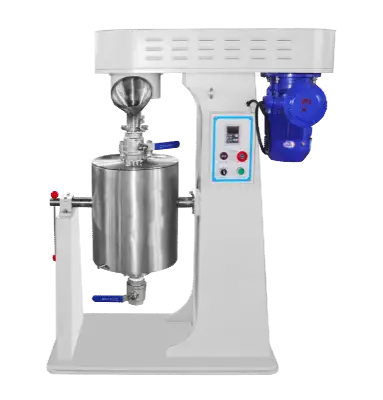
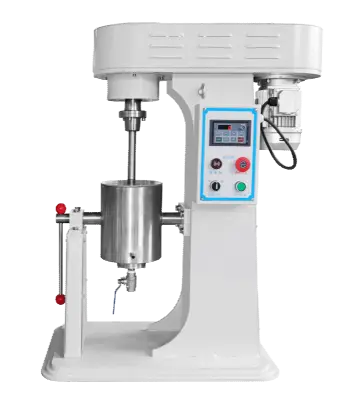
TENCAN is the international brand of Changsha Tianchuang Powder Technology Co., Ltd., a manufacturer based in Changsha, Hunan, that specialises in powder processing equipment. When somebody says "TENCAN ball mill," they are usually describing a family of machines rather than one single unit. That family runs from compact planetary ball mills sitting on a laboratory bench to larger mills built for production batches, plus the jars, grinding media, and accessories that go with them.
The common thread is simple. A ball mill is a hollow vessel, partly filled with hard balls, that moves in a way that makes those balls tumble, roll, and collide. Whatever material sits between the balls gets crushed and rubbed into smaller pieces. There are no blades and no cutting edges — the whole process is mechanical brute force applied thousands of times a minute.
A mill is a jar that moves — that is the whole trick
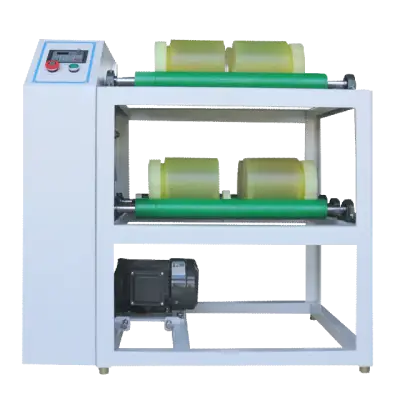
In a classic drum mill, the vessel is a horizontal cylinder turning slowly around its own axis. Friction lifts the balls up the side of the drum, and then they fall back onto the material underneath. Grinding happens through that repeated cascade, over and over, for hours.
In a planetary ball mill, the geometry changes. The jar is mounted on a rotating disc, and the jar also spins around its own centre, usually in the opposite direction. Because the two rotations add together, the balls are thrown against the jar wall with far more force than gravity alone could ever provide. The result is a much more energetic collision, which means finer grinding in less time.
That difference matters more than it sounds. A drum mill grinding a hard ceramic might need hours to reach a few microns. A planetary mill often gets there in a fraction of that time, which is one reason planetary units became the standard choice wherever people need to iterate quickly.
Why people start their search with this term
Most visitors arrive with a specific project behind them. Sometimes it is a research group that needs reproducible lab results before writing a paper or a grant application. Sometimes it is a factory that wants to bring fine grinding in-house instead of shipping material out. Sometimes it is a formulator whose supplier's powder keeps drifting out of spec, and who wants direct control over the milling step.
Whatever the reason, the useful questions are always the same: what particle size do I actually need, how does my material behave under impact, and which machine gets me there with the least fuss?
How Ball Milling Actually Breaks Particles
It helps to know what is physically happening inside the jar, because it explains almost every practical problem you will hit later on.
Impact, attrition, and shear
Three mechanisms do the work. Impact is a ball striking a particle hard enough to shatter it — imagine a hammer hitting a stone. Attrition is the slower rubbing that wears particles down at their edges and corners. Shear is the sliding force that tears softer or layered materials apart.
Hard, brittle materials tend to fail by impact and fracture cleanly. Soft, ductile, or fibrous materials behave completely differently: instead of shattering, they deform, flatten, and sometimes weld back together. That is why the same machine can produce a lovely free-flowing powder from quartz and a sticky, useless paste from a waxy organic material. The physics of your material matters as much as the machine.
The energy budget nobody talks about
Here is an uncomfortable truth about milling: most of the energy you put in never becomes new surface area. It turns into heat, noise, vibration, and wear on the media and the jar lining. Only a small share goes into actually creating fresh particle surfaces.
This is why milling is often the most energy-hungry step in a powder process, and why "just run it longer" is usually a bad plan. Past a certain point, extra time mostly heats your material and contaminates it with lining wear while the particle size barely budges. You are paying for noise and heat, not for progress.
What really sets your final particle size
Five variables dominate everything else:
- Media size and density. Bigger, denser balls hit harder and break coarse particles faster, but they leave a coarser floor behind. Small media grind finer, just more slowly.
- Media-to-material ratio. Too little media means too few collisions. Too much means the material gets cushioned, and the balls waste their energy hitting each other.
- Rotation speed. More speed means more energy per impact, up to a ceiling where the balls simply stick to the wall.
- Milling time. Helpful at first, then increasingly wasteful, then mostly harmful.
- The material itself. Hardness, brittleness, moisture content, and the tendency to agglomerate all set a practical floor.
That last point is the one people underestimate. Every material has a size below which grinding stops working — not because the machine is weak, but because particles become small enough that they stick back together as quickly as you break them apart.
Inside the Jar: Media, Lining, and Speed
Once you understand the mechanisms, the hardware choices start to make sense. Three of them decide most of your outcome.
Choosing grinding media
Media come in many materials, and the choice is a trade-off between density, hardness, and how much contamination you can tolerate. Dense media such as tungsten carbide or zirconia hit hard and grind fast, but they cost more and can shed wear debris into your product. Softer or lighter media such as agate or alumina are gentler on the product but slower.
The rule of thumb we give people is this: pick the lightest, cheapest media that still reaches your target size without taking forever. Media that are far harder than your material simply chew up the jar lining instead of the powder.
Speed and the critical speed trap
Every rotating drum mill has a critical speed — the rotation rate at which the contents are pinned to the wall by centrifugal force and stop tumbling entirely. Below that point, grinding happens. Too far below, it happens slowly. At or above it, you are running an expensive centrifuge.
Planetary mills behave differently because of the compound motion, but the same instinct applies: more speed is not automatically better. Once the charge stops cascading, extra rpm only adds heat and wear.
Wet or dry?
Wet milling uses a liquid carrier, which suppresses dust, carries heat away, and keeps fine particles from re-agglomerating. It is often the fastest route to sub-micron sizes. Dry milling avoids the drying step and the solvent cost, but it invites dust, static, and caking.
If your downstream process is a slurry — battery cathode mixes, ceramic slips, paints — wet milling slots in naturally. If your product must ship as a dry powder, dry milling saves you an entire unit operation, provided your material cooperates.
Where Ball Milling Hits Its Ceiling
Ball mills are wonderfully flexible, but they are not magic. There is a zone where they start to struggle, and knowing that zone saves a lot of frustration.
The dry fine-grinding wall
In dry grinding, as particles get smaller, their surface area grows quickly and so do the forces that make them stick together. Van der Waals attraction, static charge, and simple mechanical interlocking all push back against you. The powder coats the media and the jar wall, cushions the impacts, and effectively protects itself from further breakage.
The practical result is a wall. You can keep running the mill, but the particle size curve flattens out and refuses to drop. Where exactly that wall sits depends on the material, but it is real for every dry powder.
Heat, wear, and contamination
Every hour of milling puts wear on the jar and the media. Some of that worn material ends up in your powder. For a coarse refractory that is irrelevant. For a battery material, a pharmaceutical excipient, or a high-purity pigment, a few parts per million of iron or zirconia can ruin the batch.
Heat is the other quiet problem. Many materials are heat-sensitive: they oxidise, change crystal form, lose potency, or melt at the particle surface and stick together. A long ball milling run generates a surprising amount of heat, and the powder has nowhere to put it.
Agglomeration and re-welding
There is a frustrating effect where freshly created surfaces are chemically eager. They grab onto neighbours, and in ductile materials they can actually cold-weld back into larger lumps. You can see this in the numbers: the median particle size drops, but the top of the distribution grows a tail of agglomerates. Your laser diffraction result looks fine, your sieve analysis does not, and your customer complains.
When that starts happening, you are no longer fighting the machine. You are fighting surface chemistry, and it is time to look at a different grinding principle.
Enter the Micro Airflow Pulverizer
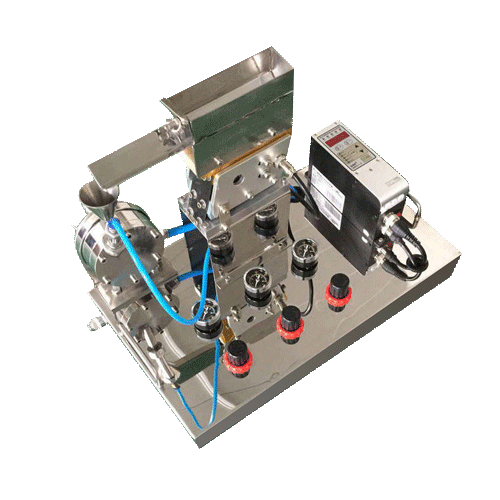
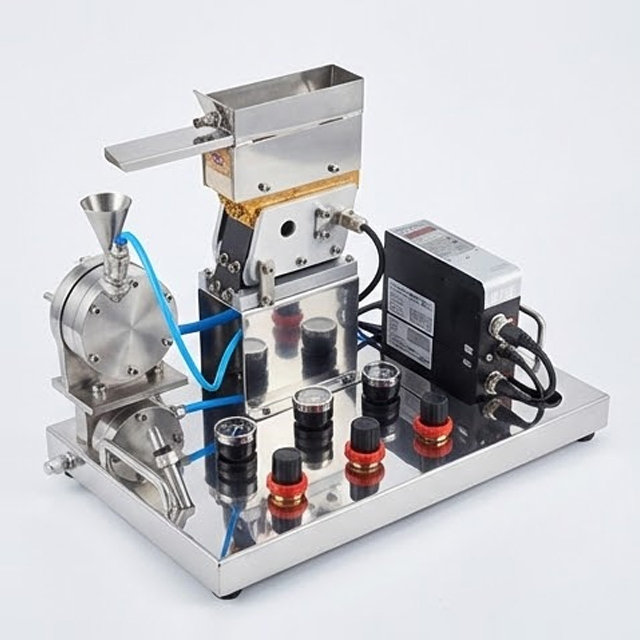
This is where the second machine in our story comes in. The micro airflow pulverizer attacks the same problem from a completely different direction — and it does it without grinding media at all.
What "micro airflow" actually means
The name describes the working principle rather than the size of the machine. Compressed air (or another inert gas) is accelerated to very high velocity through specially shaped nozzles. That fast-moving gas stream carries your powder with it, and the particles smash into each other at speed. The grinding energy comes from the gas, not from steel or ceramic balls.
Because there are no media, there is no media wear and no media contamination. That single fact changes what the machine is suitable for.
How the air does the breaking
Inside the grinding chamber, particles are repeatedly accelerated and collided. Head-on collisions between particles travelling in opposite directions are the most effective — they fracture cleanly rather than smearing. Because the process is driven by gas velocity, it is fast: residence time inside a jet mill is measured in seconds, not hours.
That short residence time is a big deal for heat-sensitive products. The material simply does not sit around long enough to accumulate much heat, and the expanding gas actually cools as it works. You get a fine powder without cooking it.
The classifier wheel — the real secret
Air alone would give you an unpredictable spread of sizes. The control comes from an integrated classifier wheel spinning at the top of the chamber. Particles fine enough to follow the airstream through the wheel's gaps exit as product. Coarser particles are thrown back into the grinding zone for another pass.
This is a continuous, self-regulating loop. You are not grinding for a fixed time and hoping; the machine keeps rejecting anything too coarse until it is small enough. That is why jet milling gives a tight, repeatable particle size distribution, and why it scales more predictably than a batch ball mill.
Ball Mill or Micro Airflow Pulverizer? An Honest Comparison
Neither machine is better in the abstract. They solve different problems, and the right answer depends on your powder, your specification, and your budget. Here is how they stack up in the areas that matter.
| Factor | Ball mill | Micro airflow pulverizer |
|---|---|---|
| Grinding energy source | Moving media (impact and attrition) | High-velocity gas and particle-particle collision |
| Grinding media | Required — balls, cylinders, or beads | None |
| Contamination risk | Present, from media and lining wear | Very low, since nothing touches the product but gas |
| Heat build-up | Significant over long runs | Minimal, thanks to seconds-long residence time |
| Particle size control | Time-based, distribution can drift | Classifier-based, tight and repeatable |
| Typical role | Coarse-to-fine grinding, mixing, mechanochemistry | Final ultrafine grinding and de-agglomeration |
| Consumables | Media and jars wear out | Minimal; nozzles and classifier are long-life parts |
| Cleaning and changeover | Slower, requires emptying and media handling | Fast, thanks to a simple flow path |
| Best for | Flexible lab work, hard and abrasive feeds, small batches | Heat-sensitive, high-purity, or very fine products |
Choose the ball mill when…
You want maximum flexibility from one machine. You are working at laboratory scale and need to try many formulations. Your feed is coarse and needs a big size reduction before anything else happens. Your material is hard and abrasive and does not care about a little iron. Or you need mixing and grinding in the same step, which ball mills do rather well.
Choose the micro airflow pulverizer when…
Purity is non-negotiable. Your product is heat-sensitive. You need a tight top size rather than just a small average. You are already below the dry grinding wall and cannot get further with media. Or you want a continuous process that runs unattended instead of a batch you have to load and unload.
A lot of real plants use both: a ball mill for the first reduction, then a jet mill for the finishing pass. That combination is often cheaper than trying to force one machine to do everything.
Process Parameters That Actually Move the Needle
Whether you end up with a planetary ball mill, a production drum mill, or a jet mill, a handful of settings decide your result. These are the ones worth your attention.
Feed particle size
Every mill has a comfortable feed window. Feed it boulders and you waste energy crushing things that a jaw crusher should have handled. Feed it dust that is already fine and you reduce throughput for no gain. Matching your pre-crushing step to the mill's appetite is one of the cheapest improvements available.
Feed rate and solids loading
In a jet mill, pushing the feed too hard floods the chamber. Particles no longer have room to accelerate, collisions become glancing rather than head-on, and the product coarsens even though you are using more air. Backing off the feed rate often improves fineness more than raising pressure does.
In a ball mill the equivalent mistake is overfilling the jar. Past about half full, the charge stops cascading properly and grinding efficiency collapses.
Energy input and air pressure
More energy generally means a finer product, but with sharply diminishing returns. Doubling grinding pressure rarely halves your particle size; it usually just doubles your compressed-air bill. Find the knee in the curve — the point where extra energy stops buying you meaningful fineness — and run there.
A quick material checklist
- Hardness. Very hard materials grind slowly and wear everything they touch.
- Brittleness. Brittle materials fracture cleanly; ductile ones smear and weld.
- Moisture. Damp powder bridges, cakes, and blocks classifiers. Dry it first.
- Fat or oil content. Sticky organics are the classic jet-mill headache; chilling the feed sometimes helps.
- Target specification. Decide whether you care about the median, the top size, or the whole curve — they are different goals.
Applications: Where Each Machine Earns Its Keep
Abstract comparisons get you only so far. Let's look at where these machines actually show up.
Battery and energy materials
Cathode and anode materials demand tight particle size control and near-zero metallic contamination. A stray particle of iron can create a short circuit inside a cell, so media-free grinding has an obvious appeal. Jet milling is common for final sizing, while ball milling handles mixing and pre-grinding. Keeping the whole chain clean matters more here than raw throughput.
Ceramics, glass, and minerals
These are the traditional ball mill territories. Hard, abrasive, and often cheap enough that media wear is an acceptable cost. Ball mills handle large volumes and produce the consistent, well-mixed slips that pressing and casting need. When a ceramic powder must reach sub-micron sizes with a controlled top cut, an airflow pulverizer becomes the finishing step.
Food, pharma, and nutraceuticals
Here the priorities flip. Cross-contamination between batches is unacceptable, and many active ingredients degrade when they get hot. The short residence time and simple, easily cleaned flow path of an airflow pulverizer suit these products well. Ball mills still appear in R&D kitchens and pilot plants, usually wet, for developing formulations before scale-up.
Chemicals and pigments
Pigments need to be de-agglomerated rather than crushed — the primary particles are already the right size, they just clump together. A jet mill is excellent at this because the gas stream separates clumps without over-grinding the individual particles. Over-grinding changes colour and surface behaviour, so control here is a quality issue, not just a cost issue.
Troubleshooting: Five Problems You Will Actually Hit
1. Particle size will not go any lower
In a ball mill, check for overfilling, worn or too-large media, and insufficient speed. In an airflow pulverizer, check the classifier setting, the feed rate, and the air pressure. If everything is nominal and you are still stuck, you have probably reached the material's practical grinding limit — and no parameter change will fix that.
2. Contamination is showing up in analysis
Media and lining wear are the usual suspects. Switch to harder, denser, or more chemically compatible media, or move the final grinding step to a media-free machine. Also check your handling: sometimes the contamination enters after the mill, from ducting, sieves, or storage.
3. Throughput is disappointing
In jet mills, this is very often a feed rate problem rather than a pressure problem. In ball mills, it is usually a fill level or media charge problem. Before you buy a bigger machine, make sure the one you have is running at its own sweet spot.
4. Static, sticking, and caking
Fine dry powders love to cling. Grounding and antistatic measures help. Reducing moisture in the feed helps more. In extreme cases, a small amount of a flow aid or a switch to wet processing solves what no amount of mechanical adjustment will.
5. Noise, heat, and vibration
Ball mills are loud and they get hot; that is normal but it should be monitored. Rising temperature in the powder is a warning that you are past the useful point of the run. Unexplained vibration usually means an unbalanced load, worn media, or a mechanical issue worth investigating before it becomes a failure.
A Practical Selection Checklist
Before you commit to anything, work through these in order:
- Define the specification. Median size, top size, distribution width, and any purity limits. Write them down.
- Test your material's behaviour. Is it brittle, ductile, sticky, heat-sensitive, abrasive? A small lab test answers this faster than any catalogue.
- Decide batch or continuous. Batch suits flexible, small-volume work. Continuous suits steady production with tight quality control.
- Estimate the real cost. Include media replacement, compressed air or power, labour, cleaning time, and rejected batches — not just the purchase price.
- Plan the whole flow. Pre-crushing, feeding, classification, dust collection, and packaging all affect the final result.
- Start at lab scale. Prove the recipe on a small machine, then scale the geometry rather than guessing.
Questions We Get Asked Most
Can one machine replace the other completely?
Rarely. Ball mills handle coarse feeds and mixing well; airflow pulverizers excel at fine, clean, heat-sensitive finishing. Many plants run both, in series, because each does its own job efficiently.
Is a media-free mill always cleaner?
It removes one contamination source, which is often the biggest one. But you still need clean gas, clean ducting, and clean handling downstream. Purity is a system property, not a single machine's feature.
How fine can I realistically go?
It depends entirely on your material. Soft, brittle, dry powders go much finer than sticky or ductile ones. The only reliable answer comes from testing your own sample rather than reading a specification sheet.
Do I need a classifier as well?
An airflow pulverizer usually has one built in, which is exactly why it delivers such a tight distribution. If you want to tighten a ball mill's output, an external classifier is the usual next step.
Where to Go Next
Grinding decisions get easier once you stop thinking in terms of "which machine is best" and start thinking in terms of "what does my powder need." If your feed is coarse and your tolerance for a little wear is high, a TENCAN ball mill will serve you well for years. If your product is fine, heat-sensitive, or purity-critical, the micro airflow pulverizer is worth a serious look, because it removes media wear from the equation entirely.
If you are not sure which side of that line your material sits on, send us a sample description — hardness, moisture, target size, and what you are grinding for. That is usually enough for us to point you at a starting configuration and save you a few expensive experiments. Powder processing rewards a bit of patience up front, and it punishes guessing later.
Related Products
Get In Touch
Our professional team will reply to you within one business day. Please feel free to contact us!