
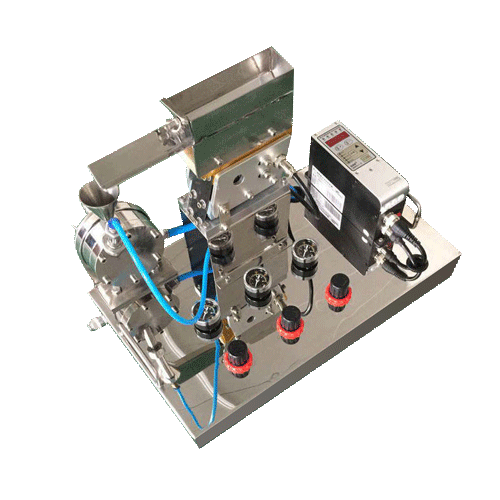
Micro Airflow Pulverizer: The Ultimate Lab-Scale Jet Mill for Fine Grinding

What is a Micro Airflow Pulverizer?
Have you ever needed to grind a tiny sample of powder down to a few microns, but worried about contamination from grinding media or heat damage? That's exactly where a micro airflow pulverizer (also called a lab air jet mill) shines. Think of it as a miniature tornado inside a chamber — it uses high-speed jets of compressed air or inert gas to smash particles against each other, reducing them to ultra-fine sizes without any moving parts touching the material.
At TENCAN (Changsha Tianchuang Powder Technology Co., Ltd.), we've designed our micro airflow pulverizer specifically for researchers who need consistent, repeatable, and contamination-free grinding for batch sizes as small as a few grams. It's the go-to tool for labs working on pharmaceuticals, advanced ceramics, battery materials, and even food ingredients.
How Does It Work?
The principle is surprisingly simple, yet incredibly effective. Compressed air (or nitrogen, argon, etc.) is injected through specially designed nozzles into the grinding chamber. The gas expands rapidly, creating sonic or supersonic velocities. The feed material — typically particles under 0.5 mm — is introduced into this high-speed gas stream.
Particles are accelerated and collide with each other at high relative speeds. The impact forces fracture them into finer fragments. Because the grinding action is purely particle-on-particle, there's no wear from grinding media, no metal contamination, and the process generates very little heat. A classifier wheel at the top of the chamber can be used to control the maximum particle size, ensuring a tight distribution.
Key Advantages of Jet Milling
- No contamination: No balls, beads, or other grinding media to wear out.
- Low temperature: The expanding gas cools the chamber, making it ideal for heat-sensitive materials like pharmaceuticals or waxes.
- Ultra-fine particle size: Achievable down to D50 < 5 µm, and even sub-micron with multiple passes.
- Narrow size distribution: The integrated classifier ensures consistent results.
- Safe for reactive materials: Use inert gas to prevent oxidation or explosion.
Micro Airflow Pulverizer vs. Ball Mill: Which One Should You Choose?
You might be familiar with planetary ball mills — they are fantastic for many applications. But when you need ultra-fine particles (below 10 µm) and absolutely cannot tolerate any contamination from grinding media, the micro airflow pulverizer is the better choice. Here's a quick comparison:
| Feature | Micro Airflow Pulverizer | Planetary Ball Mill |
|---|---|---|
| Grinding mechanism | Particle-particle impact via gas jets | Impact and friction from balls |
| Contamination risk | Virtually none | Possible from ball/liner wear |
| Heat generation | Low (gas expansion cools) | Moderate to high |
| Minimum particle size | D50 < 5 µm typical | D50 ~ 1 µm (with very long milling) |
| Sample throughput | Grams to a few hundred grams | Grams to kilograms |
So, for tasks like grinding active pharmaceutical ingredients (APIs) or preparing ultra-pure battery cathode powders, the micro airflow pulverizer is often the preferred tool.
Applications Where It Excels
The micro airflow pulverizer from TENCAN is used in a wide range of industries:
- Pharmaceuticals: Grinding drugs to enhance bioavailability, dry powder inhalation formulations.
- Advanced Ceramics: Producing fine powders for electronic ceramics, solid oxide fuel cells.
- Battery Materials: Preparing electrode materials like LiFePO₄, NMC, and solid electrolytes.
- Pigments & Dyes: Achieving consistent color strength and dispersion.
- Food & Nutraceuticals: Fine grinding of spices, herbs, and functional ingredients.
- Minerals & Metals: Ultra-fine grinding of talc, graphite, mica, and soft metals.
Key Technical Parameters to Consider
When selecting a micro airflow pulverizer for your lab, you'll want to look at these specs:
- Feed particle size: Typically ≤ 0.5 mm (larger particles may need pre-crushing).
- Final particle size: D50 can be as low as 1–10 µm, with some models capable of 0.5 µm.
- Throughput: Lab models handle 5–200 g per batch or continuous feeding up to 1 kg/h.
- Gas consumption: Usually 1–6 m³/h at 6–8 bar pressure.
- Inert gas capability: Essential for oxygen-sensitive materials.
- Cleaning ease: Look for easy disassembly and smooth surfaces to avoid cross-contamination.
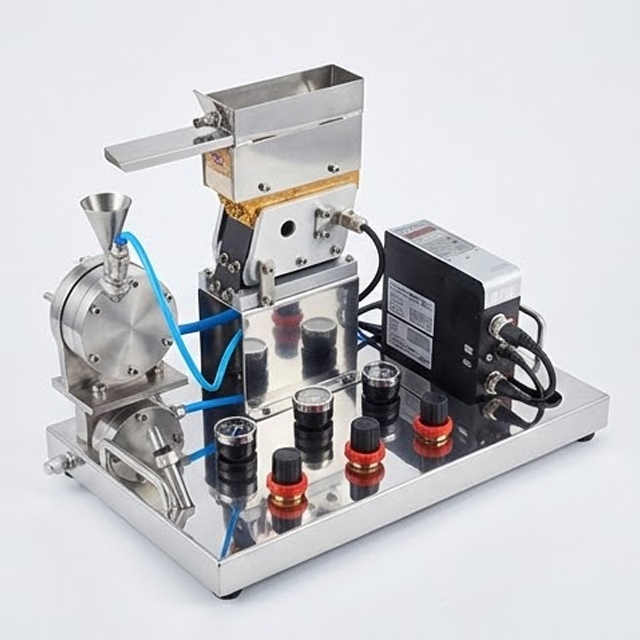
Our TENCAN micro airflow pulverizer is designed with these parameters in mind, offering a compact footprint and user-friendly operation. You can explore the full details on the product page.
Tips for Getting the Best Results
To make your micro airflow pulverizer work its magic, keep these tips in mind:
- Pre-dry your material: Moisture can cause clogging or agglomeration. A simple drying step at 60–80°C often helps.
- Use the right gas pressure: Higher pressure gives finer particles but uses more gas. Start at 6 bar and adjust.
- Optimize feed rate: Too fast and you'll overload the chamber; too slow and you waste energy. Find the sweet spot.
- Check the classifier speed: If your model has an integrated classifier, adjusting the rotor speed controls the cut point.
- Clean thoroughly between batches: Especially important when switching materials to avoid cross-contamination.
Why Choose TENCAN's Micro Airflow Pulverizer?
At TENCAN, we've been building powder processing equipment for over a decade. Our micro airflow pulverizer is a result of feedback from hundreds of labs worldwide. Here's what sets it apart:
- All stainless steel construction for durability and easy cleaning.
- Compact design that fits on a standard lab bench.
- Interchangeable nozzles to adjust grinding intensity.
- Optional inert gas kit for handling reactive materials.
- Quick-release clamps for fast disassembly and cleaning.
Whether you're developing a new formulation or scaling up a process, the micro airflow pulverizer is a reliable partner. And if you ever need help, our team is just a message away.
Parting Thoughts
The micro airflow pulverizer is a brilliant example of how a simple idea — using air to smash particles — can solve some of the toughest grinding challenges in modern materials science. Its contamination-free, low-temperature, and ultra-fine capabilities make it indispensable for labs that demand the highest quality powders.
If you're curious about how it could fit into your workflow, I encourage you to check out the product page or reach out to us. We love talking about powder! 😊
Related Products
Get In Touch
Our professional team will reply to you within one business day. Please feel free to contact us!