
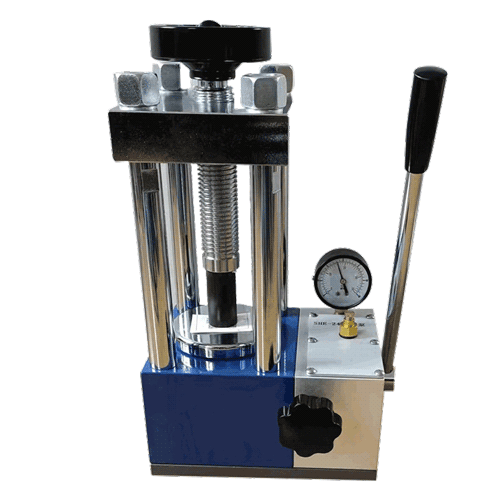
Manual Tablet Press: A Complete Guide to Manual Pressing for Powder Compaction

Have you ever found yourself staring at a pile of fine powder, wondering how to turn it into a solid, uniform tablet or pellet without investing in a massive, expensive automatic machine? If you're working in a lab, a small-scale production facility, or even a university research department, a manual tablet press might be exactly what you need. It's simple, reliable, and surprisingly versatile.
In this guide, we'll walk through everything you need to know about manual tablet presses: what they are, how they work, who uses them, and why a unit from 长沙天创粉末技术有限公司 (TENCAN) deserves your attention. Let's dive in.
What Is a Manual Tablet Press?
A manual tablet press is a desktop-sized device that uses hand-operated leverage to compress powder into a solid tablet or pellet. You control the pressure by turning a handle or lever, which pushes a punch into a die cavity filled with your material. It's the most straightforward way to form a compact from powder – no electricity, no hydraulics, just pure mechanical advantage.
Think of it like a heavy-duty garlic press, but for scientific or industrial materials. You load the powder, apply force, and – pop – out comes a perfect tablet. Simple, right?
How Does It Work?
Let's break down the operation step by step. The heart of a manual tablet press is a die – a cylindrical hole in a steel block. The die sits on a base, and a punch (a precisely fitting rod) enters from the top.
- Fill the die: You place the die on the base, pour your powder into the cavity, and level it off.
- Insert the top punch: Place the upper punch into the die, on top of the powder.
- Apply pressure: Turn the handle or lever. The mechanism pushes the upper punch down, compressing the powder between the two punches.
- Eject the tablet: Release the pressure, lift the upper punch, and then push the lower punch (or use the ejection lever) to pop the tablet out.
That's it. The whole process takes seconds. And because you control the force manually, you can feel exactly how the powder behaves – a real advantage for material development.
Key Features of a Well-Designed Manual Tablet Press
Not all manual presses are created equal. When you're choosing one, pay attention to these features:
1. Sturdy Frame and High Leverage
You need enough mechanical advantage to generate real pressure. A good press multiplies your hand force by 20x or more. TENCAN's manual press, for example, is built with a solid steel frame and a long lever arm, so you can achieve up to 20 tons of pressure with moderate effort.
2. Interchangeable Die Sets
One press should work with multiple die sizes. Common diameters range from 5 mm to 40 mm or more. This flexibility lets you make tablets of different sizes for different experiments.
3. Pressure Gauge (Optional but Very Useful)
Some manual presses come with a built-in pressure gauge or a load cell that lets you see exactly how much force you're applying. This is crucial for repeatable results. If you're pressing a material that needs 5 tons every time, you want to know you're hitting that mark.
4. Quick-Release Mechanism for Ejection
Ejecting the tablet should be easy. A good design has a separate ejection lever or a reversible lower punch that lets you push the tablet out without damaging it.
5. Safety Features
Manual presses can generate serious force. Look for a press with a safety guard that prevents accidental contact with moving parts. A stable base also prevents tipping.
Who Uses a Manual Tablet Press?
You might be surprised by the range of applications. Here are some typical users:
- Chemical and pharmaceutical R&D labs: Testing new formulations, creating small batches of drug tablets, or making placebo tablets for trials.
- Materials science researchers: Compressing powders for X-ray fluorescence (XRF) analysis, making pellets for spectroscopy, or preparing samples for mechanical testing.
- Small-scale production: Craft breweries making hop pellets, herbal supplement manufacturers, or specialty chemical companies producing small quantities of a product.
- Educational institutions: Teaching students about powder compaction, tablet properties, and process control.
- Geology and mineralogy: Pressing soil or rock powder into pellets for analysis.
In short, anyone who needs a few tablets at a time, with high control over the process, will find a manual press invaluable.
Manual vs. Automatic Electric Tablet Press: Which One Do You Need?
This is a common dilemma. Let's clear it up.
A automatic electric tablet press is a motorized machine that can produce hundreds of tablets per hour with consistent pressure. It's perfect for production runs of more than a few hundred tablets. But it's also larger, more expensive, and requires electricity.
A manual tablet press, on the other hand, is:
- Cheaper: Typically a fraction of the cost of an automatic press.
- Portable: No electricity needed – take it anywhere.
- Quiet: No motor noise.
- Hands-on: You feel the compaction curve, which helps in formulation development.
- Low maintenance: Fewer moving parts, less to break.
If you're making fewer than 100 tablets per day, or if you need to test different formulations frequently, a manual press is the smarter choice. If you need high volume, go automatic.
Why Choose TENCAN's Manual Tablet Press?
At 长沙天创粉末技术有限公司 (TENCAN), we've been in the powder equipment business for years. We understand that a manual press has to be built to last, with precision machining and practical design. Here's what sets our press apart:
- Heavy-duty construction: Our frame is made from thick steel plate, welded and machined for rigidity. No flex, no wobble, even at 20 tons.
- High-quality tool steel dies: Hardened and ground to tight tolerances for smooth operation and long life.
- Easy die change: Our quick-release system lets you swap dies in seconds.
- Optional pressure gauge: Get precise feedback on your compaction force.
- Compact footprint: Fits on any lab bench.
You can see the full details on our Manual Tablet Press product page.
Practical Tips for Getting Great Tablets
Making good tablets isn't just about the press. Here are a few tips from our experience:
- Use a consistent fill weight: Weigh or measure your powder accurately. The amount of powder determines the tablet thickness and density.
- Consider adding a binder: If your powder is brittle or doesn't stick together, add a small amount of binder (like starch or microcrystalline cellulose).
- Apply pressure slowly: A sudden, jerky force can cause capping or lamination. Apply steady, increasing pressure.
- Clean the die regularly: Powder residue can build up and cause sticking. A quick wipe with a dry cloth between runs helps.
- Experiment with dwell time: Holding the pressure for a few seconds (dwell time) can improve tablet strength.
Common Questions About Manual Tablet Presses
Q: Can I press metal powders?
Yes, but you'll need a very strong press and hardened dies. Some metal powders require high pressure (over 10 tons) and may need a lubricant to prevent sticking.
Q: How do I clean the dies?
Use a soft brush and a dry cloth. Avoid water or solvents that could corrode the steel. For stubborn residues, you can use a bit of ethanol or isopropyl alcohol.
Q: What's the maximum tablet size?
It depends on the die set. Most manual presses accept dies from 2 mm to 50 mm in diameter. The thickness is limited by the die depth – usually 10–20 mm.
Q: Is it safe for a beginner?
Absolutely. Just follow the instructions: keep your fingers away from the die area, and never exceed the rated maximum pressure. Start with low force and work your way up.
Conclusion
A manual tablet press is a workhorse of the powder processing world. It's affordable, reliable, and gives you total control over your compaction process. Whether you're a researcher, a small-scale manufacturer, or a student, having one on your bench opens up a world of possibilities.
If you're looking for a manual tablet press that's built to last, check out TENCAN's offering. We've designed it with real-world use in mind, and we're always happy to answer your questions. Feel free to explore our sitemap to see our full range of powder equipment.
Happy pressing!
Related Products
Get In Touch
Our professional team will reply to you within one business day. Please feel free to contact us!