
3D Powder Blender: How It Works

Powder looks simple from the outside. You pour it, you shake the container, you look through the lid, and everything seems uniform. Then you pull a sample from the top of the drum and another from the bottom, run them through your assay, and the numbers do not match. That gap between “looks mixed” and “is mixed” is exactly the problem a 3D powder blender was designed to close.
If you work with fine chemicals, battery materials, ceramics, food powders, pigments or metal powders, you already know that blending is the step that gets the least attention until it goes wrong. And when it goes wrong, it goes wrong quietly. The batch is already packed, already sampled, already shipped. No amount of downstream processing will fix a segregation problem that started inside the blender.
So let’s walk through the whole picture: what a 3D powder blender actually is, why the motion matters, where it shines, where it stops, and how to set it up so your assay results match your expectations. Any technical term we use, we’ll explain right after we use it.
What Is a 3D Powder Blender?
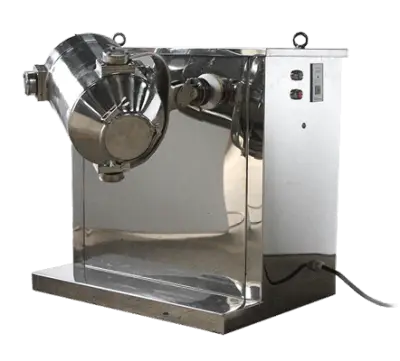
A 3D powder blender is a rotary drum mixer that moves its container along more than one axis at the same time. Instead of spinning around one fixed horizontal shaft the way a V-blender or a double-cone blender does, the drum tilts, tumbles and rolls through a compound path. The powder inside gets lifted, dropped, folded and re-folded from a slightly different direction on every pass.
The word “3D” here has nothing to do with 3D printing or a computer model. It describes the three-dimensional trajectory of the material inside the drum. The drum itself is typically asymmetric rather than a perfect cylinder, so the powder never settles into one predictable circular track. That is the entire point. A predictable track is what creates dead zones, and dead zones are where your unmixed pockets live.
Where does this machine fit? Batch blending of dry powders and granules, especially when you want a gentle, low-shear mix, low contamination risk and a drum that is easy to clean between products. Heat-sensitive and shear-sensitive materials tend to do well, because most of the energy going into the powder is gravity rather than a fast-spinning blade grinding against the particles.
Where does it not fit? Slurries, pastes and continuous processes. If your material flows like toothpaste, or your line runs nonstop for days, this is the wrong equipment family. We’ll come back to that distinction later, because mixing it up costs people a lot of money.
Why the Motion Matters: Tumbling, Shear and Diffusion
Mixing powder is a fight against two things: gravity, which wants to pull dense particles down, and segregation, which wants to undo whatever you just achieved. When we say a blender “works,” we really mean three physical mechanisms are happening inside the drum at the same time.
Tumbling: Gravity Does the Heavy Lifting
As the drum rotates, friction from the wall drags the powder bed upward. The bed keeps rising until it can’t hold its shape anymore, then it collapses in an avalanche. In plain terms: the powder climbs the wall like sand on a dune, then slides down in a wave. Every avalanche pulls material from the surface down into the core and pushes core material back to the surface.
This is the bulk of your mixing, and it’s why tumble blenders are so effective on free-flowing powders. It’s also why speed matters so much. Too slow and the bed barely moves. Too fast and the powder sticks to the wall instead of avalanching, which stops the mixing entirely.
Diffusion and Shear: The Fine-Scale Work
Diffusion sounds fancy, but it just means individual particles drifting through the gaps between their neighbours. It’s slow — painfully slow on its own — but it’s the mechanism that fixes the last few percent of uniformity, the part that shows up in your assay.
Shear is layers of powder sliding across each other. High-shear mixers use blades to force this. A tumbler gets it more gently, from the way the bed folds over itself. Gentle is good news for fragile granules, flakes and crystals, which can shatter or dust up under an aggressive impeller.
Why Changing Direction Beats Spinning in a Circle
Here’s the practical difference. In a single-axis tumbler, the powder repeats the same flow pattern over and over. Whatever region that pattern misses, it keeps missing. In a 3D powder blender, the container’s orientation keeps changing relative to gravity, so the powder bed is constantly re-oriented. Material that was sitting at the “bottom” a moment ago is now on the “side,” and the flow pattern never stabilises long enough to leave a permanent dead zone.
The result is usually a shorter blending time for the same uniformity target, and less of the stratification that builds up when powder flows in one direction for too long.
Inside the Drum: What Actually Decides Your Blend
The machine sets the motion. Your powder decides the outcome. These four variables explain most of the blending problems we see in real production.
Particle Size and Density: The Segregation Engine
When two powders differ in particle size, the smaller particles sift downward through the gaps between the larger ones. Engineers call this percolation. When they differ in density, the heavier particles sink and the lighter ones float to the top. Both effects are the opposite of mixing.
So the honest rule is this: you are not trying to make segregation impossible, you are trying to make your blend good enough before segregation wins. If your two ingredients differ wildly in size or density, expect to blend longer and to sample more carefully.
Fill Level
Fill level is the single most underrated setting in powder blending. Load the drum too lightly and there isn’t enough inter-particle contact — the powder just sloshes around. Load it too full and there’s no headspace for the avalanche, so the bed rotates as one solid mass and barely mixes at all.
Most operators land in a comfortable middle range where there’s clearly space for the bed to roll over itself. Always ask a supplier for the working volume, not the total volume. A drum rated at a given size is almost never run at that size.
Rotation Speed
Speed controls which mechanism dominates. At low speed you get gentle avalanching and very little shear — great for fragile material, slow for uniformity. As speed rises, the bed becomes more active and blending time drops. Push it too far and the powder is pinned to the wall by centrifugal force, which looks dramatic and mixes nothing.
That ceiling is usually called the critical speed. You want to stay comfortably below it, and the ideal value depends on drum diameter, so the same RPM setting means different things on different machines. Think in terms of the motion you observe, not just the number on the display.
Blending Time
More time is not always better. For free-flowing powders, over-blending can actually make uniformity worse, because the longer the bed keeps moving, the more time segregation has to pull it apart again. The right answer is a measured one: blend, sample from several positions, plot the results, and find the point where uniformity stops improving. That point is your process time.
What a 3D Powder Blender Does Well — and Where It Stops
Let’s be specific about strengths, because “good at mixing” is not a specification.
- Gentle handling. Low shear means granules, agglomerates and flake materials keep their shape instead of turning into fines.
- Low dust exposure. A closed drum with a sealed lid keeps fine powders contained during the run, which matters for both operator safety and product loss.
- Easy cleaning and changeover. Fewer internal parts and no shaft-mounted blades means fewer places for residue to hide.
- No dead zones from a fixed flow pattern. The changing direction of motion keeps re-mixing regions that a single-axis tumbler would leave alone.
- Predictable scale-up path. Because the mixing mechanism is geometric rather than blade-driven, larger drums follow the same logic as small ones.
And the limits, stated just as plainly:
- Not for liquids or pastes. If it flows, this is the wrong machine.
- Poor at dispersing liquid binders. Adding a spray of binder into a tumbling bed is possible, but getting it evenly distributed is much harder than in a high-shear mixer.
- Batch only. There’s no version of this that runs continuously without a fundamentally different design.
- Sticky or very cohesive powders. If your material clumps and sticks to stainless steel, it will clump and stick to the drum wall too.
Powder Blending vs Liquid Stirring: Pick the Right Tool
A large share of the questions we get mix up two completely different jobs. Blending dry powder and stirring a liquid are governed by different physics. Dry powder moves under gravity, friction and air; a liquid moves under viscous drag and turbulence. The hardware looks vaguely similar from across the room and behaves nothing alike.
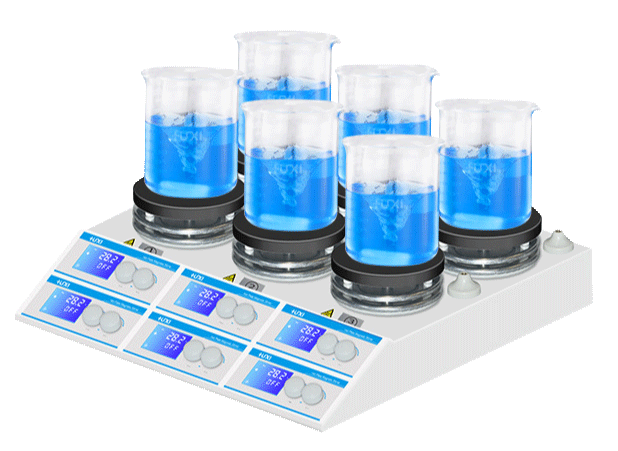
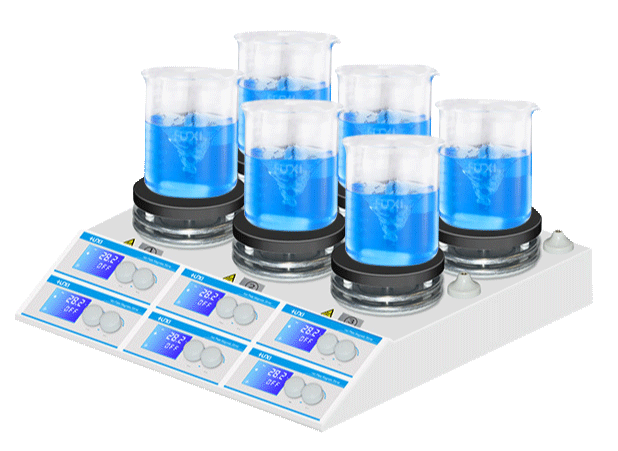
If your sample is a liquid or a slurry in a beaker — a binder solution, a suspension, a dissolved precursor — a magnetic stirrer is the right instrument. For labs that need several samples running at the same time, the Multi station magnetic stirrer covers multiple positions in one unit, which is far more practical than lining up a row of single-position stirrers on the bench. It’s a genuinely useful companion piece when you’re preparing binder solutions or digesting blended powder samples before analysis.
But if the question is “are my dry ingredients evenly distributed?”, no stirrer will answer it. Stirring a powder with a bar just pushes it around. You need a real blender, plus a sampling plan that proves the result.
The Parameters Worth Checking Before You Buy
Spec sheets all look similar. These are the items that actually separate a machine that works for you from one that frustrates you for years.
Working Volume and Fill Ratio
Ask for working volume first. Total drum volume is a geometric fact; working volume is what you can realistically blend in it. Once you know that number, decide your fill ratio and lock it into the process, because changing fill ratio between the lab and production is one of the most common reasons a formula “stops working” after scale-up.
Speed Control and Repeatability
Variable speed is not a luxury, it’s how you tune the machine to the material. But the more important feature is repeatability: can you set a speed and a time and get the same motion on batch one and batch five hundred? Digital setpoints, a timer and a stable drive make your process documentable. Documentable processes pass audits.
Drum Geometry and Material of Construction
For general industrial powders, stainless steel is the default. For metal-sensitive products, or where wear and contamination are a concern, an internal lining or a different drum material may be the better choice. Look at the internal finish too. Polished surfaces shed powder; rough welds trap it.
Discharge, Sealing and Dust Control
How do you empty the drum without creating a dust cloud in the room? Butterfly valves, slide gates and drum-in-drum designs all exist for exactly this reason. If your powder is flammable, static grounding and correct electrical protection are not optional extras — they are part of the process safety case.
When Your Blend Still Fails: A Troubleshooting Shortlist
“It looks mixed, but the assay disagrees”
Almost always a sampling problem or a segregation problem, not a machine problem. Check where you sample from. A scoop from the top surface tells you nothing about the middle of the bed. Take multiple samples, take them from different depths and positions, and take them after the powder has settled rather than during discharge.
“Fine powder cakes on the drum wall”
That’s usually moisture, static or both. Powders with even a little surface moisture become cohesive and start sticking. Dry the feed material, control the humidity in the room, and consider whether the powder is picking up charge as it tumbles. Anti-static measures and correct grounding often solve the sticky-wall problem on their own.
“Great in the lab, bad in production”
This is the classic scale-up trap. The usual culprits are a changed fill ratio and a changed effective speed. If the production drum runs at the same RPM but a much larger diameter, the powder experiences a different force regime entirely. Match the motion, not the number.
Scaling Up Without Surprises
Scale-up in powder blending is not a simple multiply. You can’t assume a blend that takes ten minutes in a small drum will take ten minutes in a big one, any more than a small cake and a large cake bake in the same time.
Three things help. First, keep the fill ratio the same as the validated lab process. Second, match the dynamic behaviour of the bed — the way it avalanches and folds — rather than just copying a rotational speed. Third, and most importantly, verify with a tracer study. Put a small amount of a detectable marker into the batch, blend, sample at multiple points, and measure the distribution. That data is what turns a guess into a validated process.
If you can only remember one thing from this section: production blending times are usually longer than lab times, not equal, and you should never sign off a scale-up based on a visual inspection.
Cleaning, Changeover and Cross-Contamination
In food, pharmaceutical and fine chemical production, the blender is often the biggest cross-contamination risk in the plant, simply because it touches every ingredient.
Design helps more than discipline here. A drum with smooth internal surfaces, minimal crevices and a removable or swappable container cleans far faster than one with internal baffles and welded seams. Dedicated drums per product are a common solution in multi-product plants — the mixing drive stays, the drum changes.
Then validate it. Swab testing after cleaning is the only honest way to know whether your procedure actually works, and it should be done on the hardest-to-reach spots: the discharge valve, the lid seal and the corners. If you can’t reach it with a cleaning tool, you can’t verify it either.
Maintenance itself is modest. Check seals, check the drive, confirm the drum rotates freely and that the motion still matches the original setting. A blender that has slowly drifted out of alignment can quietly change its mixing behaviour without anyone noticing.
Questions We Get Asked a Lot
Is a 3D powder blender the same as a tumble blender?
It’s a type of tumble blender, yes — but the multi-axis motion is what separates it from single-axis designs like V-blenders and double-cone blenders. The family relationship is real; the performance difference comes from how many directions the drum moves through.
How long should one batch blend?
There’s no universal number, because it depends on your fill level, speed, particle sizes and how uniform you need to be. The honest answer is that you should determine it experimentally, with samples, and then record it as part of the process. Guessing produces batches that pass on Tuesday and fail on Friday.
Can it handle powders with very different densities?
It can blend them, but it cannot stop them from segregating once mixing stops. With strongly mismatched materials, keep the blended powder from moving unnecessarily after discharge, and avoid long drops and vibration between the blender and the next process step.
Do I need an inert atmosphere or vacuum capability?
That depends on the material. Reactive metal powders, oxygen-sensitive chemicals and flammable dusts often need an inert gas blanket. It’s worth deciding this before you buy, because retrofitting gas connections and sealing is more expensive than specifying them from the start.
What’s the difference between this and a ribbon blender?
A ribbon blender uses an internal agitator to push and fold the powder. It’s fast and handles cohesive material better, but it adds shear, heat and cleaning complexity. A 3D powder blender moves the whole container instead, which is gentler, cleaner and generally easier to validate — at the cost of some blending speed.
Where This Leaves You
A 3D powder blender is not a magic box. It’s a well-understood piece of geometry that uses gravity and changing direction to fold powder over itself, again and again, until the differences between samples become small enough to pass your specification.
Get the fundamentals right — a sensible fill level, a speed that lets the bed avalanche, a time you have actually measured, and a sampling plan you trust — and the machine will do exactly what you expect, batch after batch. Skip those steps and even the best-built blender in the world will hand you a batch that looks perfect and assays badly.
Start with your powder, not with the brochure. The powder always decides.
Related Products
Get In Touch
Our professional team will reply to you within one business day. Please feel free to contact us!