
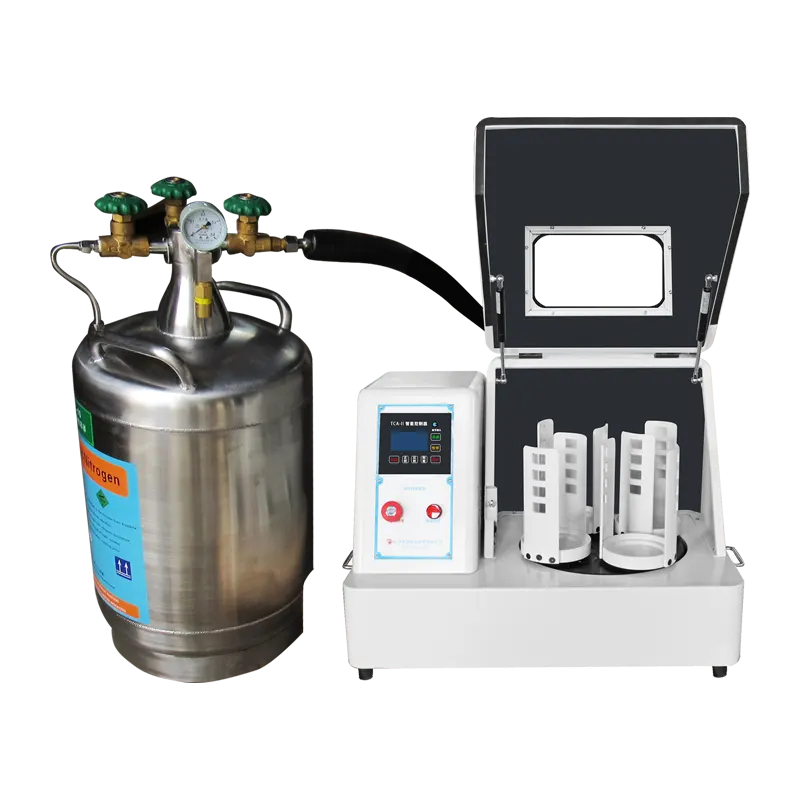
Liquid Nitrogen Planetary Ball Mill: Cryogenic Grinding Without the Guesswork

You can spend a lot of time tuning a ball mill and still end up with a sample that smears, oxidizes, or loses the very thing you wanted to measure. Often the culprit isn’t the jar, the balls, or the recipe. It’s heat. A liquid nitrogen planetary ball mill exists to solve that problem, and once you understand how it works, the whole process becomes much less mysterious.
This guide is for people who need to grind difficult, heat-sensitive materials without turning the sample into a different material. We’ll look at the principle, the practical setup, the mistakes that waste time, and the questions worth asking before you buy. No magic, no hand-waving—just the cold, useful details.
Why Heat Quietly Ruins a Good Milling Run
In a planetary ball mill, energy enters the powder through impact and friction. That energy does the grinding work, but it also turns into heat. With a heat-sensitive sample, the rise can be enough to soften a polymer, degrade a pharmaceutical, oxidize a metal powder, or drive off a volatile component. The mill may look calm on the outside while the inside is cooking.
Heat also changes the way particles behave. Sticky samples coat the jar and the balls, so the grinding media stop doing their job. Fine particles may re-agglomerate as soon as they form. A powder that should flow freely can turn into a paste. Those are not small inconveniences; they can make a result impossible to reproduce.
Cryogenic grinding interrupts that chain. By keeping the sample cold and brittle, it reduces plastic deformation and helps fractures run cleanly. The goal is not to freeze everything for its own sake. The goal is to protect the material long enough to reduce it predictably.
The effect is easy to underestimate because a jar can feel only slightly warm on the outside while the powder inside is much hotter. Heat builds at particle contacts, and those tiny hot spots are exactly where reactions and softening begin. By the time the sample looks wrong, the damage is already done.
What a Liquid Nitrogen Planetary Ball Mill Actually Does
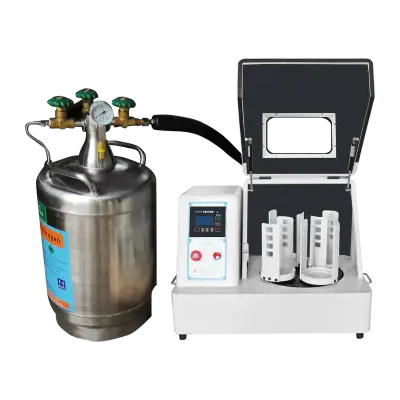
The name tells you most of the story. It is a planetary ball mill with a cryogenic system that uses liquid nitrogen to keep the grinding jars cold. You load the sample and the grinding balls into a jar, the jar spins around a central axis while also rotating in the opposite direction, and the balls collide with the powder. The cold environment keeps those collisions from overheating the material. If you want to see the actual configuration, the Liquid Nitrogen Planetary Ball Mill page is the place to start.
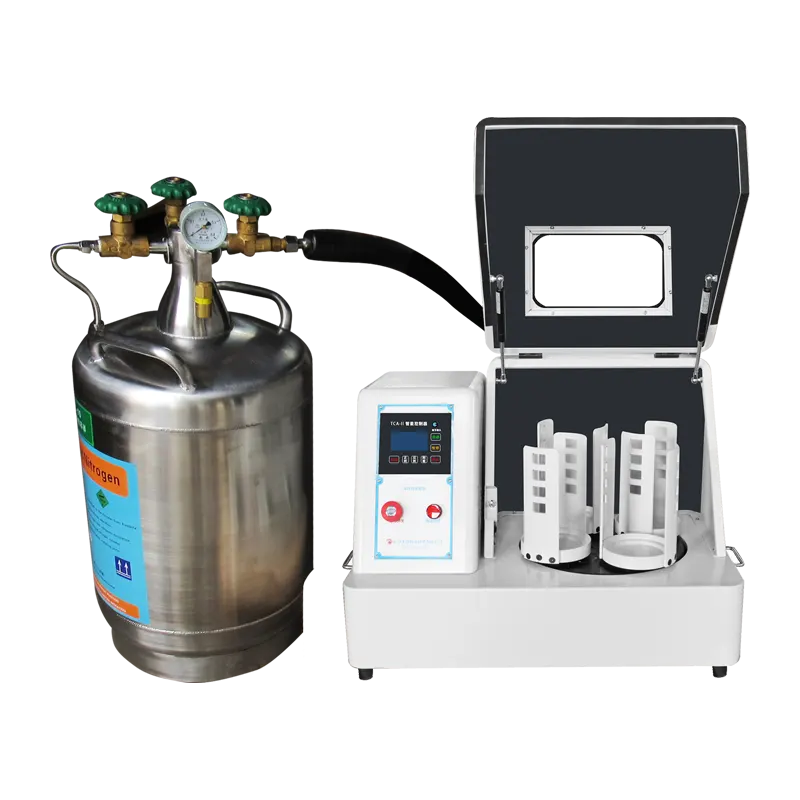
The planetary motion is the engine of the process. Because the jar rotates around its own axis and around the main axis, the balls are pushed against the wall, lifted, and then released. The result is a mix of high-energy impacts and rubbing. That combination is excellent for fine comminution, mechanical alloying, and mixing, but it is also why temperature control matters so much.
Cold also changes the mechanical behavior of the charge. Many materials that are ductile at room temperature become glassy and brittle when chilled, so they fracture instead of flattening. That shift is the practical reason cryogenic milling works: you are not grinding a soft material harder; you are temporarily changing how it responds to impact.
Liquid nitrogen is the temperature-control side of the machine. It is extremely cold, inert, and it boils away without leaving a residue, which is why it suits this job. The mill does not simply pour nitrogen over the sample and hope for the best; the cooling system is designed to remove heat from the jars and hold the process in a useful low-temperature range.
The word “planetary” is not decoration. It describes a geometry that creates a useful balance of impact and shear, and it is the reason these mills can reach fine sizes in a reasonable time. The cryogenic part does not replace that geometry; it protects the material while the geometry does its work.
Cryogenic Cooling Is a System, Not a Splash of Cold
It is tempting to imagine cryogenic milling as a quick blast of cold before grinding. In practice, that approach is unreliable. The jar, the balls, and the sample all have to be brought down to temperature, and the mill has to deal with heat generated during the run. If cooling starts too late, the first minutes of grinding can already change the sample.
A well-designed setup treats pre-cooling, continuous cooling, insulation, and safe venting as one system. The exact layout depends on the mill and the jar arrangement, so use the manufacturer’s instructions rather than improvising. The important idea is simple: the sample should enter the grinding zone already cold, and it should stay cold while the balls are working.
What Cryogenic Milling Is Good For
Cryogenic grinding earns its keep when heat is the limiting factor. Polymers, rubbers, waxes, resins, and other soft or sticky materials often mill much more cleanly when they are brittle. Heat-sensitive food ingredients, natural products, and pharmaceutical intermediates can also benefit when the goal is to preserve the material rather than cook it.
It is useful in materials research too. Mixed powders, composites, and brittle ceramics can be reduced without the same risk of thermal damage. In sample preparation for analysis, a cold grind can make it easier to get a representative powder from a material that would otherwise smear across the jar. The method is not a universal answer, but it solves a very specific family of problems.
The flip side is that cryogenic milling adds cost, handling, and complexity. If your material is already brittle and insensitive to heat, a standard planetary ball mill may be the more efficient choice. The right question is not “Can we use liquid nitrogen?” but “Does this sample actually need it?”
Think about the analysis you plan to run, too. A cryogenic grind may produce a different particle-size distribution or surface state than an ambient grind, and that can affect the next step. If the powder is going into a sensitive instrument or a reactive environment, test a small batch first and confirm that the cold process has not introduced an unwanted change.
Biological and environmental samples are another good fit when the goal is to preserve volatile compounds or avoid thermal degradation. Soils, sediments, plant tissue, and some food matrices can be prepared at low temperature with less risk of changing the chemistry during grinding. This is preparation, not a guarantee: the sample still has to be compatible with the jar, the media, and the cold.
Jars and Balls: Choose for Cold, Not Just Hardness
Once you decide to go cold, the grinding jar deserves more attention than usual. The jar material has to tolerate low temperature without cracking, and it has to be hard enough not to contaminate the sample. Stainless steel, zirconia, agate, and tungsten carbide are common choices for different reasons; each has trade-offs in wear resistance, cost, and contamination risk.
Ball selection matters just as much. Dense balls carry more impact energy, while smaller balls create more contact points and more rubbing. A mix of sizes can improve packing and help the powder move through the charge. But more balls are not automatically better: an overfilled jar can choke the motion, raise friction, and make temperature control harder.
Loading the jar is a small step that causes big problems when rushed. Keep the sample and media proportions sensible, leave enough free space for movement, and make sure the lid and seals are compatible with the cold. If a jar is designed for ambient grinding only, do not assume it will behave the same way at cryogenic temperature.
One more detail: cold makes some materials more abrasive. A jar that survives a gentle ambient run may show faster wear under cryogenic conditions, especially if the powder is hard and the energy input is high. Inspect the jar and balls regularly, and replace worn parts before contamination becomes part of your result.
Ask yourself what contamination is acceptable. A hard, wear-resistant jar is not automatically the best choice if it introduces an element you cannot tolerate in the analysis. At the same time, a very soft jar may shed material quickly under cold, abrasive conditions. Match the jar to the chemistry of the sample and the sensitivity of the measurement, not just to the Mohs scale.
Setting Up a Run That Behaves
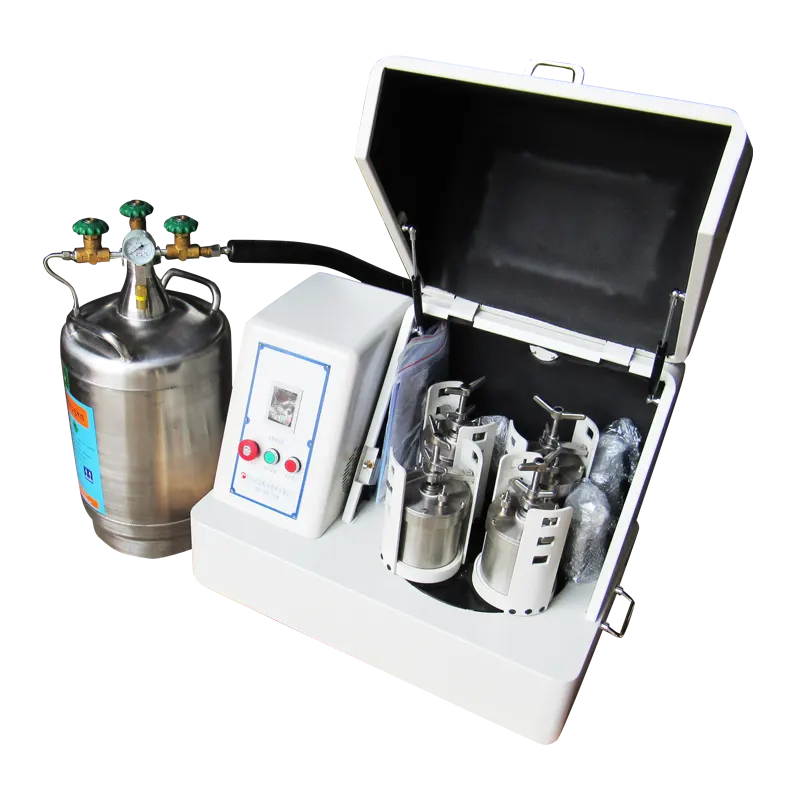
A reliable cryogenic run is mostly about sequencing. Get the cold right before you ask the mill to do heavy work, then give the material time to warm in a controlled way after the run. Skipping either end of that sequence can undo the good work in the middle. The following flow is a practical way to think about it.
Pre-Cool the Jar and the Grinding Media
Start with a cold jar and cold media, not just a cold sample. Pre-cooling the whole grinding assembly removes the sensible heat that would otherwise be absorbed by the powder in the first moments. Follow the mill maker’s procedure for the liquid nitrogen system, and give the jar enough time to reach a stable temperature before loading. Rushing this step is one of the most common reasons a first trial looks disappointing.
Load Quickly and Keep the Cold Chain
Work out your loading order before the jar gets cold. Have the sample ready, the balls counted, and the tools close at hand. Moisture is the quiet troublemaker here: frost, condensation, and damp powder can turn a free-flowing charge into a sticky mess. Keep containers closed, use dry tools, and do not leave an open jar sitting around while you look for a spatula.
Balance Speed, Time, and Heat
Higher speed and longer time both push more energy into the powder, and that means more heat to remove. A good starting strategy is to use the lowest energy that can produce the particle size you need, then adjust in small steps. Short grinding intervals with controlled cooling can be more effective than one long, hot run. Listen to the mill, watch the temperature, and change one variable at a time.
Pay attention to intervals as well as total time. A short grind followed by a pause gives the cooling system a chance to catch up, and it often produces a more uniform powder than a single long run. If the jar is clearly warming between intervals, fix the cooling before you increase the grinding time. More time on a warm sample is rarely an improvement.
Warm the Jar Safely Before Opening
When the run ends, the work is not over. Let the jar warm in a safe, controlled way, and keep it vented according to the manufacturer’s instructions. Opening a cold jar too quickly can draw in moist air, condense water on the sample, or create pressure issues if the jar is not designed for it. A little patience at this stage protects both the sample and the operator.
The Variables That Matter More Than a Recipe
Recipes are useful starting points, but they are not laws. The best settings depend on the sample’s hardness, toughness, particle size target, and sensitivity. They also depend on the jar volume, ball density, and how much material you need to process. A method that works for one gram may not scale directly to a larger batch, and that is normal.
Temperature is the variable people forget to watch. If the jar is not staying cold, the problem may be pre-cooling, loading time, jar fit, or too much grinding energy. If the sample is cold but the result is still poor, the issue may be ball size, fill level, or insufficient time. Treat temperature as a process variable, not a background detail.
Record what you do. Note the sample mass, jar type, ball charge, pre-cool time, grinding intervals, and any temperature observations. A simple log turns a lucky result into a repeatable method, and it helps you explain a failed run without guessing. In cryogenic milling, small details have a habit of becoming large effects.
Scale-up deserves its own test. A larger jar does not simply multiply the result of a small jar, because the ball motion, fill level, and heat removal all change. Start with a batch size that is representative but manageable, then adjust one factor at a time. If the larger run drifts, compare the temperature profile, not just the final particle size.
Safety Around Liquid Nitrogen Is Not a Footnote
Liquid nitrogen is a wonderful tool and a serious hazard. It can cause cold burns, and its vapor can displace oxygen in a closed room. Work in a ventilated area, use appropriate cryogenic gloves and eye protection, and never seal liquid nitrogen in a container that cannot vent. If your workplace requires an oxygen monitor or a written procedure, follow it.
The mill itself needs respect too. Keep the cryogenic components clean and dry, check seals and hoses for wear, and do not bypass interlocks or safety controls. A cold mill can develop frost on exposed parts, so keep walkways clear and label cold surfaces. Maintenance is not glamorous, but it is the difference between a reliable process and a surprise.
Training matters as much as equipment. Everyone who touches the liquid nitrogen system should know how to fill it, how to vent it, what to do if a jar fails, and where the emergency information is kept. A written routine may feel excessive until the day it prevents a bad incident. Treat cold equipment as a process hazard, not a convenience.
Common Problems and What They Usually Mean
If the powder sticks and smears, the sample may not have been cold enough at the start, or the grinding energy may be too high. If the jar frosts heavily but the powder still behaves warmly, check the contact between the jar and the cooling path. If the result is contaminated, look at jar and ball wear before blaming the sample.
Poor yield often comes back to fill level and ball charge. Too little material can cause excessive wear; too much can cushion the impacts and slow the grind. Pressure or venting problems deserve immediate attention, not a workaround. When something looks odd, stop, let the system warm safely, and inspect before running again.
If a run behaves differently from the last one, resist the urge to change three settings at once. Check the simple things first: the sample, the moisture, the jar condition, the ball charge, and the actual cooling time. Cryogenic milling is repeatable when the inputs are controlled, and frustrating when they are assumed.
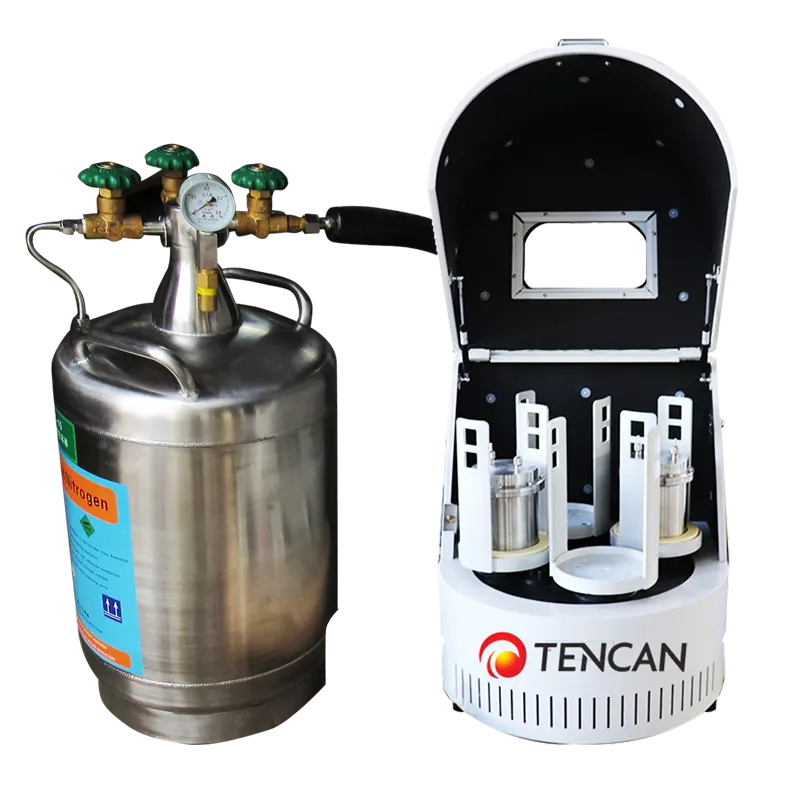
Why TENCAN’s Liquid Nitrogen Planetary Ball Mill Deserves a Look
When you need a cryogenic mill that fits a real lab workflow, TENCAN’s Liquid Nitrogen Planetary Ball Mill is worth a close look. The product page gives you the configuration details, available options, and the specifications that matter for your sample. More importantly, it gives you a starting point for a conversation about jars, media, safety, and throughput instead of a generic sales pitch.
Use the page as a checklist, not a brochure. Confirm the jar materials and volumes you need, ask how the cooling system is controlled, and make sure the safety and maintenance requirements fit your site. If you are comparing options, compare them on the same sample, the same target fineness, and the same realistic batch size. That is how you find out whether a mill is genuinely suitable.
Before you commit, write down the sample, the result you need, and the constraints you cannot bend. Then ask for a trial or a clear recommendation based on those facts. A good cryogenic mill should make your process more predictable, not more complicated. When the cold side is designed properly, the grinding side becomes easier to trust. Use it to narrow the shortlist, then test with your own material.
Related Products
Get In Touch
Our professional team will reply to you within one business day. Please feel free to contact us!