
Small Ball Mills for Sale Explained

Looking for small ball mills for sale and not entirely sure what you're shopping for? You're in good company. Most people who land on this topic are trying to solve one of two problems: they have a chunky material that needs to become a fine, uniform powder, or they already have powder and need it pressed into a solid, consistent tablet. Often it's both. A ball mill handles the first job, a tablet press handles the second, and those two decisions are far more connected than most buyers realise. So let's walk through what a small ball mill really is, how to judge one before you spend money, and where the milled powder usually goes next.
What a Small Ball Mill Actually Does
Strip away the marketing and a ball mill is a remarkably simple machine. You load your material into a rotating jar or cylinder. Along with it, you load a charge of hard balls. When the jar turns, those balls get lifted up the inner wall, then tumble, roll and drop back onto your material. Every impact chips particles apart; every rolling contact grinds the surfaces a little smoother. Repeat that a few hundred times a minute and coarse chunks slowly disappear.
Size reduction in a ball mill comes from two forces working together. Impact breaks bigger particles into smaller ones. Attrition rubs particles against each other and against the media, which is what tightens up the size distribution and pushes the fine end finer. Impact gets you from millimetres down to tens of microns. Attrition is what takes you from tens of microns to a few microns, or even below one micron with the right jar, media and time.
When people search for small ball mills for sale, "small" usually means one of two things. Sometimes it describes the machine itself — a bench-top unit you can slide onto a lab counter. Sometimes it describes the working volume, because a mill can be built like a tank and still only process a kilogram per batch. Both readings are valid, and you need to know which one matters for your project before you compare anything.
One naming quirk is worth clearing up early. "Ball mill" is the family name, not a single design. Inside that family you'll find drum mills, roller mills, vibratory mills and planetary ball mills, where jars spin around a central axis while also spinning on their own axis. That double rotation is where planetary mills get their energy, and it's why they're the default choice for fine grinding in a laboratory.
How the Grinding Actually Happens
Two mills with identical jar volumes can behave completely differently, and it almost always comes down to three variables: the media, the jar, and the rotational speed. Let's take them one at a time.
Grinding media: the part doing the real work
Media material matters more than most beginners expect. Stainless steel balls are tough and relatively inexpensive, and they hit hard, which makes them effective on hard, brittle minerals. Zirconia is denser than most ceramics and wears slowly, which makes it a popular middle ground. Agate is softer but chemically very clean, so it turns up in trace analysis work. Alumina is cheap and reasonably hard. Tungsten carbide is the heavy hitter: extremely dense, extremely wear-resistant, and priced accordingly.
Here's the trade-off in plain language. The harder and denser the media, the faster it grinds — and the more likely it is to shed a little of itself into your powder. If your batch is heading for a chemical assay, a few parts per million of steel contamination can ruin the run. If you're grinding cement clinker for a construction test, nobody will care. Match the media to what happens to the powder afterwards.
Media size is a balancing act as well. Bigger balls carry more energy per impact and chew through coarse feed faster. Smaller balls create more contact points and grind finer, but they struggle with chunky material. Experienced operators often run a mix: a few larger balls to break the feed down, plus plenty of small ones to finish the job.
The jar: container and potential contaminant
Jar material follows exactly the same logic, and in most mills the jar and the media should match. An agate jar filled with steel balls is a waste of a good agate jar, because the steel will still wear into your sample. Pair agate with agate, zirconia with zirconia, and so on.
Jar volume sets your realistic batch size. A useful rule of thumb is that media plus powder should fill roughly half the jar, leaving the rest as free space so the charge can tumble. Fill it to the brim and the balls just sit there. Fill it a quarter full and you're wasting capacity and time.
Speed, and the ceiling nobody mentions
Ball mills have a limit on useful speed, often called critical speed. Past that point, centrifugal force pins the media to the jar wall and they rotate with the jar instead of tumbling. Grinding effectively stops, even though the motor is working harder than ever. Good mills let you tune speed to suit the job; cheap ones run at one fixed speed and hope for the best.
Planetary mills sidestep part of this problem. Because the jar and the sun wheel rotate in opposite directions, the media get pushed into a high-energy tumbling pattern at much lower rotational speeds than a simple drum mill would need. That's the trick behind their fine-grinding reputation.
The Main Types of Small Mill You'll See for Sale
Before you compare specs, it helps to know which family you're actually shopping in. Each type has a personality, and picking the wrong one is the most expensive mistake in this whole process.
Planetary ball mills
Jars mounted on a rotating disc, spinning in the opposite direction to the disc itself. The result is high energy in a compact footprint, short grinding times, and the ability to reach very fine particle sizes. They're the standard tool for laboratory work where particle size really matters: ceramics, catalysts, battery materials, minerals, pigments and pharmaceutical powders. They also accept different jar materials easily, which makes switching between materials practical. The trade-off is that batch sizes stay modest.
Drum and roller mills
The classic design: a horizontal cylinder, sometimes resting on powered rollers that spin it from outside. Simple, durable, and happy to run for hours. They suit larger volumes and materials that don't need extreme fineness. If your target is a few tens of microns and your material isn't especially stubborn, a drum mill can be the practical, low-maintenance choice.
Vibratory mills
Instead of rotating, the jar shakes rapidly, which drives the media into the sample from many directions at once. Vibratory mills are quick on small samples and reach fine sizes fast, though they can be noisier and less gentle on heat-sensitive materials.
There's no universal winner here. Planetary mills win on fineness per minute. Drum mills win on simplicity and volume. Vibratory mills win on speed for small samples. Your material and your target particle size decide which trade-off you want.
What "Small" Really Means When You're Buying
Small mills live in a specific niche. They process grams to a few kilograms per batch, they fit on a bench or a small cart, and they run on ordinary single-phase power. What they give up in throughput, they make up for in flexibility. You can change jars in minutes, run a dozen different materials in a week, and dial in a recipe before committing to a larger machine.
Batch time is the number that surprises people most. A small planetary mill might need anywhere from a few minutes to several hours to reach a target particle size — and doubling your energy input does not halve your grinding time. Grinding gets less efficient as particles get smaller, because fine particles have an annoying habit of clumping back together. That's why a small mill run for a very long time can plateau instead of improving.
If you need continuous, high-volume output, a small batch mill is the wrong tool. If you need repeatability and control, it's very often exactly the right one.
Ball-to-Powder Ratio, Speed and Time: The Three Dials You Actually Control
Once a mill is in your lab, almost everything you can influence comes down to three settings. Understanding them turns guesswork into a process.
Ball-to-powder ratio
This is simply the weight of the media divided by the weight of your sample. A higher ratio means more grinding contacts per particle per revolution, which generally means faster size reduction and a finer result. Push it too far and you're loading the jar with media that has nothing to grind, wasting energy and jar space. Somewhere in the middle is usually the sweet spot, and it's worth testing a couple of ratios on your own material rather than trusting a number from a forum.
Rotational speed
More speed means more energy per impact — up to the critical speed limit. Higher speed also generates more heat, and heat changes some materials. If you're milling a polymer or a temperature-sensitive powder, a moderate speed with a longer run often beats maximum speed with a short one.
Grinding time
Time is the easiest dial to turn and the easiest to overuse. The first stretch of grinding does most of the work. After that, returns shrink quickly, and past a certain point you're mostly heating the sample and encouraging agglomeration. Run a few timed trials, measure the particle size, and find the point where the curve flattens. That's your recipe.
What to Check Before You Buy
Run through this list honestly before you compare prices. It will save you from buying a mill that technically works but never quite does what you need.
- Feed size: what's the largest particle going in? Most small mills want feed below a few millimetres, and many prefer pre-crushed powder.
- Target size: "fine" means nothing. Write down a real number — 50 microns, 10 microns, 1 micron.
- Hardness: soft organics grind easily; hard ceramics and minerals demand serious energy and hard media.
- Batch size: how much finished powder do you need per batch, and how often do you need it?
- Wet or dry: wet milling controls dust and heat and often reaches finer sizes; dry milling is simpler and easier to clean up.
- Contamination limit: decide now whether trace wear from the media is acceptable in your application.
- Jar material and spares: can you buy replacement jars and media easily, and at a sensible price? Consumables drive long-term cost.
- Controls and safety: variable speed, a timer, a lid interlock and a properly clamped jar are worth real money.
- Service and documentation: a manual you can actually follow, and a supplier who answers questions, matters more than one extra feature.
A rough map of typical jar sizes
Small mills are usually described by jar volume rather than motor power, so here's a rough map of what people tend to use each size for. Treat it as a starting point, not a rule.
| Jar volume | Typical batch | Usually chosen for |
|---|---|---|
| 0.5 L | tens of grams | method development, scarce or expensive samples |
| 1 L | up to a few hundred grams | routine lab grinding, early pilot checks |
| 2 L | several hundred grams to about 1 kg | recipe validation, batch-to-batch comparison |
| 4 L and above | 1 kg to a few kilograms | small production runs and scale-up trials |
The rule holds at every size: media plus material fill about half the jar, and the rest stays empty.
Wet milling or dry milling?
Wet milling adds a liquid — water, ethanol or a solvent — to the jar. The liquid keeps particles apart, carries heat away and suppresses the dust that dry milling always produces. For very fine targets, wet usually gets there faster. The catch is the extra step: you have to separate the powder from the liquid afterwards, usually by filtration and drying.
Dry milling skips all of that, which is why most routine laboratory work is still done dry. If your material is heat-sensitive, prone to static clumping, or you're chasing the finest possible particle size, wet is worth the extra handling.
Particle Size and Particle Size Distribution
Everyone talks about particle size, but the distribution matters just as much. Two powders can both be described as "10 microns" while behaving completely differently, because one is tightly grouped around 10 microns and the other is a broad smear from 1 to 50.
Why care? Because distribution drives behaviour. A narrow distribution flows predictably, packs evenly and behaves the same from batch to batch. A broad distribution can segregate, fill dies unevenly, and produce inconsistent results downstream. If your process ends in a pressed product, distribution is the difference between tablets that all weigh the same and tablets that vary enough to fail a check.
You influence distribution with the mill itself. A longer grind narrows the top end but can widen the fine end. Sorting the powder through a sieve after milling removes the oversize tail and tightens the whole curve. Running a controlled, repeatable milling recipe — same ratio, same speed, same time — keeps the distribution from drifting between batches.
Where Milling Fits in a Real Workflow
Milling is almost never the final step. Most projects look like this: raw material arrives, gets crushed or sieved to a manageable feed size, goes through the mill, gets checked for particle size, and then moves on to whatever shape it needs to become. For ceramics, that might be a sintered pellet. For catalysts, a coated support. For pharmaceutical, nutraceutical and many industrial powders, it's very often a tablet.
That last destination is where a lot of small-mill buyers end up, and it's worth thinking about before you buy the mill. If your powder is heading for a press, the particle size distribution you produce in the mill directly affects how well the powder flows and how strong the finished tablet turns out. Inconsistent grinding shows up later as weight variation, capping, or a tablet that crumbles at the edges. The mill isn't just prep work — it's the first half of the tablet's quality story.
From Fine Powder to a Finished Tablet
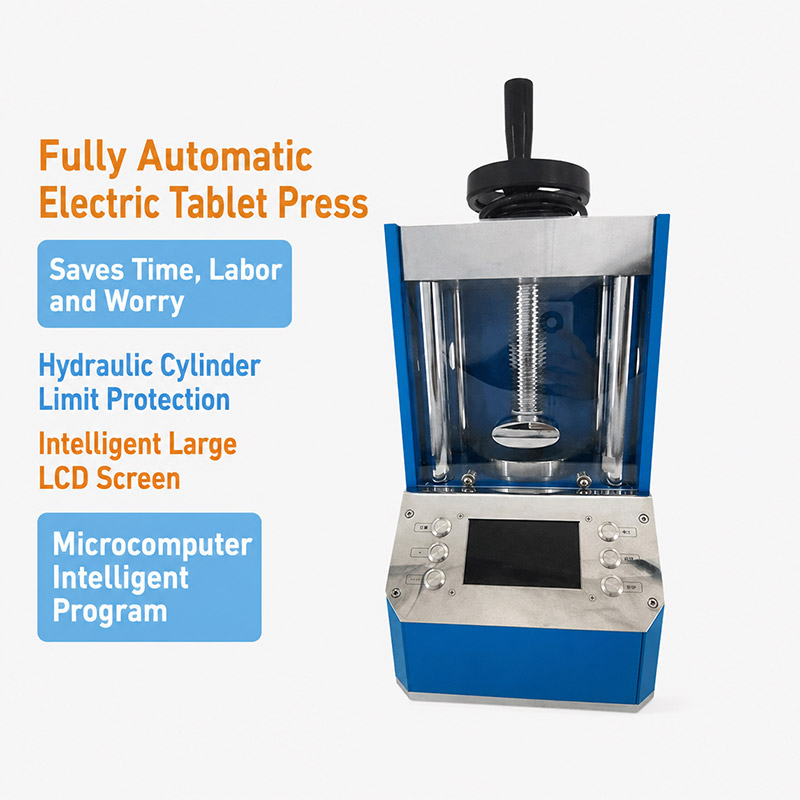
Once your powder is milled and sieved, pressing is the next stage. A tablet press fills a die with a measured volume of powder, drives a punch down to compress it into a solid shape, then pushes the finished tablet out. Easy to describe, fiddly to get right, because everything from moisture content to particle shape affects the outcome.
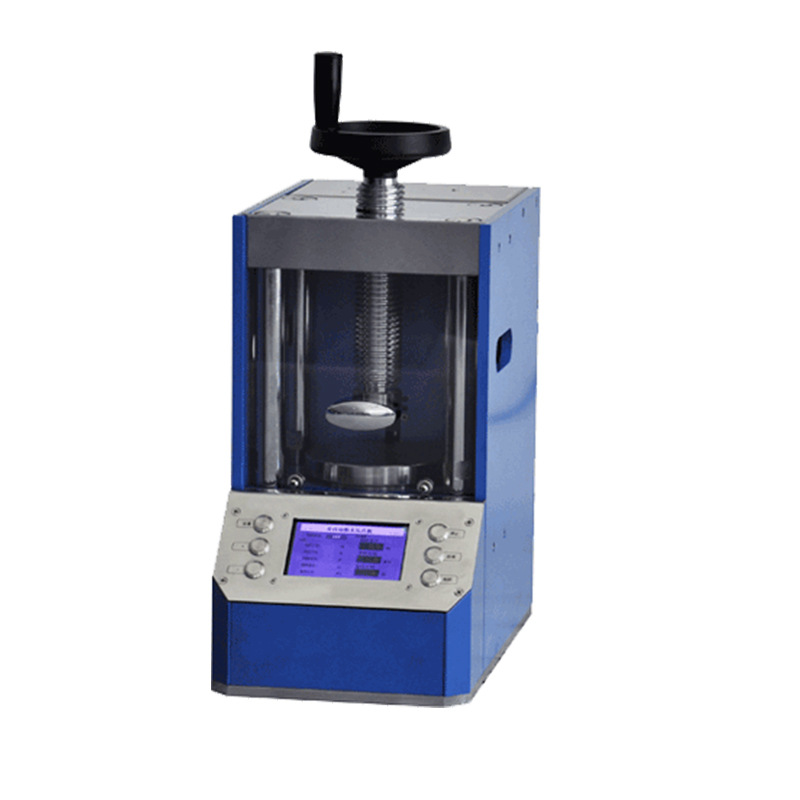
Manual presses are fine for occasional work, but once tablet production becomes routine, the arithmetic changes. You want consistent fill depth, consistent pressure and a repeatable ejection cycle — and doing that by hand gets tiring and imprecise by mid-afternoon. An automatic electric tablet press runs the whole sequence electrically: fill, compress, eject, repeat, with the settings held steady from the first tablet to the last. That's the difference between "we made some tablets" and "we made the same tablet four hundred times."
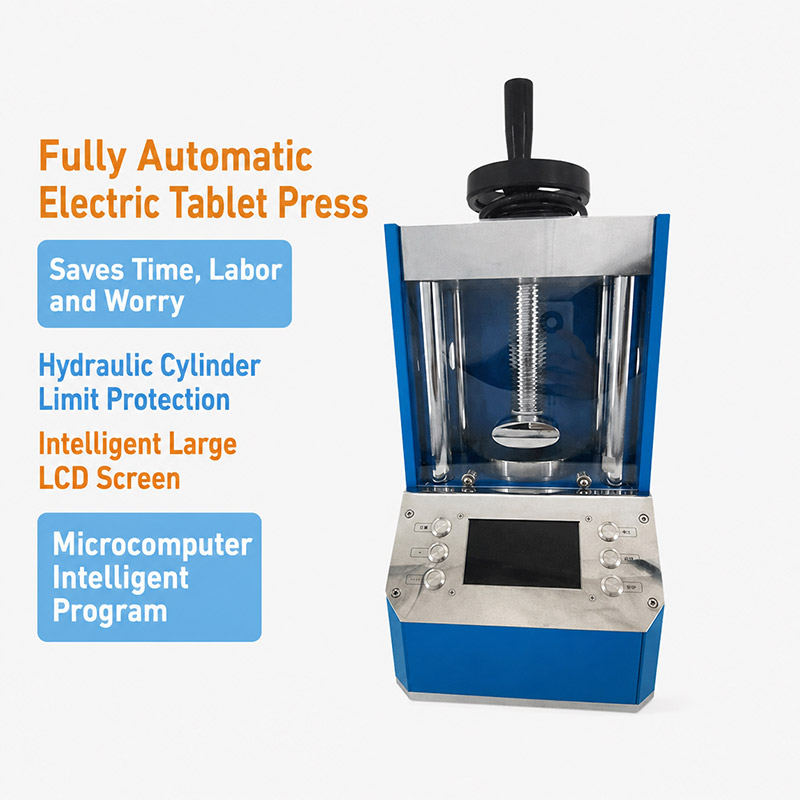
The pairing works because both machines share the same obsession: consistency. A mill that delivers a stable particle size gives the press an easy job. A press that holds stable pressure gives you tablets you can weigh, compare and test with confidence.
What to look at in a tablet press
If you're shopping for the pressing side of the workflow, keep these points in mind.
- Die and punch size determine tablet diameter and thickness. If you need several shapes, check that the tooling is available and easy to swap.
- Fill depth control sets tablet weight, so it needs to be adjustable and repeatable.
- Compression force has to suit your material. Free-flowing powders compress easily; sticky or very fine powders need more care and sometimes a little formulation help.
- Ejection and surface finish affect appearance. Poor ejection causes scratches and chipped edges.
- Throughput and automation level should match your real weekly output, not your best-case week.
You can review the details, tooling options and full specification for TENCAN's automatic electric tablet press on the product page. It's the natural companion to a small mill when your workflow ends in a solid dose.
How to Compare Offers Without Getting Confused
Suppliers use different words for the same things, so normalise everything into one comparison before you decide. Reduce each offer to a handful of numbers you can line up side by side: jar volume, media load, speed range, how long the unit can run before it gets hot, which jar materials are available, and how easy it is to buy consumables later.
Then ask the same three questions of every supplier. Can this mill reach my target particle size with my material, and can you show me a test result? What does a replacement jar and a media set cost, and how fast can it ship? Who do I talk to if something doesn't work as promised?
A supplier who answers those three clearly is usually a better bet than one with the longest feature list. And a test run on your actual material beats any specification sheet, because grinding results depend far more on the material than on the brochure.
Common Mistakes Buyers Make
The same handful of errors come up again and again. Any one of them can turn a perfectly good mill into a shelf ornament.
Buying by jar volume alone
A big jar with a weak motor is worse than a small jar with a strong one. Look at the whole package: media load, speed range and how long the unit can run before it gets hot.
Ignoring contamination until it matters
Steel media is perfectly fine until your analysis needs parts-per-million accuracy. Choose media and jar material based on what happens to the powder, not on what's cheapest at checkout.
Overfilling the jar
It feels efficient to load it up. It isn't. No free space means no tumbling, and the batch takes far longer — or never reaches the target size at all.
Grinding longer instead of grinding smarter
Past a certain point, extra time just heats the sample and encourages fine particles to clump. If you've plateaued, change the media size, switch to wet milling, or add a grinding aid rather than adding hours.
Forgetting the downstream step
Mill output feeds something else. If that something is a tablet press, your particle size distribution has to suit both the press and the finished tablet. Plan the two together and you'll save a lot of rework.
Skipping the sieve
A sieve after milling removes the oversize fraction and gives you a tighter distribution. It's an inexpensive step that improves everything downstream.
Questions We Hear Most
How long does it take to grind a batch?
Anywhere from a few minutes to several hours, depending on hardness, target size, media and mill energy. Soft materials with a modest target finish quickly; hard ceramics heading below a micron take patience.
Can I run a small ball mill in a normal laboratory?
Bench-top units are designed for exactly that, as long as you have stable power, a firm level surface and reasonable ventilation. Clamp everything down and keep the lid closed while the mill is running.
Do I need a planetary mill or a simpler drum mill?
If you need very fine particles in short batch times, planetary is usually the answer. If you're simply breaking down soft material to a modest size, a simpler mill can be enough.
How do I clean jars between different materials?
Run a small sacrificial batch of the next material, or grind a cleaning medium and rinse thoroughly. Cross-contamination between incompatible powders is a real and entirely avoidable problem.
Can I mill flammable or reactive powders?
Not casually. Reactive or combustible dusts need an inert atmosphere, proper grounding and equipment designed for the job. Talk to the manufacturer about your specific material before running anything.
Should I buy the mill or the press first?
Start with the step that's blocking you. If you can't get the powder you need, the mill comes first. If your powder is already fine and forming tablets is the bottleneck, go straight to the press — for instance, TENCAN's automatic electric tablet press. Either way, buy with the other machine in mind.
Bringing It Together
Small ball mills for sale come in a wide range of shapes and sizes, and the best one is simply the one that fits your material, your target particle size and your batch size. Get those three right and everything else — motor power, jar material, extra features — becomes a much easier conversation.
Then think one step ahead. Most milled powder doesn't stay powder for long, and if your project ends in a tablet, choose the mill with the press in mind and the press with the mill's output in mind. That's how you build a small-scale process that produces the same result on Friday as it did on Monday.
Related Products
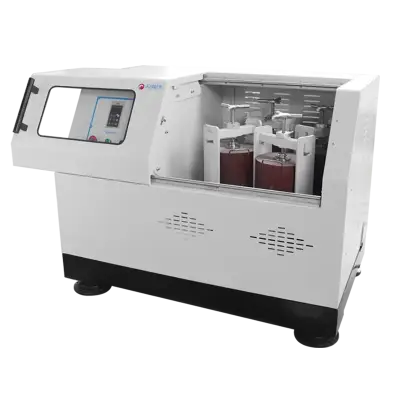
XQM-20 20L Vertical Production Planetary Ball Mill
XQM-20
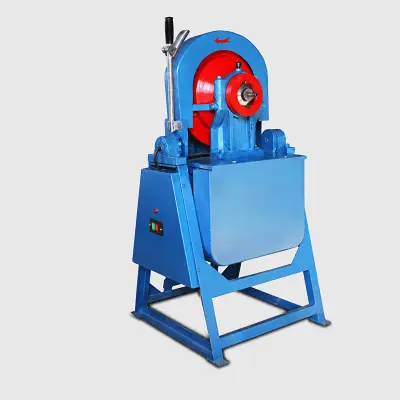
Laboratory Cone Ball Mill
XMQ
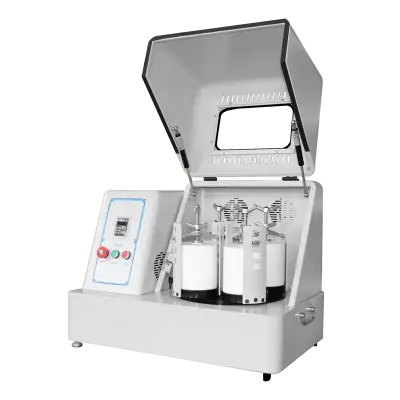
Laboratory planetary grinder
XQM
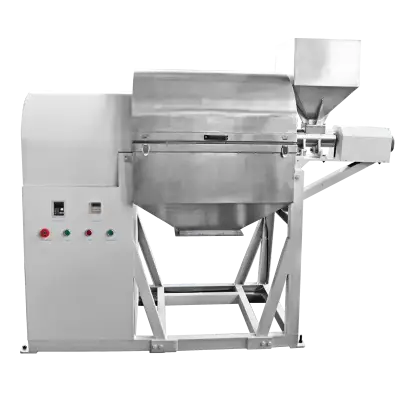
Screening Ball Mill
MS
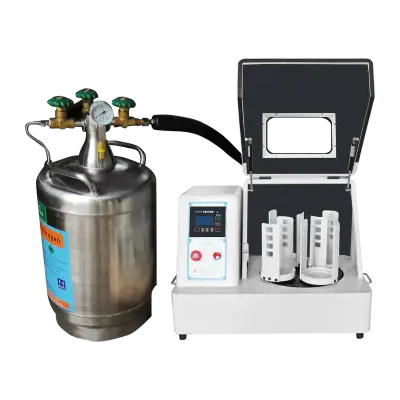
Liquid Nitrogen Planetary Ball Mill
XQM
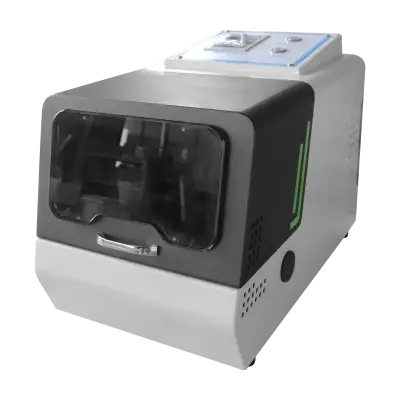
Micro Planetary Ball Mill
XQM-0.2
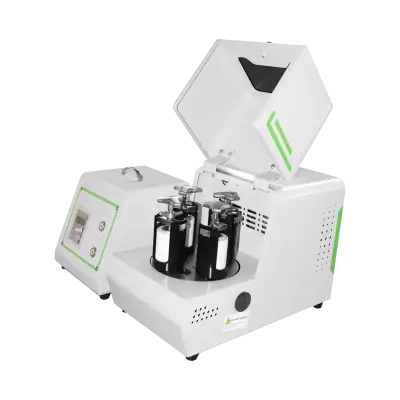
Micro Planetary Ball Mill
XQM-0.2S
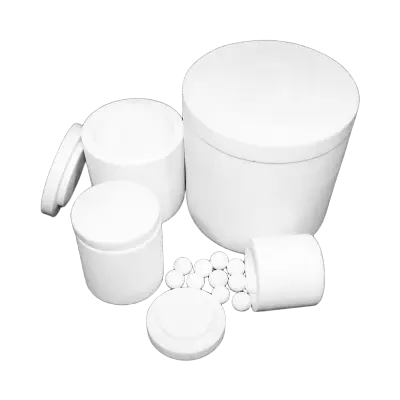
A grade Corundum planetary Mill Jar
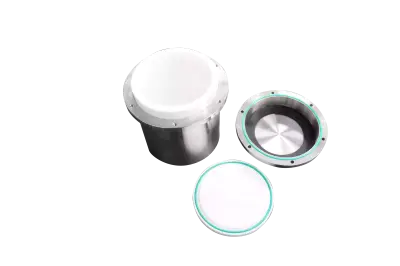
304 stainless steel lined with zirconia mill jar
Get In Touch
Our professional team will reply to you within one business day. Please feel free to contact us!