
Sieve Shaker Basics for Powder Labs

If you work with powders, you know the feeling: two batches look identical, flow the same way across a spatula, and then behave completely differently in the press, the mixer or the extruder. Nine times out of ten the difference is hiding in the particle size distribution — and the quickest, most affordable way to see it is a sieve shaker.
A sieve shaker is not glamorous. It is a drive unit, a stack of woven mesh and a timer. But it answers one of the most practical questions in powder processing: how big are my particles, and how much of the powder sits in each size band? Once you can answer that reliably, you can start controlling flowability, compaction behaviour, dissolution speed, reactivity and a dozen other things that decide whether your process runs smoothly or keeps you up at night.
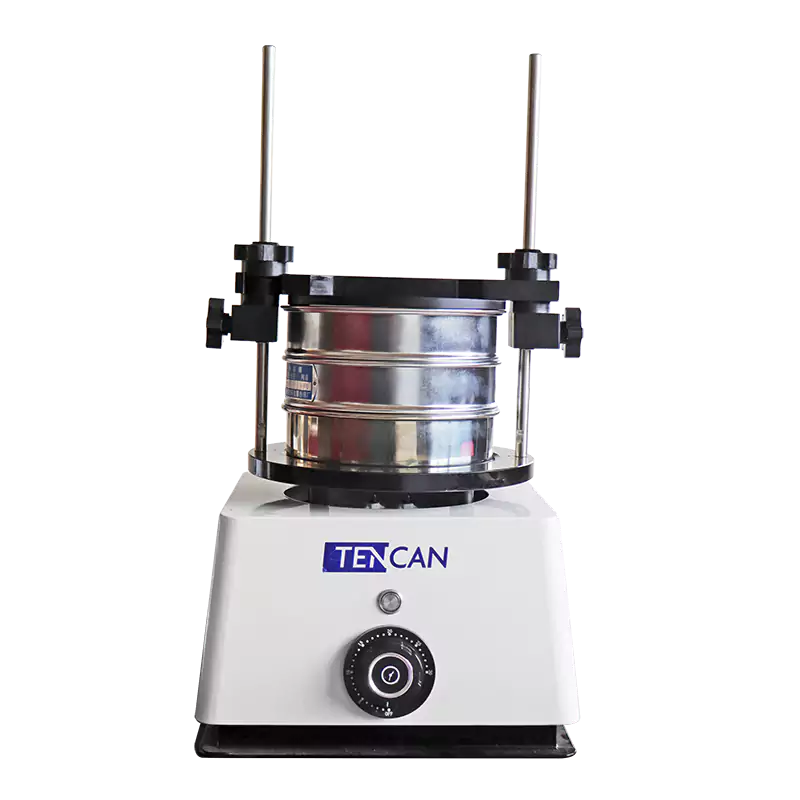
In this article we will walk through what a sieve shaker actually does, how different shaking motions change your results, how to build a method you can trust, and what to look at when you are buying one — including a compact benchtop machine built for small laboratory samples.
What a sieve shaker actually does
Strip away the housing and a sieve shaker is a machine that shakes a stack of test sieves in a controlled, repeatable way. Each sieve in the stack is a shallow pan with precisely woven wire mesh in the bottom. That mesh has square openings, and every opening in a given sieve is nominally the same size. Particles smaller than the openings pass through; particles larger than the openings stay on top. Run the stack long enough and the powder sorts itself into fractions — the material resting on the top sieve, the material on the second sieve, and so on down to the receiving pan at the bottom.
That is the whole idea. The clever part is the word "controlled". You can shake a stack of sieves by hand, and for a rough sanity check that is often good enough. But your arms get tired, your rhythm drifts, and no two operators will ever shake the same way twice. A machine applies the same motion, at the same intensity, for the same amount of time, on every single run — and that is what turns sieving from a bench trick into an analytical method you can defend in a report.
Mechanically, most units do one or more of three things: they vibrate the stack horizontally or in a slight three-dimensional orbit, they tap the top of the stack to knock loose particles through the mesh, and some designs rotate the stack so powder keeps moving across fresh mesh instead of sitting still in one spot. We will come back to those motions shortly, because the motion you choose has a real effect on how fast separation happens and how gentle the process is on fragile material.
The four parts of every sieving setup
- The sieve stack. A set of test sieves covering the aperture range you care about, with a lid on top and a receiving pan at the bottom.
- The shaker itself. The drive unit that clamps the stack and applies the motion.
- The sample. A weighed portion of powder that honestly represents the batch — the part people most often get wrong.
- The method. Amplitude, running time, and whether you sieve dry or wet. This is what makes your numbers comparable from one day to the next.
Notice that three of those four are decisions you make, not things you buy. A good shaker makes your decisions repeatable. It does not make them for you.
Why particle size distribution matters more than most people expect
Particle size is not a single number, and that is exactly why it is so useful. A powder is a population, not a value. Some of it is coarse, some of it is fine, and the shape of that distribution — how much sits at each size — quietly drives almost everything the powder does next.
Think about flow. A powder with a narrow distribution of rounded particles behaves like dry sand: it pours. Take the same material, add a tail of very fine particles, and suddenly it bridges in the hopper, sticks to the chute and refuses to feed at a steady rate. Nothing about the chemistry changed. Only the size distribution did. Similarly, in compaction, a broad distribution can pack more efficiently because small particles slip into the gaps between large ones, while a narrow distribution leaves more void space. In dissolution or leaching, the fine fraction dissolves first because it has more surface area per gram. In a kiln or a reactor, fines can react faster than the coarse fraction and change the whole thermal profile of the batch.
Where a wrong number costs real money
If you only measure particle size when a customer complains, you are already paying for it. Sieve analysis is cheap, fast and simple enough to run as routine incoming inspection. It catches supplier drift before it reaches your process, it gives you evidence when a batch of raw material does not match the certificate that came with it, and it lets you link a process problem back to a specific size fraction instead of guessing.
It also protects your own outgoing quality. If you mill, classify, granulate, spray-dry or blend, particle size is one of the few quality attributes you can measure in-house with a shaker, a balance and a sieve stack — no external laboratory, no waiting a week for results. That alone makes a sieve shaker one of the highest-value instruments on a powder bench.
How the shaking motion changes your results
This is the part that separates a shaker that works from a shaker that works for your powder. "Vibration" is not one thing. The way the energy reaches the powder changes how quickly particles find an opening and how hard they are pushed once they get there.
Vibratory motion
A vibratory shaker drives the stack in a horizontal or slightly three-dimensional orbit. Particles travel across the mesh surface, get a chance to present themselves to many openings instead of one, and fall through when their orientation and the opening line up. It is the general-purpose choice: reasonably fast, reasonably gentle, and good for a wide range of dry powders. Because the motion is continuous rather than percussive, it is kinder to friable materials such as crystals, granules and spray-dried agglomerates that you would rather not break during testing.
Tapping, and why it exists
Tapping adds a periodic knock to the top of the stack. That quick impulse does two useful things: it re-orients particles that have settled into a stable bridge over an opening, and it discourages near-size particles from lodging in the mesh and blocking it. Near-size particles — the ones whose diameter is close to the aperture — are the troublemakers of sieving. They pass, or do not pass, depending on luck. A tap gives them another chance without shaking the entire sample to death.
Rotary and combined motion
Some designs rotate the stack or combine rotation with vibration, so the powder keeps moving against fresh mesh instead of piling up in one spot. This is helpful with larger sample loads and with powders that tend to pack down. The trade-off is that more aggressive motion means more particle-to-particle and particle-to-mesh contact, which matters if your material is fragile or if you are trying to measure agglomerates rather than primary particles.
| Motion type | Speed of separation | Gentleness | Typical fit |
|---|---|---|---|
| Plain vibration | Moderate | High | General dry powders, friable granules |
| Vibration with tapping | Fast | Moderate | Near-size particles, powders that blind the mesh |
| Rotary or combined motion | Moderate to fast | Moderate to low | Larger loads, packing-prone powders |
One practical note: whatever motion you choose, use the same one every time. If half your historical data was produced with tapping on and half with tapping off, you do not have a time series. You have two unrelated data sets wearing the same label.
Dry sieving or wet sieving?
Dry sieving is the default. It is simple, it produces fractions you can weigh and keep, and it works beautifully for free-flowing powders that do not stick to each other or to the mesh. If you can pour the powder and watch it fall apart into individual grains, dry sieving will probably treat you well.
Wet sieving is what you reach for when dry sieving stops making sense. The classic symptoms: particles finer than roughly the smallest practical dry aperture cause static and cohesion problems; the sample is hygroscopic; the material agglomerates as soon as it is dry; or the fines simply will not release from the mesh no matter how long you shake. In wet sieving, a liquid carrier — usually water, sometimes an alcohol or a solvent matched to the material — washes the powder through the stack. Cohesion drops, static disappears, and stubborn fines get carried through the openings instead of sitting on the mesh looking decorative.
The catch is that wet sieving tells you something slightly different. You are measuring the size of dispersed particles in a liquid, not the size of agglomerates as they exist in your process. For some questions that is exactly what you want; for others it quietly hides agglomeration that your customers would notice. Be explicit about which question you are answering.
There is also a middle ground that people forget: treat the sample gently before sieving. Drying it at a sensible temperature, dispersing it with a light hand, and avoiding over-agitation during sub-sampling often fixes a "bad" sieving result without changing the method at all.
Building a sieving method you can actually trust
Here is a sequence that works for most powders. Adapt the numbers to your material — the point is the discipline, not the specific values.
- Decide what you are measuring. Primary particles or agglomerates? As-received or dried? Answer this before you touch the sieve stack, because it determines everything downstream.
- Take a representative sample. Powder segregates. Fines fall to the bottom of a bag, coarse particles roll to the edges. Use a riffle splitter or a proper sampling routine rather than scooping from the top.
- Weigh the sample. Record the starting mass to a sensible precision. Too little sample makes each fraction statistically weak; too much overloads the mesh and slows separation to a crawl.
- Assemble the stack. Coarsest sieve on top, finest at the bottom, receiving pan last, lid on. Check that each sieve is clean and undamaged.
- Clamp and set the parameters. Choose amplitude and time, then write them down. This is your method.
- Run it. Let the machine do the work and resist the urge to intervene mid-run.
- Weigh each fraction. Empty each sieve into a tared container, or weigh the sieve plus retained powder and subtract the empty weight. Add the fractions up and compare with your starting mass.
- Check the mass balance. If the fractions do not add up to the sample you started with, you have lost material to the mesh, to static or to the atmosphere — and your percentages are wrong.
Step eight is the one people skip, and it is the one that saves you. A mass balance within a sensible tolerance tells you the test is trustworthy. A mass balance that is off by a lot tells you something physical is happening that you have not accounted for — and that is worth knowing before you build a specification around the number.
Common mistakes that quietly ruin good data
- Overloading the sieves. A mesh buried under a deep powder bed separates slowly and incompletely. Keep the load modest and let the machine work.
- Running too briefly. Sieving has an endpoint. Stopping early just means you measured the coarse fraction's stubbornness, not the particle size.
- Running forever. After the endpoint, extra time does not improve accuracy — it abrades soft particles and manufactures fines that were not in your sample to begin with.
- Ignoring worn or damaged mesh. A single torn wire or a distorted opening lets oversize particles through and changes your result permanently. Inspect mesh regularly.
- Skipping the clean-down. Leftover powder from the previous sample shows up in the next one, usually in the smallest fraction where it does the most damage.
- Changing parameters without recording it. If amplitude or time changes, note it. Silent method changes are how good laboratories end up with unexplainable trends.
- Treating one run as truth. Run duplicates, especially when a result is about to matter.
None of these require expensive equipment to fix. They require a method document, a logbook and the discipline to follow both.
A compact option for small laboratory samples
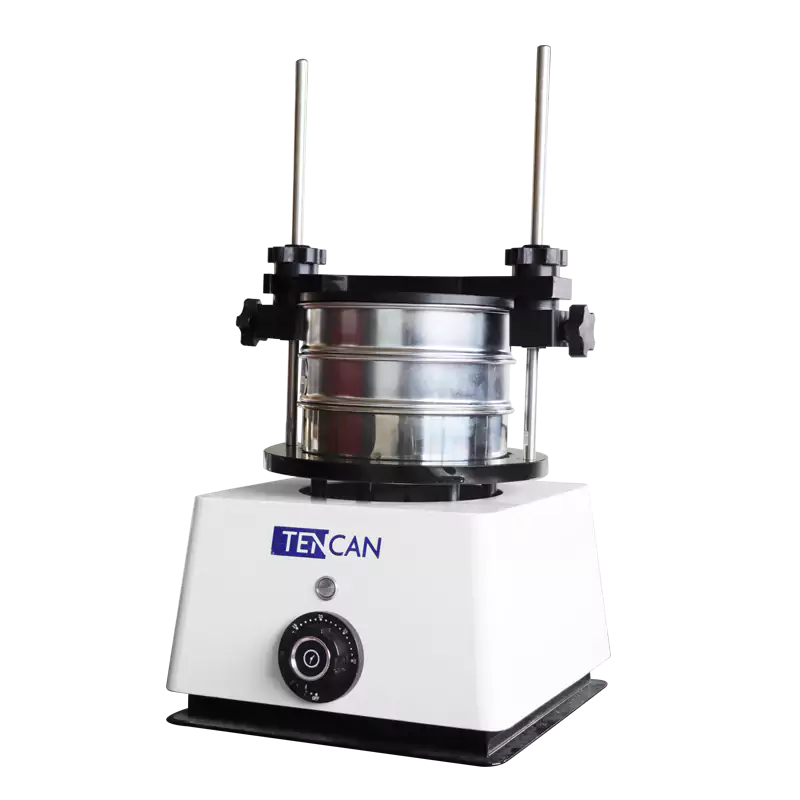
Not every laboratory needs a full-size production screening setup. Development benches, quality control corners and teaching labs usually work with small samples, limited bench space and a short list of sieve diameters. That is the gap a compact benchtop unit fills, and it is where the Small laboratory screening machine fits naturally.
The idea behind a machine like this is straightforward: bring the reliability of motorised, repeatable screening down to sample sizes and footprints that a benchtop can accommodate. You clamp your stack, set your time, and walk away. The result is the same kind of size-fraction data a larger shaker produces, in a package that does not require its own room.
When you compare a compact laboratory screening machine against a larger unit, the parameters worth checking are the practical ones. What sieve diameter does the clamping system accept — will your existing sieves work, or do you need a new set? What amplitude range is available, and can you hold a setting repeatably run after run? How long can the timer run, and does it stop cleanly? How loud is it, and how much does it walk across the bench when it is running? How easy is it to clean between samples, and how quickly can you swap a stack? Those details decide whether the instrument becomes a routine tool or a shelf ornament.
The small laboratory screening machine is built for exactly the kind of work we described earlier: small representative samples, a defined sieve stack, and a method you repeat until the numbers are boring. If you want to see the configuration and how the stack is held, take a look at the product page for the small laboratory screening machine and compare it with the sample sizes you actually run.
Keeping the instrument honest
Sieve shakers are mechanically simple, which is a gift. They survive years of daily use with very little attention, provided the attention they do get is the right kind.
Clean the mesh properly. Brushing from the underside, where particles lodge, matters more than brushing the top surface. Never poke a mesh with a hard tool to clear a blockage — you will deform openings and change the calibration of the sieve forever. A soft brush and, where appropriate, an ultrasonic bath for the sieve itself will do more for your data than any upgrade.
Check the clamping. A stack that is not held firmly will rattle, lose energy into the housing and give inconsistent results. If your numbers drift, check the clamp before you check anything else. Check fasteners periodically too; vibration has a way of loosening things that were tight last quarter.
And replace sieves when they are worn. Test sieves are consumables with a service life, not permanent fixtures. If a sieve has been in heavy use for years, or has visible damage or distortion, retiring it is cheaper than explaining a strange result to a customer.
Questions we get asked a lot
How long should a sieving run take?
Long enough to reach an endpoint, and no longer. The practical test is simple: run the sample, weigh the fractions, run it again for the same additional time, and see whether the numbers move. When an extra interval changes nothing meaningful, you have found your endpoint. Typical dry sieving runs land somewhere between a few minutes and a quarter of an hour depending on powder, load and amplitude — but the endpoint test beats any rule of thumb.
How many sieves can I stack at once?
As many as your shaker is designed to carry, with a couple of caveats. More sieves means more mass for the drive to move, which can soften the effective motion at the top of the stack. It also means more places for material to hide. For routine work, a shorter stack that covers the range you actually care about is usually more reliable and much faster to clean than a tower of eight sieves.
Why do my results change between runs?
Usually one of four things: the sample was not representative, the load changed, the parameters changed, or the mesh is dirty or worn. Static and humidity can also shift results, especially with fine or hygroscopic powders. Before blaming the machine, run a duplicate with a freshly split sample and see whether the variation is real.
Can I sieve sticky or cohesive powders?
Sometimes, with help. Reduce the load, extend the time, add tapping, control humidity, or switch to wet sieving. If agglomerates are what you want to measure, dry sieving may actually be the more honest method; if you want the primary particle size, you may need to disperse the sample first or accept that sieving has reached its limit.
Do I need to calibrate anything?
Test sieves are made to a standard and are typically verified rather than calibrated in the field, but they should be inspected and, where your quality system requires it, checked against a reference. The shaker itself has little to calibrate beyond confirming that its motion and timer are consistent. Your method document is the real calibration — write it down and follow it.
Where to go from here
Sieve analysis is one of the few techniques in powder characterisation that you can learn in an afternoon and still be refining years later. The equipment is simple, the principles are physical, and the results are immediately useful. That combination is why sieve shakers survive in laboratories surrounded by far more sophisticated instruments.
Start with a representative sample, a clean stack and a written method. Run duplicates until the numbers stop surprising you. Then, when you are ready to make the technique routine, pick a shaker that matches your sample sizes and bench space — and if small samples are your daily reality, a compact laboratory screening machine is a sensible place to begin.
Related Products
Get In Touch
Our professional team will reply to you within one business day. Please feel free to contact us!