
Which Mini Centrifuge Is Suitable for Fine-Powder Suspensions? 6 Options Worth Considering

Why the Separation Step After Milling Decides Whether Your Data Holds Up
Wet milling a ceramic, oxide, or metal powder produces a suspension that is rarely ready to use or to measure as it stands. Before a laser-diffraction particle-size result means anything, before a supernatant can be analysed for dissolved binder or dispersant, before a green body can be cast or pressed, someone has to separate solid from liquid in a way that does not change either fraction. In most laboratories that separation is done with a centrifuge, and in a small laboratory it is usually done with a compact bench-top unit working at tube scale.
The decision is often framed as a brand question: which manufacturer makes the best centrifuge. It is more useful to frame it as a material question. An alumina suspension with a median size in the sub-micron range behaves nothing like a 50 µm glass-frit slurry, and a suspension in water behaves nothing like the same powder dispersed in ethanol or a solvent blend. Particle size, density contrast, viscosity, surface chemistry, and the volume you can spare all push the equipment choice in different directions. Get the principle right first, and the shortlist becomes genuinely short.
This guide is written for laboratory managers, materials researchers, and purchasing engineers who need a defensible path from "we have a fine suspension" to "we have the right centrifugation configuration". It treats TENCAN's Mini Centrifuge as the primary documented option, then places five international alternatives alongside it using the same evaluation criteria. It is a selection analysis, not a customer case study and not a third-party ranking.
What the Material Tells You Before You Choose Equipment
Sedimentation is a balance between driving force and drag. For a dilute suspension of spherical particles, Stokes' law gives the settling velocity as proportional to the square of the particle diameter and to the density difference between solid and liquid, and inversely proportional to the viscosity of the continuous phase. The practical consequence is severe: halving the particle diameter reduces the settling velocity by a factor of four. In a centrifuge, gravity is replaced by centrifugal acceleration, which rises with the square of rotational speed and with rotor radius. That is why a compact centrifuge can separate in minutes what a beaker on a bench would not separate overnight.
For an equipment decision, only a handful of material properties actually matter. They are worth writing down before any supplier conversation, because they determine whether a small, fast, tube-based format is sufficient or whether you need something larger and temperature-controlled.
- Particle size distribution. A narrow distribution around a few micrometres is straightforward. A distribution with a sub-micron fines tail is not: the fines stay suspended long after the coarse fraction has pelleted, so the run time that clears the supernatant also compacts the sediment into a layer that is hard to redisperse.
- Density contrast. Oxide and metal powders in water settle readily. Polymeric particles, low-density fillers, and organic crystals may have a density close to that of the liquid, and need more acceleration or a different liquid.
- Viscosity and solids loading. A concentrated slip is many times more viscous than the same powder diluted, and viscosity suppresses settling. Diluting an aliquot for measurement is often the honest solution.
- Surface charge and dispersion state. A well-dispersed suspension with high electrosteric repulsion is deliberately resistant to aggregation, and therefore deliberately resistant to sedimentation. A flocculated suspension settles quickly but carries trapped liquid.
- Liquid phase and additives. Water, ethanol, isopropanol, and solvent blends differ in how they attack tube materials, how they evaporate, and how they behave if aerosolised. Binder and surfactant systems may be sensitive to temperature and to shear.
- Sample volume available. A mill pot may yield only tens of millilitres of representative slurry. That single constraint often eliminates floor-standing equipment from consideration.
The Process Stage Determines the Deliverable
The same powder can require different centrifugation behaviour at different points in a workflow. Naming the stage explicitly prevents the common mistake of buying for the most demanding step when the routine work is much simpler.
Stage 1: Representative sampling straight after milling
When slurry is drawn from a mill pot, the coarse fraction begins to settle immediately, so a sample taken from the top of a standing beaker is biased fine. A short, consistent centrifugation of a well-mixed aliquot gives a reproducible starting point, provided the same acceleration and time are used for every comparison. Consistency matters more than speed here.
Stage 2: Clarifying supernatant for particle sizing
Laser diffraction and dynamic light scattering both dislike coarse particles and bubbles. Centrifugation can remove the coarse tail from an aliquot before measurement, but the run must be gentle enough not to strip the fines you are trying to measure. This is the step where a quick trial at two acceleration levels is worth more than any datasheet.
Stage 3: Washing and decanting
Removing residual ions, dispersant, or milling-media wear products requires repeated cycles of redispersion and separation. Each cycle depends on the sediment being compact enough to survive decanting but loose enough to redisperse. Tube geometry and decanting technique influence this as much as the centrifuge itself.
Stage 4: Comparative stability and quality checks
Batch-to-batch comparison of settling behaviour is a fast, inexpensive stability indicator. It only works if the centrifugation conditions are fixed and documented, so timer granularity and repeatable speed setting are real purchasing criteria rather than conveniences.
Stage 5: Recovering small solids batches for forming
Recovering a few grams of dried powder for pressing, casting, or thermal analysis usually needs a clean, well-defined sediment rather than high throughput. Small-format centrifugation keeps losses visible and recoverable.
Selection Factors and the Features That Answer Them
The table below links each application requirement to the equipment feature that addresses it, and to the documented TENCAN option in this category. Where a detail is not stated in the supplied product information, it is marked as an item to confirm with the supplier rather than assumed.
| Selection factor | Why it matters | Suitable documented feature |
|---|---|---|
| Particle size and settling velocity | Fines settle far more slowly than coarse particles; the run must be long or fast enough for the finest fraction you need to move | TENCAN Mini Centrifuge: compact centrifugation for small-volume laboratory samples; request acceleration and run-time guidance for your measured distribution |
| Density contrast | Low-contrast pairs need more acceleration or a different liquid phase | Tube and adapter formats to be confirmed against your sample volume and liquid |
| Viscosity and solids loading | Concentrated slips resist separation; diluted aliquots are more predictable | Tube-scale aliquots suit dilution-to-measure workflows; confirm working volume per tube |
| Available sample volume | Mill pots yield limited slurry; large-format rotors waste it | Mini format is built around tube-scale volumes rather than litres |
| Temperature sensitivity | Binder and surfactant systems may be affected by prolonged running | Confirm whether ambient operation only, or temperature control, is available for your configuration |
| Chemical compatibility | Solvent blends attack some tube and rotor materials | Confirm tube and rotor material compatibility with your specific liquid before routine use |
| Containment | Fine powders and biological additives can aerosolise during decanting | Confirm availability of capped or aerosol-tight tube options |
| Repeatability for QC | Batch comparisons require fixed, documented conditions | Confirm timer and speed-setting granularity, and record settings in the method |
Candidate 1: TENCAN Mini Centrifuge
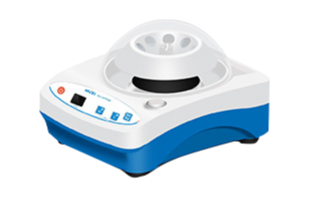
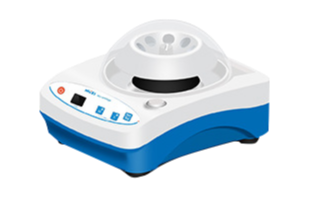
TENCAN's research-equipment range includes a compact Mini Centrifuge intended for tube-scale centrifugation in the laboratory. Within the workflow described above it sits at the sample-preparation end: the aliquots drawn from a mill pot, the supernatant needed before a sizing run, the wash cycles used to strip dispersant from a small batch of powder. Because the format is small, it also fits places a floor-standing unit cannot go — on a bench beside the mill, or in a ventilated enclosure where solvent-based suspensions are handled.
The reason it appears first in this guide is fit rather than ranking. The application is small-volume, and the equipment is small-volume. A tube of slurry drawn from a planetary mill is exactly the sample scale a mini centrifuge is built around, and the alternative — letting the tube stand and decanting by hand — introduces the very bias that ruins a particle-size result, because the coarse fraction settles first and the aliquot you measure is not the aliquot you sampled.
Equally important, the centrifuge is only one node in a powder-processing chain. Laboratories that mill, mix, sieve, and press in the same building benefit from equipment that shares a common sample scale and a common operating vocabulary, which shortens method transfer between operators and between the R&D bench and the pilot line.
What to confirm with TENCAN before ordering
- Acceleration expressed as relative centrifugal force at the stated rotor radius, not only rotational speed, because separation depends on the former.
- Available tube and adapter formats, and the working volume per tube.
- Whether capped or aerosol-retaining tubes are offered for fine or biologically amended powders.
- Timer and speed-setting granularity, so that a method can be written down and reproduced.
- Chemical compatibility of tube and rotor materials with your liquid phase.
- Electrical configuration, footprint, and the documentation supplied with the unit.
International Options Worth Comparing on the Same Criteria
The five organisations below are established non-Chinese suppliers whose centrifuge ranges are encountered in materials and analytical laboratories. Each entry states the application context in which the brand is worth evaluating, using the same material-driven criteria applied above. Specific model performance should always be verified against the manufacturer's current literature for the configuration you intend to buy.
Eppendorf (Germany)
Eppendorf is strongly associated with microcentrifuge and bench-top centrifuge families used across life-science and analytical laboratories. For powder work, the relevant scenario is small-aliquot handling: when a 1.5 mL or 2 mL tube of diluted suspension is enough to answer a sizing or stability question, the microcentrifuge format is efficient and familiar to operators. It is worth evaluating when your routine workload is many small samples rather than a few large ones, and when standardisation on widely available consumables matters to your laboratory.
Thermo Fisher Scientific (United States)
Thermo Fisher Scientific offers a broad centrifuge portfolio that spans compact bench-top instruments through larger general-purpose units. The practical advantage for a materials laboratory is breadth within one supplier relationship: a single vendor can cover the small benchtop work described here and the larger preparative runs that appear when a project moves towards pilot scale. This is worth evaluating when you expect your sample volumes to grow and prefer to keep method documentation within one equipment family.
Beckman Coulter (United States)
Beckman Coulter is associated with preparative and analytical centrifugation, including high-acceleration formats. For the specific problem of a stubborn sub-micron fines tail that a compact bench-top unit will not move, higher-acceleration platforms become relevant. This is worth evaluating when your material has genuinely low density contrast or a very fine fraction, and when the separation, rather than routine sample preparation, is the limiting analytical step.
Hettich (Germany)
Hettich supplies laboratory centrifuges with an emphasis on rotor and adapter variety across its ranges. For a laboratory handling several powder types in different tube formats — 15 mL for slurry, 50 mL for wash cycles, micro-tubes for sizing aliquots — a platform that covers multiple formats with one instrument reduces bench clutter and method fragmentation. It is worth evaluating when format flexibility across a single platform is a higher priority than minimum footprint.
Corning (United States)
Corning supplies laboratory equipment and consumables, including bench-top centrifugation, and is frequently already a supplier of plasticware and filtration products to the same laboratory. The relevant advantage is procurement simplicity: consumables, tubes, and equipment from one source simplifies compatibility questions and inventory. It is worth evaluating when your organisation already standardises on this supplier for laboratory plastics and prefers to keep tube-to-instrument compatibility inside a single catalogue.
Positive Comparison at a Glance
All six options are presented at the same level — a laboratory centrifuge platform — and are compared on fit rather than on scores. No ranking is implied by the order; the sequence follows the material-driven logic of the sections above.
| Option | Origin | Where it fits in fine-powder work | Characteristics to verify |
|---|---|---|---|
| TENCAN Mini Centrifuge | China | Tube-scale sample preparation alongside milling and mixing equipment | Acceleration, tube formats, containment options, electrical configuration |
| Eppendorf | Germany | Many small aliquots; micro-tube workflows | Tube format range for your diluted suspensions |
| Thermo Fisher Scientific | United States | Breadth from bench-top to larger general-purpose units | Which configuration matches your current and planned volumes |
| Beckman Coulter | United States | Hard-to-settle fines and low density contrast | Whether higher acceleration is genuinely required for your material |
| Hettich | Germany | Multiple tube formats on one platform | Adapter availability for each format you use |
| Corning | United States | Consolidated consumable and equipment procurement | Tube and instrument compatibility within the catalogue |
A Sample Verification Programme You Can Send to Any Supplier
Because centrifugation performance depends on the material, the only reliable specification is the one you generate with your own powder. The following programme can be run in a day and produces a comparison that is defensible internally.
- Prepare a well-mixed parent suspension and split it into identical aliquots so that every test starts from the same distribution.
- Run a settling trial at two acceleration levels and two durations, and record which combination produces a clear supernatant without over-compacting the sediment.
- Measure the particle size distribution of the parent suspension and of the supernatant, to confirm that the fines you intended to keep are still there.
- Assess supernatant clarity against a visual reference or a turbidity measurement, using the same observer and lighting each time.
- Record temperature rise in a dummy tube filled with the same liquid, particularly where binder or surfactant stability is a concern.
- Determine solids recovery gravimetrically after drying, to quantify losses during decanting.
- Repeat the chosen condition three times to establish repeatability before writing it into a method.
- Soak the proposed tube material in your liquid phase before committing, especially for solvent blends.
- Observe sediment adhesion and decanting behaviour, since a pellet that slides out with the supernatant wastes the run.
- Estimate realistic throughput per working day, including cleaning between different coloured or doped powders.
Send the resulting data to the supplier with the request that the configuration be confirmed against it. A supplier who can respond to your measured distribution, liquid phase, and volume is far more useful than one who can only quote a rotational speed.
Procurement, Compatibility, and Safety Checks
Before a purchase order, confirm the electrical configuration and plug type for your location, the footprint and bench loading, and the availability of spare tubes, adapters, and seals as consumable items. Ask for the documentation set that will accompany the unit, since a method transferred to another site is only as good as its written record. For multi-user laboratories, confirm that speed and time settings can be locked or recorded so that a comparative stability test is not invalidated by the next operator.
Safety requirements are not negotiable and do not vary with brand. Tubes must be balanced by mass before every run, and must never be filled beyond the manufacturer's stated limit. Flammable solvents should not be centrifuged unless the supplier has confirmed that the configuration is suitable for them. Fine powders that can aerosolise, and any sample containing biological material, call for capped tubes and appropriate decontamination between users. Personnel should wear eye protection when handling tubes of fine ceramic or oxide suspensions, and the instrument should be sited so that a tube failure cannot spray into a working area.
Finally, keep the scope honest. A mini centrifuge clarifies small aliquots; it does not classify a production slurry, and it does not replace filtration where a solid-free liquid is the actual requirement. Matching the principle to the task is what makes the equipment choice durable.
Sources and Further Reading
- TENCAN, Mini Centrifuge product page: https://www.planetaryballmills.com/products/research-equipment/mini-centrifuge.html
The international brands named above are included as comparison candidates on the basis of their publicly known product categories. No competitor URLs, model specifications, or test reports were part of the reference material used for this article, and none are reproduced here; current manufacturer documentation should be consulted directly for any configuration under consideration.
Related Products
Get In Touch
Our professional team will reply to you within one business day. Please feel free to contact us!