
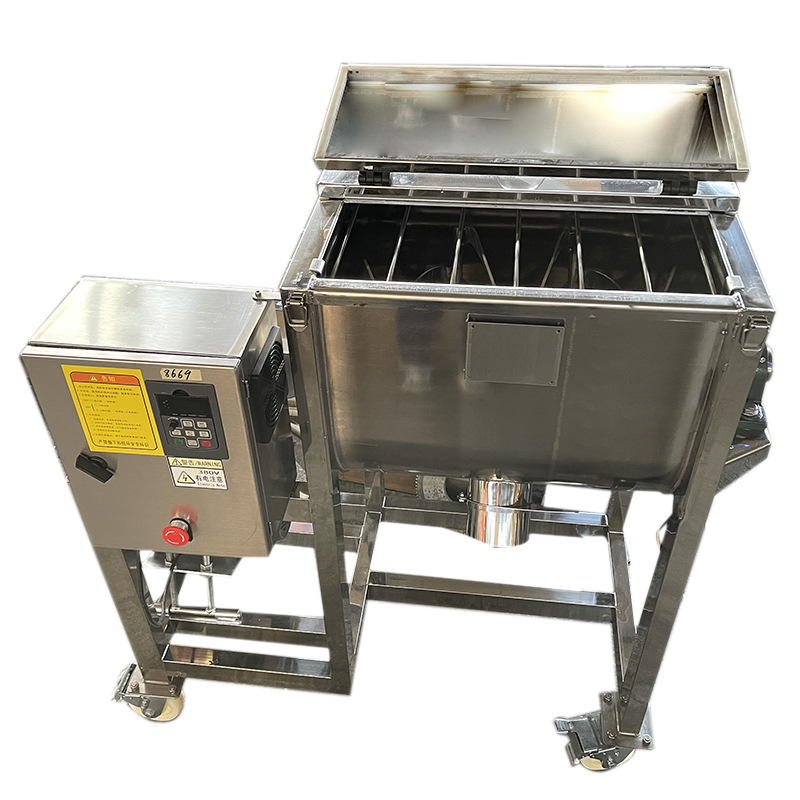
Horizontal Screw Belt Mixer: How Gentle, Uniform Powder Blending Really Works

Powder mixing looks like a simple job until a batch fails. You send a blend to the next process, and suddenly you see streaks, lumps, or a spec that drifts from one sample to the next. Most of the time, the problem isn't the recipe alone. It's how the powders were folded together, how the mixer was loaded, and whether the equipment had enough room to let the blend move.
A horizontal screw belt mixer is one of the quiet workhorses you'll see in powder plants for exactly this reason. It doesn't try to crush particles or create a tornado inside the trough. It uses a horizontal ribbon-shaped agitator to lift, fold, and exchange powder, so different ingredients meet each other again and again. The result is a blend that behaves more predictably downstream.
We're going to unpack how this mixer works, where it fits, what to check before you buy, and the small operating habits that make a big difference. No textbook detour. Just the things you'd want to know if you were standing beside the machine with a sample scoop in your hand.
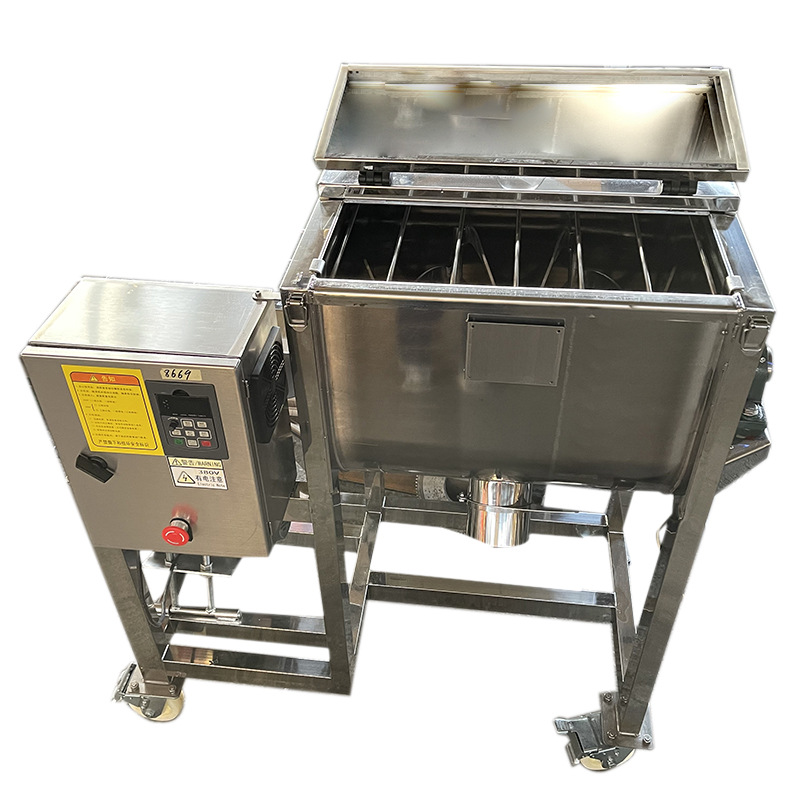
If you want the product details while you read, the Horizontal screw belt mixer page is the reference point for this article. We'll come back to it when we talk about specifications.
What a horizontal screw belt mixer actually does
Picture a horizontal trough with a long shaft running through the middle. Mounted on that shaft is a ribbon-like agitator, often called a screw belt or ribbon flight. It spirals around the shaft and pushes powder in two directions at once. One flight moves material toward the center, while another moves it toward the ends. That opposing motion is the trick. Powder doesn't just sit in one place and spin. It gets folded, lifted, and rolled back into the mix.
The mixer is designed for bulk powder and granule blends that need to be homogeneous without a lot of heat or particle damage. It works best when the trough is loaded to a sensible level, leaving enough free space for the powder to move. Fill it too high, and the agitator starts to churn instead of fold. Fill it too low, and you lose the gentle exchange that makes the design useful.
The "screw belt" in the name
That phrase can trip people up. The "screw belt" is not a drive belt, and it isn't a screw conveyor in the usual sense. It's the ribbon-shaped mixing element that spirals around the horizontal shaft. Some people call this family a ribbon blender, and that's a helpful shorthand. The ribbon creates a continuous path for the powder, so the blend keeps moving from the walls to the center and back again.
Because the agitator is broad and relatively gentle, the mixer can handle powders that would rather not be beaten up. That matters for fragile granules, heat-sensitive ingredients, and blends where one component is much denser than the rest. You're not relying on impact to mix. You're relying on repeated displacement.
Why horizontal rather than vertical
A horizontal layout gives you a long, shallow mixing zone that's easy to fill, sample, and discharge. Gravity helps the powder settle into the trough, and the agitator does the work of exchanging layers. It also makes access simpler for cleaning and inspection, depending on the build. Vertical mixers have their place, but when you want a larger working volume with a low-shear action, horizontal is often the more practical shape.
Where this mixer earns its keep
Horizontal screw belt mixers show up in a wide range of powder processes: dry mortar and mineral blends, plastic granules, food ingredients, chemical powders, pigments, fillers, and pre-mixes that feed a packaging line. The common thread is a need for repeatable dispersion of solids in solids, not a need for intense shear or paste kneading.
They're especially useful when the recipe includes small additions that need to disappear into a larger bulk. Think of a minor ingredient at a few percent or less. If that ingredient is dumped in one corner and the mixer only turns slowly, you'll chase hotspots for a long time. A ribbon agitator keeps folding the bulk over itself, so those small additions get repeated chances to spread.
Good fits
- Dry powder blends with two or more ingredients of different bulk density.
- Granule blends where you want to avoid excessive impact or attrition.
- Pre-mixes that will be packed, tableted, or fed into another process.
- Recipes that need a simple, accessible mixing trough and reliable discharge.
Where it may not be the best answer
This is not an automatic choice for very wet pastes, high-liquid slurries, or products that need aggressive shear to break down agglomerates. A ribbon mixer can handle some liquid addition, but once the material turns into a sticky mass, the gentle folding action can become a cleaning problem rather than a mixing advantage. If your process needs particle size reduction or intense dispersion, look at a different mixing principle instead of forcing this one to do the job.
Very abrasive powders also deserve a closer look. The agitator and trough will see wear, and the wear pattern depends on the material, the speed, and the duty cycle. That doesn't rule the mixer out, but it does mean you should talk through the contact surfaces and wear allowances before the order goes in.
The mixing action, step by step
When the agitator starts, the first thing that happens is bulk movement. The ribbon lifts powder from the bottom of the trough and pushes it along the axis. Because the flight is helical, the powder also rolls around the shaft. This is convection: large groups of particles are physically moved from one place to another.
As those groups meet, shear starts to do its quieter work. Layers slide past each other, and particles at the edges of those layers get exchanged. Over time, diffusion takes over at the small scale. Individual particles work their way into the gaps between others. You can't see this part happening, but it's why a good blend keeps improving after the first minute or two.
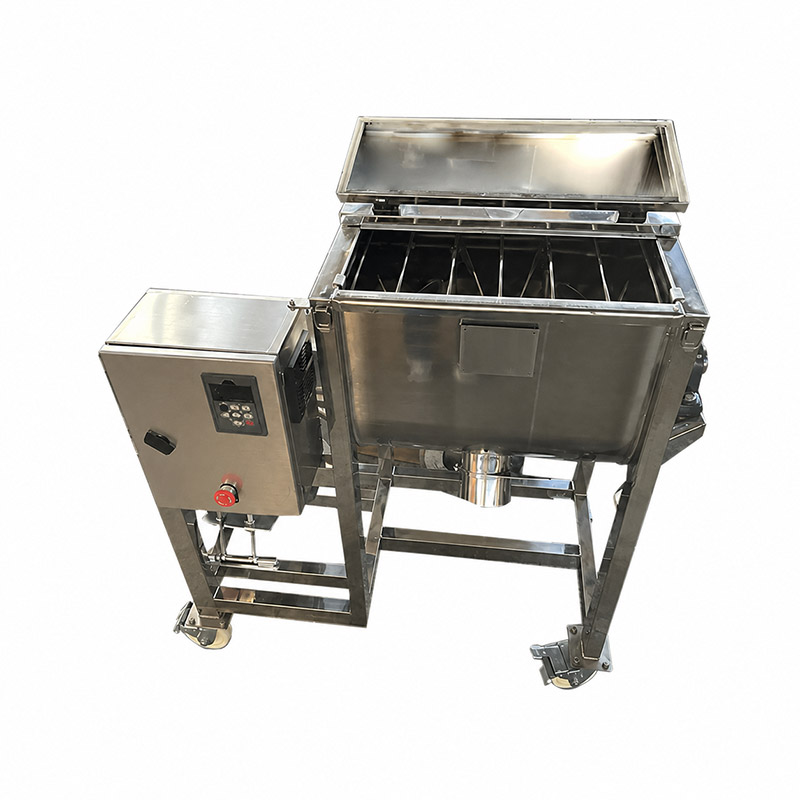
The practical takeaway is simple. You need enough movement to keep the whole bed active, but not so much that you fluidize the powder or throw it against the top of the trough. A steady, full-body roll is better than a fast, local whirl. That's also why the correct fill level matters more than many people expect.
What to check before you choose one
Model-specific figures vary with the build, the material, and the options you choose, so don't treat a random number from a catalog as universal. The product page is the right place to confirm the current configuration details. What you can do now is decide which parameters actually matter for your powder. The table below is a practical starting point.
| Parameter | Why it matters |
|---|---|
| Working volume and batch size | You need a realistic usable batch, not just a gross tank volume. |
| Fill level | Too full or too empty both reduce mixing quality. |
| Agitator speed | Controls the balance between gentle folding and faster turnover. |
| Motor and drive sizing | Must suit the bulk density and starting load of your material. |
| Contact material and finish | Affects corrosion resistance, cleaning, and product purity. |
| Discharge type and height | Determines how cleanly the batch leaves and how it connects to your line. |
| Shaft seals and bearings | Influence dust containment, maintenance access, and service life. |
| Cleaning access | Matters for changeovers, allergens, and color-sensitive products. |
Use this list as a conversation guide, not a scorecard. A mixer that looks good on paper can still disappoint if the fill level is wrong or the discharge doesn't match your container. The equipment has to fit the whole process, not just the mixing step.
Working volume and fill level
Ask for the usable working volume and the recommended fill range for your material. Bulk density changes everything. A light, fluffy powder may fill the trough visually while leaving plenty of air space. A dense mineral powder may hit the drive limit long before the trough looks full. Give the supplier your bulk density, particle size range, and the batch weight you actually want to run.
Material contact and surface finish
If you make food, pharmaceutical, or sensitive chemical products, the contact surfaces need to suit your cleaning and purity requirements. Surface finish, weld quality, and dead corners matter more than a shiny brochure photo. For corrosive ingredients, confirm the wetted material and any lining or coating before you commit. A small upgrade at the specification stage is usually cheaper than a rebuild later.
Discharge, seals, and cleaning access
The discharge is where good mixing meets real life. A fast, complete discharge keeps the batch moving and reduces the chance of residue carrying into the next recipe. Look at the valve type, the opening size, and the height above the floor. Then look at the seals. Dust finds its way into places you'd rather it didn't, so choose a seal arrangement you can inspect and maintain without a full teardown.
A practical product snapshot
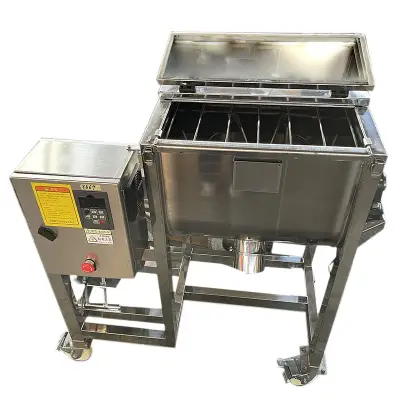
The Horizontal screw belt mixer from TENCAN is built around this horizontal, low-shear mixing concept. The product page is the place to confirm the current model details, available options, and the specifications that apply to your batch. If you're comparing mixers, use the page as a checklist against your own powder data rather than as a stand-alone sales sheet.
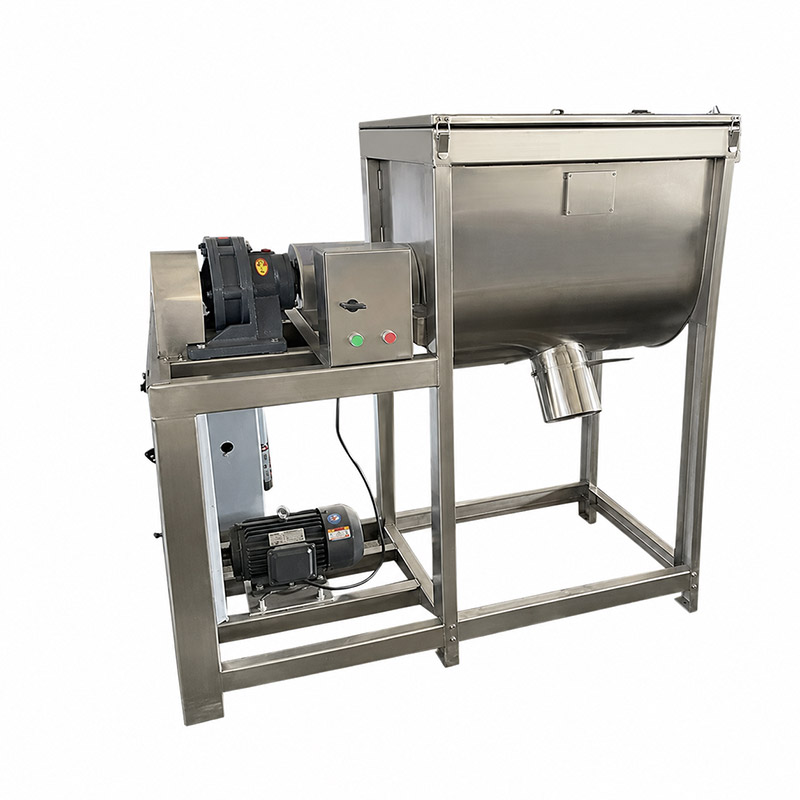
Here's the honest way to read a product page: match the working volume to your real batch, check the contact material against your ingredients, and confirm how the discharge will fit under the mixer. Those three points will eliminate more bad fits than any glossy feature list.
Installation and operation habits that improve results
A good mixer can still produce a poor blend if it's treated like a black box. The machine needs a level base, enough clearance for access, and a discharge path that doesn't choke the flow. Give it a stable power supply and the controls your operators actually need. Then train people on the fill level, the loading order, and the sampling routine. Those habits are part of the mixing system, even if they don't show up on the datasheet.
Loading order matters more than you think
Put the coarse or denser ingredients in first, then add the smaller components in a way that lets them disappear into the moving bed. Don't dump a tiny additive into a dead corner and expect the ribbon to find it in five seconds. If you have several minor ingredients, pre-blend them with a small portion of the bulk before they go into the main batch. That simple step reduces streaking and shortens the time needed to reach a uniform blend.
Don't chase speed by overfilling
It's tempting to squeeze in one more bag to hit a batch target. Resist that urge unless the manufacturer confirms the higher fill is safe and still mixes well. Overfilling robs the powder of the free space it needs to fold. The agitator may labor, the blend may become uneven, and the drive may see loads it wasn't sized for. A slightly smaller batch that mixes properly is worth more than a full batch that has to be reworked.
Sample like you mean it
Take samples from several positions, not just the top surface. Use a sampling thief or a small probe that reaches into the bed. Test the component that matters most, not only the easiest one to measure. If your spec is a minor additive, sample for that additive. A blend can look uniform and still fail the one test that decides whether the batch is released.
Cleaning, maintenance, and changeover
Dry powder mixers don't usually fail dramatically. They drift. A seal starts to weep, a discharge valve doesn't close cleanly, or a ribbon picks up a buildup that changes the mixing pattern. A short inspection routine catches these things before they become batch losses. Check the agitator, the shaft seals, the discharge, and the access covers. Look for wear, looseness, and product buildup. Listen for new noises. Your operators will hear a change before the maintenance log shows one.
Cleanability by design
If you switch products often, cleaning access belongs in the buying decision, not in the afterthought column. Ask how the shaft seals are reached, whether the trough can be fully accessed, and where residue tends to collect. For color-sensitive or allergen-sensitive products, a design that looks tidy but hides powder in a narrow ledge will cost you time on every changeover.
Wear parts and spares
Ask which parts are expected to wear and how quickly, given your material. Abrasive powders will tell you the truth soon enough, but you'd rather know before the first shutdown. Keep the realistic spares on hand: seals, fasteners, and any agitator or discharge components that see regular contact. A small spares kit is cheaper than a week of downtime.
Common questions from powder processors
How do I know the mixer is right for my powder?
Start with a small trial, not a guess. Send a sample of each ingredient, your target ratio, bulk density, and the batch size you want to run. A supplier can then recommend a working volume and a realistic fill level. If the material is fragile, heat-sensitive, or prone to agglomeration, say so up front. The mixing principle may still fit, but the agitator speed, fill level, and discharge details need to reflect those risks.
Can it handle heat-sensitive or fragile materials?
This design is generally gentler than high-shear mixers because it relies on folding rather than impact. That said, gentle is not the same as risk-free. Long mixing times, overfilling, or a poor discharge can still damage sensitive products. Run a trial with your actual material and check the particle size and appearance after mixing, not just the chemical uniformity.
Do I need a full specification before I ask for a quote?
No, but the more you share, the better the first recommendation will be. Tell the supplier your ingredients, bulk density, target batch weight, desired cycle time, discharge height, and cleaning requirements. Add any constraints around floor space, dust extraction, and available power. Those details narrow the options quickly and stop you from comparing machines that were never meant for your process.
What about dust and housekeeping?
Powder handling always creates some dust, especially during loading and discharge. Plan for dust extraction or a contained transfer method, and give operators a clear routine for cleaning the loading area. The mixer's seals and access covers should support that routine, not fight it. Good housekeeping isn't just about appearance. It keeps material from building up in places where it can cross-contaminate the next batch.
A simple selection checklist
- Define the real batch weight and the bulk density of each ingredient.
- Confirm the usable working volume and the recommended fill range.
- Match contact materials to the powder's corrosivity and purity needs.
- Plan the discharge height, container, and dust control before installation.
- Decide how often you'll clean and what access that requires.
- Ask which parts wear and keep the right spares on hand.
- Run a trial with your actual ingredients, not a generic sample.
When you're ready to compare details, the Horizontal screw belt mixer page gives you a focused starting point. Bring your powder data, your batch size, and your cleaning routine. That's the conversation that gets you a mixer that blends gently, discharges cleanly, and keeps your line predictable.
Related Products
Get In Touch
Our professional team will reply to you within one business day. Please feel free to contact us!