
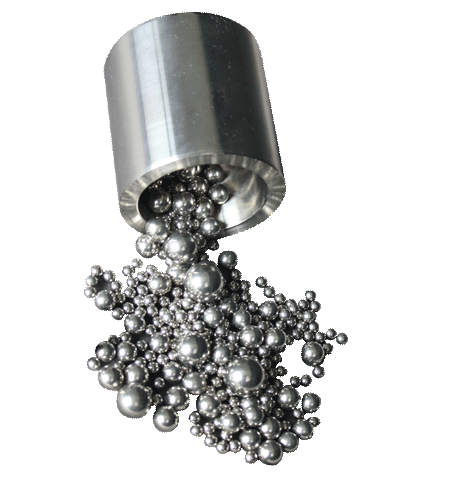
High-Energy Planetary Ball Mills

If you have ever stood next to a high-energy planetary ball mill while it runs, you know the sound: a rhythmic, slightly angry rumble that says something is being crushed very hard. That rumble is the whole point. A planetary ball mill does not merely tumble powder the way a simple jar mill does — it flings grinding balls against the jar wall under centrifugal force that makes ordinary gravity look lazy. That is what lets you take a coarse powder and turn it into sub-micron, sometimes nanoscale material in an afternoon instead of a week.
Below we walk through the technology in practical terms: what "high energy" really means, how the grinding action happens inside the jar, which variables you can turn and which ones bite back, where 304 stainless steel grinding balls fit into the picture, and the mistakes that send most first-time users back to the drawing board. The physics is the same whether you are milling battery cathode powder, a metal alloy, ceramic frit, or a rock sample.
What "High-Energy" Really Means
A ball mill, at its core, is a container partly filled with hard balls. When the container moves, the balls collide with each other and with the wall, and whatever powder is trapped in those collisions gets fractured. That is the entire idea, and it has been around for well over a century.
The difference between a gentle mill and a high-energy planetary ball mill comes down to one word: acceleration. In a classic tumbler mill the jar rotates slowly around a horizontal axis, so the balls are lifted by gravity and then fall back down. The impact energy is modest, the number of collisions per second is small, and a typical grind takes many hours — sometimes days — to reach a fine powder.
A planetary mill changes the geometry. The jars are mounted on a rotating disc, usually called the sun wheel or main disc, and each jar also spins around its own axis. Critically, the jars spin in the opposite direction to the disc. Because the two rotations oppose each other, the charge inside the jars is alternately pressed against the outer wall and then the inner wall, over and over, many times per second. The balls do not fall; they are thrown.
The acceleration involved is usually described in multiples of g, the acceleration of normal gravity. Depending on the machine, the jar diameter, the disc radius, and the rotational speed you select, a high-energy planetary ball mill can subject the charge to forces many times stronger than gravity. That is why the same job that takes a tumbler mill a full day can be finished here in tens of minutes. The speed setting is not a cosmetic knob — it changes the physics.
Finer powder, and sometimes a brand-new material
There is a second consequence of high energy that is easy to overlook: when you hit particles hard enough and often enough, you stop simply making them smaller. You start changing them.
Repeated fracture and cold welding can drive atoms across particle boundaries, producing alloys from elemental powders — a process called mechanical alloying. You can force normally immiscible metals into a solid solution, create nanocrystalline grains, amorphize a crystalline phase, or trigger a chemical reaction between solid powders without any solvent at all, which is what mechanochemistry is about. None of that happens reliably in a low-energy mill; it needs the violent, repetitive collisions that "high energy" describes.
So when someone asks whether they need a high-energy planetary ball mill, the honest answer is: it depends on your goal. Straightforward size reduction down to a few micrometres? A gentler mill may do. Nanocrystalline powders, amorphous phases, mechanical alloying, or reactions between solids? You need the energy.
How the Grinding Actually Happens Inside the Jar
It helps to picture what is going on inside a single jar, because the machine behaves nothing like a blender.
Three motions at once
Every point in the jar is subject to the rotation of the sun wheel, the counter-rotation of the jar about its own axis, and the resulting Coriolis effect that curves the paths of the balls. The practical result is a set of ball trajectories that constantly change direction relative to the jar wall. Balls climb the wall, get flung across the jar, land on the powder bed on the opposite side, then repeat. On the way they also roll and shear against one another.
That combination matters. Impact alone is good for brittle material. Friction and shear are what refine soft, ductile, or sticky powders. A planetary mill delivers all three at once, which is why it handles such a wide range of materials.
The jar fill level, and why half-full is the rule of thumb
If you fill a jar to the brim, the balls have nowhere to move and nothing to impact. Fill it too little and the balls spend their time bouncing off the wall instead of crushing powder between them. The usual starting point is to let the grinding balls occupy roughly a third of the jar volume, add powder until it just fills the voids between the balls, and leave the rest as free space. In practice that means the jar looks about half full when you close it. If you can shake the jar gently and hear the charge moving freely, you are in the right range.
Ball-to-powder ratio: the number that changes everything
The ball-to-powder ratio, usually written BPR, is simply the mass of grinding media divided by the mass of the sample. A low ratio means each powder particle is struck relatively rarely; a high ratio means more collisions per particle per unit time. Raising the BPR speeds up refinement and makes mechanical alloying possible, but it also increases wear on the media and jar, raises the temperature, and pushes more contamination into your powder.
Typical working values run from about 10:1 for straightforward size reduction up to 20:1, 30:1, or higher for mechanical alloying and mechanochemistry. If you are starting from scratch, begin around 10:1 and increase only when you have evidence that you need more energy — not just because a journal paper used 50:1.
Speed, and the point of diminishing returns
Faster is not automatically better. As rotational speed rises, the balls are pressed harder against the jar wall, and beyond a certain point they stop tumbling freely and simply travel with the wall — a condition often called centrifuging. When that happens, grinding efficiency collapses even though the motor is working harder and the jar is getting hotter. The art is to run just below the point where the charge starts sticking to the wall, then let time do the rest.
Time, and the pause button
Long continuous runs heat the jar, the powder, and the seals. Most experienced users program the mill to run in cycles — for example, a few minutes of grinding followed by a short pause — so the jar can shed heat. This is not purely about protecting the machine. Heat can recrystallise a nanocrystalline powder, decompose a temperature-sensitive phase, or cause a sticky powder to cold-weld into a solid lump on the jar wall. If your material is heat-sensitive, the pause is not optional.
The Variables You Can Actually Control
Once you understand the mechanics, choosing grinding conditions becomes a series of trade-offs rather than guesswork. Here are the levers that matter most, in roughly the order they affect your result.
Jar and media material
Every minute of grinding wears the jar and the balls. That wear ends up in your powder, so material choice is really a question about which contaminant you can tolerate. Agate is chemically inert and low-wear but soft and slow. Zirconia is dense and tough and adds zirconium. Tungsten carbide is extremely dense, grinds fast, and adds tungsten and cobalt. Hardened steel is cheap and tough but adds iron and chromium. Stainless steel sits comfortably in the middle ground.
A useful rule: pick the densest media your budget and your contamination limits allow. Denser balls carry more kinetic energy at the same rotational speed, which shortens grinding time and therefore reduces total wear per batch.
Ball size and size distribution
Bigger balls carry more mass and deliver harder single impacts; smaller balls create far more contact points and grind finer. For coarse feed material, start with a mix — a spread of diameters gives you both crushing power and fine grinding. For final polishing of an already-fine powder, shift toward smaller media. A narrow, single-size charge is rarely optimal.
Dry grinding versus wet grinding
Dry grinding is simpler: no solvent to remove afterwards, no drying step, no liquid handling. Its weakness is that fine particles tend to re-agglomerate and coat the jar wall, and ductile powders cold-weld. Wet grinding with water, ethanol, isopropanol, or another suitable liquid keeps particles dispersed, carries heat away, and usually reaches a finer final size faster. The trade-off is that you then have to separate the liquid, and some materials react with or dissolve in the solvent you choose.
If you must grind dry but your powder is sticky, a small amount of process control agent — a few percent of a fatty acid or a brittle additive — can stop the powder from welding into lumps. It stays in the product, so make sure it is acceptable downstream.
Atmosphere and sealing
Some powders oxidise the moment they meet air, and some are sensitive to moisture. Sealed jars that can be loaded and opened in a glove box solve that problem, and they also stop fine dust from escaping during the run. If your material is air-sensitive, decide this before you mill, not after you see the colour change.
Where 304 Stainless Steel Grinding Balls Fit In
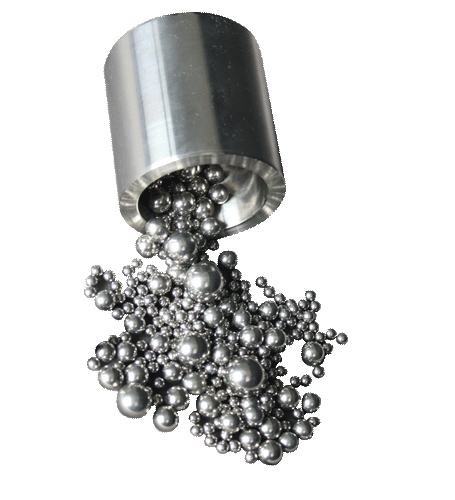
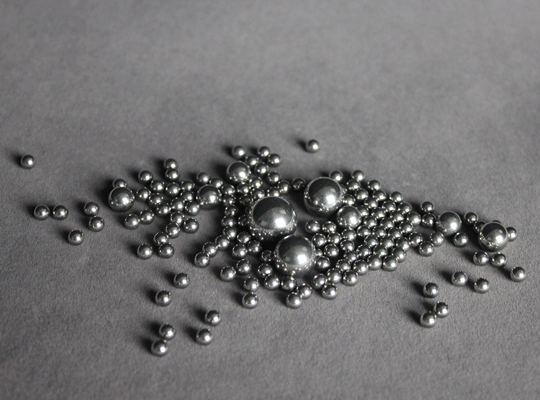
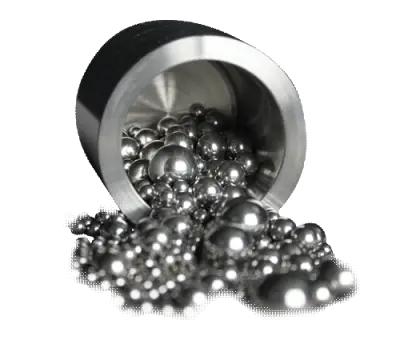
Now the practical part. If you have been shopping for grinding media, you have probably run into the 304 stainless steel grinding ball range made by TENCAN (Changsha Tencan Powder Technology Co., Ltd.). 304 stainless steel, also written SUS 304 or AISI 304, is the classic austenitic stainless grade: an iron-based alloy containing chromium and nickel that resists rust and most mild chemical attack far better than ordinary carbon steel.
For ball milling, that translates into properties you can actually use. The balls are tough rather than brittle, so they deform under repeated high-energy impacts instead of shattering. They are considerably denser than ceramic media, so each collision carries more punch. And because the surface resists corrosion, they survive wet grinding with water, alcohol, and many common solvents without turning your slurry rusty.
Where 304 stainless grinding media really earn their keep:
- Hard, brittle powders that need impact energy — minerals, oxides, glass frit, ceramics, slags.
- Wet grinding with aqueous or alcoholic slurries, where carbon steel would corrode away.
- Larger jars and heavier charges, where lighter ceramic media would simply be too weak to do the job.
- General laboratory work where a small amount of iron contamination is acceptable or can be removed later with a magnet or a mild acid wash.
You should also know the trade-offs, because no media is universal. Steel wears, and that wear shows up as iron and chromium in your powder. For trace-metal analysis, for magnetic materials, or for anything destined for a battery electrode where iron acts as a poison, that is a real problem — and you should move to agate, zirconia, or tungsten carbide instead. Stainless balls are also not the right choice for strongly acidic or chloride-rich slurries, where even 304 can pit.
A simple way to think about it: 304 stainless is the dependable mid-range option. Not the cheapest per kilogram, not the most chemically inert, but a solid balance of density, toughness, corrosion resistance, and cost for the majority of everyday grinding jobs. You can see the full line on the 304 stainless steel grinding ball page.
What People Use High-Energy Planetary Ball Mills For
Because the same machine can crush, mix, alloy, and react, planetary mills show up in a surprising number of fields. A few representative ones:
Materials science and metallurgy
Mechanical alloying is the classic application. You load elemental or pre-alloyed powders, and the repeated impacts mix them at the atomic scale. This is how nanocrystalline alloys, oxide-dispersion-strengthened metals, and amorphous metal powders are commonly produced in the lab.
Battery and energy materials
Cathode and anode powders, solid electrolytes, and conductive additives all benefit from tight particle size control. Milling can reduce particle size, break up agglomerates, and even create composite particles where one phase coats another — useful when you want intimate contact between an active material and a conductive additive.
Ceramics, glass, and minerals
Ceramic raw materials, frits, and mineral samples are hard and brittle, which suits impact-dominated grinding. In geology and environmental analysis, planetary mills are a standard way to reduce rock, soil, and sediment samples to a fine, homogeneous powder before X-ray fluorescence or X-ray diffraction.
Mechanochemistry and solvent-free synthesis
Some reactions that traditionally need solvents, high temperature, or long reflux times can be driven by milling alone. Fewer solvents means less waste, and in many cases the reaction is faster and cleaner.
Pharmaceuticals, food, and biology
Fine milling of active ingredients, plant material, and food powders is common, though here the emphasis shifts to contamination control, temperature limits, and cleanability. If your product must be food-grade or pharma-grade, media wear and jar material become the deciding factors, not grinding speed.
Mistakes That Waste Batches
Most disappointing results trace back to a handful of avoidable problems.
Overfilling or underfilling the jar
Too much powder and the balls cannot move; too little and they hit the wall instead of each other. Either way you spend an hour producing almost nothing. Keep the jar about half full and make sure there is free space for the charge to tumble.
Using the wrong ball size
Tiny balls cannot break coarse particles; huge balls cannot reach a fine finish. Match the media to the job, and consider a mixed charge.
Ignoring heat
Jars get hot enough to burn your hand, and that heat is doing chemistry inside your sample. Use interval grinding and, if needed, a water-cooled jar arrangement for heat-sensitive materials.
Forgetting about contamination
If you are measuring trace elements or magnetic properties, the media you chose may be the largest source of your error. Run a blank — mill the jar with no sample, then analyse the residue — and you will know exactly what your setup contributes.
Grinding far too long
Past a certain point, extra time stops making the powder finer and starts causing re-agglomeration, unwanted amorphisation, or phase changes. Run a short grind curve first: mill a small batch in steps, sample between steps, and measure. That single experiment will save you more time than any rule of thumb.
Safety Notes That Beginners Skip
A planetary mill is a high-energy device, and a few habits keep it safe and accurate.
- Clamp jars properly. A jar that works loose at speed is a projectile. Check the clamping and the seal before every run.
- Respect reactive metal dusts. Aluminium, magnesium, titanium, and some other metals form powders that can be pyrophoric or explosively reactive. Handle them with the same discipline you would use in any powder-handling lab.
- Watch pressure. Sealed jars can build up pressure from heat, outgassing, or a reaction that releases gas. Vent or cool when the chemistry demands it.
- Guard your ears. These machines are loud. Hearing protection is normal practice, not a luxury.
- Let jars cool before opening. Besides the burn risk, hot powder can oxidise the moment it hits air.
Questions We Hear Most Often
Can a planetary ball mill really make nanoparticles?
Yes, but not by default. Reaching the nanoscale depends on enough energy, a high enough ball-to-powder ratio, and often wet grinding with a dispersant to stop the fresh surfaces from sticking back together. Expect a distribution of sizes rather than a single perfect number.
How long should I grind?
Start with short intervals and measure. A brittle mineral may be done in minutes; a ductile metal powder may need hours with pauses. There is no universal recipe, only your own grind curve.
What is the difference between a planetary mill and an attritor or vibratory mill?
Attritors stir media in a stationary tank and excel at large volumes. Vibratory mills shake a tube and are good for very small samples. Planetary mills sit in the middle: small to moderate batch sizes, very high energy density, and excellent control over speed and time, which is why they dominate laboratory and pilot-scale research.
Can I use the same jar for a different material?
Only after proper cleaning. Cross-contamination from a previous sample — especially an abrasive or magnetic one — can ruin your next result in ways that are hard to diagnose.
Choosing the Right Setup for Your Powder
Here is how we would approach a new material in the lab. First, decide what success looks like: a target particle size, a phase you want, a reaction you need to drive. Second, pick media and jar material based on the contamination you can tolerate and the hardness of your feed. Third, set a conservative ball-to-powder ratio and a moderate speed, run a short cycle, and sample. Fourth, adjust one variable at a time — ratio, then speed, then time — and record everything.
If your material is brittle, non-magnetic, and tolerant of a little iron, dense steel media such as the 304 stainless steel grinding balls from TENCAN are a sensible, hard-wearing starting point that handles both dry and wet processes. If contamination is critical, move up the material ladder to zirconia or agate. Either way, the machine rewards patience: understand the physics, respect the heat, and let your own grind curve — not somebody else's recipe — tell you when you are done.
Grinding is one of those jobs where a small investment in understanding pays off immediately. Once you know why the jar spins backwards, why the fill level matters, and why your media choice shows up in the analysis, a high-energy planetary ball mill stops being a black box and becomes what it should be: a fast, controllable tool for making the powder you actually wanted.
Related Products
Get In Touch
Our professional team will reply to you within one business day. Please feel free to contact us!