
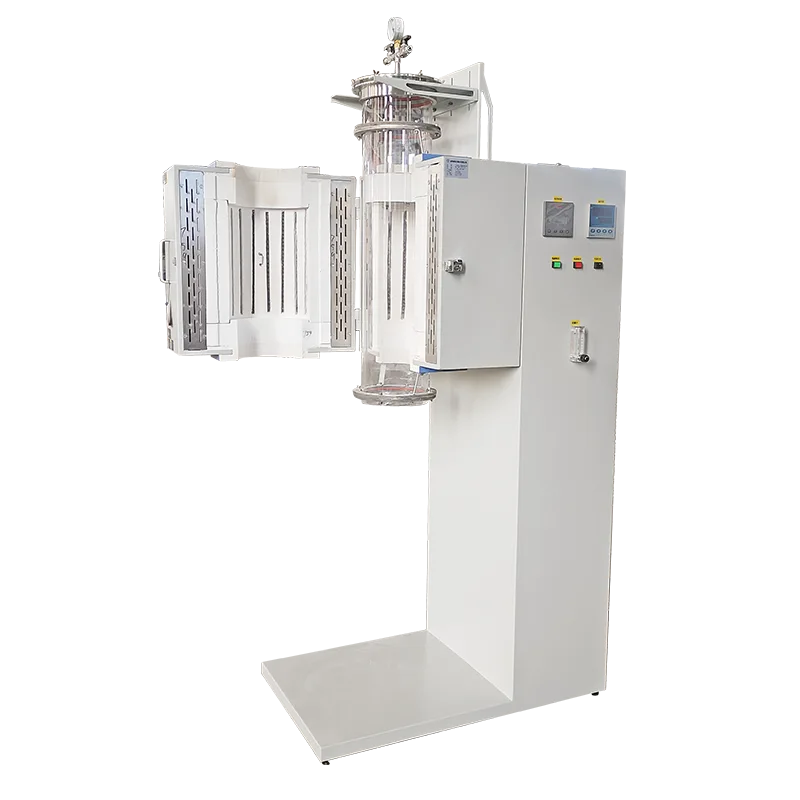
Vertical Tube Furnace: A Complete Guide to Its Working Principle, Applications, and Selection Tips

What Is a Vertical Tube Furnace?
If you've ever worked on material synthesis, thermal treatment, or chemical vapor deposition (CVD), you’ve probably come across a vertical tube furnace. Simply put, it’s a type of furnace where the heating chamber is a cylindrical tube mounted vertically. The sample is placed inside a crucible or directly on a boat, and it’s heated from the bottom or through surrounding heating elements.
The vertical orientation isn’t just a design quirk—it offers real functional benefits, especially when you’re dealing with powder samples, gravity-sensitive materials, or continuous feeding processes. It’s a favorite in both academic labs and small-scale production lines.
How Does a Vertical Tube Furnace Work?
The core structure is beautifully simple: a vertical quartz or ceramic tube sits inside insulation layers, surrounded by resistance heating elements (often Kanthal or silicon carbide rods). The entire assembly is housed in a metal shell with temperature sensors and a controller.
Here’s the step-by-step:
- The sample is loaded from the top. Gravity helps keep it in place, which is excellent for loose powders.
- The tube is sealed with flanges at both ends, allowing you to control the atmosphere—argon, nitrogen, or even vacuum.
- The heating elements raise the temperature at a controlled rate (programmable ramp rates are common).
- Thanks to vertical convection, hot air rises naturally, creating a uniform temperature gradient inside the tube.
- After the process, you can cool the sample either by natural cooling or forced cooling (gas quenching).
Because of this design, vertical furnaces excel in processes where you want minimal contact between the sample and the tube wall, or when you need to feed material continuously from the top while collecting product at the bottom.
Key Features of a High-Quality Vertical Tube Furnace
When you browse a product like the Vertical Tube Furnace from TENCAN, here are the specs you should pay attention to:
| Parameter | Typical Range |
|---|---|
| Max temperature | 1200°C, 1400°C, or 1700°C (depending on heating elements) |
| Temperature accuracy | ±1°C |
| Tube diameter | 40 mm – 100 mm |
| Heating zone length | 200 mm – 600 mm |
| Control system | Programmable PID with multi-stage ramp/soak |
| Atmosphere | Air, inert gas, vacuum (vacuum tube furnace option) |
Most modern vertical tube furnaces also include touchscreen interfaces, over-temperature protection, and data logging via USB or Ethernet. That makes them ideal for repeatable, traceable experiments.
Vertical vs. Horizontal Tube Furnace: Which One Should You Choose?
You might wonder: “Why not just use a horizontal tube furnace?” Both have their strengths. Let’s compare:
- Space efficiency: A horizontal tube furnace takes up more bench width. A vertical furnace has a smaller footprint—perfect when lab real estate is tight.
- Sample handling: In a horizontal furnace, long samples or multiple boats can be placed along the tube. In a vertical furnace, you usually process one sample at a time, but gravity keeps powders from sticking to the tube walls.
- Atmosphere control: Vertical designs are better for processes that require fast gas purging—gas flows straight through from top to bottom, minimizing dead volume.
- Continuous operation: If you want to feed material from above and collect it below (like in calcining or pyrolysis), a vertical furnace is practically mandatory.
So if your work involves powder processing, small footprint, or vertical feeding, go vertical. For multiple samples or large workpieces, horizontal might be easier.
Common Applications of Vertical Tube Furnaces
You’ll find these furnaces in a surprising variety of fields:
- Materials research: Sintering ceramics, annealing thin films, and synthesizing new compounds under controlled atmospheres.
- Chemical vapor deposition (CVD): Growing graphene, nanotubes, or semiconductor layers on substrates placed vertically.
- Catalyst preparation: Calcining catalyst powders at high temperatures while allowing gases to flow through the powder bed.
- Lithium battery material processing: Heating electrode precursors like NCM or LFP under inert gas.
- Environmental testing: Thermal degradation studies of waste materials or biomass.
- Pharmaceuticals: Drying and sterilization of heat‑stable powders.
How to Select the Right Vertical Tube Furnace for Your Lab
Choosing the perfect model doesn’t have to be overwhelming. Keep these factors in mind:
1. Temperature requirement
Check your process temperature. For general sintering, 1200°C is enough. For advanced ceramics or refractory materials, you’ll need 1600–1700°C. TENCAN offers multiple temperature grades—just browse the Vertical Tube Furnace product page to see options.
2. Tube material
Standard fused quartz tubes work up to 1200°C. For higher temperatures, you’ll need alumina (Al₂O₃) tubes—they can go to 1700°C but are more expensive and less transparent.
3. Atmosphere control
If you need vacuum or ultra‑pure gas environments, look for a model with high‑quality flanges and a vacuum pump port. The vacuum tube furnace series is designed exactly for that.
4. Control precision
For sensitive experiments, you want PID controllers with ≤±1°C accuracy and multi‑segment programming. Many TENCAN furnaces come with intuitive touchscreens—makes life much easier.
5. Tube diameter and length
Match the tube size to your sample dimensions. A 50 mm diameter is a good all‑rounder; if you’re handling larger batches, consider a 80 mm or 100 mm tube.
Maintenance Tips for Long Service Life
A vertical tube furnace is a long‑term investment. Here’s how to keep it running smoothly:
- Always heat and cool gradually (≤10°C/min) to prevent thermal shock to the tube.
- Clean the tube interior after each run if you processed sticky or corrosive materials.
- Check the O‑rings and vacuum seals regularly—replace them if they become hardened.
- Keep the controller and power section free from dust.
- Calibrate the thermocouple once a year to ensure accuracy.
Conclusion
The vertical tube furnace is a versatile, space‑saving workhorse for any lab dealing with high‑temperature processing. From sintering powders to growing thin films, its vertical design brings unique advantages that horizontal furnaces can’t match.
If you’re looking for a reliable, professional‑grade vertical tube furnace, check out the full range from TENCAN’s Vertical Tube Furnace collection. And while you’re at it, explore related units like the Muffle Furnace for batch sintering or the Rotary Tube Furnace for continuous processing—you might find the perfect partner for your workflow.
Remember, the right furnace doesn’t just heat your samples; it unlocks new possibilities.
Related Products
Get In Touch
Our professional team will reply to you within one business day. Please feel free to contact us!