
Double Cone Mixer: Working Principle, Key Parameters, and How to Choose Yours

Powders are oddly temperamental things. They sit quietly in a bin and look perfectly still, but the moment you try to combine two of them they start behaving like an unruly crowd — segregating by size, clumping in corners, and stubbornly refusing to cooperate. The double cone mixer is one of the simplest answers to that problem ever invented, and after decades it is still one of the most trusted. In the pages below we will go through what the machine is, how it blends powder, which parameters genuinely affect your results, and how to tell whether it belongs on your line.
We will keep the theory light and the practical detail heavy, because most people reading this are not trying to pass an exam — they are trying to buy the right blender, or to work out why the one they already own keeps giving inconsistent batches. If you want to see the hardware first, you can jump straight to the double cone mixer product page and come back.
What a Double Cone Mixer Actually Does
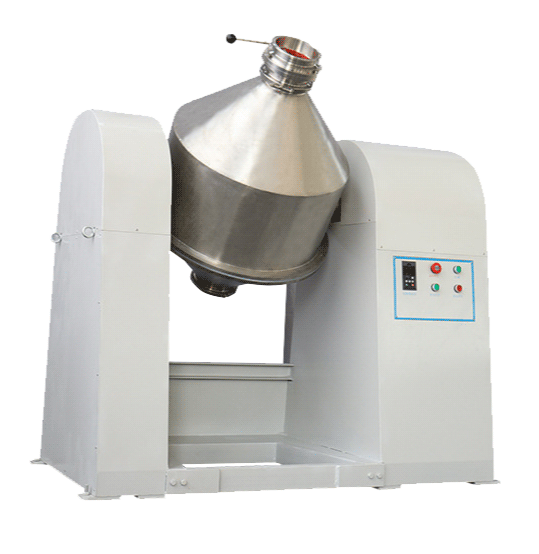
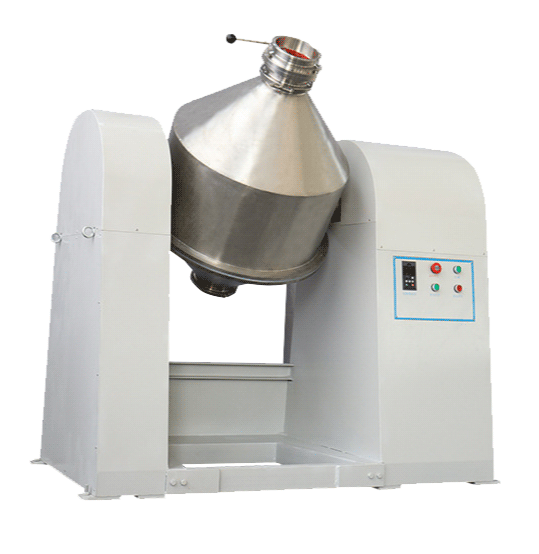
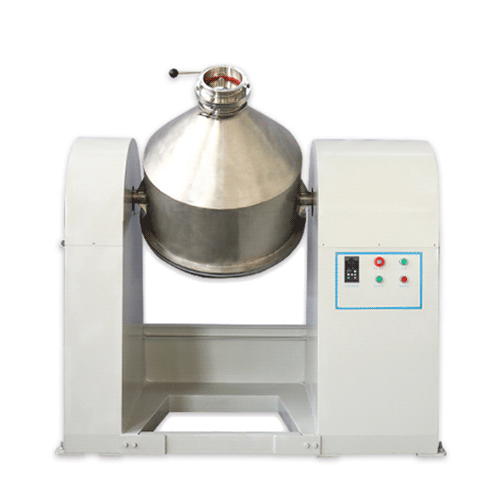
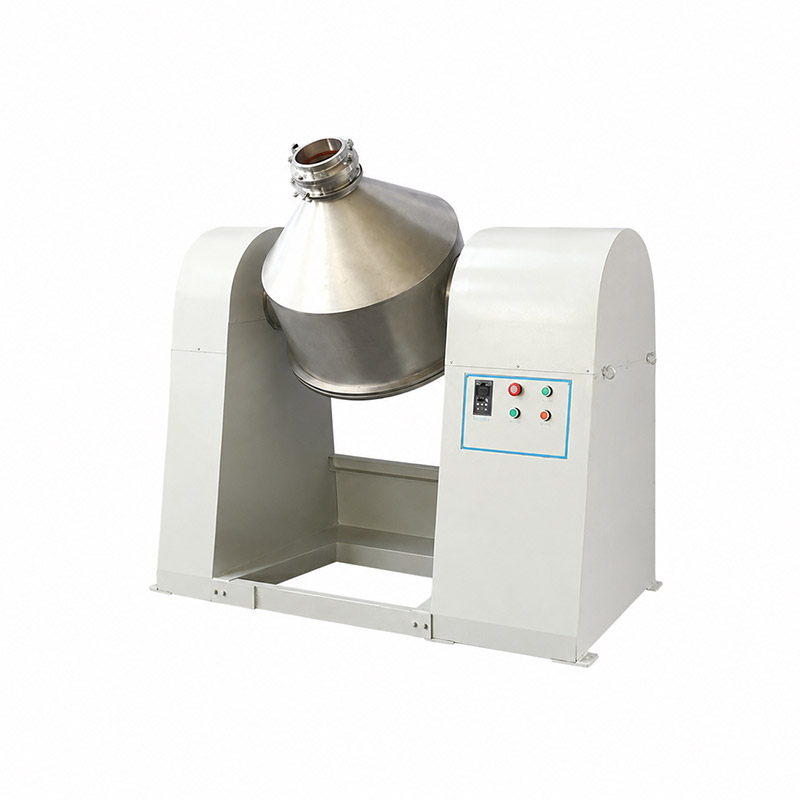
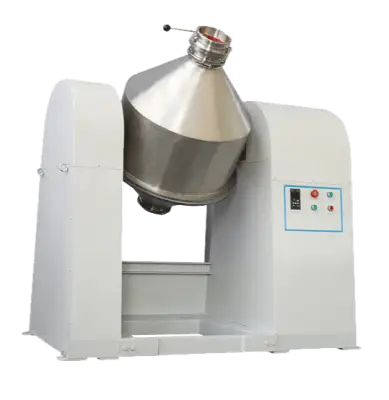
A double cone mixer is a rotating vessel shaped like two cones joined at their wide bases, with a short cylindrical section in the middle. Powder is charged through a port on the shell, the vessel turns slowly on a horizontal shaft, and the material inside tumbles, folds and recombines. When the batch is uniform, it discharges through a valve at the lowest point.
No blades. No high-speed rotor. No fluidising air. The machine never forces the powder to mix — it lets gravity and geometry do the work. That single design decision explains almost everything about where this blender is brilliant and where it is the wrong choice.
The shape is the machine
Picture the interior as two funnels pointing away from each other. As the shell rotates, powder at one end slides down its cone wall toward the centre, while powder at the other end does the same thing from the opposite direction. Because the two halves are offset across the central cylinder, those streams meet, cross and swap places many times per revolution. The cone angle controls how quickly the material slides, the central band gives the two halves a place to exchange particles, and the discharge throat keeps the bed deep enough to fold rather than merely skim across the wall. Change any of those three proportions and you have, in effect, a different mixer.
This is also why you cannot judge a tumbling blender by its volume alone. Two machines with the same working capacity can blend very differently if one has a steeper cone and a longer centre section.
What "gentle" really means
When people in the powder industry call a mixer gentle, they mean three specific things: low shear, low heat input, and low attrition. Attrition is simply the breaking of particles into smaller pieces or dust. A double cone mixer scores well on all three because the only energy it puts into the powder comes from tumbling. Compare that with a ribbon blender dragging a steel ribbon through the bed, or a high-shear granulator passing a blade through the material at speed. For fragile granules, spray-dried agglomerates, crystals or coated particles, that difference is often the entire reason the equipment gets chosen.
How Blending Happens Inside the Rotating Shell
From the outside, mixing looks like magic. Inside a double cone mixer it is really three mechanisms working at once, and each one operates on a different scale.
Diffusion — the patient, particle-by-particle mechanism
Diffusion is what happens when individual particles wander into the gaps between their neighbours. In a tumbling bed it is slow and random: every particle takes a small, unpredictable step and the blend improves gradually. Diffusion is the mechanism that eventually gives you a fine, even mixture, but on its own it is far too slow to do the whole job. Left to diffusion alone, a large batch could take hours. That is exactly why a well-proportioned shell also creates the conditions for the next two mechanisms.
Convection — the fast mover
Convection means bulk movement: whole clumps and layers of powder travelling from one region of the vessel to another. Each time the shell rotates, a slice of the bed slides down a cone wall and is carried across the centre line, so material from the left end ends up near the right end within a handful of revolutions. This is what makes large-scale blending practical. If you want a quick mental test for any tumbler, ask how far a lump of powder travels in a single rotation. The greater that distance, the faster the batch comes together.
Shear — the small, local effect
Shear is the sliding of one layer of powder over another. In a double cone mixer it stays mild and is mostly limited to the moving surface of the bed, which is precisely the point. A little shear is useful for breaking down loose lumps and weak agglomerates, while heavy shear generates heat, wears the product and smears soft or waxy materials. Tumbling gives you a touch of shear where you want it, at the free surface, and very little of the damaging kind.
Why the central crossing zone decides everything
The section where the two cones meet is the busiest part of the machine. Material leaving one half passes through it on the way to the other, and this is where most of the real exchange happens. A shell with a short or poorly matched centre section becomes two cones that merely happen to share a shaft — the ends mix internally but never truly trade material. That is why experienced buyers look at the ratio of cone length to centre diameter, not just the total volume on the nameplate.
Where a Double Cone Mixer Earns Its Keep
Because the motion is gentle and the container itself is the mixer, this design suits a particular kind of job.
Jobs it handles beautifully
- Dry powders of similar particle size and density that must reach a tight uniformity target.
- Fragile granules, agglomerates and coated particles that must not be broken down.
- Free-flowing food ingredients — premixes, spice blends, drink powders, flour blends.
- Pharmaceutical and nutraceutical dry blends where low heat and easy cleaning matter.
- Ceramic, glass, pigment and toner powders, where contamination control is critical.
- Specialty chemical blends that must avoid metal pickup from a contact surface.
- Small to medium batches that can be charged, blended and discharged in one vessel.
Jobs where you should look elsewhere
- Wet masses, pastes and slurries, which tumbling simply cannot move.
- Very cohesive or ultrafine powders that ball up instead of flowing.
- Ingredients with a large density difference, which tend to segregate again once motion stops.
- Sticky, greasy or heat-sensitive materials that coat the walls.
- Processes that need a liquid added and dispersed under high shear.
- Continuous, high-throughput lines, where a batch tumbler becomes the bottleneck.
The Parameters That Actually Decide Your Results
Specification sheets look alike, but a handful of numbers does most of the work. Here is what each one changes.
Working volume versus total volume
Total volume is the geometric capacity of the shell. Working volume is how much powder you can realistically load and still blend properly. The gap between them is not marketing padding — it is the free space the bed needs in order to tumble. As a broad rule of thumb, a tumbling blender performs best when loaded to somewhere around half to two-thirds of its total volume. Fill it to the brim and the powder simply rotates as a solid block, and none of the mixing mechanisms ever start.
Rotation speed
Speed looks like the obvious lever — spin it faster, blend it quicker — but tumblers have a sweet spot. Too slow and the bed barely moves, so blending drags on. Too fast and centrifugal force pins the powder against the wall, where it turns with the shell instead of cascading. Somewhere in between, the material lifts, rolls and folds. That window depends on shell diameter: larger vessels need slower rotation to keep particles cascading rather than centrifuging.
Fill level — the parameter people ignore
You can also get into trouble by loading too little. A shallow bed can slide around the wall without ever folding into itself, which is why a machine that blends beautifully at full capacity may be disappointing with a small trial batch. Consistency between batches matters more than hitting an exact percentage. If you routinely run very different batch sizes, say so before ordering, because the geometry may need to be biased toward the smaller load.
Discharge geometry
Where the powder leaves the vessel matters as much as how it mixes inside. A valve at the true low point empties cleanly; a poorly placed port leaves a dead pocket of the previous product behind. Ask how the discharge diameter matches your powder's flowability, and whether the valve can be operated, inspected and cleaned without dismantling half the machine.
Contact material and surface finish
Everything that touches the powder should be chosen for that powder. General-purpose stainless steel covers most dry blending. Higher-alloy grades suit corrosive or high-purity products. A polished internal finish minimises residue and makes cleaning faster. Non-metallic or specially coated contact surfaces are used when iron contamination is unacceptable. Internal welds should be ground smooth and free of crevices, because crevices hold material and hand it to the next batch.
Drive, sealing and dust control
Rotation has to come from somewhere, and the shaft needs bearings and a seal. A properly sized geared drive holds its speed steadily even as the load shifts, which keeps blend times repeatable. Seals should keep lubricant out of the product and dust out of the bearings. Charging ports, vents and extraction points should be positioned so the vessel can be filled without a dust cloud. Where combustible dust is a concern, the motor, wiring and earthing all have to be rated accordingly.
Blend Time and Uniformity: How to Read the Numbers
Uniformity is usually reported as a coefficient of variation, or CV. In plain language, it compares how much the concentration of a key ingredient varies between samples with the average concentration you were aiming for, expressed as a percentage. Lower is better. Many specifications call for under five percent, and tighter where potency or colour matters. The number only means something, though, if you also state how you sampled — how many samples, from which positions, of what size, and how they were analysed.
Blend curves all have the same shape. Uniformity improves quickly at first, then flattens into a plateau. Everything past that plateau is not improvement; it is extra wear, extra dust and a growing risk of demixing. Demixing is the un-mixing that happens because particles differ in size or density and gradually swap places again during long, free-flowing tumbling. The useful habit is to stop at the plateau, confirm it with samples, and resist the urge to run "a bit longer to be safe".
How It Compares With Other Gentle Blenders
| Blender type | Mixing action | Best suited to | Main limitation |
|---|---|---|---|
| Double cone mixer | Tumbling with a strong central crossing zone | Free-flowing dry powders and fragile granules; clean discharge | Not for cohesive, sticky or wet materials |
| Twin-shell blender | Two angled cylinders repeatedly split and recombine the bed | Small to medium dry blends | More sensitive to fill level |
| Ribbon or paddle blender | Mechanical agitation, higher shear | Cohesive powders, liquid addition | Attrition, heat, longer cleaning |
| Rotary drum | Simple tumbling with little internal geometry | Large volumes of free-flowing solids | Slow, weaker on fine uniformity |
The short version: if your powder flows and must stay intact, the double cone family is normally the first place to look. If your powder is sticky, ultrafine or needs a liquid folded in, no amount of tumbling will rescue you.
Practical Tips From the Shop Floor
- Charge in layers, placing a minor ingredient between two portions of the major one rather than dumping it in a single corner.
- Record fill level, rotation speed and blend time for every product, and treat that record as your recipe.
- Sample in exactly the same pattern every time — uniformity figures are only comparable when the method is.
- Stop blending when the curve flattens, not when the shift ends.
- Inspect seals and earthing regularly; a dry tumbling vessel is a fine place for static to build up.
- Clean between products with a written, repeatable procedure, and choose a design that opens easily if you change products often.
- Watch for vibration. It usually points to a bearing or alignment problem rather than anything wrong with the powder.
- Do not judge a batch by the first powder out of the valve. Sample from the middle of the discharge stream.
Choosing a Double Cone Mixer From TENCAN
Changsha Tencan Powder Technology Co., Ltd. (TENCAN) builds this type of machine for exactly the work described above: dry powders that need a uniform blend without being beaten up in the process. The design attention goes where it matters in daily operation — the proportions of the crossing zone so the two halves genuinely exchange material, a discharge that empties cleanly, contact surfaces matched to the product, and a drive that holds its speed as the load changes.
The practical route to a decision is to start with your powder rather than the machine: bulk density, flowability, particle size, and how fragile or abrasive it is. Then match the working volume to your typical batch, pick the contact material, and decide how the vessel will be charged, vented, earthed and cleaned. You can see how the machine is built, and what options are available, on the specification page for the double cone mixer — worth reading before you talk to anyone, because it turns a vague enquiry into a precise one.
Questions We Hear Most
Can it handle a very small minor ingredient, such as a one-to-a-thousand dilution?
It can, provided you introduce the minor component sensibly. The ratio itself is rarely the problem; the problem is dumping a tiny scoop of powder into a large bed and hoping. Pre-blend the minor ingredient with a portion of the major one, then add that premix in layers, and make sure the vessel is filled enough for the bed to fold rather than slide. Verify with samples, because very low concentrations are exactly where sampling error fools people.
How do I clean it?
It depends on your product and your rules. Dry cleaning means vacuuming and wiping the shell, valve and charging port. Between incompatible products you may need a wet wash with detergent and a rinse, or a solvent wipe. The areas that matter most are the discharge valve, the charging port and the shaft seal, since those are where residue hides. Smooth internal surfaces and a valve that comes apart without tools make the job dramatically faster, and it is much easier to specify that from the start than to retrofit it later.
Will it work for sticky or moisture-sensitive powders?
For sticky powders, the honest answer is usually no — tumbling depends on flow, and no amount of motor power changes that. Moisture-sensitive materials are a different story: they can work well if the vessel is sealed, vented with dry air or nitrogen, and the powder never picks up humidity during charging or discharge. Be realistic about the difference between a product that is merely damp and one that genuinely coats surfaces.
So there it is: a machine with no blades, no rotor and no complicated internals, that gets the job done with shape and gravity. If your powder flows, if your granules must survive intact, and if your uniformity target is tight, a double cone mixer deserves a serious look — and now you know which numbers to ask about before you commit. You can find the full range and the design details on the double cone mixer page.
Related Products
Get In Touch
Our professional team will reply to you within one business day. Please feel free to contact us!