
Chemical Glove Box: A Powder Guide

Why a Chemical Glove Box Exists at All
Here is the thing about chemistry: a lot of it hates air. Not in a dramatic, must-be-locked-in-a-vault way, but in a quiet, ruthless way. You set up a beautiful reaction, the catalyst is perfectly clean, and then oxygen sneaks in at a few parts per million and turns your active species into rust. Moisture does the same damage from the other direction. It hydrolyzes your precursors, kills your yield, and leaves you staring at a spectrum that makes no sense at all.
A chemical glove box is the answer to that problem. It is a sealed enclosure with a transparent window and a pair of long gloves built into the front panel. You slide your hands into the gloves, and suddenly you are weighing, stirring, and assembling air-sensitive materials inside an atmosphere you actually control, usually nitrogen or argon, with oxygen and moisture held below one part per million.
But here is the part people miss. A chemical glove box is not just a very fancy sealed box. It is a system. A working box is an enclosure, a gas purification loop, a set of antechambers, a control system, and a pile of small habits that keep the whole thing honest. Miss any one of those, and your inert environment starts leaking in ways you will not notice until an experiment fails three weeks later.
The Real Job: Hold Oxygen and Water Below the Damage Threshold
Most air-sensitive chemistry starts misbehaving somewhere between 10 and 100 ppm of oxygen or moisture, and some of it starts much sooner. Lithium metal, organolithium reagents, Grignard reagents, zero-valent metal complexes, metal-organic frameworks, sulfide solid electrolytes, and a long list of catalysts all care deeply. So the design target for a serious box is usually under 1 ppm of both O2 and H2O, and a well-maintained unit will sit at 0.1 ppm on a good day.
That number is not a marketing number. It is a real, measurable, daily reality that depends on the condition of your gloves, the health of your catalyst, and whether someone remembered to close the antechamber properly at six o'clock last night.
Glove Box, Fume Hood, or Desiccator?
People mix these three up constantly, so let us separate them fast. A fume hood protects you from the chemistry but does nothing to protect the chemistry from the air. A desiccator protects a small sample from ambient humidity but does not let you work with it. A chemical glove box does both jobs at once: it keeps the atmosphere away from the material, and it keeps you away from the material, while still leaving your hands free to weigh, stir, mill, and build things.
That combination, protection in both directions plus genuine working access, is why the box ends up at the center of so many laboratories instead of sitting in a corner.
How a Chemical Glove Box Actually Works
Strip away the stainless steel and the glass, and a glove box is really four systems pretending to be one piece of furniture. Understanding each one makes you much better at troubleshooting and much harder to fool when a supplier starts quoting numbers.
1. The Enclosure and the Window
The main chamber is normally welded stainless steel with a large transparent front panel made from laminated glass, polycarbonate, or acrylic. The choice depends on the model and on how much solvent abuse it will take over its lifetime. The window is the entire point: you need to see what your hands are doing in there. Ports, feedthroughs, and electrical connectors are built into the walls so you can run stirrers, hot plates, balances, and sensors without ever breaking the seal.
Look at the interior welding quality if you get the chance. Rough welds, unfinished corners, and sharp internal edges collect powder and are miserable to clean. A polished interior is not vanity. It is hygiene.
2. The Antechamber and Why Cycle Time Matters
The antechamber, sometimes called the airlock or transfer chamber, is a small vacuum-tight box attached to the main chamber with two doors: one to the outside world, one to the inside. You place your sample in, close the outer door, evacuate the chamber, refill it with inert gas, and repeat. Two or three cycles later, the atmosphere inside is clean enough to open the inner door and bring the sample in.
This is where a surprising amount of your day quietly disappears. A large antechamber on a slow pump can take ten or fifteen minutes per transfer. Move twenty samples in a day and you have lost hours. When you compare boxes, look hard at antechamber volume, pump speed, and whether the controller offers an automatic cycling program. It sounds like a small feature. It is not.
3. The Gas Purification Loop
This is the heart of the machine. Gas is continuously pulled out of the main chamber, pushed through a blower, and passed over two beds. The first is usually a copper-based catalyst that grabs oxygen, and it reacts with it rather than just trapping it. The second is a molecular sieve that grabs water by adsorption. After the beds, the cleaned gas returns to the chamber.
Both beds eventually get tired. The sieve fills up, and the copper catalyst becomes saturated, so the loop has to be regenerated. That means heating the beds while running a hydrogen and inert gas mixture through them, which reduces the oxidized copper back to its active form and drives the collected moisture out. Regeneration runs overnight, and it is the reason a glove box has a slightly ritualistic relationship with its own schedule.
The quality of that loop decides everything. A box with a weak blower and undersized beds will fight to stay under 1 ppm no matter how carefully you operate it.
4. Pressure Control and Sensors
A glove box normally runs at a slight positive pressure, just a few millibars above the room, so that any small leak pushes inert gas outward instead of pulling air inward. Pressure is managed by a foot pedal, a manual valve, or an automatic control loop that adds gas when pressure drops and vents when it rises. Automatic control is worth every cent if you plan to run the box all day.
Sensors matter just as much. Continuous oxygen and moisture analyzers let you see the state of your atmosphere at a glance, and they will tell you immediately when a glove fails or a door is not sealing. Trust the numbers, not the vibe.
The Main Types of Chemical Glove Boxes
Not every box is built for the same job, and picking the wrong style is an expensive lesson. Here is how the main families differ.
Inert Atmosphere Boxes
This is the standard workhorse. Nitrogen or argon fill, a recirculating purification loop, one or two antechambers, and a pair of gloves. If you are working with lithium, catalysts, or any oxygen-sensitive powder, this is almost certainly what you are describing. Single-station versions fit one person comfortably; multi-station versions let two or three people work side by side in the same atmosphere.
Recirculating Boxes With Solvent Filters
Use a lot of solvent inside a box and you will eventually poison the catalyst bed with volatile organic compounds. The fix is an additional solvent trap, usually a cooled or high-surface-area filter placed before the purification beds, which strips solvent vapor out of the circulating gas before it reaches the copper catalyst.
If your process involves working with wet slurries, wet grinding, or regular solvent dispensing, this is not optional equipment. It is what keeps the loop alive.
Vacuum Glove Boxes
Vacuum boxes are simpler and cheaper. They are evacuated and backfilled rather than continuously purified, so they are suited to short handling tasks rather than long experiments. If you only need to open an ampoule, weigh a sample, and seal a cell, a vacuum box is a sensible budget answer. If you need a stable sub-ppm atmosphere for hours, it is not.
Specialty and Hybrid Boxes
There are also boxes built for particular jobs: transparent chambers for optical inspection, boxes with integrated thermal processing, boxes with robotic handling for high-throughput work, and boxes designed to hold a specific analytical instrument. If your process has an unusual footprint, tell the supplier early, because retrofitting a port after delivery is far more painful than designing it in.
What People Actually Do Inside a Chemical Glove Box
The list of applications is longer than most people expect. A few of the classics:
- Preparing and handling battery materials, from lithium metal and sulfide solid electrolytes to the composite slurries that go into a cell.
- Weighing and transferring air-sensitive catalysts, ligands, and organometallic precursors.
- Synthesizing metal-organic frameworks and other porous materials that lose their structure in humid air.
- Assembling and sealing electrochemical cells, including coin cells and pouch cells.
- Working with pyrophoric powders and reactive metal hydrides, where safety and atmosphere control are the same problem.
- Preparing powder samples for analysis, including grinding, sieving, and packaging before the sample ever meets room air.
- Handling OLED materials, semiconductor dopants, and phosphors that degrade on contact with moisture.
- Dispensing and drying air-sensitive pharmaceuticals and active ingredients in small quantities.
Notice how many of those involve powder. That is not a coincidence, and it is where the conversation usually gets interesting.
The Powder Problem: Where Milling Meets Inert Atmosphere
Powders have enormous surface area. A fine powder that looks inert in a jar might be reacting with moisture the whole time, and you will only find out when the analysis comes back wrong. The smaller you grind, the more surface you expose, and the faster that reaction runs.
Why Particle Size and Atmosphere Are Connected
Think about what comminution actually does. Grinding breaks particles apart and continually creates fresh surfaces. Those fresh surfaces are chemically hungry. For an oxygen-sensitive or moisture-sensitive material, every new square centimeter of surface is a new opportunity to oxidize or hydrolyze, and the reaction products sit right there on the particle, changing its color, its conductivity, its sintering behavior, and its performance in a final device.
So the equation is simple. If you mill a sensitive powder in air, you are not milling your material. You are milling a slowly forming coating of its oxide. If you mill it wet, in a properly chosen liquid medium, and keep the whole circuit under an inert blanket, you keep the surface clean.
Bringing a Production Type Sand Mill Into the Workflow
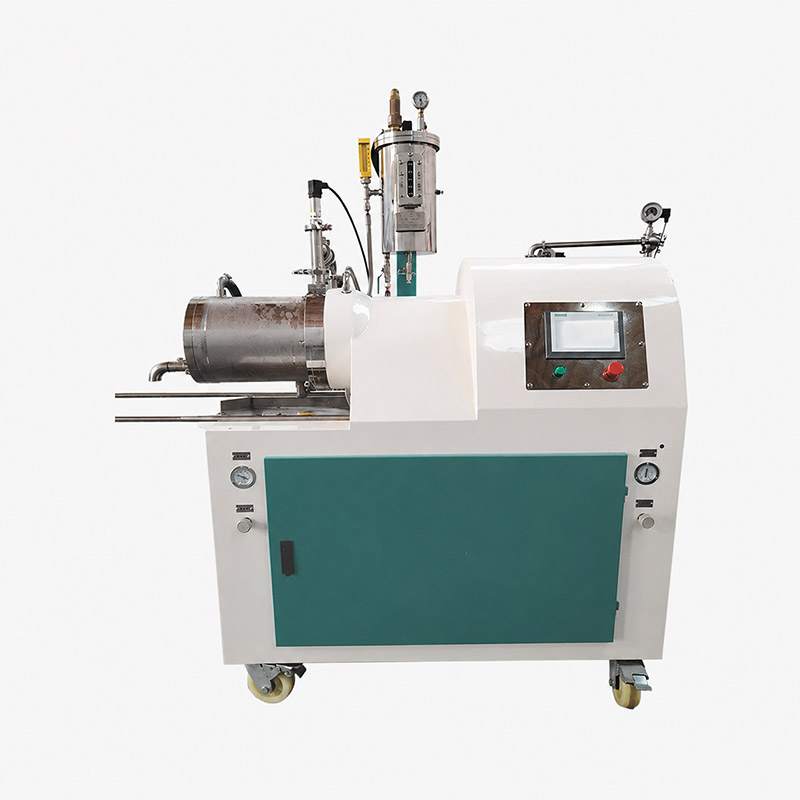
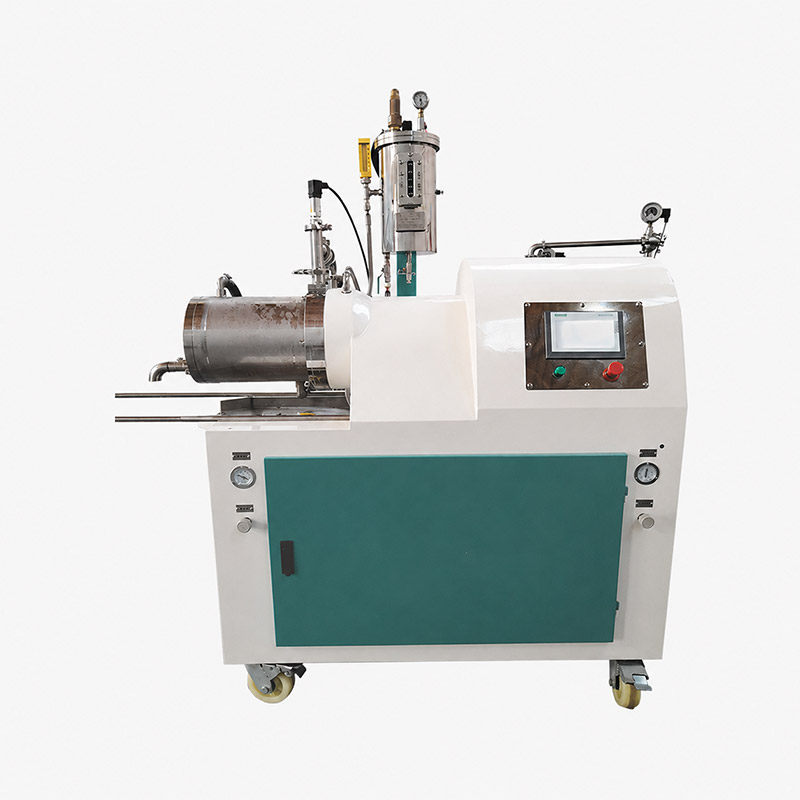
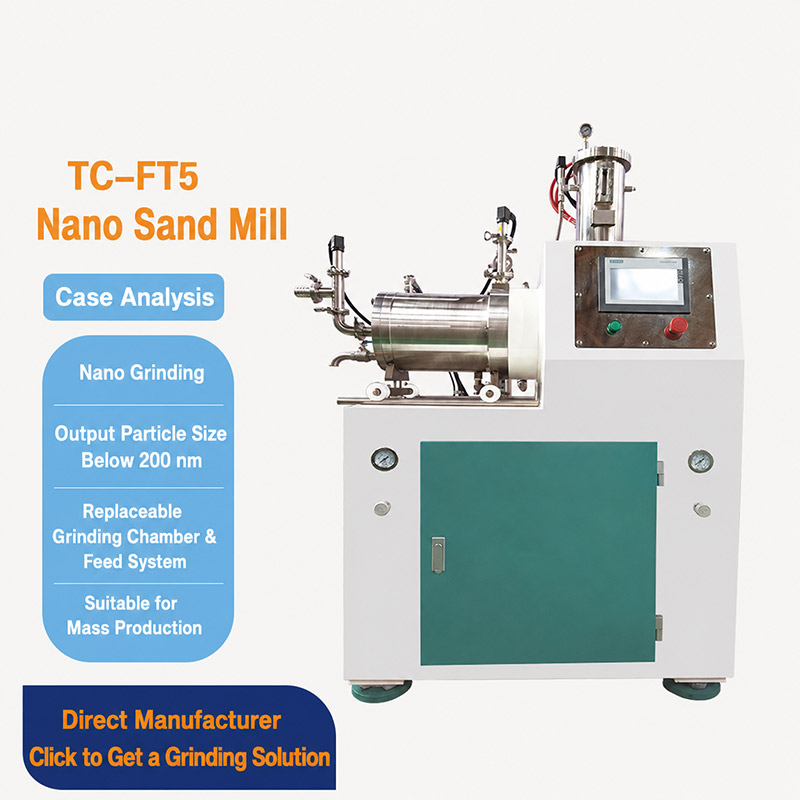
This is where a production type sand mill earns its place. A sand mill, sometimes called a bead mill, grinds and disperses material by pumping a slurry through a chamber filled with small grinding media while a rotating shaft keeps those media in violent, controlled motion. The shear and impact between the beads break agglomerates down and reduce particle size, and the design is built for continuous, repeatable output rather than one jar at a time.
For a chemical glove box workflow, three properties matter most. First, wet grinding: the powder is suspended in a liquid carrier, which drastically reduces the amount of free surface exposed to the surrounding gas, and makes it far easier to keep the material protected. Second, closed processing: a well-designed mill is a sealed circuit, so the atmosphere around the slurry can be controlled rather than left to the room. Third, repeatability: production-scale equipment gives you the same particle size distribution run after run, which matters enormously when you are trying to prove that an inert process is actually producing a consistent material.
Where does the glove box fit? Two ways, usually. Small quantities of oxygen-sensitive powder go into the box for weighing, mixing, and sample preparation, while the mill handles the larger volumes of slurry in a closed loop. Or the mill output is transferred directly into the box for cell assembly and packaging, so the material never sees ambient air between grinding and use. Either way, the goal is the same: shorten the time your powder spends in contact with oxygen and water.
Wet Grinding, Slurries, and the Atmosphere Above Them
Wet grinding brings its own atmosphere question. A slurry in an open tank is a large, moving liquid surface, and whatever gas sits above that surface will dissolve into the liquid, at least partially. If you want to keep dissolved oxygen low, you sparge with inert gas, seal the vessel, and keep the headspace blanketed.
Solvent choice also interacts with your glove box. Volatile solvents inside a box will attack the purification catalyst unless you have dedicated solvent filtration, and they will also fog your window. Many labs handle this by keeping the bulk slurry work outside the box in a closed system, and bringing only small, sealed samples inside. If you want the full technical picture on the grinding side, the production type sand mill page lays out the configuration options and the operating parameters worth reviewing before you plan your process line.
Specs Worth Asking About Before You Buy
Suppliers quote a lot of numbers, and some matter much more than others. Here is a practical checklist you can walk through with any vendor.
| What to ask | Why it matters |
|---|---|
| Baseline O2 and H2O levels | The <1 ppm figure is the promise; ask how quickly it recovers after a transfer. |
| Leak rate of the main chamber | A leaky box will never hold a good atmosphere, no matter how good the catalyst is. |
| Antechamber volume and pump speed | Directly controls how much of your day is spent waiting for transfers. |
| Purification bed capacity | Determines how often you regenerate, and how much solvent exposure the loop tolerates. |
| Glove material and thickness | Chemical compatibility, dexterity, and puncture resistance trade off against each other. |
| Pressure control method | Manual pedals are cheaper; automatic control saves gas and your attention. |
| Interior finish and cleaning access | Powder work demands smooth surfaces and reachable corners. |
| Ports, feedthroughs, and power | Decide up front whether a mill, stirrer, balance, or heater goes inside. |
| Footprint and glove height | Ergonomics is not a luxury. Shoulder pain ends more glove box careers than bad chemistry. |
If a vendor can talk comfortably about all nine rows, you are dealing with someone who has actually operated a box. If they cannot, keep asking.
Running a Chemical Glove Box Day to Day
Startup and Purge
After a shutdown, or after the box has been opened for maintenance, you purge with inert gas to push the atmosphere down before handing the job over to the purification loop. Purge long enough, watch the analyzers, and do not be tempted to skip ahead because the readings look close. Close is not the same as clean, and the catalyst bed will pay for your impatience later.
Regeneration
Regeneration is a scheduled event, not an emergency. When moisture or oxygen readings start drifting up and staying up, the sieve or the catalyst is telling you it is full. Regenerating at the first sign of drift keeps the loop healthy. Procrastinating until the box will not go below 5 ppm means you have been running compromised experiments for a week and did not notice.
Solvents, Vacuum, and Heat Inside the Box
All three are useful and all three are hostile to your atmosphere. Solvents poison the catalyst. Repeated vacuum cycling stresses gloves and seals. Heat drives out adsorbed moisture from whatever you put in the oven, which then goes straight into the loop. Use dedicated solvent traps, keep vacuum work local rather than pulling the whole chamber, and give the box time to recover after an oven run.
The Mistakes Almost Everyone Makes Once
- Opening the inner door too soon after a single purge cycle, betting that one evacuation was enough.
- Transferring a container that still has moisture clinging to the outside of the lid.
- Leaving a solvent bottle open inside the box overnight, which quietly poisons the catalyst.
- Ignoring a small pinhole in a glove because it is on the back of the hand where the leak is slow.
- Pushing sharp metal tools around without thinking about what is underneath them.
Every one of these has a story behind it, and none of them are funny at the time.
Maintenance Rhythm That Keeps You Under 1 ppm
A glove box rewards routine. Inspect gloves visually before every session and test them periodically with a proper leak check. Replace gloves at the first sign of stiffening, discoloration, or thinning, because a glove is both your barrier and the most likely failure point in the whole system.
Check the antechamber door seals, the main window gasket, and the O-ring on every access port on a fixed schedule. Leak test the chamber occasionally with a pressure hold test. Change the solvent filter when it starts loading up. Keep a log of regeneration dates and analyzer readings, because patterns in that data tell you what is happening long before an experiment fails.
Keep the interior clean. Powder residue that sits in a corner for months will slowly release moisture every time you disturb it, and it will contaminate any sample that touches the same surface. A quick wipe-down with a compatible solvent, kept up regularly, is much easier than a deep clean that forces you to open the box.
Safety Notes You Should Not Skip
An inert atmosphere is a hazard as well as a tool. Nitrogen and argon are not toxic, but they displace oxygen, and an enclosure full of them is a genuine asphyxiation risk if a glove tears badly or a large volume escapes into a small room. Ventilation in the room matters, and a personal oxygen monitor near the box is a cheap precaution that is hard to argue with.
Glove material has to be matched to your chemistry. Solvents, acids, and reactive powders all attack different polymers at different rates, and a glove that handles one beautifully can fail quickly with another. Check compatibility before you start, not after your hand is inside.
Finally, remember that a glove box concentrates risk. Pyrophoric powders, reactive metals, and flammable solvents inside a sealed, oxygen-poor enclosure behave differently than they would on an open bench. Plan what you would do if something ignited, and make sure the person working next to you knows the plan too.
Frequently Asked Questions About Chemical Glove Boxes
Can you put powder work inside a glove box?
Yes, and you often should. Weighing, sieving, mixing, and sealing powders that react with air all happen comfortably inside a box. The practical challenge is cleaning: fine powder gets everywhere, so use trays, work on a liner, and clean as you go rather than at the end of the month.
Do you need a glove box for milling?
Not always. If your material is only mildly moisture-sensitive and you are grinding it wet in a sealed mill, a well-controlled closed circuit may be enough. If the material is genuinely air-sensitive, or if the milled powder goes straight into an air-sensitive device, then yes, the box is where the downstream handling belongs.
Can a mill go inside the glove box?
Small planetary and ball mills sometimes do, but a production-scale mill will not fit, and putting one there would flood the loop with solvent vapor and dust. The usual arrangement is to keep the mill outside in a closed, inert-blanketed configuration and move sealed samples into the box for the delicate steps.
How long does it take to reach 1 ppm?
After a proper purge, a healthy loop usually reaches low single-digit ppm within an hour or two, then continues down toward 0.1 ppm over the following hours. A box that plateaus above 1 ppm and stays there almost always has a leak, a saturated bed, or solvent contamination.
How often do gloves need replacing?
It depends entirely on use. A heavily used box with solvent work and sharp tools might replace gloves every few months, while a lightly used box can go a year or more. Inspect frequently, replace at the first sign of trouble, and never patch a glove and forget about it.
Is a chemical glove box the same as an isolator?
The words overlap. Isolator usually describes a sealed enclosure used in pharmaceutical or nuclear settings where the priority is containment in one direction. A chemical glove box is usually built around atmosphere quality in both directions. The hardware looks similar; the design targets are different.
Matching the Box to Your Process
The right chemical glove box is the one that fits the way you actually work. If you handle a few grams of catalyst a week, a compact single-station box with a good purification loop is plenty. If you are running a powder process from grinding through cell assembly, you need a box that can absorb the airflow, the solvent load, and the sample traffic without losing its atmosphere.
Whichever direction you go, keep the two halves of the problem in view. The box protects your material from the air; the grinding equipment decides what that material looks like in the first place. When both are specified with the same care, the process stops being a series of lucky experiments and starts being something you can repeat on a Tuesday afternoon. Start with the production type sand mill if your bottleneck is particle size, and build the atmosphere control around it from there.
Related Products
Get In Touch
Our professional team will reply to you within one business day. Please feel free to contact us!