
Stainless Steel Vibrating Screen Machine: How to Sieve Powder Faster and Cleaner

Powder is messy stuff. You blend it, dry it, grind it, and somehow it still clumps together, hides a few oversized chunks, and throws dust exactly where you don't want it. If your job involves powders — food ingredients, chemicals, ceramics, battery materials, cosmetics, you name it — you already know a batch can look perfect in the mixer and still fail a simple quality check. Most of the time, the fix isn't a bigger blender. It's a screen.
That's where a stainless steel vibrating screen machine earns its keep. It sits at the end of a line or right in the middle of one, shakes a mesh at a controlled rhythm, and lets good powder fall through while everything else stays on top. The idea is simple. The execution is where the interesting details live — mesh choice, vibration settings, contact materials, cleaning between products, and keeping the mesh from blinding halfway through a shift.
Let's walk through all of it, the way we'd explain it to a colleague standing next to the machine.
What a Stainless Steel Vibrating Screen Machine Actually Does
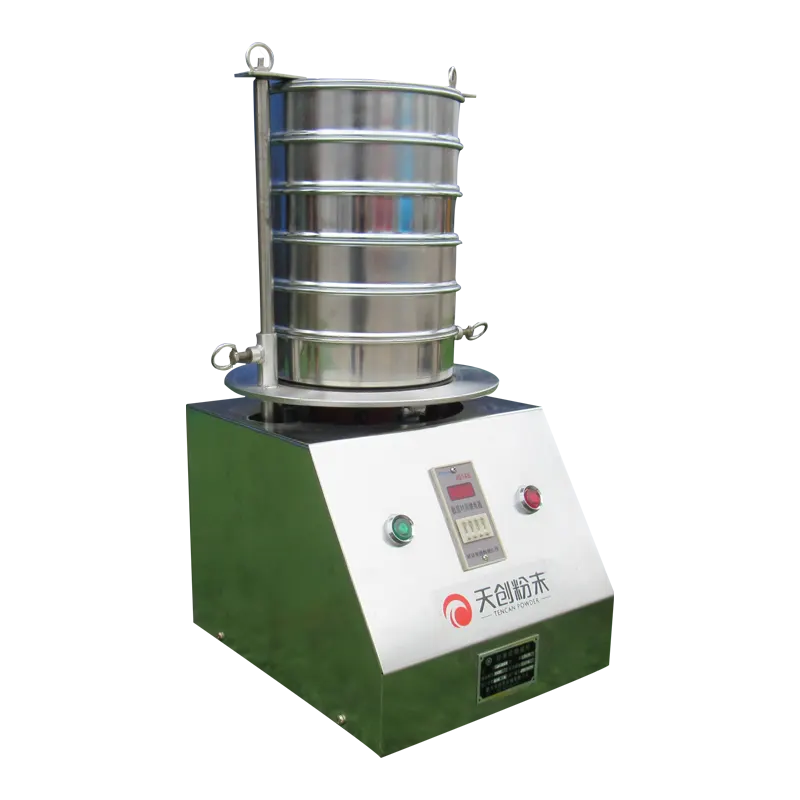
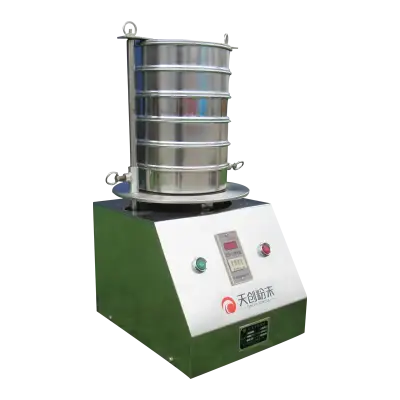
A vibrating screen machine — sometimes called a vibro sifter, rotary vibrating screen, or simply a sieving machine — separates powder by particle size using a mesh and vibration. Powder enters at the top, the mesh vibrates, small particles pass through and exit one way, oversized material travels across the screen and leaves another way. Depending on how many decks you stack, you can split one feed into two, three, or more size fractions in a single pass.
The machine itself is a fairly straightforward assembly, which is part of why it stays reliable in daily production.
The main parts, in plain language
- Vibration source: a motor with adjustable eccentric weights at the top and bottom. Turning those weights changes how far the machine throws the powder and how it travels around the screen.
- Screen deck and mesh: the frame that holds the woven mesh or perforated plate. This is the part that actually does the separating.
- Spring isolators: springs that let the body vibrate freely while the base stays steady, so the machine doesn't shake your floor or your neighboring equipment.
- Clamping rings and covers: quick-release clamps that hold the decks together, plus a dust-tight cover with an inlet on top.
- Discharge spouts: a separate outlet for each fraction, positioned so it can connect to hoses, hoppers, or bulk bags.
Stack a few decks and you have a compact grading station. Add a dust cover and it behaves well in a room that needs to stay clean.
Why stainless steel matters more than you'd think
Contact parts on a sieving machine see abrasive powder all day, every day. A painted or mild steel surface will scratch, chip, and eventually rust — and every chip is a contaminant in your product. Stainless steel solves that in one move: it resists corrosion, wipes clean, tolerates moisture and mild chemicals, and doesn't shed coating into the powder stream.
The common grades you'll hear about are 304 and 316L. Both are food-contact friendly; 316L usually gets the nod when the powder is salty, acidic, or when the cleaning routine involves harsher detergents. If your product ends up in a person's body — food, supplements, cosmetics, pharma intermediates — this isn't a nice-to-have. It's the baseline.
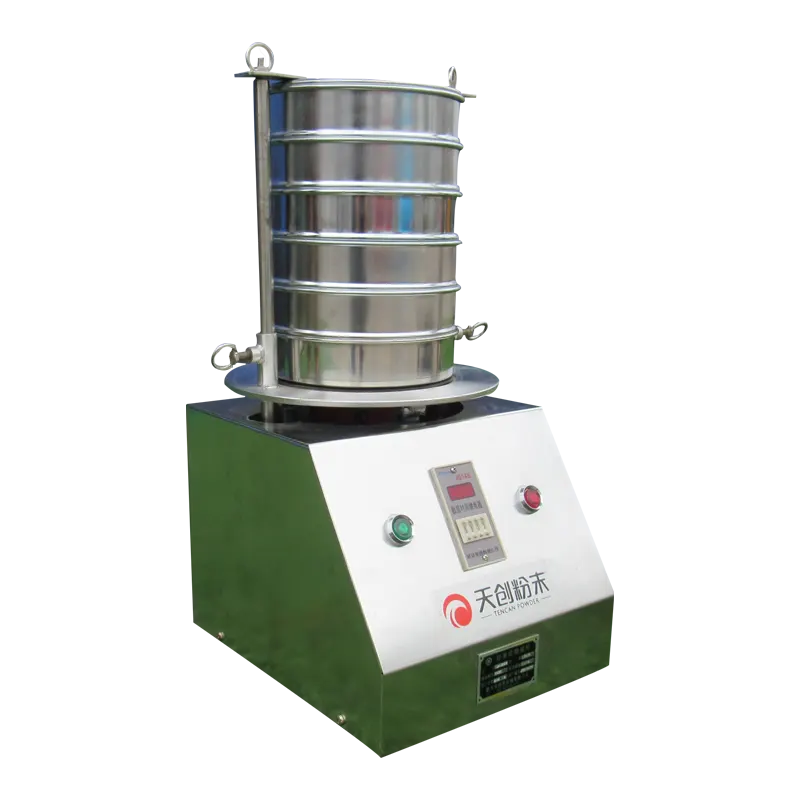
If you want to see how these details come together on a real machine, TENCAN's stainless steel vibrating screen machine is a useful reference point: product-contact parts in stainless steel, a compact footprint, and a design meant for quick teardown between batches. TENCAN is the short name for Changsha Tianchuang Powder Technology Co., Ltd.
How Vibration Actually Separates Powder
Here's the part people usually gloss over. Sieving isn't just "small stuff falls through holes." If it were that simple, you'd tilt a mesh and let gravity do the work — and you'd be standing there for an hour with a brush in your hand.
The problem with passive sieving is that powder is not a pile of independent, well-behaved spheres. Particles stick to each other, clump into loose balls, and plug the openings they're supposed to pass through. A static mesh blinds itself within minutes at fine mesh sizes.
Vibration fixes all of that at once, and it does it in three distinct ways.
Job one: keep particles meeting the holes from every angle
A vibrating mesh constantly tosses particles up and lets them land again. Every landing is a fresh chance to find an opening at the right orientation. Instead of one attempt, each particle gets hundreds of attempts. Throughput rises dramatically for the same mesh size, and nobody has to push powder along by hand.
The motion is typically circular or three-dimensional: powder spreads outward in a spiral across the mesh, travels to the rim, and the oversize leaves through a dedicated outlet. That spiral path is what lets you run a continuous feed instead of working batch by batch.
Job two: break up soft agglomerates
Loose clumps held together by moisture or static aren't really "oversize" — they're just powder that got too friendly with its neighbors. The repeated impacts knock those weak bonds apart, and the freed particles pass through the mesh as they should. What stays behind is genuinely oversized material, which is exactly what you want on the reject side.
Job three: keep the mesh from blinding
Blinding — mesh openings blocked by stuck particles — is the number one enemy of any sieving operation. Vibration, plus a well-chosen mesh type and the right amount of throw, keeps holes clear. Too little amplitude and fine powder sits on the mesh like a blanket. Too much and the powder bounces above the mesh instead of through it, which throws capacity away.
Amplitude, frequency, and mesh aperture: the three dials that decide everything
Think of these as the settings that turn a generic machine into your machine:
- Amplitude is how far the screen moves on each stroke. Small amplitude suits fine, light powders; bigger amplitude moves heavy or damp material and helps prevent pegging.
- Frequency is how fast it moves — hundreds to a couple of thousand oscillations per minute on most machines. Higher frequency generally helps fine powders pass; lower frequency handles coarse, heavy material with less wear.
- Mesh aperture is the actual opening size in the cloth. This number defines your cut point, and it has to match both your target particle size and your throughput goal.
Get those three right and the machine runs itself. Get them wrong and you'll spend your shift cleaning mesh and re-screening rejects.
Reading the Specs: What to Nail Down Before You Order
When you compare machines, don't start with price. Start with the powder. Everything else follows from what you're actually screening: bulk density, moisture, particle shape, static behavior, abrasiveness, and the size range you need to cut.
Once you know your powder, these are the parameters worth writing down before you talk to anyone.
| Parameter | What it controls | What you need to decide |
|---|---|---|
| Mesh aperture | The cut point — which particles pass and which stay behind | Your largest acceptable particle size, plus a safety margin |
| Screen diameter / deck size | Capacity — how much powder the mesh can process per hour | Your required throughput, and specifically your peak, not your average |
| Number of decks | How many size fractions come out in one pass | Whether you need one cut, two cuts, or a full grading split |
| Material grade | Corrosion resistance and cleaning compatibility | Product-contact requirements: 304 usually, 316L for harsher duty |
| Vibration drive | Amplitude, motion pattern, and how adjustable it is | Whether your powder is light and fine or heavy and damp |
| Discharge layout | How the fractions leave the machine | Height, direction, and connection to hoses, hoppers, or drums |
| Dust-tight cover | Containment and operator exposure | How dusty or hazardous your material is |
| Mobility and footprint | Where it lives and whether it moves | Fixed line position, or one machine serving several lines |
One warning: doubling screen diameter does not double capacity in a straight line, and going finer on mesh always costs throughput. If someone quotes a capacity figure without asking about your material, treat it as a starting point, not a promise.
Questions worth asking any supplier
- Which parts touch the product, and exactly which stainless grade are they?
- How long does it take to strip the machine down for cleaning — with tools or without?
- Can amplitude be adjusted in the field, or does it need a motor swap?
- How is the mesh held in place, and how often does it need replacing?
Matching Mesh to Your Powder
Mesh is the heart of the whole operation, and it's where most people make their first mistake: they pick the finest mesh they can find and then wonder why throughput collapsed.
Pick the aperture from your spec, not your ambition
Your mesh only needs to be as fine as your quality requirement demands. If the specification says "nothing above 500 microns," a mesh with an aperture comfortably below that does the job. Going finer than necessary buys you nothing except lower capacity, more blinding, and faster mesh wear.
Leave a margin between your target maximum particle and your mesh aperture, because mesh tolerances and particle shape both affect what sneaks through. Sharp, needle-like particles behave very differently from round ones — long thin crystals can pass a hole that a sphere of the same mass would never fit through.
Woven mesh, perforated plate, or bar screen?
- Woven mesh gives the finest cut points and the best open area. It's the default for powders.
- Perforated plate is far more durable and handles coarse, heavy, or highly abrasive material. The trade-off is a coarser cut point and less open area.
- Bar screens and grids are for rough de-lumping and protection screening ahead of other equipment, not for precise grading.
When your powder fights back
Some powders are genuinely difficult: hygroscopic salts, oily food ingredients, fine pigments with heavy static, anything that forms a film on metal. For these, setup matters as much as mesh choice. Feed evenly instead of dumping, keep moisture out, ground the equipment properly, and use motion that keeps material traveling across the surface instead of sitting in one spot.
There are also add-on approaches on the market, such as screen-cleaning devices that knock stuck particles loose from below, or ultrasonic de-blinding systems for very fine meshes. If your material is in that category, raise it early. It's much cheaper to specify up front than to retrofit later, and you can review the standard configuration on the stainless steel vibrating screen machine page to see what's available as a baseline.
Everyday Powder Problems a Vibrating Screen Solves
Lumps and agglomerates that ruin a batch
Moisture, static, and storage pressure all create clumps. A lump that survives into your final product is a defect: it won't dissolve at the same rate, it won't blend evenly, and it will show up in a customer complaint. Screening catches those clumps and knocks the weak ones apart before they cause trouble.
Oversize particles and foreign material
Every process sheds something. Bags lose fibers, equipment loses the occasional washer, dried product forms hard flakes on the walls of a dryer. A screen placed at the right point in the line is a final checkpoint that stops these things from reaching a package. In regulated industries, that checkpoint isn't optional — it's part of your quality system.
Dust and housekeeping
A dust-tight machine with a proper cover doesn't just protect your product, it protects your operators and your cleaning budget. Powder that stays inside the machine is powder nobody has to sweep off the floor, and it's far less of an exposure risk for the people running the line.
Batch-to-batch consistency
Two batches of the same product can vary in flowability and particle distribution. A screen normalizes that: whatever comes in, what leaves has a controlled top size. That consistency is what makes downstream filling, mixing, and tableting predictable — and predictable is what makes a production schedule hold.
Where It Fits on Real Production Lines
Food and bakery ingredients
Flour, sugar, starch, cocoa, spice blends, and powdered drink mixes all benefit from screening before blending and before packing. It catches lumps from humidity and removes foreign matter. Stainless steel construction and easy teardown matter here, because changeovers can happen several times a day.
Chemicals and fine powders
In chemical production, screening often protects the next step in the process rather than the final product — making sure a reactor or mixer receives a consistent, lump-free feed. Abrasive or corrosive materials push you toward more durable mesh, perforated plates, and higher-grade stainless steel.
Ceramics, glass, and battery materials
These powders are usually abrasive and often expensive. You don't want to lose good material with the reject stream, and you don't want contamination from worn metal. A tight, well-maintained screen with the right aperture maximizes yield while keeping the cut point honest — and in battery material production, where particle size directly affects performance, that cut point is a process parameter, not a convenience.
Cosmetics, pharma, and personal care
Powder foundations, talc, and pharmaceutical intermediates demand cleanliness, containment, and documentation. Stainless steel contact surfaces, dust-tight covers, and fast, tool-free disassembly decide whether a machine is practical in these environments.
Setup, Operation, and Maintenance Habits That Pay Off
Before the first run
- Level the base and confirm the springs sit correctly — a machine that rocks wastes its vibration on your floor.
- Check that the clamping rings are snug and the cover seals properly. Loose clamps mean powder escaping at the joint.
- Use flexible connections, not rigid pipes, on the inlet and outlets. Rigid connections fight the vibration and eventually crack.
- Ground the equipment properly if you run powders that build static.
While it's running
Feed at a steady rate instead of dumping in a bucket at once. Overloading a screen is the fastest way to send good powder out with the rejects, because particles don't get enough chances to find an opening. Watch the discharge streams. The reject outlet should carry a small, steady flow, not a torrent — if it's carrying product, your feed is too fast or your amplitude is wrong.
Cleaning between products
Quick-release clamps exist for a reason. Strip the decks, brush the mesh from both sides, and wipe the contact surfaces dry. For allergen or regulated changeovers, inspect the mesh for residue and consider a dedicated set of screens per product family. Never use tools that can deform the mesh — a dented screen doesn't just look bad, it changes the cut point and lets oversize material through.
Maintenance you can do in minutes
- Inspect the mesh regularly for tears, sagging, and stretched areas around the clamps.
- Check motor mounting bolts and spring condition; vibration loosens anything that isn't tight.
- Keep spare mesh and spare clamps on the shelf. Downtime costs far more than a screen, and it's usually the mesh, not the machine, that stops production.
- Log your settings: amplitude position, mesh size, feed rate. When a new operator takes over the line, that log is worth its weight in gold.
Safety and Hygiene Notes
Isolate power before any cleaning or mesh change — the machine moves faster than your hand. Keep guards in place and never reach through an inlet while it's running. Treat dust as a real hazard too, since many powders are combustible or respirable, so keep covers closed and use dust-tight connections. And remember that a clean screen is only as clean as its surroundings: if the discharge spout runs into a dusty hopper, you've done the sieving work for nothing.
Making the Call: Matching the Machine to Your Powder
If you take one idea away, take this one: the machine is the easy part, the match is the hard part. A stainless steel vibrating screen machine with the wrong aperture, the wrong motion, or a cleaning routine nobody has time for will sit idle within a month. The same machine, specified around your actual powder and your actual shift routine, quietly pays for itself for years.
So before you buy, write down your cut point, your peak throughput, your material's quirks, your cleaning frequency, and your hygiene requirements. Then compare machines against that list. If you want a compact stainless steel unit that covers the common cases, start with the Stainless steel vibrating screen machine from TENCAN, and ask your specific questions rather than accepting a generic quotation.
Powder doesn't get any less messy. But with the right screen in the right place, it becomes predictable — and predictable powder means fewer complaints, fewer rejects, and a shift that ends on time.
Related Products
Get In Touch
Our professional team will reply to you within one business day. Please feel free to contact us!