
Soil Grinder and Sieve Machine: The Ultimate Solution for Efficient Soil Sample Preparation

Why Soil Sample Preparation Matters More Than You Think
If you've ever worked in a soil testing lab, you know the drill: raw soil samples are messy, lumpy, and full of organic matter, stones, and roots. To get accurate results from chemical analysis, particle size distribution, or mineralogical studies, you need a uniform, fine powder. That's where a dedicated soil grinder and sieve machine comes into play. It doesn't just crush the soil; it also screens it to the exact particle size you need, saving you hours of manual work.
Think about it: grinding and sieving used to be two separate, tedious steps. You'd grind the sample in a mortar or a ball mill, then pour it through a stack of sieves, shaking it by hand for ages. Not only is that inefficient, but it also introduces human error and cross-contamination. A combined soil grinder and sieve machine changes the game entirely.
In this article, we'll walk you through everything you need to know about this essential piece of lab equipment, from how it works to why it's a must-have for any serious soil research facility. We'll also look at the technical specs of the model offered by Changsha Tianchuang Powder Technology Co., Ltd. (TENCAN), a trusted name in powder processing equipment.
What Is a Soil Grinder and Sieve Machine?
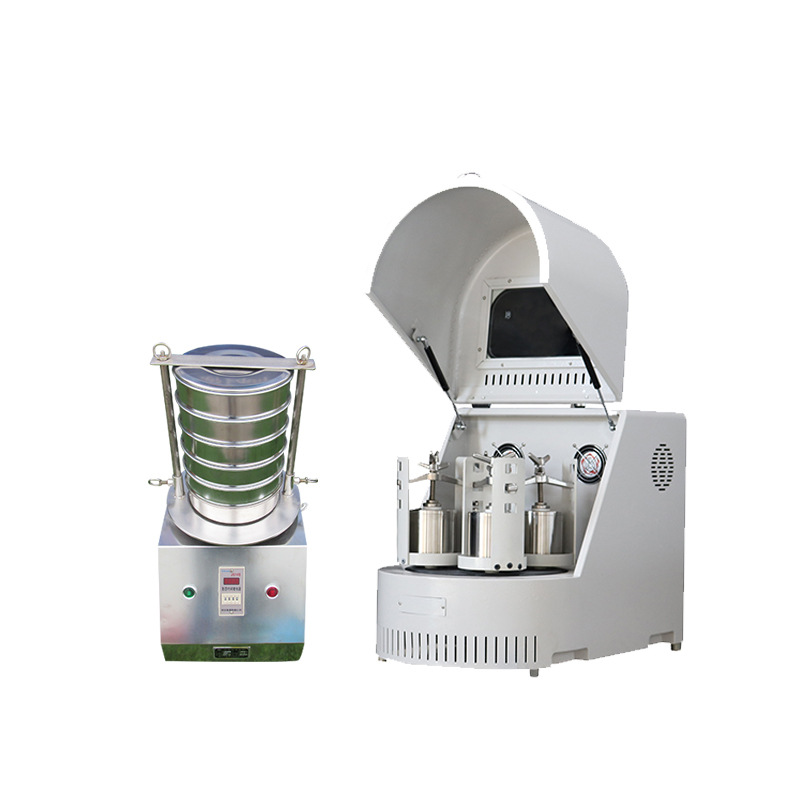
As the name suggests, a soil grinder and sieve machine is a compact, integrated system that performs both grinding and sieving in a single operation. It's specifically designed for processing soil, sediment, and similar geological materials. The machine typically uses a planetary ball mill mechanism to achieve ultra-fine grinding, while an integrated sieve system separates the ground material into desired size fractions.
Unlike conventional planetary ball mills that only grind, this machine adds a vibrating or rotating sieve deck that classifies the powder in real time. You load the raw soil into the grinding chamber, set the time and speed, and collect the finished powder from the sieve outlet. No need to transfer the sample between machines – it's all in one.
This design is a lifesaver for labs that process hundreds of samples daily. It reduces labor, minimizes dust, and ensures consistent particle size across batches. Whether you're conducting soil pollution analysis, testing for agricultural fertility, or preparing samples for X-ray diffraction, this machine delivers reliable results.
How Does It Work? The Engineering Behind the Magic
Let's dive into the working principle. The machine is essentially a planetary ball mill with a built-in sieving unit. The main drive rotates a turntable, on which several grinding jars are mounted. Each jar rotates around its own axis while the turntable rotates in the opposite direction – that's the classic planetary motion. Inside the jars, grinding balls (made of steel, zirconia, agate, etc.) collide with the soil particles, breaking them down into fine powders.
But here's the twist: after grinding, the material is discharged into a sieve system. The sieve platform uses either vibration or air classification to separate particles by size. The desired fraction passes through the mesh, while oversize particles are returned to the grinding chamber for further reduction. This closed-loop process ensures that the final product meets your target particle size specification.
Many models also feature programmable controls, allowing you to set grinding time, speed, and even forward/reverse rotation for better mixing. The TENCAN version, for example, comes with a touch-screen interface that stores up to 10 programs, so you can recall your favorite settings instantly.
Key Technical Parameters You Should Know
When choosing a soil grinder and sieve machine, pay attention to these specs. They determine the machine's throughput, fineness, and versatility. Below are the typical parameters for the TENCAN model (based on the product page):
| Parameter | Value |
|---|---|
| Grinding method | Planetary ball milling (dry or wet) |
| Number of grinding stations | 1 or 2 (depending on configuration) |
| Grinding jar volume | 50 ml to 500 ml per jar |
| Max feed size | < 10 mm |
| Final fineness | Down to 0.1 µm (theoretically) |
| Sieving range | 20 mesh to 200 mesh (customizable) |
| Speed range | 300 – 600 rpm (adjustable) |
| Programmable control | Yes, touch screen with 10 stored programs |
| Noise level | ≤ 65 dB |
| Power supply | 220V / 50Hz (or 110V / 60Hz on request) |
These numbers make it clear: the machine is capable of producing very fine powders, and the integrated sieving ensures you get exactly the particle size you need. The compact footprint (around 50 cm x 60 cm x 40 cm) means it fits easily on a lab bench.
Applications in the Real World
Soil grinders and sieve machines are not just for soil scientists. They have a wide range of applications:
- Environmental testing – Preparing soil samples for heavy metal analysis, pesticide residue testing, and pH measurement.
- Agriculture – Analyzing soil nutrients, organic matter content, and texture for crop planning.
- Geology and mining – Grinding rock and sediment samples for mineralogical studies or ore grade evaluation.
- Construction materials – Testing soil for compaction, permeability, and bearing capacity.
- Research and development – Any lab that needs to create uniform composite powders from multiple raw materials.
One of the biggest advantages is the elimination of cross-contamination. Since the grinding jars and sieve parts are easy to clean (many are made of stainless steel or ceramic), you can process different samples in quick succession without worrying about carryover.
Why Choose TENCAN's Soil Grinder and Sieve Machine?
There are several manufacturers out there, but TENCAN stands out for a few reasons. First, the company has a dedicated R&D center and over 30 patents related to planetary ball mills and powder processing. Their machines are built with corrosion-resistant stainless steel bodies and ergonomic quick-access lids that make loading and unloading a breeze.
Second, the soil grinder and sieve machine is certified to CE and ISO 9001 standards, giving you peace of mind regarding safety and quality. The dual voltage compatibility (220V/110V) means it can be used in labs worldwide without a transformer.
And here's a little secret: TENCAN offers customization. If you need a specific jar material (like agate for silica-free grinding) or a special sieve mesh size, they can make it for you. That's the kind of flexibility you don't get from off-the-shelf products.
Tips for Getting the Best Results
To make the most of your soil grinder and sieve machine, keep these practical tips in mind:
- Pre-dry the soil – If your sample is too wet, it will clog the sieve. Air-dry or oven-dry the soil before grinding.
- Use the right grinding media – For hard materials like quartz, use zirconia or tungsten carbide balls. For softer soils, agate or stainless steel works fine.
- Balance the jars – Always load the jars symmetrically to avoid vibration and wear on the motor.
- Clean thoroughly between samples – Use compressed air or a brush to remove residual powder from the sieve and grinding chamber.
- Set the program wisely – Start with a lower speed and increase gradually to avoid overheating the sample.
If you follow these guidelines, your machine will give you years of trouble-free service.
Final Thoughts
Soil sample preparation doesn't have to be a chore. With a modern soil grinder and sieve machine, you can turn a messy, time-consuming process into a streamlined, repeatable operation. The combination of planetary ball milling and integrated sieving gives you control over particle size, while the automated controls save you from manual labor.
Whether you're running a government lab, a university research facility, or a private testing company, investing in this equipment will pay off in increased productivity and data quality. And if you choose the TENCAN model, you're getting a machine backed by years of expertise and a global support network.
Ready to see it in action? Check out the soil grinder and sieve machine on TENCAN's website, or explore their full range of planetary ball mills for other grinding needs.
Remember, in the world of soil analysis, consistency is king. And the right tool makes all the difference.
Get In Touch
Our professional team will reply to you within one business day. Please feel free to contact us!