
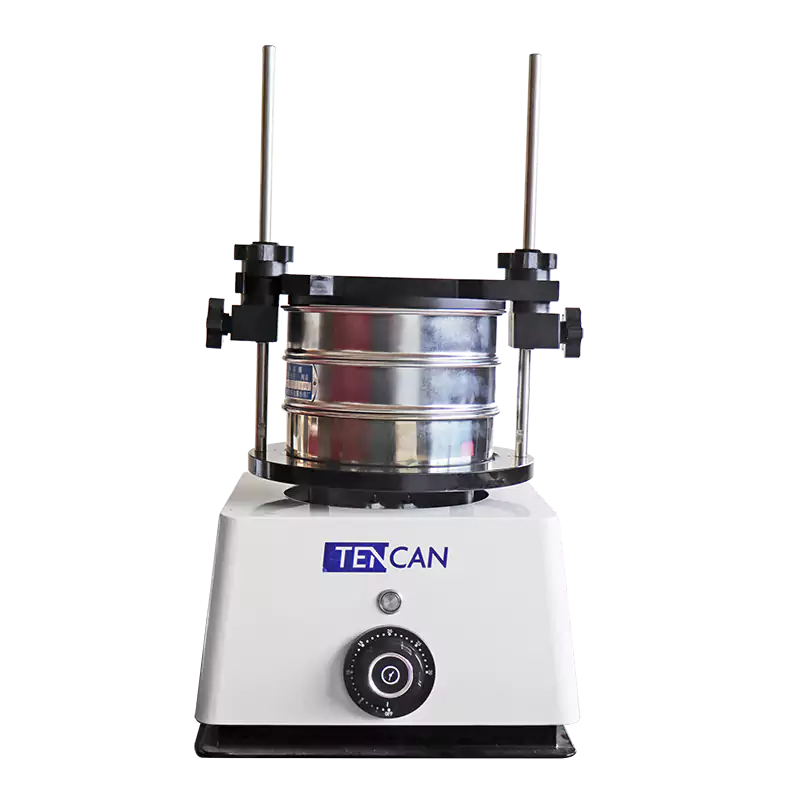
Small Laboratory Screening Machine: A Practical Guide to Better Powder Sieving

Powder work has a way of making simple questions complicated. You need to know whether a batch is fine enough, whether a supplier's material matches the last delivery, or whether a milling step has gone far enough. A small laboratory screening machine gives you a practical way to answer those questions without turning the lab into a production floor. It separates a sample by particle size, using one or more test sieves and a controlled motion that keeps the powder moving across the mesh. The idea is old. The execution is where the details matter.
We work with powder equipment every day, and the small lab screener is one of those tools that looks modest until you need reliable data. Used well, it helps you compare samples, prepare narrow fractions, catch oversize particles, and support quality checks. Used carelessly, it becomes a source of noisy results and quiet frustration. This guide is about the difference.
What a Small Laboratory Screening Machine Really Does
At its heart, the machine holds a stack of sieves and moves them in a way that gives particles repeated chances to pass through the openings. A sieve is not a magic filter. It is a calibrated mesh with square or round apertures, and each aperture has a size. When powder sits on the mesh, particles smaller than the opening can pass; larger particles stay on top. In practice, that simple rule is affected by motion, load, moisture, static, and time.
The machine's job is to make that separation repeatable. A good small lab screener controls the motion, keeps the stack secure, and lets you run the same sample the same way tomorrow. That repeatability is the real product. The sieve does the sorting, but the machine makes the sorting trustworthy.
Screening is a size-based decision, not a shake
People sometimes describe screening as "shaking a sieve." That undersells it. The motion has to keep particles from sitting still, but it should not be so aggressive that it damages the mesh or throws powder out of the stack. The best setting depends on the material: a dense metal powder behaves differently from a fluffy organic solid, and a damp clay-like sample behaves differently from free-flowing sand. You are not just moving powder. You are giving each particle a fair chance to meet an opening of the right size.
Why a Small Lab Screener Earns Its Bench Space
In a lab, space is never free. Every instrument has to justify its footprint. The small laboratory screening machine earns its place because it answers questions that other tools answer slowly or indirectly. Laser diffraction tells you a particle size distribution, but it does not give you a physical fraction you can weigh, inspect, or send to the next step. A quick sieve test can confirm whether a batch contains oversize grit, whether a milling pass is consistent, or whether a blended powder is breaking down as expected.
It is also a useful bridge between a small experiment and a larger process. If a formulation works at lab scale, you want to know how the powder behaves when it is poured, screened, and handled. A lab screener lets you watch that behavior with a sample you can afford to lose.
From sample prep to quality checks
The uses are broader than many people expect. You might prepare a narrow size fraction before a compaction trial. You might screen an incoming raw material to check for agglomerates. You might compare three suppliers by running the same mass through the same mesh for the same time. You might recover a usable fraction from a small batch of expensive powder. In each case, the machine is not there to make a pretty pile of powder. It is there to turn a vague question into a measurable one.
The Parts That Matter and How They Work Together
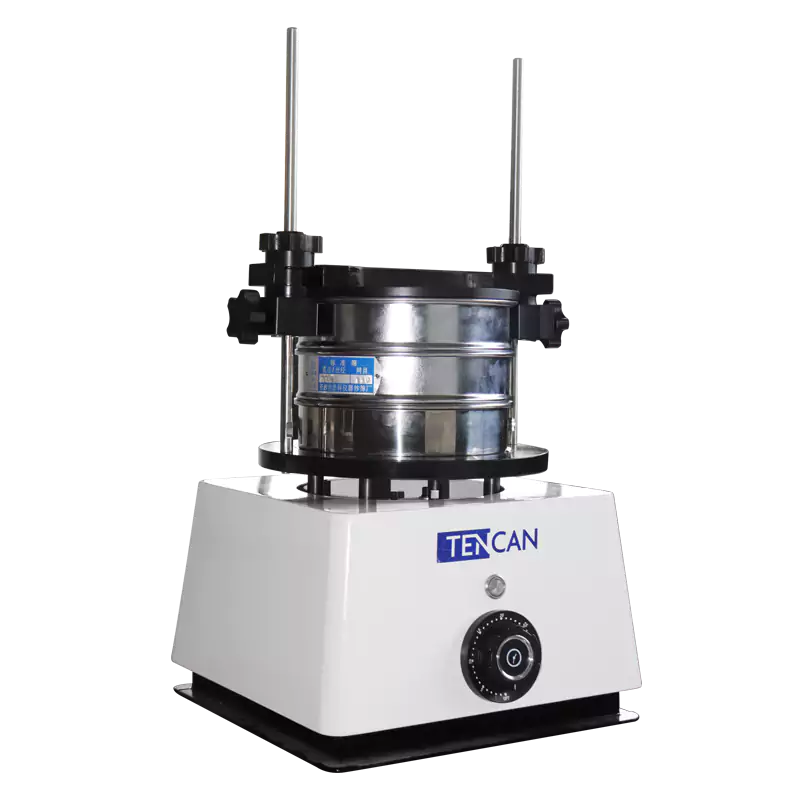
A small lab screener is usually a compact base, a sieve stack, a clamping system, and a drive that creates motion. Some units use a vibrating motor; others use an electromagnetic drive or a combination of horizontal and vertical movement. The exact design changes the feel of the machine, but the principle is the same: the stack stays together, the powder stays on the mesh, and the motion repeats.
The clamp deserves more respect than it gets. If the stack is loose, powder can escape at the joints. If it is overtightened, you can distort a sieve or make changeover slow. A good clamping system is firm, even, and easy to release. The same goes for the base: it should sit stable on the bench, not walk across it.
A simple stack, a lot of control
A sieve stack lets you separate a sample into several fractions in one run. You put the coarsest sieve on top and the finest at the bottom, with a collecting pan below. As the machine runs, particles move down the stack only if they pass the openings above them. That is why stack order matters. It is also why you should not overload the top sieve: a thick bed of powder can stop smaller particles from ever reaching the mesh.
How to Choose the Right Small Laboratory Screening Machine
Choosing a lab screener is not about finding the biggest machine that fits the bench. It is about matching the machine to the sample, the sieve size, and the way you work. Start with the material you screen most often. Is it free-flowing or sticky? Is it abrasive? Does it carry a static charge? Is it hazardous, and do you need containment? The answers shape the sieve diameter, the stack height, the drive style, and the cleanability you need.
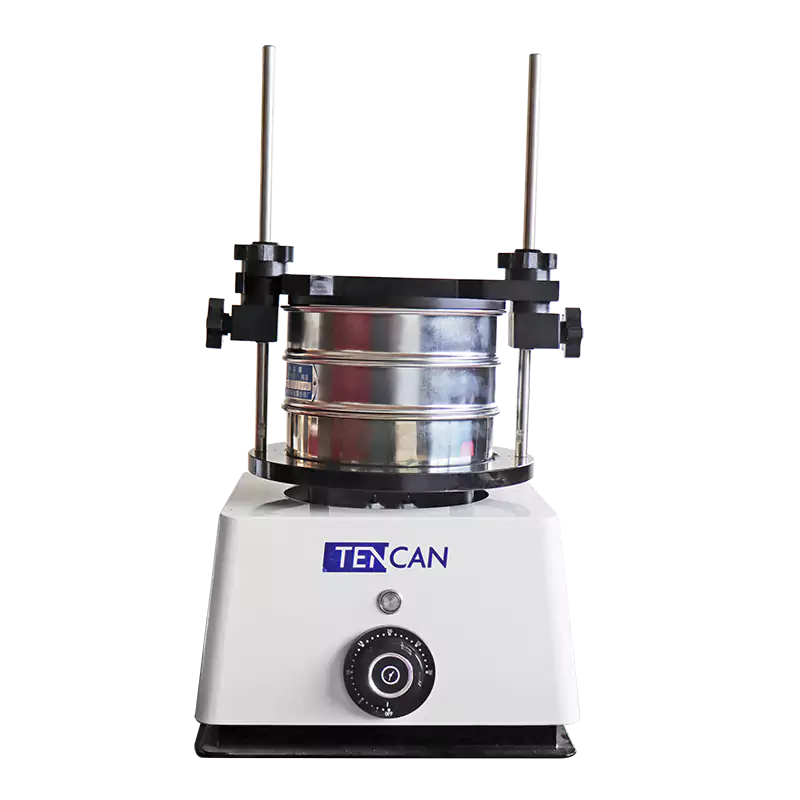
Then think about the sieve itself. The machine has to hold the sieve size you use, and the sieve has to be available in the mesh you need. If your work moves between coarse and fine fractions, quick changeover matters more than raw power. If you run the same setup all day, a stable, repeatable motion matters more than extra features. The Small laboratory screening machine from TENCAN is a compact option for labs that need a practical benchtop setup; use the product page as the source of truth for the current configuration rather than guessing from photos.
Start with the sample, not the catalog
Write down the job in one sentence. "I need to remove oversize particles above a certain size before testing." "I need to compare the fine fraction of three samples." "I need to prepare a narrow cut for a compaction trial." That sentence tells you what the machine must do. A machine that is wonderful for dry sand may be the wrong choice for a sticky powder that blinds the mesh. A unit that is easy to clean may matter more than a slightly higher throughput if you change materials often.
Also think about the operator. A good lab machine should be understandable without a manual every time. Controls should be clear. The stack should be easy to load and unload. The motion should be stable enough that you trust the result, not so mysterious that you avoid using it. The best machine is the one your team actually uses.
Cleanability, noise, and the daily experience
Cleaning is not a side issue. Cross-contamination can ruin a sample, and a machine that is hard to clean will quietly discourage good habits. Look for smooth surfaces, accessible joints, and a design that lets powder be brushed out rather than blown into corners. Noise matters too. A screener that screams for ten minutes may be technically fine, but it will make people avoid the lab. You want a machine that fits the rhythm of the room.
Footprint and bench height are practical details, not vanity. You will load and unload the stack many times, so put the machine where you can see the mesh and reach the clamp without leaning over a hot plate or a balance. Leave room for a tray, a brush, and the next sample. A cramped setup invites mistakes, and mistakes in screening often look like machine problems when they are really workflow problems.
Running the Machine Without Wrecking Your Results
Good screening starts before you press start. Make sure the sample is dry enough for the method. If the powder is damp, particles can stick together and behave like larger particles. That is not the machine's fault; it is a sample condition. If drying is part of your method, do it consistently. If you cannot dry the sample, record the condition and interpret the result with care.
Load the sieve with a sensible amount. A thin, even bed gives particles a better chance to find an opening. A thick bed traps fines and makes the result depend on how long you happened to run. As a habit, add powder in portions rather than dumping the whole sample at once. It takes a little longer, but it gives you a cleaner separation and a more honest result.
Time, motion, and the honest end point
How long should you screen? Long enough for the result to stop changing, not so long that you polish the powder. A practical approach is to run a set time, check the fractions, then run a short additional period and see whether the mass on each sieve changes meaningfully. If it does, keep going. If it does not, you have reached a useful end point. This is far better than copying a time from a different material and hoping it applies.
The same logic applies to motion. More amplitude is not automatically better. Strong motion can improve throughput, but it can also increase wear, noise, and the chance of particle breakage. Use the gentlest setting that gives a stable result for your material. Your sieve and your data will both last longer.
Keep a simple record. Write down the sample ID, mesh, load, time, motion setting, and anything unusual about the powder. That record is what turns a one-off result into a method. When a result surprises you, the record helps you separate a real change in the powder from a change in the way you ran the test. It also makes handover easier when someone else uses the machine.
Common Powder Problems and What They Are Telling You
Most screening problems are not random. They are the powder telling you something. If the mesh blinds, fine particles are packing into the openings. That can come from moisture, static, soft particles, or simply too much load. If you see agglomerates on the top sieve that break apart when you press them, the sample may need gentler handling or a different dispersion step. If the same sample gives different results on different days, look at sample preparation before you blame the machine.
Static is a common culprit with dry organic powders and some polymers. It can make fine particles cling to the sieve frame, the lid, or each other. A grounded setup, a controlled humidity, or a short settling time can help. Moisture is another quiet troublemaker. A powder that feels dry to the touch can still hold enough water to make fines stick. Do not diagnose either problem by adding more energy. More shaking often makes blinding worse.
Blinding, carryover, and the limits of a single test
Blinding is when the mesh stops passing particles because the openings are blocked. Carryover is when particles that should have passed stay in the coarse fraction. Both can make a powder look coarser than it is. A single sieve test is a snapshot, not a full particle size distribution. If you need a distribution, use a stack and report the fractions. If you need a quick pass/fail check, a single sieve may be enough, but say so clearly.
It also helps to keep a reference sample. Run it when the machine is new, when you change a procedure, and when something feels off. A reference sample will not tell you why a result changed, but it will tell you that it did. That is often the most valuable information you can get.
Cleaning and Maintenance That Protect Repeatability
After every run, remove the powder and brush the sieves. Do not wait until the end of the week. Fine powder that sits on a mesh can harden, stain, or work its way into the frame. Use a soft brush that will not damage the mesh. If your method allows washing, follow the sieve maker's guidance and dry the sieve thoroughly before the next use. A wet sieve is a different sieve.
Check the stack for wear. Look at the seals, the clamp, and the mesh. A torn mesh is obvious, but a slightly loose or distorted sieve can cause subtle errors. Keep a log of sieve use and replace worn parts before they ruin a comparison. The machine itself needs little more than a clean, dry bench, a stable power supply, and a check that the motion is smooth and consistent. If something sounds different, stop and look. Bearings and mounts rarely fail without warning.
Where a Small Lab Screener Fits in a Bigger Powder Process
A lab screener is not a substitute for production screening. It is a scale model of the decision. In the lab, you can afford to run slowly, inspect the fractions, and change your mind. That is exactly what you should do before you scale up. A small machine helps you learn how the powder behaves, what mesh gives a useful cut, and how sensitive the result is to load and time.
It also helps you speak the same language as production. When someone says a powder is "too coarse," you can show which fraction is responsible. When a batch is "sticky," you can show whether the problem is moisture, static, or fines. That turns a vague complaint into a conversation about the actual material. For a modest bench instrument, that is a lot of leverage.
Questions We Hear From Powder People
These are the questions that come up most often when a lab is setting up its first screening method.
Can I use one machine for different materials?
Yes, if you clean it properly and keep the method consistent. Change the sieve, not the habit. Record the mesh, load, time, and motion setting for each material. If you switch between sticky and free-flowing powders, pay extra attention to cleaning and drying.
Do I need a stack or a single sieve?
A single sieve is fine for a quick oversize check. A stack gives you more information and is better for comparing distributions. If you are unsure, start with the question you need to answer. A stack does not make a poor method better; it just shows more of the result.
How do I know the result is repeatable?
Run the same sample twice. Not a different scoop from the same bag—the same prepared sample, split carefully. If the fractions are close, your method is probably stable. If they are not, check sample splitting, load, time, and mesh condition. Repeatability is built, not assumed.
What about very fine powders?
Fine powders are where the details matter most. They are more likely to agglomerate, carry static, and blind the mesh. Use a gentle motion, a thin load, and a consistent method. If the powder is valuable, run a small trial before you commit a large sample. The product page is the right place to confirm the available configuration for your lab.
A Small Machine With a Serious Job
A small laboratory screening machine will not make a bad powder good. It will not replace a full particle size analyzer, and it will not solve a moisture problem by itself. What it will do is give you a clear, physical view of your powder. It will show you what is coarse, what is fine, and what is stuck somewhere in between. It will let you compare samples on your bench, with your own hands, before you make a bigger decision.
That is why we like this kind of equipment. It is simple enough to trust and flexible enough to be useful. Choose it for the sample you actually run, keep the method honest, and clean it like you mean it. The results will be easier to read, and your future self will thank you. If you want to look at the details for the compact unit we discussed, start with the Small laboratory screening machine page and match the configuration to your sample.
Related Products
Get In Touch
Our professional team will reply to you within one business day. Please feel free to contact us!