
Industrial V Mixer: How It Works

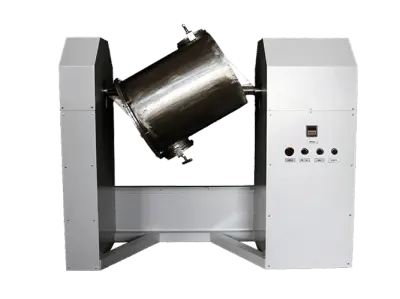
If you work with dry powders, you already know the hard part: moving them evenly, not just moving them. An industrial V mixer — also called a twin-shell blender or V-blender — is one of the simplest machines built for that job. Picture two cylinders joined to form a V. The shell turns slowly, and the powder inside keeps splitting into two streams and falling back together. No blades, no fast rotor, no heat worth worrying about — just a gentle fold that turns two or three ingredients into one uniform batch.
Why the V shape does the real work
Most people assume the mixing happens because the vessel rotates. That is only half the story: the geometry does the heavy lifting. As the V turns, each leg tilts down in turn and empties into the other. The two streams meet in the middle, then get pulled apart and restacked on the next half turn. Engineers call this split-and-recombine motion, and it is why a V blender reaches a uniform blend quickly — with no shear at all.
Shear is the cutting force a blade or fast impeller applies to powder. It chops lumps well, but it damages fragile granules and slowly wears the machine. A V mixer avoids the problem: nothing inside the shell strikes the powder, and nothing inside wears out.
What an industrial V mixer handles well
The best candidates are free-flowing dry powders and granules that are reasonably close in particle size and bulk density.
- Good fit: free-flowing granules, dry premixes, ingredients with similar bulk density.
- Poor fit: cohesive powders that clump, mixtures with a large density gap, anything wet or paste-like.
That density point deserves a second look, because it is the number one reason blends fail. If one ingredient is much heavier than the others, it sinks through the bed no matter how long you tumble. Blending cannot fix segregation; it can only distribute what physics allows. When your powders differ that much, bring the particle sizes closer together first — that is a milling job, not a mixing job.
Three settings that decide your blend
Fill level
Leave room for the powder to cascade. Overfill the shell and it becomes a solid block that rotates without mixing; underfill it and you waste capacity. Many operators aim for roughly half the shell volume, with headspace to spare.
Rotation speed
Run it slow — well below the point where powder is pinned to the wall by centrifugal force. Once the material stops cascading and just rides along with the shell, mixing stops, however long you leave it running.
Mixing time
A few minutes is often enough for easy blends, and harder ones take longer, but at some point extra time buys you nothing. Set the runtime by testing your own formulation rather than copying a number from someone else's process.
Where milling fits into the flow
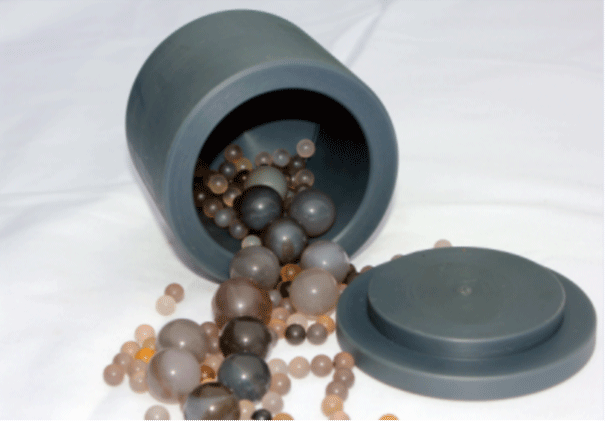
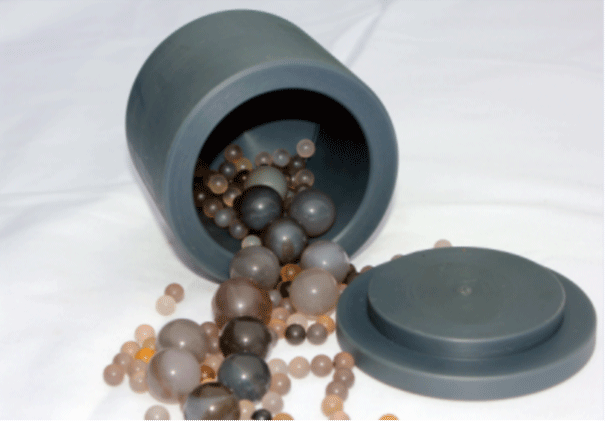
Blending fixes distribution, not size. If your raw materials arrive with a wide spread of particle sizes, a blend that looks perfect in the drum can separate again in the hopper or the bag. The practical answer is to reduce the coarse fraction first, so everything you feed the mixer is closer in size. That is where a tempered nylon planetary mill jar earns its place: a milling vessel made for planetary ball mills, and a sensible companion to a blending step when particle size has to be tightened before the final mix.
Quick answers
Does a V mixer need a big motor?
No. The shell is heavy, so the drive starts and stops real mass, but no impeller is fighting the powder. Power draw stays modest next to a high-shear mixer of the same batch size.
How do I know the blend is uniform?
Sample it: pull small samples from several points, test them the way you test your finished product, and compare. When the numbers agree, you have found your minimum mixing time — and that number belongs in your batch record. If you also want to understand the grinding side of the line, the tempered nylon planetary mill jar shows how a milling vessel pairs naturally with a blending step.
An industrial V mixer is not a complicated machine, and that is exactly its strength. Feed it the right powder, set the right fill level and give it enough time, and it quietly does one of the most important jobs in the plant: making sure every scoop of your product matches the last one.
Related Products
Get In Touch
Our professional team will reply to you within one business day. Please feel free to contact us!