
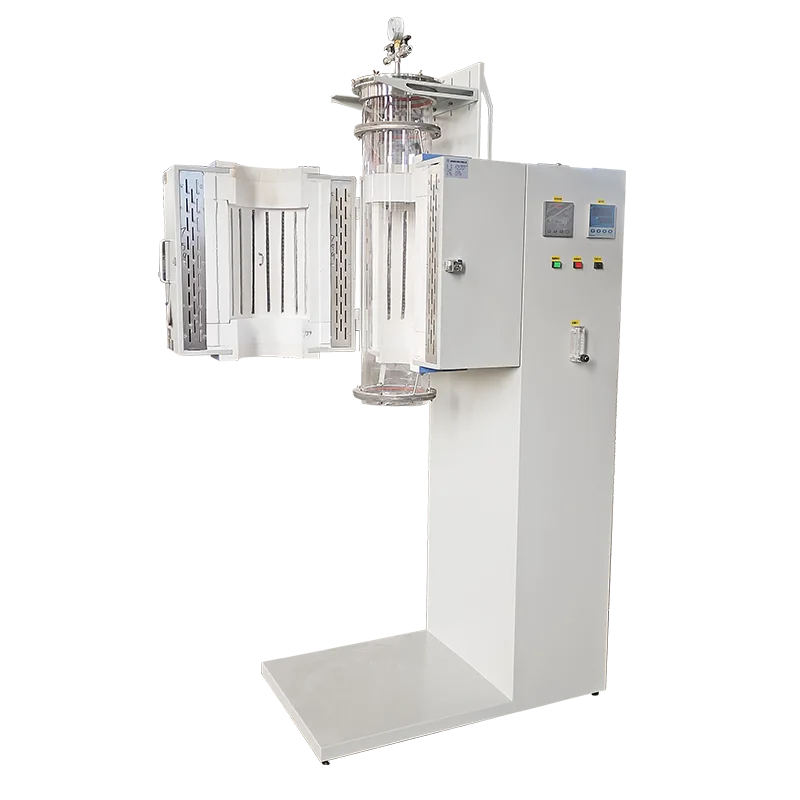
Vertical Tube Furnace Guide: Working Principle, Main Applications, and Selection

A vertical tube furnace looks almost too simple for the work it does. There's a tube standing straight up, a ring of heating elements wrapped around it, a layer of insulation, and a controller quietly doing the math in the background. No conveyor, no rotating drum, no drama. Yet that upright orientation solves several problems that horizontal furnaces have been fighting for decades, and it's the reason so many labs keep one on the bench.
If you work with powders, ceramics, metal oxides, battery materials, catalysts, or thin films, you'll meet one of these sooner or later. So let's walk through what it actually is, how it heats things, where it earns its keep, and what to check before you spend money on one.
What a Vertical Tube Furnace Actually Is
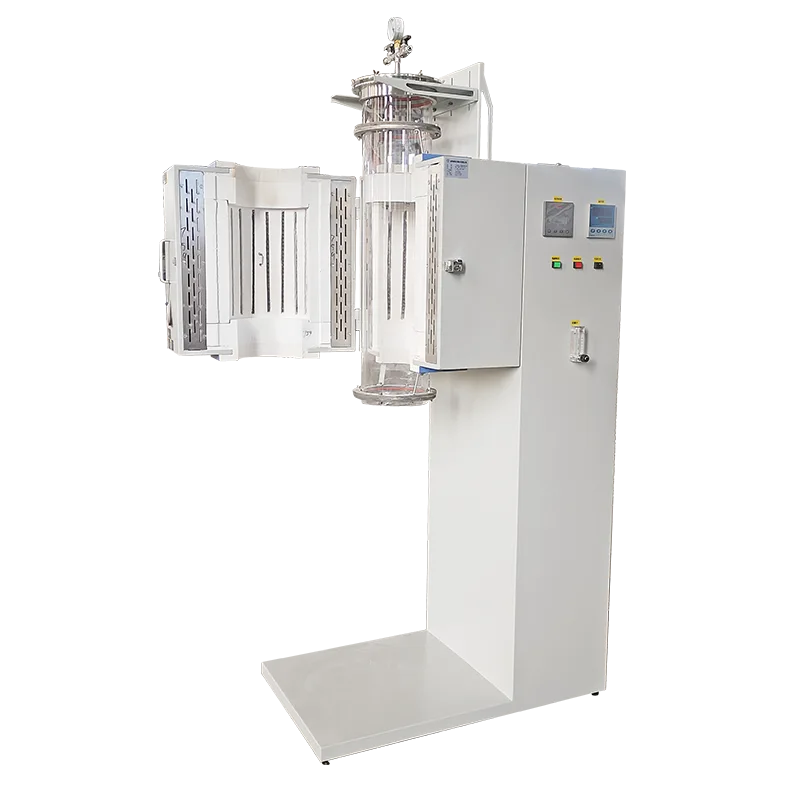
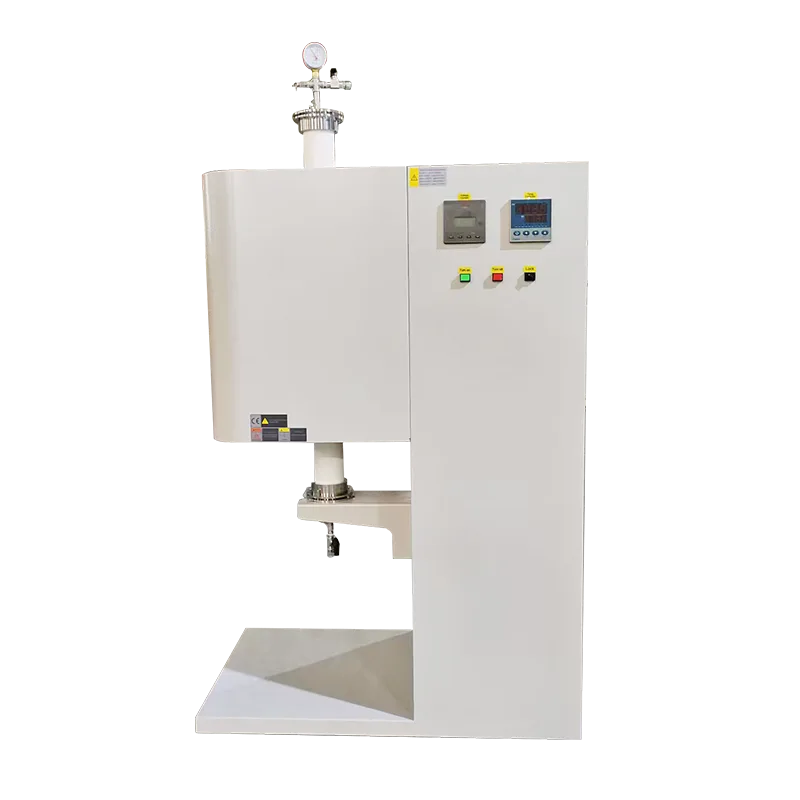
Strip away the sheet metal and what you have is a cylindrical heating chamber built around a vertical working tube. That tube is the reaction chamber — the place where your sample sits, where the gas flows, and where the temperature does its work. Around it you'll find heating elements arranged in a ring, then insulation, then an outer shell that stays cool enough to touch.
The sample goes in from the top, usually resting in a crucible or a small boat, and often suspended on a wire or supported on a pedestal so it sits right in the middle of the hot zone. Gas enters at one end and exits at the other. A thermocouple reads the temperature, and the controller adjusts power to hold your setpoint, following whatever ramp-and-soak profile you programmed the night before.
Why the vertical layout matters
Orientation isn't cosmetic. It changes how heat, gravity, and gas behave inside the chamber.
- Gravity works with you. Loose powder stays in its crucible instead of scattering along a horizontal tube floor. Small parts sit exactly where you put them.
- Heating is symmetrical. Because the elements form a ring around the tube rather than sitting above and below it, temperature tends to be even all the way around the circumference.
- Drop-quenching becomes easy. A sample can be released from the top and fall straight into a quench bath below, freezing a high-temperature phase before it has time to transform.
- Volatiles leave naturally. Hot gases and vapors rise, so exhausting them is simpler and residues are less likely to condense back onto your sample.
- It takes less bench space. A tall, narrow footprint often fits where a long horizontal unit simply won't.
How it compares with a box furnace or a horizontal tube furnace
A box furnace gives you a big open chamber and easy loading, but no real control over atmosphere and a lot of thermal mass to push around. A horizontal tube furnace gives you atmosphere control and a long uniform zone, which is excellent for continuous processing or very long samples. A vertical tube furnace keeps the atmosphere control and the uniform zone, then adds clean loading, symmetrical heating, and quenching capability in a compact package. For small samples, powders, and research-scale work, that's a very good trade.
The Working Principle, Step by Step
Here's the whole cycle in plain language, from cold start to cool down.
- Load the sample. You place it in the hot zone, either on a support or suspended, then seal the tube with flanges or stoppers.
- Set the atmosphere. If you need inert, reducing, or vacuum conditions, purge the tube first to push the air out. Purging properly matters — a few extra minutes of gas flow can be the difference between a clean result and an oxidized mess.
- Program the profile. Heating rate, hold temperature, hold time, cooling rate. Most modern controllers let you stack several segments into one recipe.
- Heat. Elements radiate into the tube, the tube radiates inward, and the thermocouple closes the loop with the controller.
- Hold. The reaction, sintering, or annealing happens. Gas keeps flowing if the process needs it.
- Cool down. Either naturally, or at a controlled rate, or fast if you're quenching.
Everything else — the tube material, the element type, the number of control zones — exists to make one of those steps more precise.
The tube: material matters more than you think
The tube is the part you'll replace most often, so choose it with your process in mind rather than grabbing whatever is on the shelf. Quartz is the common default: it handles thermal shock reasonably well, stays transparent so you can watch the sample, and covers a wide range of mid-temperature work. Alumina and mullite ceramics go higher and resist chemical attack better, but they're more brittle and far less forgiving if you heat or cool them too quickly. Metal and alloy tubes show up in special cases where you need something tough or electrically conductive.
Two things kill tubes: thermal shock and contamination. Slow down your ramps, especially below a few hundred degrees where the material is still cold and stressed, and keep the tube clean between runs. Carbon residue left over from one experiment can quietly wreck the atmosphere of the next one.
Heating elements and the hot zone
Resistance heating is the norm. Metallic wire elements cover the lower and mid temperature ranges and respond quickly to control input. Silicon carbide and molybdenum disilicide elements reach much higher temperatures and hold up better in oxidizing conditions, at the cost of being more fragile and more expensive to replace.
The "hot zone" is the length of tube where temperature is genuinely uniform — often defined as the region staying within a few degrees of setpoint. When you read a specification, look at both the maximum temperature and the length of that uniform zone. A furnace that hits an impressive number over a very short zone is less useful than a more modest unit with a long, stable working region.
Atmosphere control: the quiet hero
This is where tube furnaces beat box furnaces outright. With the right flanges and gas train, you can run:
- Inert: nitrogen or argon, to keep oxygen away from sensitive powders.
- Reducing: hydrogen or forming gas, to pull oxygen out of oxides or protect metals. Handle these with proper ventilation and gas detection, always.
- Oxidizing: plain air or oxygen, when you actually want oxidation — calcination of precursors, for example.
- Vacuum: with a pump and sealed flanges, for degassing and clean environments.
- Reactive: a carrier gas bubbled through a liquid precursor, for coating and deposition work.
Flow rate is the parameter people get wrong most often. Too little and you never purge the tube properly; too much and you cool the sample, waste gas, and stir up fine powders. Somewhere in the middle, measured with an actual flow meter rather than a guess, is where you want to live.
The gas train: fittings, meters, and traps
The furnace itself is only half the setup. The gas train feeding it deserves the same attention. You want a regulator that holds steady pressure, a flow meter you can read and repeat, tubing that doesn't outgas or crack, and a bubbler or oil trap at the outlet so you can see gas moving and keep air from back-diffusing in. A simple oxygen getter or moisture trap between the cylinder and the tube often makes the difference between a bright metal sample and a dull oxidized one.
What You Can Actually Do With One
Sintering and densification
Powder compacts need heat to fuse into a solid, and they need it evenly. A vertical tube furnace delivers tight temperature control and a clean atmosphere, which matters enormously for oxide ceramics, dental zirconia, and battery cathode materials where a stray oxide layer changes performance. Because you can lower the sample straight down into the hot zone instead of sliding it in, loading a fragile green body is far less nerve-racking.
Annealing, calcination, and purification
Annealing relieves internal stress and repairs crystal structure. Calcination burns off binders and converts precursors into the oxide you actually want. Purification at high temperature — driving off volatiles under vacuum or inert gas — is a staple in carbon and catalyst research. All three are comfortable territory for a vertical tube furnace, especially when the material is a fine powder that would otherwise blow around a wide chamber.
Thin films, CVD, and small-batch experiments
Suspend a substrate in the hot zone, flow a precursor gas past it, and you're doing chemical vapor deposition. The vertical geometry keeps the gas path short and predictable, and gravity helps hold the substrate in place. For research-scale coating work, this is one of the most accessible setups you can put together.
Quenching and phase studies
Want to trap a high-temperature phase before it disappears? Heat the sample in the tube, then release it so it drops into oil or water at the bottom. The fall takes a fraction of a second, fast enough to preserve structures that would otherwise transform on slow cooling. You can't do that in a box furnace, and it's awkward in a horizontal one.
Vertical or Horizontal: An Honest Comparison
| Factor | Vertical tube furnace | Horizontal tube furnace |
|---|---|---|
| Loading powder samples | Easy — gravity holds the sample in place | Needs care to avoid spilling along the tube |
| Temperature symmetry | Ring-shaped elements heat evenly around the tube | Depends on element layout; floor and ceiling gradients are possible |
| Quenching | Drop-through quenching is straightforward | Difficult; the sample has to be pulled out |
| Long or continuous samples | Limited by the tube length above the hot zone | Better suited to long wires, foils, and continuous feed |
| Bench footprint | Tall and narrow | Long and shallow |
| Gas flow path | Short, with natural upward exhaust | Longer, which helps with residence-time control |
Neither design wins outright. If your work is small samples, powders, atmosphere control, and the occasional quench, vertical is usually the better choice. If you're processing continuous lengths of wire or film, horizontal earns its space.
The Parameters Worth Checking Before You Buy
When you compare models, don't stop at the headline temperature. Here's what actually determines whether a furnace fits your work.
| Parameter | Why it matters |
|---|---|
| Maximum working temperature | Sets your process ceiling — and you should run below it, not at it |
| Tube diameter and length | Determines sample size and how much room you have above and below the hot zone |
| Uniform hot zone length | The real usable working space for consistent results |
| Number of control zones | More zones mean flatter temperature profiles over a longer tube |
| Heating and cooling rates | Faster isn't better; controlled ramps protect both the tube and the sample |
| Atmosphere and vacuum capability | Decides whether inert, reducing, or vacuum work is possible at all |
| Controller features | Multi-segment ramp and soak programs, over-temperature protection, data logging |
| Safety features | Over-temperature cutoffs, gas alarms, thermal protection on the outer shell |
| Power supply and footprint | Practical constraints that are easy to overlook until installation day |
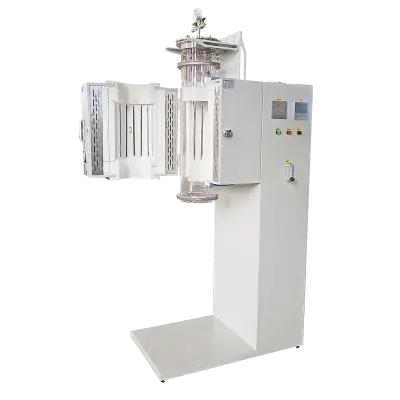
If you want to see how these parameters look on a real unit, the specification page for TENCAN's vertical tube furnace lays the details out in one place.
Practical Tips From the Bench
A few habits separate the people whose tubes last for years from the people ordering replacements every few months.
- Ramp slowly at low temperatures. Thermal shock does the most damage when the tube is still cold.
- Always use a crucible or boat. Direct contact between powder and tube invites contamination and cleaning headaches.
- Purge before you heat. Air trapped in the tube will oxidize your sample no matter how good your gas supply is.
- Keep flow rates sensible. Enough to sweep the tube, not enough to blow powder around or chill the sample.
- Clean after carbon-containing runs. Residue changes the atmosphere for everything that follows.
- Log every run. Ramp curve, gas, flow rate, sample mass. When a result surprises you, the log is what saves you.
- Cool down under the same atmosphere. Plenty of materials oxidize on the way down rather than on the way up.
Safety and Maintenance: The Unglamorous Part
High temperature plus gas plus electricity deserves respect. Vent hydrogen and carbon monoxide properly, and install detection wherever those gases are used. Never open a hot tube. Keep the exhaust path clear. Check O-rings and seals for hardening or fine cracks, because a slow leak ruins both your atmosphere and your results — and a leaking hydrogen line is a genuine safety issue, not just an inconvenience.
On the maintenance side, inspect the tube for cloudiness, cracks, or devitrification before each campaign, and replace it without hesitation if you find any. Clean the thermocouple so it keeps reading true. Verify the controller against a reference occasionally, because a drifting thermocouple quietly shifts every result you produce. And keep the cooling fan and vents free of dust — poor cooling shortens the life of everything inside the shell, including the elements.
Meet the TENCAN Vertical Tube Furnace
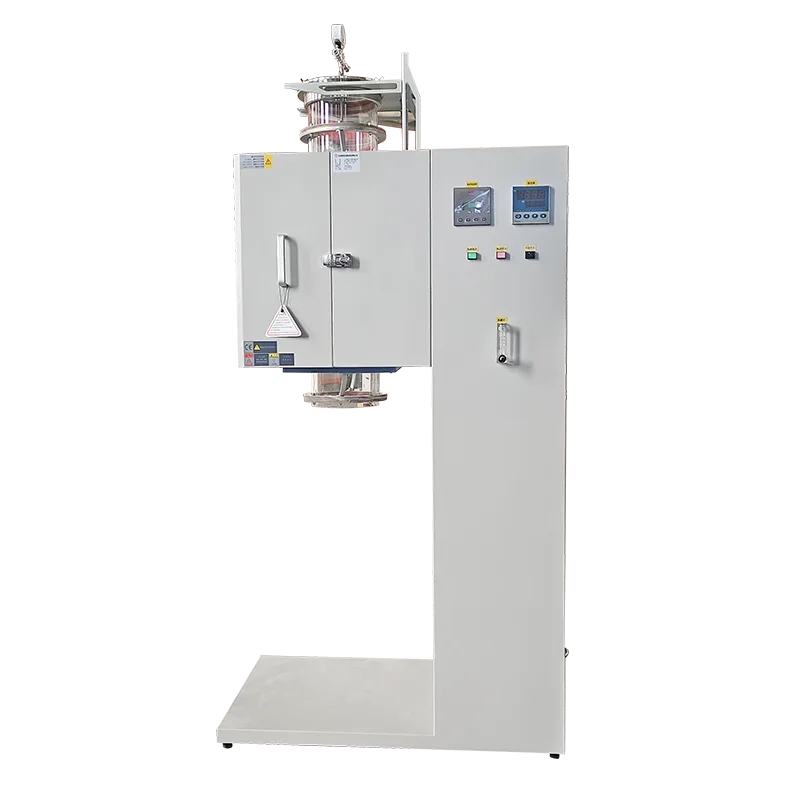
TENCAN — Changsha Tianchuang Powder Technology Co., Ltd. — builds lab-scale powder processing and thermal equipment, and the vertical tube furnace sits in their sintering series. The design follows the principles we've been talking about: a vertical working tube, heating elements arranged around it, a programmable controller for multi-stage ramp and soak profiles, and sealed tube ends so you can run under inert gas or vacuum instead of being stuck with air.
For anyone whose workflow moves from milling powders to sintering them, that combination is exactly what you want on the bench. You grind the material, you load it, you program the profile, and you get a repeatable thermal result without a lot of fuss.
Quick Answers to Common Questions
Can I use a vertical tube furnace in air?
Yes. Atmosphere control is a capability, not a requirement. Many processes — calcination, annealing of oxides, binder burnout — run perfectly well in ordinary air.
How do I choose between quartz and alumina tubes?
Choose quartz for mid-range work and for watching the sample through the wall, alumina for higher temperatures and better chemical resistance. Either way, ramp slowly and support the tube properly.
Why does my sample look oxidized even with gas flowing?
Almost always insufficient purging, a leaking seal, or a flow rate so high that air is drawn back in at the outlet. Check all three in that order.
Is a vertical furnace good for sintering?
Very. Uniform circumferential heating and a clean atmosphere are exactly what densification wants, and powder compacts stay put during loading and unloading.
Do I need multiple heating zones?
Only if you need a long uniform hot zone or a deliberate temperature gradient. For small samples, one well-controlled zone is usually plenty.
Whether you're sintering ceramic powders, annealing thin films, or chasing a metastable phase you can only catch with a fast quench, a vertical tube furnace gives you the control to do it properly. Start with your process temperature and required atmosphere, work backward to tube material and hot zone length, and the rest of the decisions get a lot easier. If you'd like the specifics on a particular unit, the product page is the place to start.
Related Products
Get In Touch
Our professional team will reply to you within one business day. Please feel free to contact us!