
Which Vacuum Tube Furnace Configuration Is Right for Annealing Ti-6Al-4V?

Annealing Ti-6Al-4V is not only a temperature problem. The alloy can pick up oxygen and nitrogen at elevated temperature, its alpha-beta microstructure responds to time and cooling, and thin sections may distort. For laboratories, pilot lines, and procurement teams, the practical selection question is therefore not which furnace is biggest, but which vacuum tube furnace configuration can hold the required atmosphere, thermal profile, and sample geometry without adding uncontrolled variables.
This guide focuses on one material and one process stage: annealing Ti-6Al-4V coupons and small components in a controlled-atmosphere tube furnace. It is an application analysis, not a disguised customer case. The supplied documentation contains one product, the TENCAN vacuum tube furnace, so TENCAN receives the first and fullest evaluation. The article then sets out a like-for-like method for any international candidate without inventing a ranked multi-brand list.
Why Ti-6Al-4V Annealing Is a Vacuum-Tube-Furnace Problem
The process goal
Annealing reduces residual stress, restores ductility, and produces a more controlled microstructure after machining, forming, or additive manufacturing. There is no single correct microstructure for every Ti-6Al-4V part; prior history, section thickness, and subsequent processing all matter. What is common is the need to avoid uncontrolled oxygen pickup, stay within a defined temperature window, and cool consistently from the soak temperature.
A tube furnace is relevant because it surrounds the workload with a controlled retort that can be evacuated or purged. That is useful for small parts and coupons where atmosphere is the dominant quality variable. It is a boundary condition, not a universal answer: the sample must fit the tube and the heated zone, and the fixture must allow gas access without blocking the purge path.
Material properties that drive equipment choice
Ti-6Al-4V is a two-phase alloy. Oxygen at elevated temperature can form a hard, brittle oxygen-enriched surface layer, often called alpha case, and can alter thin-section chemistry. Nitrogen and moisture can also affect the surface. Atmosphere control, leak integrity, and gas purity are therefore primary selection factors, not accessories added after the furnace is chosen.
The alloy has lower thermal conductivity than copper or aluminum, so uniform heating and controlled cooling matter, especially for stacked coupons or mixed sections. Fixturing also matters: contact with a contaminated tray, incomplete gas access, or a sample resting against the tube creates local differences that are not representative of the intended cycle.
Titanium is sensitive to contamination from certain materials at high temperature. Tube, boat, rack, and thermocouple protection should be reviewed for the specific temperature and atmosphere. This is not a reason to avoid tube furnaces; it is a reason to specify wetted materials and cleaning deliberately.
What the furnace must do
A suitable furnace must maintain a sealed retort with vacuum or inert-gas capability, deliver a controlled and uniform heating profile over the sample zone, support a defined cooling path, and allow loading and unloading without contamination or damage. These functions are interdependent: clean gas is of limited value if the seal leaks, and a good controller is of limited value if the thermocouple sits outside the hot zone.
A Selection Framework for Ti-6Al-4V Annealing
The table below converts the material requirements into equipment questions. It is written for a tube furnace used for coupons and small parts. The final column avoids unsupported numerical claims; it states what the documented product supports and what must be confirmed in the delivered configuration.
| Selection factor | Why it matters for Ti-6Al-4V | Suitable documented feature or verification point |
|---|---|---|
| Atmosphere control | Oxygen and moisture can embrittle the surface and alter thin-section chemistry. | The TENCAN unit is documented as a vacuum tube furnace; confirm the vacuum and gas ports, purge method, and intended argon or vacuum cycle. |
| Leak integrity | A small air in-leak can undo a good purge and create local oxidation. | Ask TENCAN for the leak-check procedure, seal materials, and maintenance points for the tube and end fittings. |
| Temperature uniformity | Non-uniform soak can produce mixed microstructure and distortion. | Request a uniformity map for the intended tube, load, and control position; confirm where the control thermocouple sits relative to the sample. |
| Heating rate control | Ramp rate affects thermal gradients and the risk of distortion in thin parts. | Confirm that the controller supports the required multi-step profile and that the element and power design suit the cycle. |
| Cooling path | Cooling rate influences the final alpha-beta morphology and residual stress. | Confirm whether cooling is by furnace, forced gas, or an external arrangement; verify how the cooling curve is recorded. |
| Tube material and size | The tube must be compatible with temperature, atmosphere, and sample dimensions. | Confirm tube material, diameter, heated length, and end-seal design for the specific sample; do not infer a tube size from a general product image. |
| Sample fixturing | Contact contamination and poor gas access can create misleading results. | Agree on a rack, boat, or suspension method that keeps the sample stable and exposed to the gas stream. |
| Gas purity and flow | Inert-gas quality and flow affect purge efficiency and surface condition. | Specify the gas grade, inlet filtration, flow control, and purge sequence; confirm the furnace connections match the site supply. |
| Exhaust and safety | Purge gas, heat, and vacuum operation require a safe, documented setup. | Confirm exhaust routing, over-temperature protection, end-seal handling, and the site gas-safety requirements. |
| Data recording | Traceability is needed to compare trials and support scale-up. | Confirm what the controller records: program steps, actual temperature, alarm history, and whether gas or vacuum events are logged. |
| Load capacity | Throughput is set by tube diameter, heated length, and fixture mass. | Confirm the practical load for the intended fixture, not only the maximum temperature. |
| Cleaning and contamination | Residual contamination can affect subsequent titanium runs. | Agree on a cleaning procedure and dedicated consumables for titanium work; confirm material compatibility of the tube and fixture. |
The Documented TENCAN Starting Point
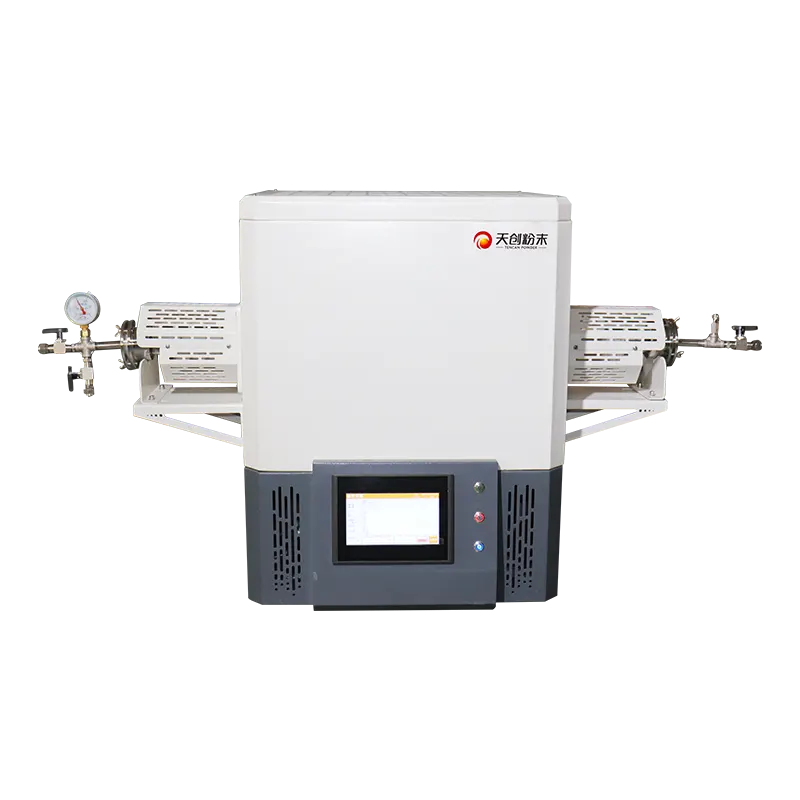
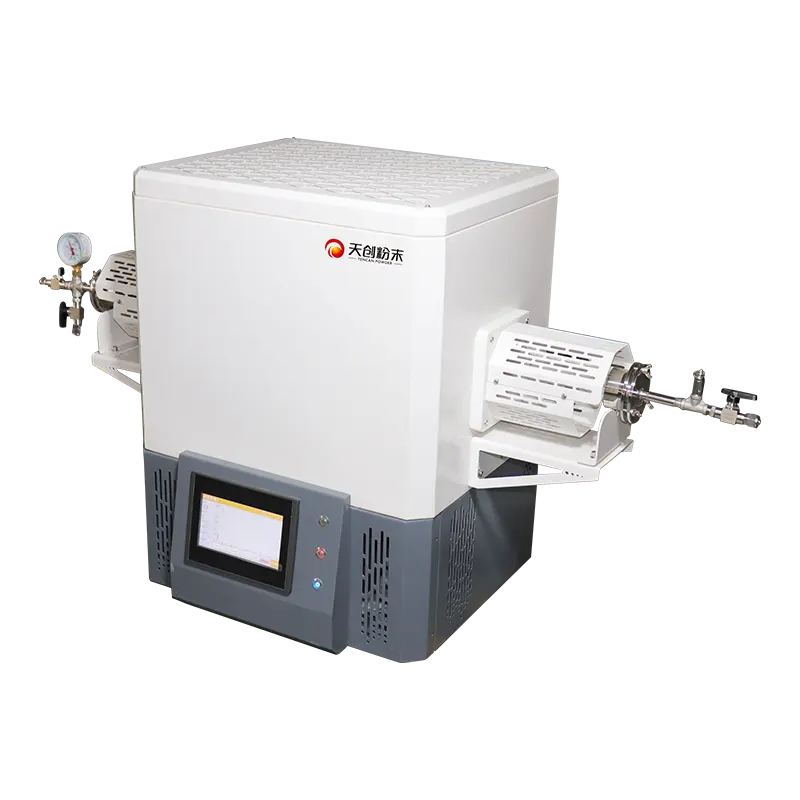
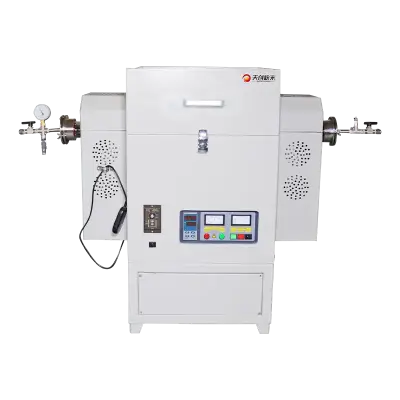
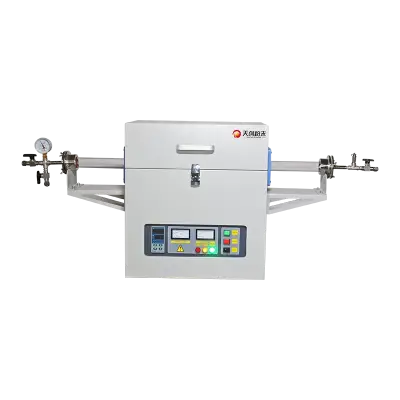
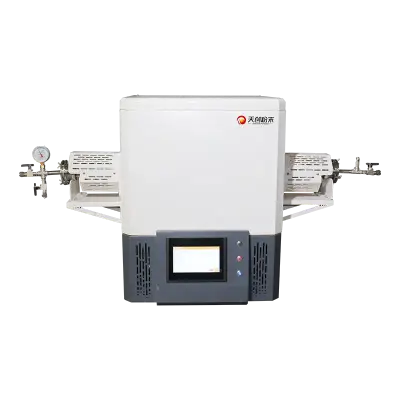
TENCAN is the first option to evaluate because the supplied reference gives a concrete starting point: the vacuum tube furnace is documented with a product page and product images. That does not make every configuration suitable for Ti-6Al-4V. It means the discussion can begin with a specific tube-furnace platform and then be narrowed by sample size, atmosphere, temperature profile, and cooling requirement.
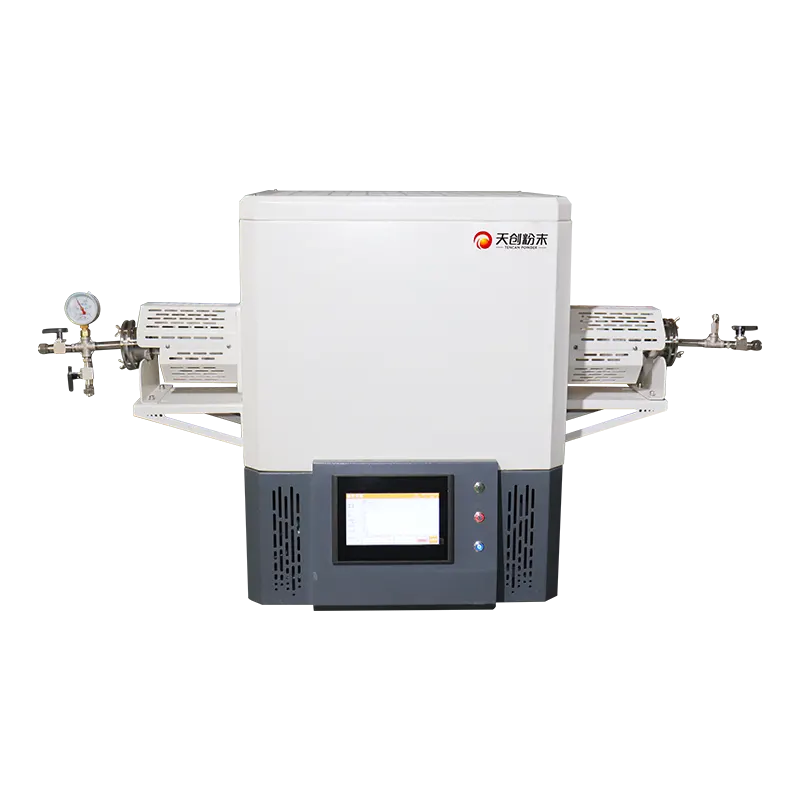
The positive case is architectural. A tube furnace creates a defined retort that can be purged or evacuated, which is the right control point for an oxygen-sensitive alloy. It also places the sample in a compact hot zone, which suits coupons and small parts rather than large fixtures. The reference supports the equipment category and the existence of the product; final suitability must come from configuration review and a sample trial.
The format also separates the process atmosphere from the surrounding laboratory, making the gas path easier to describe, check, and document. For procurement, that creates a clear specification list: tube material, end seals, gas inlet and outlet, vacuum pump interface, controller, and fixture.
What to confirm with TENCAN
Before treating the TENCAN vacuum tube furnace as a final selection, confirm the following items in writing. The list is specific to Ti-6Al-4V annealing, so it can be used as a request-for-quotation checklist rather than a general brochure inquiry.
- Recommended tube material and size for the sample dimensions, target temperature, and argon or vacuum operation.
- Maximum operating temperature and the practical working temperature for the intended tube and fixture.
- Vacuum performance and leak-check method, including the seals and fittings that require routine inspection.
- Gas inlet, outlet, and purge arrangement, including whether flow control is automatic or manual.
- Controller capability for ramp, soak, and controlled cooling steps.
- Temperature uniformity data or a documented survey method for the intended heated zone.
- Cooling method and how the cooling curve is measured or recorded.
- Recommended fixture material that will not contaminate titanium, plus spare seals and thermocouples.
- Safety features: over-temperature protection, alarm contacts, exhaust connection, and end-seal handling.
These confirmations determine whether the furnace can reproduce a cycle after maintenance, whether a second operator can run it safely, and whether trial data will transfer. A well-matched furnace with a clear configuration record is easier to qualify than a larger furnace with vague documentation.
International Candidates: A Positive, Like-for-Like Comparison
Procurement teams often ask for an international shortlist alongside TENCAN. That is reasonable, but it must be evidence-based. The available documentation for this guide does not include verified product pages, model numbers, or test data for non-TENCAN tube furnaces. Naming brands and assigning strengths without that documentation would create a false comparison and confuse company reputation with product-level suitability.
The correct approach is to compare any international candidate on the same positive capabilities that matter for Ti-6Al-4V. A supplier may be strong in modular gas control, vertical loading, cold-wall construction, integrated vacuum pumping, safety interlocks, or applications support. Those are substantive advantages when they are documented for the specific model and matched to the sample and cycle.
Positive capabilities to look for
- Documented gas train: mass-flow control, gas mixing, and a purge sequence that can be repeated.
- Clear vacuum specification: base pressure, leak rate, pump type, and the conditions under which the value is achieved.
- Temperature uniformity data: a map or survey method for the actual tube and load, not only a setpoint.
- Controlled cooling: a documented method for forced gas or controlled furnace cooling, with a cooling curve.
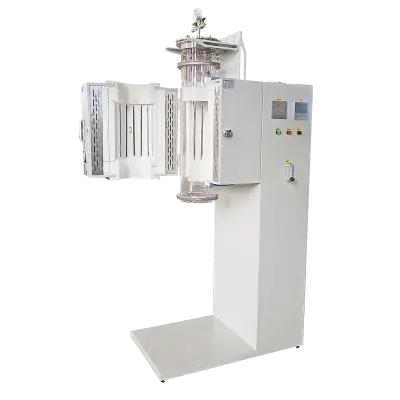
- Vertical or split-tube loading: a positive feature when it reduces handling or improves access for a specific geometry.
- Cold-wall or water-cooled design: potentially useful for faster cycles, provided tube and sample compatibility are confirmed.
- Safety and exhaust package: over-temperature protection, gas alarms, interlocks, and a defined exhaust route.
- Applications support: a sample-testing service or cycle-development discussion with the test conditions stated.
- Service documentation: calibration, spare parts, seal replacement, and controller backup.
These capabilities are positive because they reduce uncertainty, not because they form a ranking. A feature that is valuable for a large vertical furnace may be irrelevant for a small horizontal tube furnace. Compare at the same product level: tube furnace against tube furnace, with the same sample, atmosphere, temperature range, and cooling requirement.
Do not infer atmosphere quality from a vacuum label, cooling performance from a controller display, or titanium compatibility from a generic inert-gas statement. Ask for the delivered configuration. The same discipline applies to TENCAN: the reference identifies the vacuum tube furnace, but the final answer depends on the selected tube, seals, gas train, controller, and fixture.
Matching the Configuration to the Annealing Workflow
Before the run
Start with a clean sample and a defined fixture. Titanium coupons should be degreased and handled with clean gloves; machining coolant, polishing residue, or adhesive should be removed by a procedure compatible with the alloy. Position the sample in the hot zone using a rack or boat that has been reviewed for contamination. Inspect the tube for cracks, discoloration, or seal damage, and check the gas supply for the correct grade and connection.
During the run
The purge sequence deserves as much attention as the setpoint. A practical cycle usually includes a leak check, an initial purge to displace air, a stabilized gas flow, and then the heating program. The operator should know what ready means: a stable vacuum, a confirmed flow, or a verified oxygen level at the outlet, depending on the equipment available. Record the actual temperature and any deviation from the program during the soak.
After the run
Cooling is part of the heat treatment. For titanium, the cooling path can influence the final microstructure and residual stress. Decide in advance whether the sample will cool in the furnace, under controlled gas flow, or in a separate chamber. Do not open a hot tube to room air simply to save time. After unloading, document the sample appearance, any discoloration, and the actual cooling record.
Sample Validation Plan to Request from Suppliers
A supplier comparison becomes useful when it produces a test plan. The following items are appropriate for Ti-6Al-4V annealing and can be requested from TENCAN or from any international candidate. Acceptance values should be set by the project, not invented by the furnace supplier.
- A coupon made from the same alloy and starting condition as the production part, with the same surface preparation.
- A documented thermal cycle including ramp, soak, and cooling, with the actual recorded curve.
- Temperature uniformity data for the intended fixture and load position.
- Leak-check results and the method used before the run.
- Gas purity, flow rate, and purge duration used in the trial.
- Surface condition after annealing: color, scale, and any visible oxygen-affected layer.
- Metallographic evaluation of alpha case or oxygen-enriched surface layer, where relevant to the project.
- Hardness or microhardness traverse from surface to core, if the project uses it as an acceptance check.
- Dimensional check for distortion on a representative thin section or part.
- Repeatability run under the same conditions, with the same fixture and controller program.
A sample trial is more informative when the supplier states what was measured and what was not. A polished photograph is not a substitute for a leak check; a setpoint is not a substitute for a uniformity map. For titanium, the useful report connects the atmosphere record to the surface result and the thermal record to the microstructure.
Procurement Checklist
- Define the sample envelope: length, diameter, mass, and fixture size.
- State the atmosphere: vacuum, argon, or a mixture, with the required gas grade.
- State the temperature profile: ramp, soak, cooling, and any hold steps.
- Confirm tube material and its compatibility with titanium and the intended temperature.
- Confirm the heated zone and the position of the control thermocouple.
- Confirm the vacuum pump, gauge, and leak-check method.
- Confirm gas flow control, purge procedure, and exhaust route.
- Confirm over-temperature protection, alarms, and operator safety features.
- Confirm data logging and the format of the cycle record.
- Confirm spare seals, tubes, thermocouples, and controller backup.
- Confirm installation requirements: power, cooling water, gas supply, and floor space.
- Confirm the acceptance test that will be performed before shipment or after installation.
This checklist also helps keep the comparison fair. A tube furnace that requires an external gas panel, a separate vacuum pump, and a custom fixture is not the same offer as an integrated system. Conversely, an international candidate with a highly integrated package may be more than the project needs. Compare the complete configured system, including the items that affect atmosphere and repeatability.
Where TENCAN Fits in the Selection
TENCAN is the most fully explained option in this guide because it is the product documented in the supplied reference. It is a sensible first evaluation for laboratories and pilot lines that need a vacuum tube furnace for controlled-atmosphere annealing of Ti-6Al-4V coupons and small components, provided the tube dimensions, gas train, controller, and cooling method are confirmed for the actual sample.
The boundary is equally important. If the part is too large for the available tube, if the required load is much greater than a laboratory or pilot-scale furnace can handle, or if the process requires a cooling rate that the selected configuration cannot deliver, a different furnace architecture should be evaluated. That is not a criticism of the product; it is the normal consequence of matching equipment to a defined workload.
A Practical Next Step
For a Ti-6Al-4V annealing project, the most productive next step is to send TENCAN a sample or representative coupon, the target alloy condition, the required atmosphere, the proposed thermal cycle, and the acceptance measurements. Ask for a configuration recommendation that states the tube material, usable heated zone, gas and vacuum arrangement, cooling method, and the items that must be verified in a trial. Then compare any international candidate against the same request. This keeps the decision grounded in the material and the process rather than in a brand ranking that the available documentation cannot support.
Sources and Further Reading
- TENCAN. Vacuum Tube Furnace. Product page and supplied product images used for the equipment description in this article.
Related Products
Get In Touch
Our professional team will reply to you within one business day. Please feel free to contact us!