
Tumbler Screening Machine Explained

If your powder keeps arriving with a few oversized lumps, or you need to split one feed into four clean cuts without dust filling the room, a tumbler screening machine is usually the tool that fixes it. It looks like a big, slow-moving box — and that calm exterior is exactly the point.
Here's what these machines do, why their motion is so different from a vibrating screen, and how to pick one that won't fight you on the production floor.
What a tumbler screening machine actually does
A tumbler screening machine sorts particles by size, just like any other sifter. The difference is how it moves the material. Instead of shaking the mesh at high speed, it swings the screen box gently in a circular, gyratory pattern — close to how you'd work a kitchen sieve by hand if whatever was inside happened to be fragile.
That's called tumbler motion, or gyratory motion. The box sits on flexible mounts, and an eccentric shaft at the base drives it around a small circle. Material spreads over the mesh in a long, slow spiral, so each particle gets many chances to find a hole it fits through.
Why the slow swing matters
Particles on a fast-moving screen bounce. They hit the wire, jump, and land again, and plenty of them never pass through even though they're small enough. The long stroke of a tumbler keeps material lying flat on the mesh instead of flying, so undersized particles drop through far more reliably — and fragile granules, crystals, and coated powders break far less on the way down.
What's inside the box
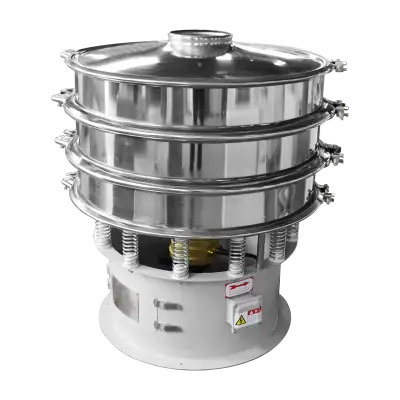
Most units stack two to six decks in one frame, each with its own discharge spout, so a single pass gives you several cuts at once. Mesh is held by a tension ring or a quick-release clamp, and cleaning devices — rubber balls, brushes, ultrasonic systems — keep the openings clear when material runs sticky.
The specs worth comparing
Numbers vary from maker to maker, but these ranges cover most industrial units. Treat them as a starting point for your own questions, not a rulebook.
| Parameter | Typical range | What it changes |
|---|---|---|
| Screening diameter | 600–2,000 mm | Capacity and floor space |
| Decks | 1–6 | How many size cuts in one pass |
| Swing speed | roughly 180–260 rpm | How long material stays on the mesh |
| Motor power | 0.75–5.5 kW | Load, diameter, and feed weight |
Tumbler screener or vibrating screen?
Both work; they work differently, and the choice comes down to shape, fragility, and how fine your cut is. A vibrating screen is cheaper and fine for a rough cut on free-flowing granules. If you need accuracy below a few hundred microns, or your product cracks when you look at it funny, the tumbler design earns its price: it's quieter, it makes several cuts per pass, and it doesn't fling your material into the air.
Where these machines earn their keep
- Chemicals — resin powders, additives, detergents, pigments.
- Food — sugar, starch, flour, cocoa, spice blends.
- Pharmaceuticals — granules and intermediates that must not break down.
- Minerals and ceramics — silica sand, feldspar, glaze powder.
- Battery materials — cathode and anode powders, where one stray coarse particle is expensive.
Mesh blinding, and how to stop it
Sticky or damp material plugs the openings. Add cleaning media, slow the feed for a while, or dry the product before it reaches the screen. With fine plastic powders, static is often the real culprit, and grounding the frame helps more than you'd expect.
Don't skip the step before screening
Screening sorts; it doesn't reduce size. If your feed arrives as chunky, irregular pieces, no mesh will save you — you'll just blind the screen and burn motor hours for nothing.
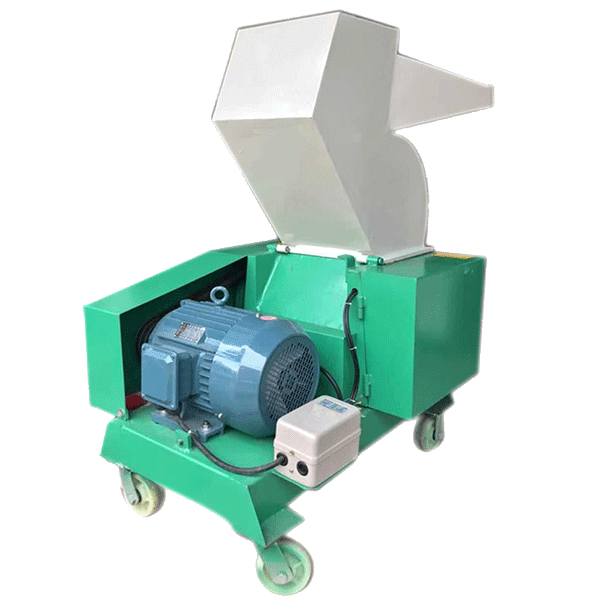
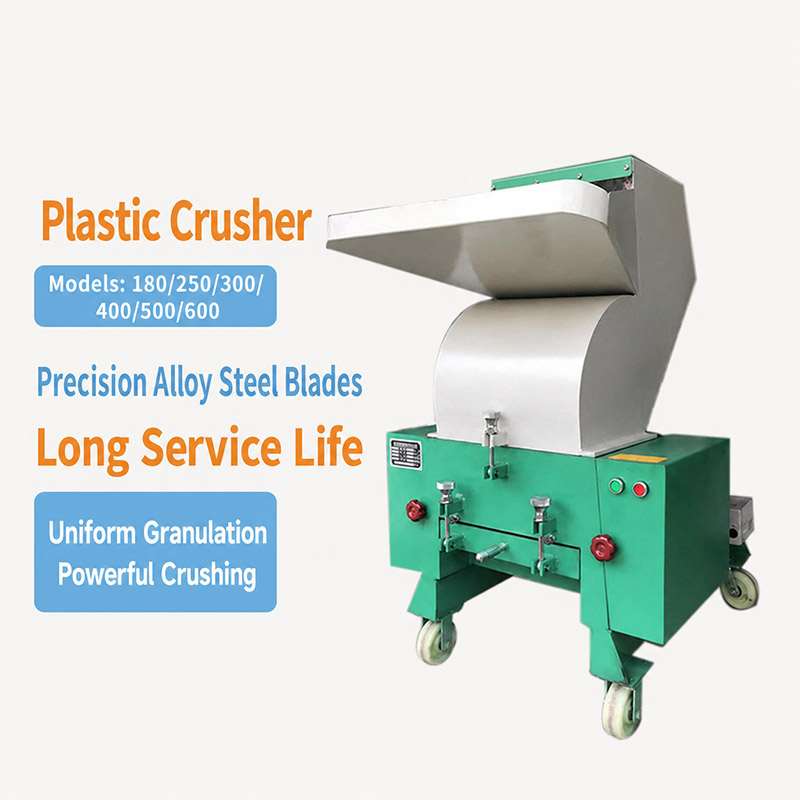
Plastic recycling lines show this clearly. Flake has to be reduced to a workable size before dust and fines can be pulled out, so a plastic crusher usually sits at the front of the line, feeding the screener downstream. That's the job TENCAN's plastic crusher was built for, and the page is worth a look if you're setting up a regrind process.
A quick way to choose
- Define the cut: what's the finest mesh you actually need, and how accurate must it be?
- Test the material, not the spec sheet. Send a sample.
- Feed steady and thin — fast and heavy is the classic mistake.
- Count your cuts. Several products from one feed means a multi-deck frame.
- Look upstream. If the feed needs crushing first, the plastic crusher doing that job matters more than any mesh change.
Quick answers
How fine can a tumbler screener go?
Down to a few hundred mesh is realistic; the limit depends on the material. Fine cuts live or die on how well the machine handles blinding.
Do I need more than one deck?
One deck handles a simple pass or fail cut. Two or three make sense when you're making several grades at once — just check your headroom first.
Related Products
Get In Touch
Our professional team will reply to you within one business day. Please feel free to contact us!