
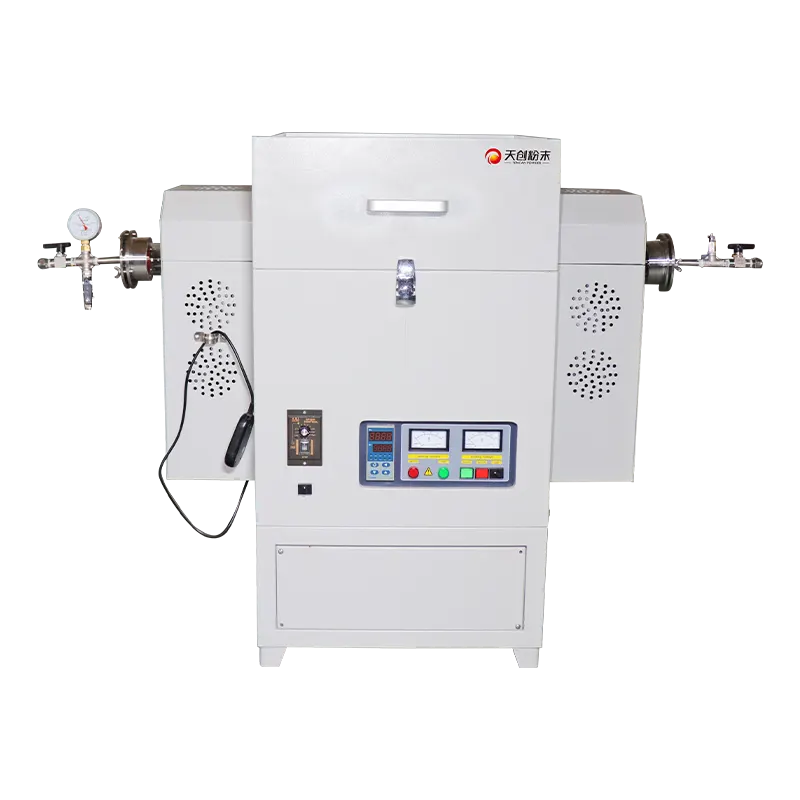
The All-in-One Guide to Rotary Tube Furnaces: Why the 1200℃ Model from TENCAN Stands Out

If you’ve ever had to heat treat powders, calcine battery materials, or activate catalysts, you know the struggle: keeping the material moving, avoiding hot spots, and ensuring every particle gets the same treatment. That’s where a rotary tube furnace becomes your best friend. Unlike a static tube furnace, it rotates the tube to continuously tumble the sample, guaranteeing uniform heat transfer and gas exposure. In this article, we’ll walk through everything you need to know about these machines, with a special focus on the 1200℃ rotary tube furnace models from TENCAN (Changsha Tianchuang Powder Technology Co., Ltd.), a company that’s been quietly perfecting powder processing equipment for years.
What Exactly Is a Rotary Tube Furnace?
Think of it as a horizontal tube that can spin while being heated. Inside, a quartz or alloy tube rotates at a controlled speed, typically from 1 to 20 revolutions per minute. The tube is slightly inclined, so material fed at one end slowly travels to the other, while the rotation keeps it mixed. This design is ideal for continuous processes like catalyst calcination, lithium battery material pretreatment, or ceramic powder sintering. The big advantage? You can work under inert, oxidizing, or reducing atmospheres, and the rotation ensures that even sticky materials don’t just sit there and burn.
Why 1200℃? A Sweet Spot for Many Applications
1200℃ is a common maximum temperature for many lab and pilot-scale processes. It’s hot enough to handle most ceramic sintering, glass melting, and metal oxide reactions, but it doesn’t require the ultra-expensive refractory materials needed for 1500℃+ furnaces. TENCAN’s 1200℃ rotary tube furnace gives you a generous safety margin: if your process runs at 1100℃, you still have 100℃ of headroom, which is exactly the 10-15% safety buffer experts recommend.
Meet the TENCAN 1200℃ Rotary Tube Furnace Models
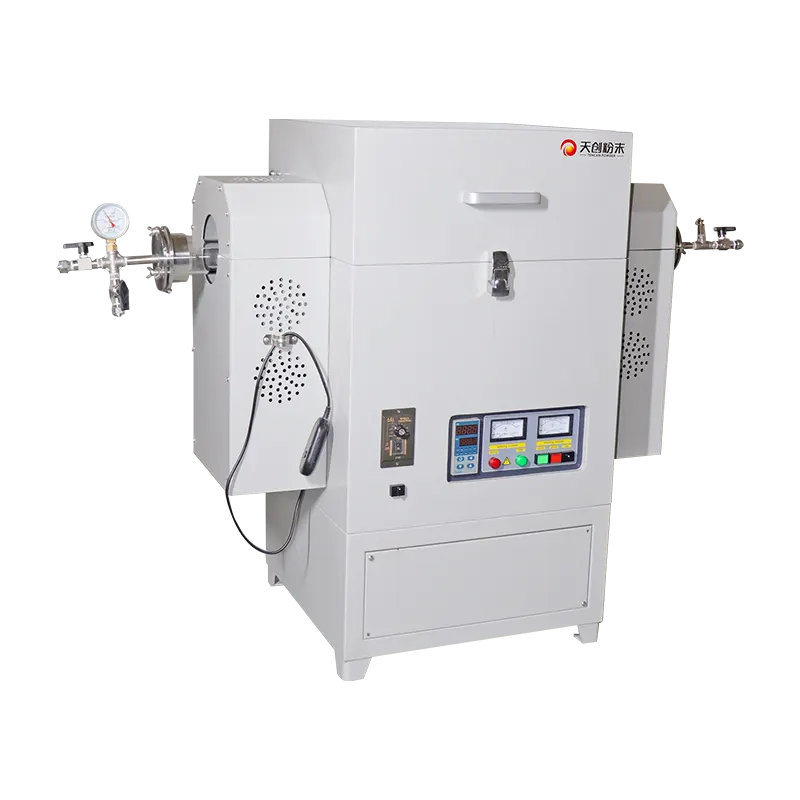
Let’s get into the details. TENCAN offers two main variants: the single-zone model SK-G06123K-R and the dual-zone model SK-G06123K-2R. Both share the same robust construction, but the dual-zone version gives you more precise temperature profiling along the tube length. Here’s a snapshot of the key specs:
| Parameter | SK-G06123K-R (Single Zone) | SK-G06123K-2R (Dual Zone) |
|---|---|---|
| Max Temperature | 1200℃ | |
| Heating Zone Length | 420 mm | |
| Constant Zone Length | 210 mm | 280 mm |
| Heating Element | High-resistance alloy wire OCr27Al7Mo2 | |
| Heating-up Time (empty) | < 15 min | |
| Rated Power | 3 kW | |
Note: The table above is based on the latest available data from TENCAN. The single-zone model is great for simple, uniform heating, while the dual-zone version allows you to create a temperature gradient – perfect for processes like CVD or stepwise calcination.
What Makes TENCAN’s Rotary Tube Furnace Special?
You might be thinking: “There are plenty of rotary tube furnaces out there. Why choose this one?” Fair question. Here are three things that I really appreciate after digging into the design:
1. Sealing That Actually Works
Rotating a tube while keeping it gastight is tricky. The seal between the rotating tube and the stationary end caps is a common failure point. TENCAN uses a combination of dynamic and static seals, carefully engineered to maintain vacuum or positive pressure even during continuous rotation. This means you can confidently run experiments under argon, nitrogen, or even reactive gases without worrying about leaks.
2. Intelligent Temperature Control
The furnace features a microcomputer PID controller with multi-segment programmable ramps. You can set up to 30 segments (or more with an option) for complex heating profiles. The thermocouple placement is optimized to give you real-time feedback from the actual heating zone, not just the furnace wall. The result? Temperature accuracy within ±1℃, which is critical for processes like lithium iron phosphate synthesis.
3. Material Quality and Safety
The furnace tube is available in high-purity quartz, 99 alumina, or 310S stainless steel, depending on your chemical compatibility needs. The heating elements are made from OCr27Al7Mo2, a high-resistance alloy that delivers consistent performance up to 1200℃. The outer shell has a double-layer structure with a cooling fan, keeping the surface temperature below 60℃. Over-temperature, over-current, and leakage protection are standard.
How to Choose the Right Rotary Tube Furnace for Your Work
Alright, let’s say you’re convinced that a rotary tube furnace is what you need. But with so many options, how do you pick the one that fits? Here’s a simple checklist to guide you:
- Temperature requirements: Always leave a 10–15% safety margin above your maximum process temperature. If your process runs at 1000℃, a 1200℃ furnace is a safe bet.
- Atmosphere control: Do you need inert gas, reducing gas, or vacuum? Check the sealing design and the pressure rating. TENCAN’s rotary tube furnace can be equipped with mass flow controllers and vacuum pumps.
- Throughput and tube diameter: For lab-scale work, a 60mm diameter tube (like the SK-G06123K series) is common. For larger volumes, consider a bigger tube or a continuous feed system.
- Rotation speed and tilt angle: Adjustable speed (typically 0–20 rpm) and tilt angle (0–15°) give you control over residence time. If you need to process materials that are very fine or sticky, look for a furnace with variable speed and a smooth inner surface.
- Data logging: For R&D, you’ll want a furnace that can record temperature, rotation speed, and gas flow. TENCAN offers optional touchscreen interfaces and software for data export.
Real-World Applications
So where do you actually use a rotary tube furnace? Here are a few examples that might resonate with you:
- Battery material synthesis: Pre-lithiation of silicon anodes, calcination of NMC precursors, or carbon coating on LiFePO4. The rotation prevents agglomeration and ensures uniform coating.
- Catalyst activation: Many catalysts need to be reduced under hydrogen at high temperature. A rotary tube furnace allows the gas to contact every particle.
- Ceramic powder calcination: For materials like alumina or zirconia, the rotary motion helps achieve consistent phase transformation.
- Thermal decomposition of organic precursors: For example, producing metal oxides from metal-organic frameworks (MOFs) – the gentle tumbling avoids crushing the delicate structures.
Final Thoughts: Why TENCAN Deserves a Look
I’ve been in the powder equipment world for a while, and I’ve seen a lot of furnaces that promise the moon but deliver mediocre performance. TENCAN, on the other hand, focuses on the details that matter: reliable seals, accurate temperature control, and robust construction. They’ve been supplying tube furnaces to universities and industries for years, and their 1200℃ rotary tube furnace is a workhorse that won’t let you down.
If you’re in the market for a rotary tube furnace, I’d recommend checking out the SK-G06123K-R and SK-G06123K-2R models. They cover the sweet spot for most lab and pilot applications, and TENCAN’s support team can help you customize the setup for your specific process. And hey, if you need other thermal equipment, their muffle furnaces and horizontal tube furnaces are also worth a look.
Remember, choosing a furnace is not just about the specs on paper – it’s about how it performs in your lab, day after day. With a TENCAN rotary tube furnace, you’re getting a tool that’s been refined through real-world feedback. That’s a partnership you can trust.
Related Products
Get In Touch
Our professional team will reply to you within one business day. Please feel free to contact us!