
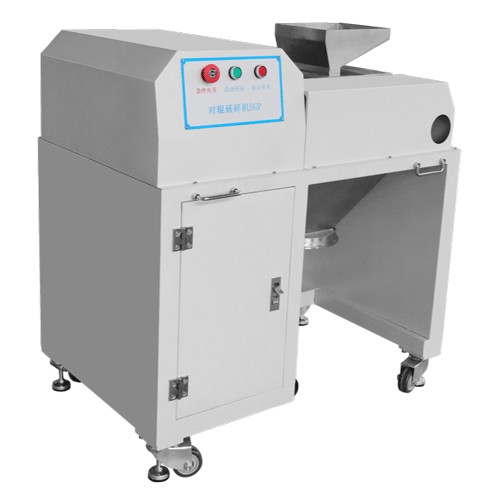
Double Roll Crusher: How It Works, Key Parameters, and When to Choose It

Imagine you're running a lab or a small-scale processing plant and you need to reduce chunks of coal, limestone, or slag down to a consistent, manageable size. You want something robust, easy to maintain, and that doesn't kick up a huge cloud of dust every time it runs. That's exactly where the double roll crusher earns its reputation.
In the world of powder processing, this machine is a quiet workhorse. It's not flashy, but it's incredibly effective – especially for mid-range hardness materials. In this guide, we'll walk through how it works, the technical specs that matter, and where this crusher really shines.
What Exactly is a Double Roll Crusher?
A double roll crusher is a machine that reduces the size of material by compressing it between two counter-rotating cylindrical rolls. Think of it like a heavy-duty pasta maker, but for rocks and minerals. Instead of pasta dough, you feed in lumps of coal, coke, limestone, or slag. The two rolls rotate towards each other, pulling the material in and crushing it down before it falls out through the bottom gap.
This design is famously simple and reliable. It's been around for more than a century, and for good reason. It handles sticky, wet, or dry materials without clogging, produces minimal fines during operation, and offers an extremely simple way to adjust your output size.
How Does a Double Roll Crusher Work? (The Working Principle)
Let's break down the crushing action into its basic steps.
1. The Counter-Rotation
The two cylindrical rolls are powered by electric motors and rotate in opposite directions. As the rolls spin towards each other, a natural 'nip' zone is created at the top of the rolls. Material fed into this zone is grabbed and pulled downward.
2. Compression and Shear
As the material is pulled between the rolls, it experiences a combination of compression (the force of being squeezed) and shear (a slicing action). This dual force efficiently fractures the particles along their natural grain boundaries. This is particularly useful for materials where you want to avoid creating excessive fine powder – the machine tends to produce a more uniform, cubical product.
3. Gap Adjustment
The real secret to this crusher's versatility lies in the way the output size is controlled. The gap between the two rolls is adjustable. You can increase or decrease this gap by turning a simple handwheel or using a hydraulic system. Here's the simple logic:
- Narrower gap = Smaller output particles.
- Wider gap = Larger output particles.
This adjustability allows you to fine-tune the machine for different materials and target particle sizes without needing to change any internal parts.
4. Safety Relief
A critical safety feature is the spring-loaded relief system on the movable roll. If an uncrushable object (like a piece of steel) tries to enter the crusher, one of the rolls is pushed back against its springs. This creates a temporary larger gap, allowing the object to pass through without damaging the rolls or the frame. The springs then push the roll back into its normal position immediately. This protection system is a huge reason why the machine is so durable.
Key Technical Parameters You Should Know
When choosing a double roll crusher, you can't just pick one based on the name. You need to match the machine's capabilities to your material's characteristics. Here are the most important technical parameters, based on models available from TENCAN (Changsha Tianchuang Powder Technology Co., Ltd.).
| Model | Roll Diameter × Width (mm) | Max Feed Size (mm) | Output Size (mm) | Capacity (t/h) | Motor Power (kW) |
|---|---|---|---|---|---|
| 2PG400×250 | 400 × 250 | ≤ 25 | 1 – 8 | 5 – 10 | 5.5 × 2 |
| 2PG610×400 | 610 × 400 | ≤ 40 | 1 – 20 | 12 – 20 | 15 × 2 |
| 2PG750×500 | 750 × 500 | ≤ 40 | 2 – 10 | 5 – 12 | 18.5 × 2 |
Note: These parameters are typical for smooth-roll crushers. Performance varies based on material type and moisture content.
What Materials Can a Double Roll Crusher Handle?
This machine is not a primary crusher for huge boulders. Instead, it excels as a secondary or tertiary crusher for materials with a compressive strength below 160–250 MPa. Common feedstocks include:
- Coal and coke
- Limestone and gypsum
- Slag and clinker
- Shale and clay
- Salt and fertilizers
- Glass and ceramics
- Ore samples (for laboratory analysis)
One of its standout features is its ability to process sticky or wet materials. Unlike a jaw crusher or cone crusher, the double roll design doesn't get clogged easily because there's no dead zone and the material is forced through by the rotating action.
Double Roll Crusher vs. Other Crushers
You might be wondering, 'When should I choose a double roll crusher over a jaw crusher or a hammer mill?'
- vs. Jaw Crusher: A jaw crusher is better for primary crushing of very large, hard rocks. The double roll crusher is better for secondary crushing where you need a more consistent, finer product (typically 10mm to 2mm).
- vs. Hammer Mill: A hammer mill can produce a finer product, but it generates a lot more dust and fine powder. The double roll crusher gives you a more uniform, coarser product with much less over-grinding. The hammer mill also produces more noise and vibration.
- vs. Cone Crusher: For very hard, abrasive rocks, a cone crusher is often preferred. The double roll crusher is more cost-effective for medium-hard materials and offers easier gap adjustment and maintenance.
For laboratory and small-scale production, TENCAN offers a range of related equipment. If you need even finer size reduction after the roll crusher, you might want to look at their Lab Jaw Crusher 2025 for primary crushing, or their Lab Jaw Crusher for smaller quantities.
Maintenance Tips for a Long-Lasting Machine
The double roll crusher is low-maintenance, but not no-maintenance. Here are the simple things you should do:
- Check the springs regularly: The relief springs need to be in good condition to protect the machine. If a spring is sagging or broken, replace it.
- Lubricate the bearings: The pillow block bearings should be greased according to the manufacturer's schedule. TENCAN's models use heavy-duty bearings that are easy to access.
- Inspect roll surfaces: Over time, the roll surfaces can wear down. For smooth rolls, they can be resurfaced. For toothed rolls, the teeth may need to be built up or replaced. TENCAN offers Teeth Roll Crushers for more aggressive, lumpy materials.
- Check the gap: Regularly verify that the gap setting is consistent from side to side to ensure uniform product size.
Conclusion: Is a Double Roll Crusher Right for You?
If your work involves processing medium-hard materials like coal, limestone, or slag, and you need a consistent, uniform output with minimal dust and easy adjustability, then a double roll crusher is an excellent choice. Its simple, robust design means it can run for years with very little trouble. For a specific model that fits your needs (from lab scale up to 10+ t/h), I highly recommend taking a closer look at the Double Roll Crusher from TENCAN. It's a machine that really delivers on its promise of simplicity and reliability.
Related Products
Get In Touch
Our professional team will reply to you within one business day. Please feel free to contact us!