
3D Mixer for Powder Blending: How Three-Dimensional Tumbling Works in Practice

Try blending two dry powders by shaking them together in a jar and the problem shows up within seconds: streaks of one material, pockets of the other, and the finer powder drifting quietly to the top. Scale that same behaviour up to a few hundred kilos on a production line and it stops being a curiosity and becomes a genuine quality-control headache. A 3D mixer is built to solve exactly that problem, and it does it with a motion that looks almost too simple to work.
In this article we will walk through what a 3D mixer actually is, why three-dimensional tumbling treats powders differently from a plain rotating drum, where it earns its place in a powder processing line, and how to judge whether it suits your material. No sales talk — just the mechanics, the trade-offs and the practical details that decide whether your blend comes out uniform, batch after batch.
What Is a 3D Mixer, and Why "3D"?
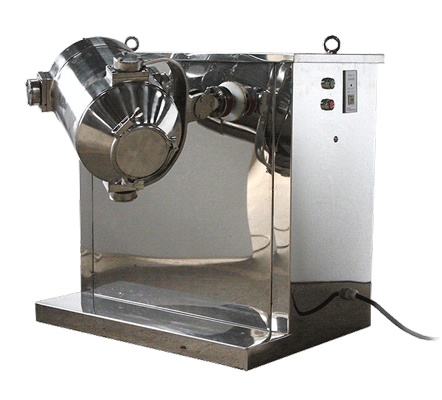
A 3D mixer is a dry powder blending machine whose drum moves in several directions at once. Instead of spinning around a single fixed axis the way a simple drum blender or a V-blender does, the mixing vessel rotates, tilts and swings at the same time. Powder inside is never just carried up the wall and dropped back down the same path — it is continuously redirected, folded over and slid past itself.
That combination of movements is where the name comes from. Material travels through all three dimensions of the vessel rather than circulating in a flat, repeating loop, and this constant change of direction keeps the whole bed in motion instead of letting it settle into a lazy, predictable rhythm.
Three Motions, One Drum
Picture the drum doing three things at once: turning on its own axis, swinging on a pivot and rocking gently back and forth. The result is a slow, continuous tumbling dance. Because the direction of gravity relative to the powder bed keeps shifting, material is always falling into the space the drum has just vacated. Nothing stirs the batch with a blade and nothing pushes it along with a screw. To a large extent, the powder blends itself.
Gentle Motion Is a Feature, Not a Compromise
This matters more than it might sound. Many powders are not inert sand. They are fragile crystals, coated granules, spray-dried agglomerates, or blends in which one active ingredient makes up a tiny fraction of the total. Fast-spinning blades can fracture particles, push heat into the batch, or smear one component across the vessel wall. Tumbling is far kinder to the material, and for heat-sensitive or friable products that difference decides whether the blend still meets specification after mixing.
How a 3D Mixer Actually Blends Your Powder
Three mechanisms do the work inside the drum, and understanding them makes it much easier to troubleshoot a batch that is not behaving the way you expect.
The Three Mechanisms Behind Every Good Blend
- Convection: large groups of particles move together as the bed rolls over. This is the bulk transport that carries material from one end of the batch to the other.
- Diffusion: individual particles wander across the boundary between two regions. It is slow, but it is what turns a broadly mixed batch into a genuinely uniform one.
- Shear: layers of powder slide over one another, smearing one ingredient through the next and breaking up small clusters along the way.
A well-designed tumbling motion produces all three, and does not lean too heavily on any single one. That balance is why one machine can handle a free-flowing granular product and a blend containing a small percentage of fine additive without any change to the setup.
What Good Motion Looks Like from the Outside
Watch a properly loaded drum and the powder will not sit at the bottom and slosh around. You should see a continuously renewed free surface, material cascading down the face of the bed, and no dead zone tucked into the corners. Underfill the drum and the batch slides instead of tumbling. Overfill it and there is no room for the material to fall, so mixing becomes slow and uneven. Most blending problems on the shop floor trace back to loading level rather than to the machine itself.
Where a 3D Mixer Earns Its Keep
Because the process is dry, gentle and fully enclosed, 3D mixers turn up across a surprisingly wide spread of industries. A few typical examples:
- Pharmaceutical and nutraceutical powders: blending an active ingredient into a diluent when content uniformity is a specification and particle damage is unacceptable.
- Battery and electronic materials: distributing fine active or conductive additives evenly through a bulk powder.
- Ceramics and glass: combining oxides, frits and colourants before pressing or sintering.
- Food and nutrition: dry mixes, spice blends, premixes and instant powders.
- Metallurgy: mixing metal powders with lubricants or alloying additions ahead of compaction.
- Chemicals, cosmetics and agrochemicals: pigments, fillers and low-dose additives that need to disappear into the bulk.
The common thread is a dry blend where uniformity is a requirement rather than a nice-to-have, and where you would rather not beat the particles up in order to get there.
3D Mixer vs. Other Powder Blenders
| Mixer type | Motion | Usually chosen for | Watch out for |
|---|---|---|---|
| 3D mixer | Multi-directional tumbling of the whole vessel | Gentle, uniform dry blending of fragile or low-dose powders | Batch operation, and loading level has to be right |
| V-blender or double-cone | Rotation about a single axis | Free-flowing granules and simple dry blends | Limited shear, so segregation-prone mixes can be tricky |
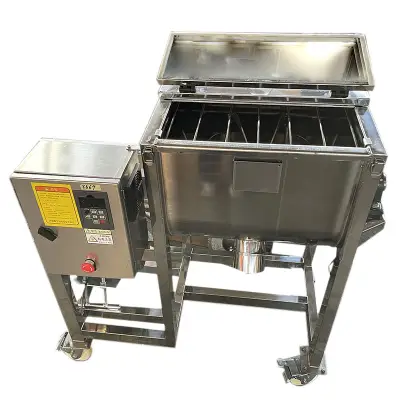
| Ribbon or paddle blender | Mechanical agitation inside a fixed trough | Large volumes and continuous duty | Higher shear and heat, more particle attrition |
| High-shear mixer | Fast rotating impeller and chopper | Agglomerate building and densification | Far too aggressive for fragile particles |
None of this means one design beats all the others. It means blend quality follows from the motion you apply, and tumbling machines sit at the gentle end of that spectrum. If your product is a delicate granule, a low-dose pharmaceutical blend, or anything whose particle shape has to survive the process, that gentleness is the entire point.
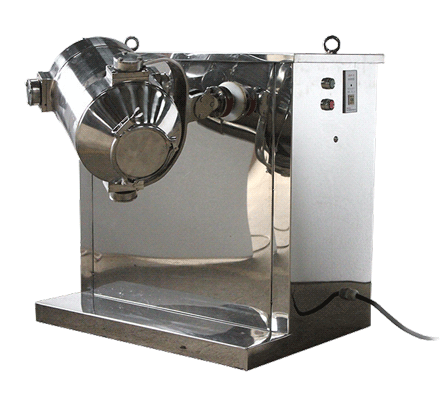
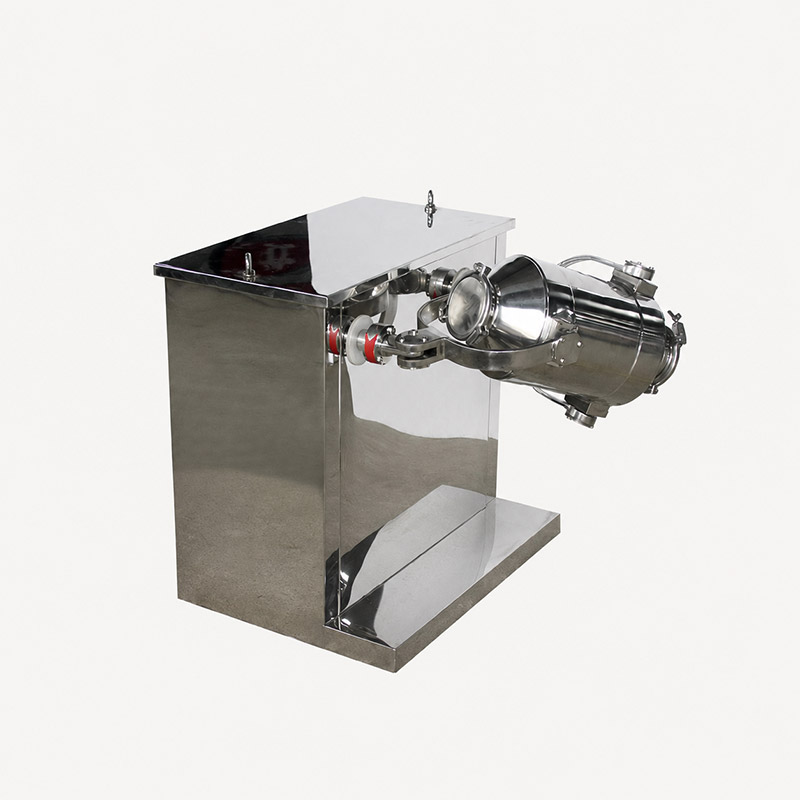
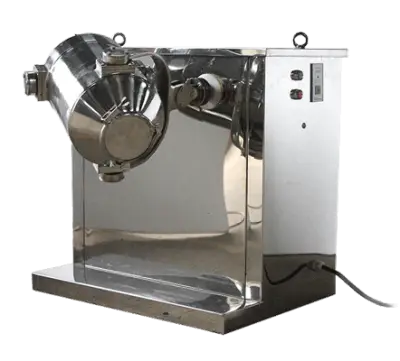
If you want to see how the motion is arranged on a real machine, the 3D mixer page shows the drum, the drive and the discharge arrangement together, which is much easier to judge than a description in text.
Choosing the Right 3D Mixer: The Parameters That Matter
A specification table can look like a wall of numbers, but only a handful of them really change how your product behaves. Here is what to focus on when you compare models.
Working Volume and Batch Size
Start from the batch you actually run every week, not the largest batch you might run once a year. As a rule of thumb, many powders blend best when the drum is filled to roughly half to two-thirds of its total volume: enough material to tumble over itself, and enough headspace for it to fall through. A drum that is much larger than your batch will not mix efficiently, while one that is too small forces you to overfill it and lose the tumbling action. Capacities differ from model to model, so match working volume to your routine batch and read the specification table of the specific model before you commit.
Drum Geometry and Internal Finish
The shape and internal surface of the drum decide how the bed rolls and how easily the vessel cleans up. A smooth, rounded interior with no sharp internal corners gives the powder fewer places to hide, which matters a great deal if you switch products regularly or work under food and pharmaceutical hygiene rules.
Rotation and Swing Speed
Speed control matters more than top speed. Push the drum too fast and the powder sticks to the wall under centrifugal force instead of tumbling, which is the opposite of what you want. Variable frequency control lets you slow the motion down for a fragile granule and speed it up slightly for a dense, free-flowing powder, and that flexibility is worth more than a bigger motor.
Loading and Discharge
Think about how the powder gets in and how completely it comes out. Dust-free loading, a discharge that empties the vessel without leaving a pocket of material behind, and a working height that does not require operators to climb are all practical details that decide whether the machine is pleasant to live with. A blender that empties perfectly in two minutes saves more time across a year than a faster motor ever will.
Material of Construction and Surface Finish
Product contact parts are normally stainless steel, and the finish ranges from a standard industrial surface to a highly polished one. Pick the finish that matches your industry rather than the one with the highest price tag — a food or pharmaceutical application will want polished, easy-to-clean contact surfaces, while a technical ceramic blend may be perfectly happy with a standard finish. If you are working with Changsha Tianchuang Powder Technology Co., Ltd. (TENCAN), this is one of the first questions the engineering team will ask, because it shapes the whole build.
Powder Physics: Why Some Blends Refuse to Cooperate
Two batches of the same recipe can behave completely differently in the same machine, and the reason usually lies in the particles rather than the equipment.
Segregation: The Quiet Enemy of a Good Blend
Segregation is what happens when particles of different size or density stop travelling together. Big particles roll further when the bed avalanches, fine particles sift down through the gaps, and a light ingredient can float its way to the surface. The uncomfortable part is that a mixer can cause segregation as easily as it cures it: keep tumbling a segregation-prone blend long after it is uniform and you will start to unmix it again. This is why sampling, rather than a stopwatch, is the honest way to set a mixing time.
Cohesion, Moisture and Static
Very fine powders do not flow so much as clump. Humidity makes them stickier, electrostatic charge makes them cling to the drum wall and to each other, and both effects fight against a clean blend. Keeping the powder dry, controlling the room environment, and where regulations allow it using a small amount of flow aid will usually bring a difficult formulation back into comfortable territory.
Practical Tips for a Better Blend
Once the machine is on your floor, most blend quality comes down to a handful of habits:
- Load consistently. Decide a fill level and stick to it between batches; inconsistent loading is the most common cause of inconsistent results.
- Mix to uniformity, then stop. Take samples at intervals during a trial run and find the point where the numbers stop improving.
- Pre-blend small ingredients. Mix a low-dose additive with a scoop of the bulk first, then add that premix to the drum, so it does not land as a concentrated patch on the surface.
- Add liquids last and sparingly. A little binder or oil goes in after the dry components are combined, and slowly enough that it does not create lumps.
- Keep the feed dry. Store powders sealed, and check moisture before a critical batch rather than after.
- Sample properly. A sample taken from the top surface tells you very little; take several from different depths and positions.
- Clean between products. Cross-contamination between a coloured product and a white one is a blend problem you create during changeover, not during mixing.
Cleaning, Maintenance and Compliance
Because the mixing chamber is a sealed vessel with no internal agitator, cleaning is refreshingly straightforward. There are no blades or shafts to remove, no packed glands in the product zone, and no narrow channels where powder can build up unnoticed. In practice, most operators open the drum, wipe or wash the interior, and are ready for the next product in a fraction of the time a ribbon blender would demand.
Maintenance is equally undemanding. The moving parts sit outside the product contact area, so routine work is largely a matter of checking the drive, the bearings, the seals and the discharge valve, plus confirming that the drum still runs smoothly and without abnormal vibration. For regulated industries, the sealed design also makes validation easier: you can document a cleaning procedure and a mixing time, and repeat it batch after batch with confidence.
Frequently Asked Questions
How long does one batch take to mix?
For most dry blends this is a matter of minutes rather than hours, and the honest answer is "as long as it takes to reach uniformity, and no longer". The right mixing time depends on your particle sizes, bulk densities and fill level, so the sensible approach is a short sampling trial: run the mixer, take samples at intervals, analyse them, and stop when the result stops improving. Running well past that point does not make the blend better, and with segregation-prone powders it can make it worse.
Can a 3D mixer handle sticky or moist powders?
Free-flowing and mildly cohesive powders are its natural territory. Very sticky, paste-like or genuinely wet materials belong to a different class of machine, because tumbling only works when the bed can actually flow. If your material is borderline — a little hygroscopic, a little electrostatic — pre-drying, humidity control or a small amount of flow aid usually brings it comfortably back into range.
Is it suitable for small research and development batches?
Yes, and this is often where people first meet the technology. Smaller units let formulation teams test blends at laboratory scale before committing to production volumes, which is far cheaper than discovering a uniformity problem after a full-scale line has been installed. The motion principle is the same, so results from a small unit usually translate well when you scale up.
Does it work when one ingredient is a very small fraction of the batch?
It can, provided the additive is introduced sensibly. Dumping a few grams of active material on top of a large powder bed and hoping for the best is not a mixing strategy. Pre-blend the small ingredient with a portion of the bulk first, add the premix to the drum, and let the tumbling motion distribute it from there. That single habit solves a large share of low-dose uniformity complaints.
Choosing a Machine That Fits Your Powder
A 3D mixer is not a universal answer to every blending problem, but for dry powders where uniformity matters and particle integrity cannot be sacrificed, three-dimensional tumbling is hard to beat. It is gentle, it is easy to clean, and it produces the kind of repeatable blend that keeps a specification sheet honest.
Before you decide, write down three things: your routine batch size, the particle size range of your coarsest and finest components, and how fragile your product is. Those three answers narrow the field faster than any specification table. If you want to compare configurations and see what the motion looks like on a finished machine, start with the TENCAN 3D mixer and match the working volume to the batch you run most often — that is the decision that will matter most in daily production.
And if a blend ever goes wrong, remember the order to check things in: loading level first, mixing time second, and particle behaviour third. Nine times out of ten, the machine is doing exactly what it was asked to do.
Related Products
Get In Touch
Our professional team will reply to you within one business day. Please feel free to contact us!