
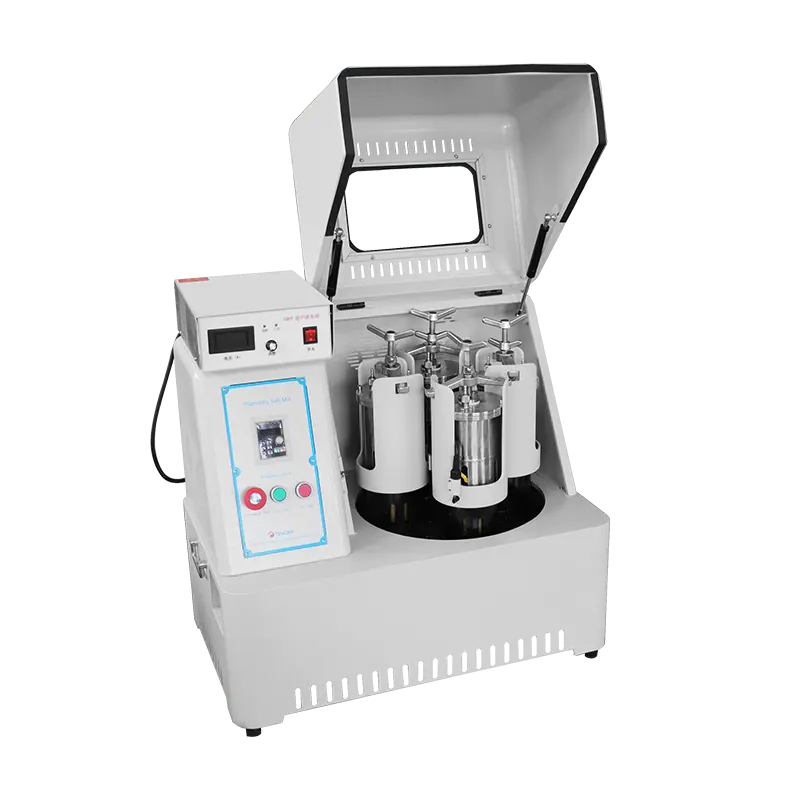
Ultrasonic Planetary Ball Mill: The Ultimate Guide to Superior Grinding with Sonic Energy

What Is an Ultrasonic Planetary Ball Mill?
If you've ever worked with planetary ball mills, you know they already do a fantastic job at reducing particle sizes down to the micron or even submicron level. But what if you need to go further—down to the true nanoscale—and also prevent those fine particles from clumping back together? That's where the ultrasonic planetary ball mill comes into play.
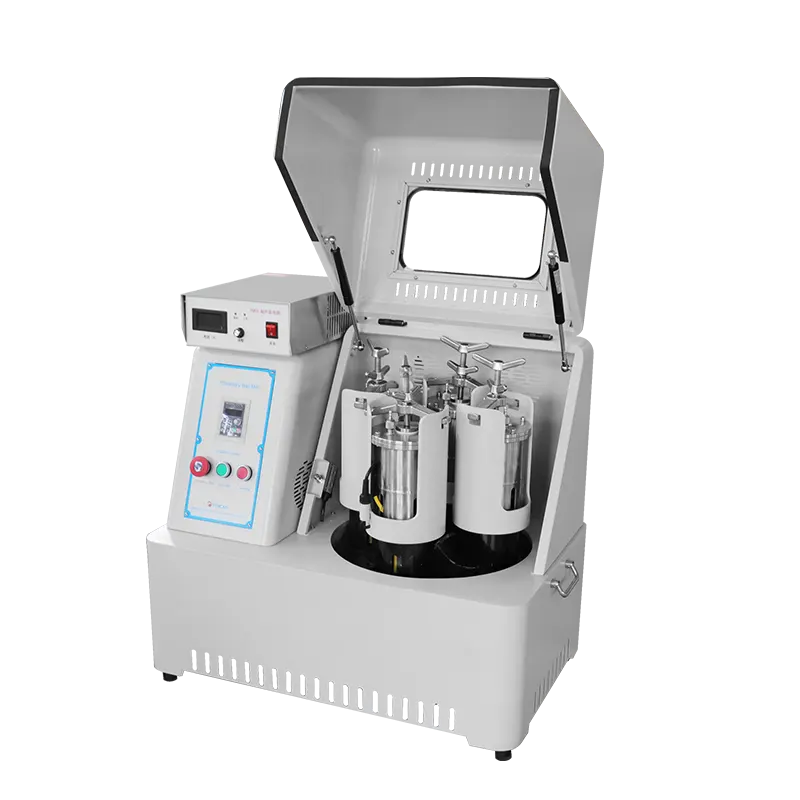
Think of it as a hybrid powerhouse. It takes the classic planetary ball mill—which already excels at high-energy grinding through its unique 'planet-like' motion—and adds a built-in ultrasonic probe that bombards the slurry with high-frequency sound waves. The result? Faster grinding, finer particles, and a remarkably uniform dispersion that's hard to achieve with conventional methods.
I've spent years around powder processing equipment, and I can tell you this combination is a game-changer, especially for materials that are notoriously difficult to mill—things like hard ceramics, layered materials, or temperature-sensitive compounds. In this guide, we'll peel back the layers on how this technology works, why it matters, and how you can choose the right setup for your lab or production line.
How Does It Work? The Marriage of Two Forces
To understand the ultrasonic planetary ball mill, you first need to appreciate its two core mechanisms.
1. Planetary Motion: The High-Energy Foundation
Every planetary ball mill works on a simple yet brilliant principle: the grinding jars (planets) rotate around their own axes while also orbiting around a central axis—just like planets in a solar system. This dual rotation creates powerful centrifugal and Coriolis forces that drive the grinding balls to collide with the material and the jar walls at very high energies. These collisions generate intense impact, shear, and friction, pulverizing the material into fine powders.
In a standard planetary mill, the grinding energy is already much higher than in a conventional ball mill. But even with all that force, some materials still resist breakage, and fine particles often re-agglomerate due to van der Waals forces and electrostatic attractions.
2. Ultrasonic Energy: Breaking the Agglomeration Barrier
This is where the ultrasonic component shines. In an ultrasonic planetary ball mill, a piezoelectric transducer (typically located at the bottom or inside the grinding chamber) generates high-frequency acoustic waves—usually in the range of 20 kHz to 40 kHz. When these waves travel through the liquid medium (water, ethanol, or other solvents), they create countless microscopic bubbles that rapidly grow and collapse. This phenomenon is called acoustic cavitation.
Each bubble collapse produces localized temperatures of several thousand degrees Celsius and intense micro-jets that can strip particle surfaces, break agglomerates, and even modify particle morphology. The ultrasonic energy doesn't just complement the mechanical grinding—it continuously disperses the freshly broken particles, preventing them from sticking together and exposing new surfaces for further size reduction.
So, in effect, you get two processes happening simultaneously: mechanical comminution from the planetary action, and de-agglomeration from ultrasound. The synergy is remarkable.
Key Advantages Over Conventional Planetary Ball Mills
▶ True Nanoparticle Production
With a standard planetary mill, you often hit a 'grinding limit' where particles stop getting smaller because the energy isn't enough to overcome the material's fracture toughness, or because agglomeration balances the breakage. Ultrasonic assistance pushes that limit further down. Many users report achieving particles in the 10–50 nm range consistently, which is tough with mechanical force alone.
▶ Superior Dispersion and Homogeneity
Ever opened a grinding jar after a long run and found a hard cake stuck to the bottom? That's agglomeration. The ultrasonic action keeps the slurry fluid and well-mixed, so you get a uniform suspension with fewer aggregates. This is especially valuable when preparing slurries for battery electrode coatings, ceramic inks, or nanofluids.
▶ Faster Milling Times
Because the ultrasound continuously breaks up freshly formed agglomerates, the effective milling time can be reduced by 30% to 50% compared to a conventional planetary mill running under the same conditions. More throughput in less time—always a win.
▶ Lower Heat Build-up
Milling generates heat, and heat can degrade heat-sensitive materials. The cavitation effects in ultrasonic milling actually help with local heat dissipation. Combined with programmable pause cycles (which many modern planetary mills offer), you can keep the temperature under control. For truly temperature-sensitive samples, TENCAN also offers a low-temperature planetary grinding machine that works with liquid nitrogen.
▶ Cleaner Process (No Additives Needed)
Sometimes, to prevent agglomeration during grinding, researchers resort to chemical surfactants or dispersants. These can contaminate the final product and require additional purification steps. Ultrasonic energy can often achieve the same de-agglomeration effect physically, without any chemical additives—giving you a cleaner product.
Where Is It Used? Real-World Applications
Because of its ability to produce ultra-fine, well-dispersed powders, the ultrasonic planetary ball mill has found a home in many cutting-edge fields:
- Battery Materials: Grinding cathode and anode materials (like NMC, LFP, silicon, graphite) to submicron or nanometer scale, improving electrochemical performance. TENCAN's dual planetary ball mill is also popular for battery research.
- Ceramics and Refractories: Milling alumina, zirconia, silicon carbide, etc., to achieve dense, homogeneous green bodies for sintering.
- Pharmaceuticals and Biomedicine: Preparing drug nanoparticles or breaking cell walls for active ingredient extraction—ultrasound aids in cell disruption.
- Nanomaterials Synthesis: Producing graphene, carbon nanotubes, or other 2D materials by exfoliation and comminution.
- Chemical Industry: Enhanced mixing and grinding of catalysts, pigments, and fertilizers.
Technical Specifications: What to Look For
When shopping for an ultrasonic planetary ball mill, you'll want to consider the following parameters. While specifications vary by model and manufacturer, TENCAN's ultrasonic planetary ball mills offer a well-rounded set of features suitable for both research and pilot production.
Ultrasonic System
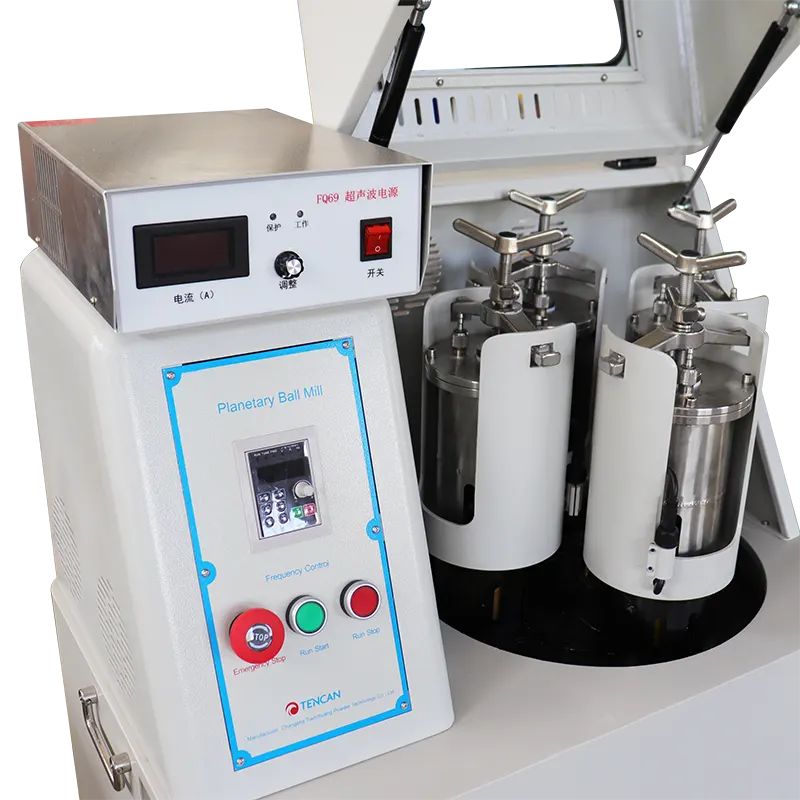
- Frequency: Typically 20–40 kHz. Lower frequencies (20 kHz) give stronger cavitation, while higher frequencies (40 kHz) produce smaller bubbles and more gentle action.
- Power: Adjustable from 0 to 500 W or more, allowing you to tune the intensity to match your material's characteristics.
- Probe Material: Titanium alloy probes are standard for durability and corrosion resistance.
Planetary Grinding System
- Number of Grinding Stations: Usually 2 or 4 stations, capable of holding jars from 50 mL up to 5 L each.
- Speed Range: Sun wheel rotation: 50–600 rpm; jar rotation: 100–1200 rpm. Higher speed means higher energy, but may require cooling cycles.
- Drive Mechanism: Belt-driven or gear-driven. Gear-driven offers better torque but more noise; belt-driven runs quieter.
- Control: Touch screen interface with programmable timing, speed ramping, pause cycles, and ultrasonic power profile is now standard on TENCAN's models.
Safety and Convenience
- Overheat Protection: Automatic shut-off if the motor or ultrasonic transducer exceeds safe temperature.
- Soundproof Enclosure: Recommended for heavy use—ultrasonic milling can be noisy.
- Atmosphere Control: Some models allow inert gas purging for air-sensitive materials (e.g., TENCAN's micro planetary ball mill for glove box).
Why Choose TENCAN's Ultrasonic Planetary Ball Mill?
Changsha Tianchuang Powder Technology Co., Ltd. (TENCAN) has been a trusted name in powder processing equipment for years. Their ultrasonic planetary ball mill stands out for its robust construction, precision control, and thoughtful integration of the ultrasonic system. Here's what I really appreciate about it:
- The ultrasonic probe is designed to be easily removable and interchangeable, so you can use the mill in standard mode when ultrasound isn't needed.
- The touchscreen software allows you to create and save milling recipes, ensuring repeatability across different batches.
- The company offers a wide range of jar materials (stainless steel, agate, zirconia, PTFE, etc.) to suit various sample types, including abrasive and corrosive materials.
- They also provide comprehensive support—from installation to process optimization—which is invaluable when you're pushing the boundaries of nano-milling.
Tips for Getting the Best Results
Before you jump in, here are a few practical tips gleaned from working with these machines:
- Optimize the ball-to-powder ratio – A typical starting point is 10:1 to 20:1 (ball weight to powder weight), but ultrasonic milling often works well with a slightly lower ratio because the ultrasound helps break agglomerates.
- Use the right liquid medium – The viscosity and surface tension of the liquid affect cavitation. Water and ethanol are common, but you can use organic solvents if the jar and probe seals are compatible.
- Don't run it dry – Ultrasound needs a liquid medium to transmit energy. Wet milling is mandatory when using the ultrasonic feature.
- Use pause cycles – Especially for long runs, program the mill to stop every few minutes to let the heat dissipate. Most TENCAN models include this in the control software.
- Start with a pre-milling step – If your material has large chunks (>1 mm), it's wise to do a short conventional planetary milling first, then switch on the ultrasound for the final nanogrinding stage. This reduces wear on the ultrasonic probe.
Final Thoughts
The ultrasonic planetary ball mill is more than just a fancy upgrade—it's a solution to some of the most persistent challenges in fine powder processing: particle agglomeration and the grind limit. Whether you're developing next-generation battery materials, advanced ceramics, or pharmaceutical nanoformulations, this tool can save you time and deliver better results.
If you're curious about how it compares to other grinding technologies, you might also want to check out TENCAN's laboratory full-directional planetary ball mill or the heavy-duty full-directional planetary ball mill for even more versatility. But if nanoscale is your target, the ultrasonic option is hard to beat.
Have questions about integrating ultrasonic milling into your workflow? Drop me a line—I'm always happy to talk powders.
Related Products
Contáctenos
Nuestro equipo profesional le responderá en el plazo de un día laborable. ¡No dude en contactarnos!