
What is a Three Roll Mill? Working Principle, Applications, and Selection Guide

What is a Three Roll Mill?
Have you ever wondered how those smooth, high-quality inks, paints, or even your favorite lipstick are made? A lot of the magic happens inside a machine called a three roll mill (also known as a triple roll mill or three roller mill). It's a classic piece of equipment that uses powerful shear forces to mix, refine, disperse, and homogenize thick, viscous materials. Think of it as a super-efficient mortar and pestle, but on a continuous, industrial scale.
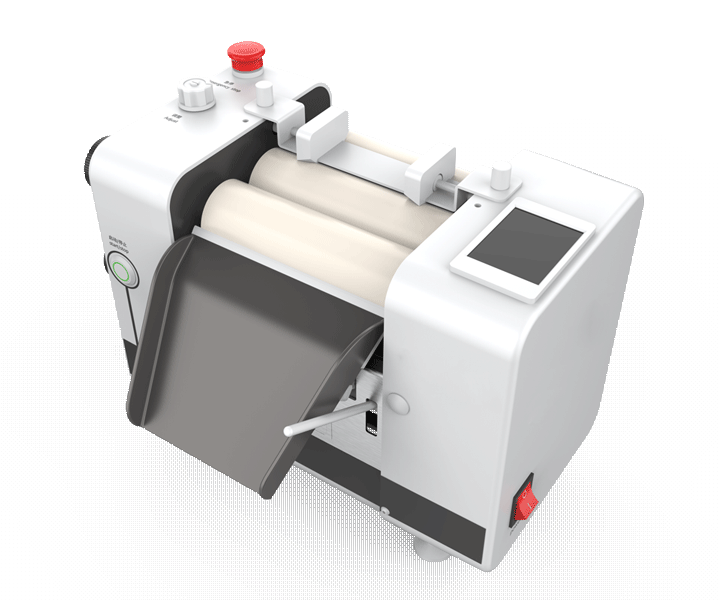
At its core, a three roll mill is a machine with three horizontally positioned rolls that rotate in opposite directions and at different speeds. The material is fed between the first two rolls, gets sheared, and then passes through the second and third rolls for even finer dispersion. The result? A perfectly uniform, de-agglomerated product with particle sizes down to the micron level.
At TENCAN (Changsha Tianchuang Powder Technology Co., Ltd.), we specialize in precision grinding equipment, and our Three Roll Mill is designed for both laboratory research and small-scale production, offering reliability and repeatability.
How Does a Three Roll Mill Work?
Let's break down the working principle in a simple way:
- Three Rolls: There are three cylindrical rolls – usually called the feed roll, center roll, and apron roll. They are made of hardened steel or ceramic (for contamination-free grinding).
- Opposite Rotation & Speed Difference: The rolls rotate in opposite directions. The feed roll has the slowest speed, the center roll is about three times faster, and the apron roll is about nine times faster than the feed roll. This increasing speed difference creates a strong shear force.
- Gap Adjustment: The gap between the rolls can be adjusted precisely (down to a few microns). The material is fed into the gap between the feed roll and the center roll. The high shear force breaks down agglomerates and disperses particles evenly.
- Knife Blade: A knife blade (or doctor blade) scrapes the finished material off the apron roll, collecting it for the next process.
The entire process is continuous, making it highly efficient for materials that are too viscous for a basket mill or colloid mill.
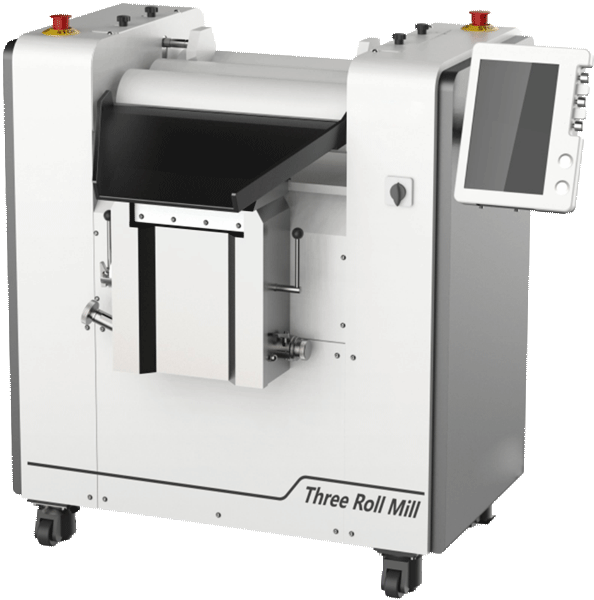
Key Applications of Three Roll Mills
Where does a three roll mill shine? It's the go-to machine for any industry that needs to disperse solid particles into a liquid vehicle (a paste or liquid). Here are some common fields:
1. Printing Inks & Paints
From offset inks to screen printing inks, three roll mills ensure perfect color consistency, gloss, and flow. They break down pigment agglomerates, giving you a high-quality end product.
2. Cosmetics & Personal Care
Lipsticks, eye shadows, creams, and toothpastes rely on three roll mills for a smooth, luxurious texture. The fine dispersion of pigments and active ingredients is critical for performance and feel.
3. Electronics & Conductive Pastes
In the electronics industry, pastes like silver conductive adhesives, solder pastes, and dielectric materials need to be perfectly homogeneous. A three roll mill ensures uniform electrical properties.
4. Pharmaceuticals
Ointments, creams, and suppositories benefit from the gentle yet effective mixing action, preserving the integrity of active ingredients while achieving a fine particle size.
5. Ceramics & Advanced Materials
For ceramic slurries, battery electrode materials, and other high-tech pastes, three roll mills can achieve particle sizes down to the sub-micron range.
Technical Parameters of a Typical Laboratory Three Roll Mill
While specifications vary, let's look at a typical lab model like the SM65 from TENCAN (a ceramic triple roll mill). Note that industrial models can be much larger.
| Parameter | Typical Value (SM65) |
|---|---|
| Roller Diameter | 65 mm |
| Roller Length | 150 mm |
| Speed Ratio (Feed : Center : Apron) | 1 : 3 : 9 |
| Motor Power | 0.75 kW |
| Voltage | 220V / 380V, 50/60Hz |
| Material of Rolls | Ceramic (Al₂O₃) or hardened steel |
| Application | Lab pilot, small batch production |
| Weight | ~80 kg |
For precise details and other models, visit the TENCAN Three Roll Mill product page.
How to Choose the Right Three Roll Mill?
Selecting the right three roll mill depends on a few factors:
- Material Type: If you're grinding high-purity materials (pharma, electronics), choose ceramic rolls to avoid metal contamination. For general use, hardened steel rolls are fine.
- Viscosity: Three roll mills handle high-viscosity pastes well. If your material is too liquid, it may drip; consider a sand mill instead.
- Throughput: Lab mills (like SM65) process small batches (50-200g per pass). For production, you need larger models with roll diameters of 100mm, 150mm, or even 260mm.
- Automation & Control: Modern mills offer frequency control, digital gap adjustment, and cooling systems for temperature-sensitive materials.
Why Choose TENCAN's Three Roll Mill?
At TENCAN, we've been manufacturing powder equipment for over a decade. Our three roll mills are built with:
- Precision bearings & gears for smooth, quiet operation.
- Ceramic or steel rolls with high hardness and wear resistance.
- Adjustable gap control down to 5 microns.
- Safety features like emergency stop and overload protection.
- Global support – we ship to labs and factories worldwide.
Whether you're developing a new ink formula, scaling up a pharmaceutical cream, or researching battery materials, a three roll mill from TENCAN can help you achieve consistent, high-quality results.
Final Thoughts
The three roll mill is a timeless tool for dispersion and grinding. Its simple yet effective design makes it indispensable in many industries. If you're looking to upgrade your lab or production line, consider the versatility and reliability of a three roll mill.
Got questions? Feel free to reach out to TENCAN for a customized solution. We're happy to help you find the perfect mill for your application.
Related Products
Get In Touch
Our professional team will reply to you within one business day. Please feel free to contact us!