
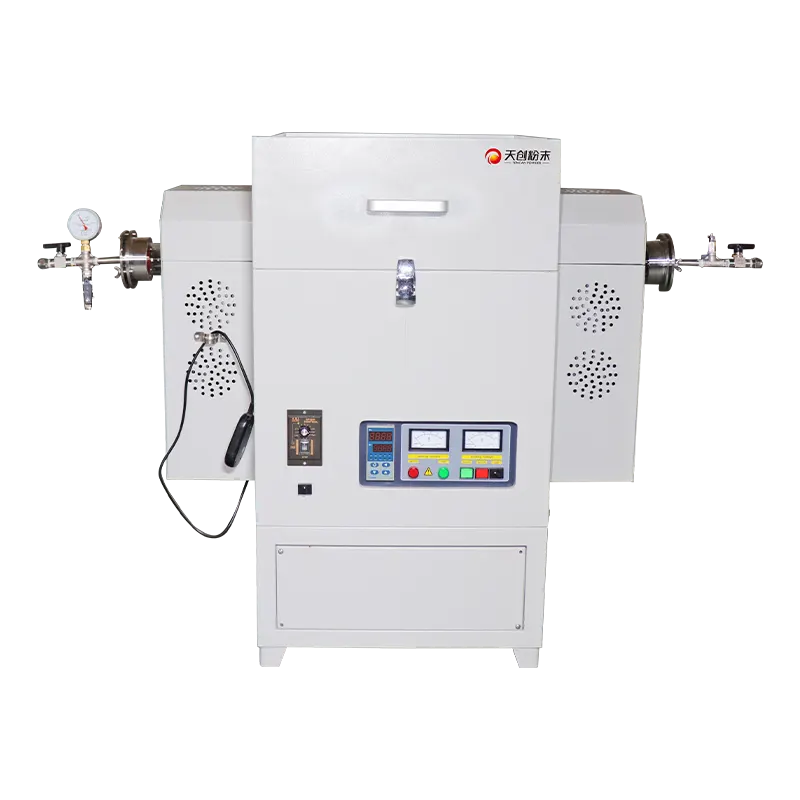
Rotary Tube Furnace Explained: Working Principle, Technical Parameters, and Practical Selection Guide

What is a Rotary Tube Furnace?
If you've ever worked with a standard tube furnace, you know the challenge: the material sits still in the hot zone, and heat transfer is limited by surface contact. A rotary tube furnace changes the game by rotating the entire tube (or the material inside) during heating. This simple but powerful motion ensures that every particle gets exposed to the furnace atmosphere and the heated wall, dramatically improving heat and mass transfer.
Also known as a rotating tube furnace or a rotary reactor furnace, this equipment is widely used in powder metallurgy, battery material synthesis, catalyst activation, ceramic calcination, and many other fields where uniform heating of granular or powdery materials is critical.
At TENCAN Powder (Changsha Tianchuang Powder Technology Co., Ltd.), we have been designing and manufacturing rotary tube furnaces for years, helping researchers and industrial users achieve consistent results in dynamic thermal processing.
How Does a Rotary Tube Furnace Work?
The core principle is elegantly simple: a cylindrical tube, typically made of quartz, alumina, or high-temperature alloy, is mounted on a set of rollers that can rotate it at a controlled speed. The tube is heated by external resistance heaters (e.g., high-resistance alloy wires or silicon carbide rods) arranged in one or more temperature zones. As the tube rotates, the material inside tumbles and cascades, continuously exposing fresh surfaces to the hot environment.
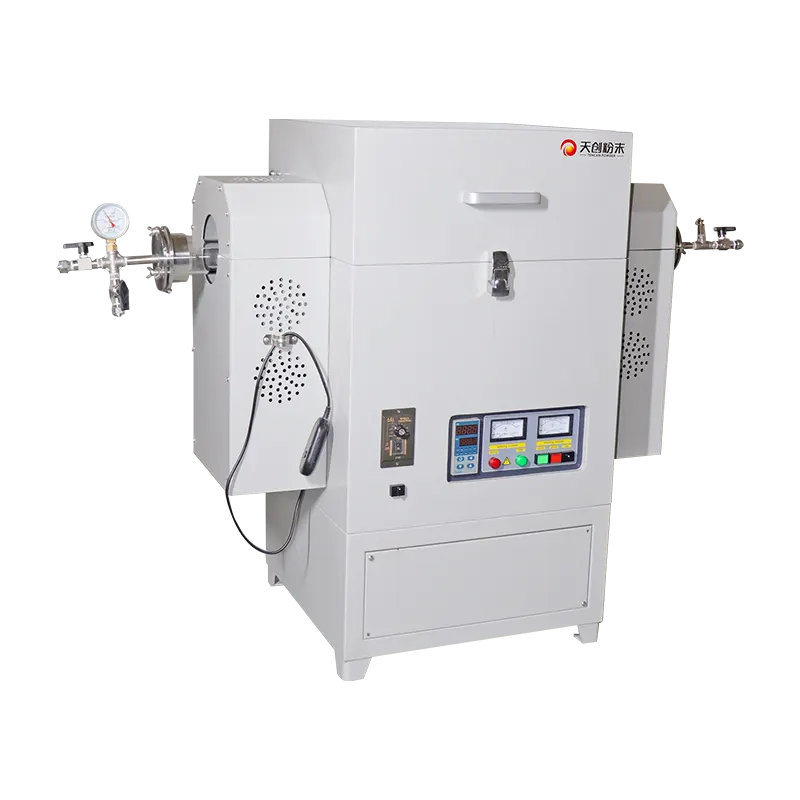
Key components include:
- Tube – the rotating vessel that contains the material. Choose based on temperature and chemical resistance.
- Heating elements – wrapped around the tube or arranged in a split furnace body.
- Drive system – motor with variable speed control to adjust rotation speed (typically 1–20 rpm).
- Sealing system – dynamic seals at the ends to allow gas flow (inert, reducing, or reactive) while the tube rotates.
- Temperature control – PID controller with thermocouples for precise regulation, often programmable for multi-step profiles.
The rotation can be continuous or oscillatory (back-and-forth over a limited angle, e.g., 315°), which is especially useful for materials that tend to agglomerate.
Key Advantages of Using a Rotary Tube Furnace
Why choose a rotary tube furnace over a static tube furnace or a box furnace? Here are the main benefits:
1. Uniform Heat Treatment
Because the material is constantly moving, hot spots are eliminated. Every particle experiences the same temperature history, leading to more consistent product quality.
2. Enhanced Gas-Solid Contact
In processes like calcination, reduction, or oxidation, the rotating action exposes fresh material surfaces to the process gas, speeding up reactions and increasing yield.
3. Continuous or Batch Processing
Rotary tube furnaces can be operated in batch mode (load material, heat, cool, unload) or as continuous flow reactors by feeding material at one end and collecting at the other. This makes them ideal for pilot-scale and production environments.
4. Lower Risk of Agglomeration
Sticky or fine powders tend to clump in static furnaces. The tumbling motion in a rotary tube prevents or breaks up agglomerates, ensuring free-flowing product.
5. Better Temperature Uniformity in the Working Zone
Many rotary tube furnaces use multi-zone heating (e.g., single zone or dual zone) to create a long, flat temperature profile. The rotation helps even out any residual gradients.
Technical Parameters of a Typical 1200°C Rotary Tube Furnace
Let's take a closer look at the 1200°C Rotary Tube Furnace from TENCAN Powder as a practical example. This model is available in single-zone (SK-G06123K-R) and dual-zone (SK-G06123K-2R) versions, both designed for laboratory and small-scale production.
| Parameter | SK-G06123K-R (Single Zone) | SK-G06123K-2R (Dual Zone) |
|---|---|---|
| Maximum Temperature | 1200°C | |
| Heating Zone Length | 420 mm | |
| Constant Temperature Zone Length | 210 mm | 280 mm |
| Heating Elements | High-resistance alloy wire OCr27Al7Mo2 | |
| Heating Up Time (empty) | Less than 15 minutes | |
| Rated Power | 3 kW | 4 kW |
| Temperature Controller | PID 30-segment programmable | |
| Tube Material | Quartz, alumina, or 310S stainless steel (optional) | |
| Rotation Speed | Adjustable, typically 1–20 rpm | |
This model features a split furnace body for easy tube replacement, high-quality ceramic fiber insulation for low energy loss, and a double-layer shell with cooling fan to keep the outer surface temperature below 60°C. It supports a variety of atmospheres including nitrogen, argon, hydrogen, and mixed gases, thanks to the dynamic sealing system.
Typical Applications of Rotary Tube Furnaces
You'll find rotary tube furnaces in many industries:
- Lithium-ion battery materials – calcination of cathode precursors (e.g., NMC, LFP) under controlled atmosphere.
- Catalyst preparation – activation or regeneration of catalysts, where uniform gas exposure is crucial.
- Ceramic powders – calcination of zirconia, alumina, and other advanced ceramics.
- Metal powder treatment – reduction of metal oxides, annealing, or sintering of fine metal powders.
- Nanomaterials synthesis – chemical vapor deposition (CVD) reactions in a rotating tube to produce uniform coatings.
- Environment and waste treatment – thermal desorption, pyrolysis of solid waste.
How to Select the Right Rotary Tube Furnace
Choosing a rotary tube furnace for your specific needs involves several considerations:
1. Temperature Requirement
Always allow a safety margin: if your process runs at 1100°C, choose a furnace rated for 1200°C or higher. The maximum operating temperature should be 10–15% below the absolute maximum rating to ensure long life of the heating elements and tube.
2. Tube Material
Quartz tubes are cost-effective up to 1100°C and provide excellent transparency for visual monitoring. Alumina (99% Al₂O₃) tubes can go to 1700°C but are more brittle. For high-pressure or corrosive environments, nickel-based alloy tubes (e.g., Inconel 600) are ideal.
3. Heating Zone Length and Number of Zones
For longer samples or continuous processing, a multi-zone furnace provides better temperature uniformity. The dual-zone model (SK-G06123K-2R) offers a longer constant temperature zone (280 mm vs 210 mm for the single-zone).
4. Rotation Speed and Angle
Most lab furnaces offer adjustable speed (1–20 rpm). Some processes benefit from oscillatory rotation (e.g., 315° back-and-forth) to prevent material from sticking to the tube walls. Check if the furnace supports this feature.
5. Atmosphere Control
If you need to introduce inert, reducing, or oxidizing gases, ensure the furnace has well-designed gas inlet/outlet and a reliable sealing system. For vacuum applications, consider a vacuum tube furnace instead.
6. Safety Features
Over-temperature protection, over-current protection, and emergency stop are essential. Many modern furnaces also include leak detection for flammable gases.
Maintenance Tips for Rotary Tube Furnaces
To keep your rotary tube furnace running smoothly:
- Regularly inspect the tube for cracks or deformation, especially if cycling between high and low temperatures.
- Lubricate the drive rollers and bearings according to the manufacturer's schedule.
- Clean the tube interior after each batch to prevent residue buildup that can affect heat transfer.
- Check the dynamic seals (e.g., O-rings, graphite packing) for wear; replace them as needed.
- Verify the calibration of thermocouples and temperature controllers annually.
Why Choose TENCAN Powder for Your Rotary Tube Furnace?
At TENCAN Powder, we combine years of thermal processing expertise with a commitment to quality. Our rotary tube furnaces are built with:
- High-purity ceramic fiber insulation for low thermal mass and fast heating.
- Advanced PID controllers (30-segment programmable) for precise temperature control.
- Robust mechanical design with user-friendly operation.
- Full CE and ISO 9001 certifications.
Whether you need a single-zone or dual-zone rotary tube furnace, we can tailor the solution to your specific process requirements. Our team also provides technical support for installation, commissioning, and process optimization.
Frequently Asked Questions
Q: Can I use a rotary tube furnace for continuous production?
A: Yes, many rotary tube furnaces are designed for continuous feeding and discharging. You can connect a screw feeder at the inlet and a collection vessel at the outlet. The rotation speed and tube inclination angle control the residence time.
Q: What is the difference between a rotary tube furnace and a rotary kiln?
A: In practice, the terms are often used interchangeably. However, "rotary tube furnace" typically refers to smaller, electrically heated units used in labs and pilot plants, while "rotary kiln" is more common for large-scale industrial applications (often gas-fired).
Q: How do I choose between single-zone and dual-zone?
A: If your material requires a long, uniform heating zone or if you want to create a temperature gradient (e.g., for preheating and reaction), dual-zone is better. For simple batch calcination with a short sample, single-zone is sufficient and more cost-effective.
Final Thoughts
A rotary tube furnace is a versatile and efficient tool for anyone working with powders or granular materials that require thermal treatment under dynamic conditions. By understanding the working principle, key parameters, and your own process needs, you can select the perfect furnace to achieve consistent, high-quality results.
If you have any questions or want to discuss your specific application, feel free to reach out to the team at TENCAN Powder. We are always happy to help you find the right thermal solution.
Related Products
Get In Touch
Our professional team will reply to you within one business day. Please feel free to contact us!