
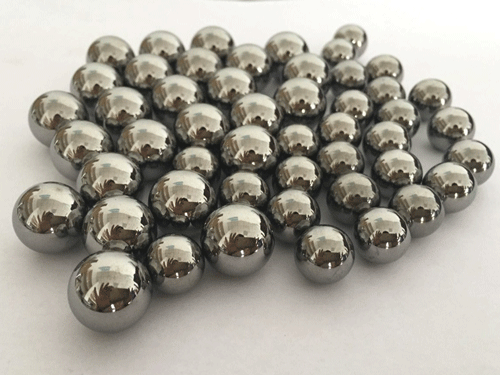
Why Tungsten Carbide Mill Balls Are the Go-To Choice for High-Hardness Grinding

What Makes Tungsten Carbide Mill Balls So Special?
If you've ever tried to grind down super-hard materials like silicon carbide, boron nitride, or cemented carbide powders, you know the struggle: most grinding media just can't take the punishment. They wear out too fast, contaminate your sample, or simply lack the impact energy to break those tough particles. That's where tungsten carbide mill balls come in.
Tungsten carbide (WC) is a ceramic compound formed by combining tungsten and carbon at extremely high temperatures (over 1400 °C). The result is a material with a hardness of around 89.5–90.5 HRA, a density of 14.7–14.78 g/cm³, and a transverse rupture strength exceeding 2300 MPa. These numbers aren't just for show — they mean these balls can crush almost anything you throw at them, while barely losing any mass themselves.
Let's walk through the key features that make tungsten carbide the heavyweight champion of grinding media.
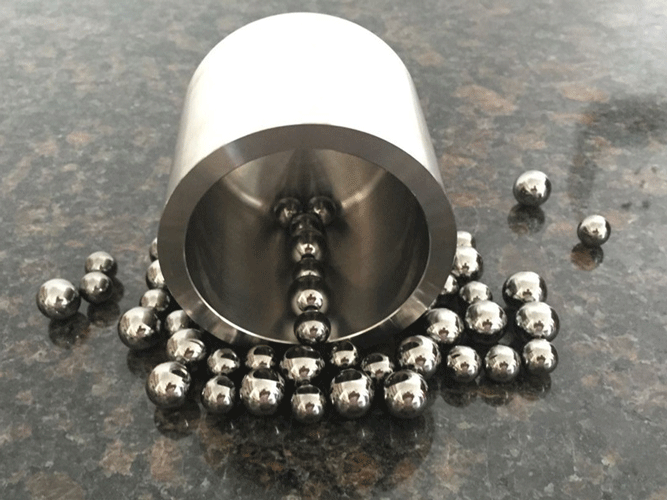
Extreme Hardness and Wear Resistance
The most obvious advantage is hardness. With a Mohs hardness of 9+ (diamond is 10), tungsten carbide is one of the hardest engineered materials. In practical terms, this means the balls will stay round for thousands of grinding cycles, delivering consistent results batch after batch. For applications like nano grinding or mechanical alloying, where even a tiny change in ball shape can alter the milling dynamics, this stability is a lifesaver.
High Density = More Grinding Power
Density is the secret weapon of tungsten carbide. At roughly 14.8 g/cm³, these balls are nearly twice as heavy as steel balls (7.8 g/cm³) and far denser than zirconia (6.0 g/cm³). In a planetary ball mill, the kinetic energy of each ball scales with its mass. So a tungsten carbide ball packs more punch per collision, enabling faster particle size reduction and higher throughput. You can often achieve the same fineness in less time compared to lighter media.
Resistance to Acid, Alkali, and Corrosion
Grinding is not always a dry affair. Sometimes you need to mill in a liquid medium — water, ethanol, or even corrosive solvents. Tungsten carbide is chemically inert in most environments, resisting attack from acids, alkalis, and organic solvents. This property is crucial for sensitive material processing where contamination from the grinding media must be kept to an absolute minimum.
Common Applications
Where do you typically see tungsten carbide mill balls in action? Here are a few real-world scenarios:
- Hard metal powder crushing — Tungsten carbide itself is often ground to finer powder for recycling or alloying.
- Ceramic and refractory material grinding — Alumina, silicon nitride, and boron carbide are no match for WC balls.
- Nano-powder preparation — High-energy ball mills use WC balls to achieve particle sizes below 100 nm.
- Sample preparation for XRF / XRD analysis — Zero contamination from the media ensures accurate elemental analysis.
- Mining and mineral processing — In ball mills and attritors for ore grinding, WC balls outlast steel by a wide margin.
Available Sizes and Grades
When you shop for tungsten carbide mill balls, you'll find a range of options to match your specific mill and material. Common diameters include 4 mm, 5 mm, 6 mm, 8 mm, 10 mm, 12 mm, 14 mm, 16 mm, 18 mm, and 20 mm. Larger sizes (up to 30 mm) are also produced for heavy-duty industrial mills.
Most standard balls are composed of WC 92% + Co 8% (grade YG8), with a grain size of 1.2–1.6 μm. This composition delivers an excellent balance of hardness, toughness, and wear resistance. For even higher hardness, grades like YG6 (WC 94% + Co 6%) are available, though they are slightly more brittle.
| Property | Typical Value |
|---|---|
| Composition | WC 92% + Co 8% |
| Density | 14.7–14.78 g/cm³ |
| Hardness | 89.5–90.5 HRA |
| TRS (Transverse Rupture Strength) | ≥2300 MPa |
| Grain Size | 1.2–1.6 μm |
| Surface Finish | Sintered rough / Semi-precision / Precision polished |
How to Choose the Right Tungsten Carbide Ball for Your Mill
Not all grinding jobs are the same. Here's a quick cheat sheet to help you pick the right ball:
1. Ball Size
Smaller balls (0.5–5 mm) are ideal for fine grinding and dispersion in stirred mills, while larger balls (10–30 mm) are better for coarse crushing in rotary ball mills. A general rule: the ball diameter should be at least 10 times the feed particle size.
2. Surface Finish
Sintered rough balls are cheapest and work well for most crushing tasks. Semi-precision balls (round but not polished) offer a good balance of cost and performance. Precision polished balls are used when you need minimal contamination and smooth surface for ball bearings or high-precision grinding.
3. Equipment Compatibility
Tungsten carbide balls work in planetary ball mills, roller jar mills, attritors, shaker mills, mixer mills, and cryomills. Their high density means you may need to adjust the mill speed or ball-to-powder ratio to avoid excessive heating.
Comparing Tungsten Carbide with Other Grinding Media
It's helpful to see how WC balls stack up against popular alternatives:
- 304 Stainless Steel Balls — Density ~7.9 g/cm³, hardness ~200 HB. Cheaper, but wear out quickly with hard materials and can introduce iron contamination.
- Zirconia Grinding Balls — Density ~6.0 g/cm³, hardness ~90 HRA. Good for contamination-free grinding of ceramics, but lower density means less impact energy.
- Agate Balls — Density ~2.6 g/cm³, hardness ~7 Mohs. Used for trace analysis, but completely unsuitable for hard materials due to low density and wear.
- Tungsten Carbide — Highest density (14.8 g/cm³), extreme hardness (89.5 HRA), excellent wear resistance. The premium choice for demanding applications.
If your budget allows and you need the best performance, tungsten carbide is hard to beat.
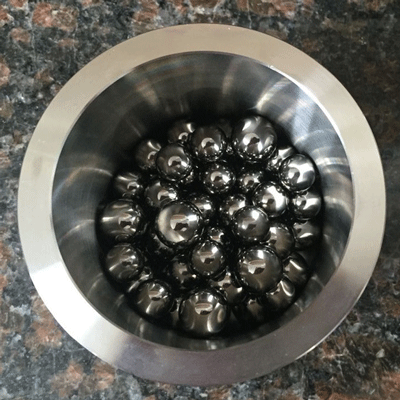
Where to Buy Tungsten Carbide Mill Balls
When you're sourcing tungsten carbide grinding media, it pays to work with a manufacturer that understands both the material science and the practical requirements of milling. Changsha Tianchuang Powder Technology Co., Ltd. (TENCAN) has been a trusted name in the lab and industrial milling community for years. They offer a full range of tungsten carbide mill balls in various sizes, grades, and surface finishes, along with expert advice on matching media to your specific mill.
Need a custom size or grade? TENCAN provides customization options, so you can get exactly the right ball for your process. Their products are vacuum-packed to prevent oxidation, and they ship globally with reliable logistics.
Final Thoughts
If you're grinding materials that are already hard, or if you simply want to maximize throughput and minimize contamination, tungsten carbide mill balls are an investment that pays off in reduced downtime and consistent quality. Their extreme density, hardness, and chemical resistance put them in a league of their own.
Next time you're setting up a mill run, give WC balls a try — your powder will thank you.
Related Products
Get In Touch
Our professional team will reply to you within one business day. Please feel free to contact us!