
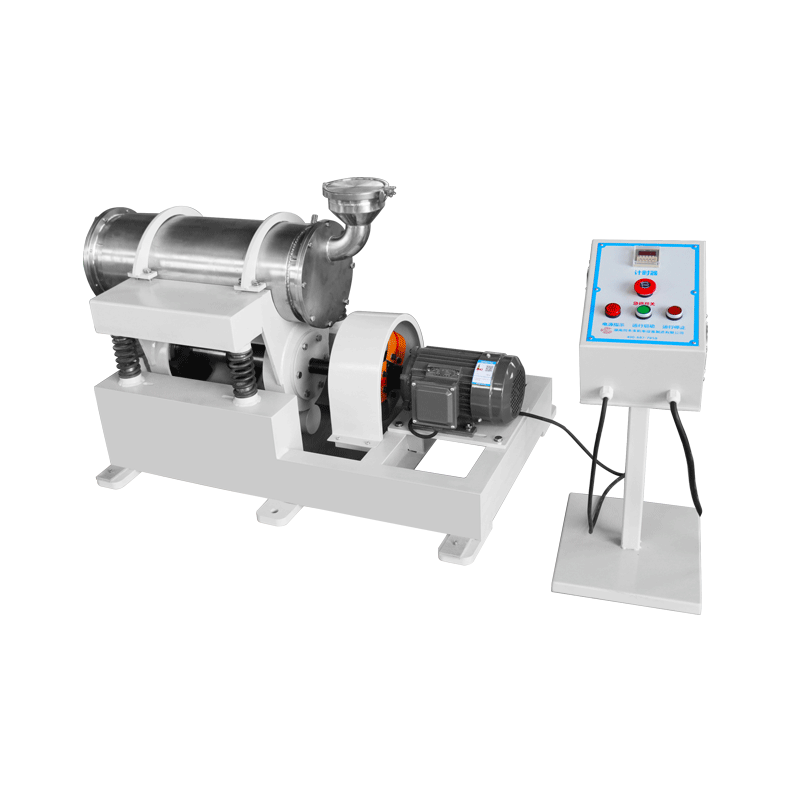
Lightweight Vibrating Ball Mill: Your Compact Lab Partner for Efficient Ultrafine Grinding

Why Vibration Beats Rotation for Fine Grinding?
If you've ever used a traditional planetary ball mill, you know it relies on a spinning sun wheel and rotating jars to generate impact. But what if you need even finer particles, faster, and with a much smaller footprint? That's where the vibration ball mill steps in.
Instead of rotating a drum, a vibrating ball mill uses a powerful motor to shake the entire grinding chamber at high frequency (typically 1200–1800 RPM). The grinding media—balls or rods—are thrown against the sample and each other in a chaotic, high-energy motion. This creates intense impact, friction, and shear forces that can reduce materials to sub-micron or even nanometer sizes in a fraction of the time required by conventional mills.
And when that vibration mill is also lightweight? You get a portable, benchtop powerhouse perfect for R&D, small batch production, and sample preparation.
What Exactly Is a Lightweight Vibrating Ball Mill?
The Lightweight vibrating ball mill from TENCAN is a compact laboratory grinding instrument designed for dry, wet, and cryogenic grinding of small samples. It uses a high-frequency vibration mechanism to achieve rapid particle size reduction.
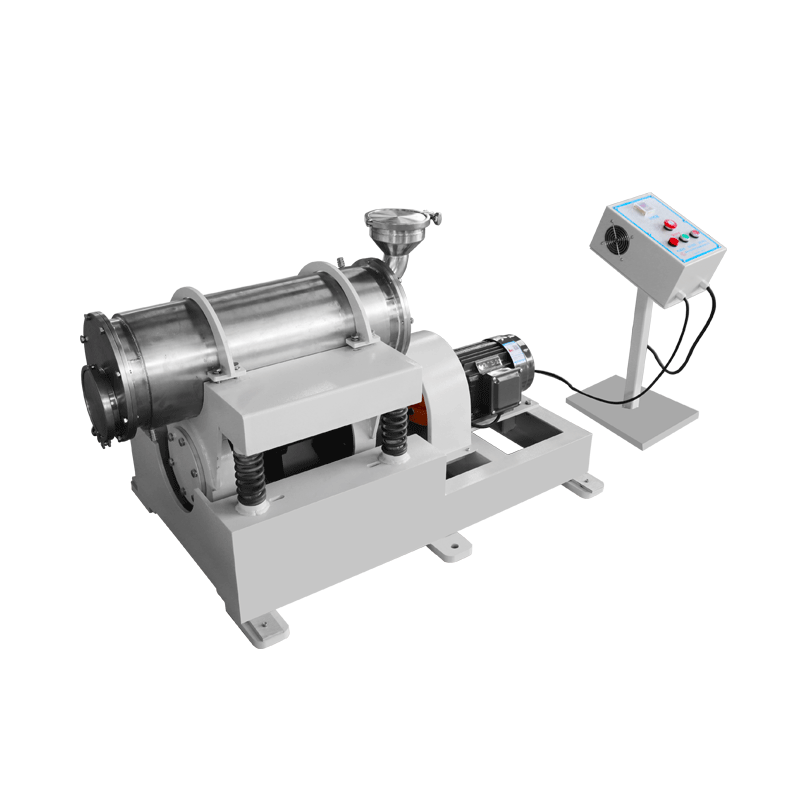
Unlike heavy-duty industrial vibratory mills that weigh hundreds of kilograms, this model is built for portability. It sits comfortably on a lab bench and can be moved between workstations without a forklift. Popular applications include grinding of ceramics, minerals, chemicals, seeds, plant materials, bones, electronic waste, and even some pharmaceutical ingredients.
Key Technical Specifications (Typical Parameters)
| Parameter | Typical Value |
|---|---|
| Vibration Frequency | 1200 – 1800 rpm (adjustable) |
| Amplitude | 2 – 5 mm |
| Grinding Jar Capacity | 50 – 500 mL (common lab sizes) |
| Feed Size | ≤ 10 mm |
| Final Fineness | ≤ 1 µm (dry), ≤ 0.1 µm (wet) |
| Number of Jars | 1 – 4 (depends on model) |
| Material of Jars | Stainless steel, agate, zirconia, tungsten carbide, etc. |
| Grinding Modes | Dry, wet, cryogenic (with LN₂ bath) |
| Dimensions (approx.) | 600 × 400 × 450 mm |
| Weight | ~ 30 – 50 kg |
| Power Supply | 220 V / 110 V, 50/60 Hz |
Note: Exact specifications vary by model; check the product page for your specific configuration.
How Lightweight Vibrating Ball Mills Achieve Nanoscale Grinding
The principle is elegantly simple: a high-frequency vibratory motor oscillates a platform holding one or more sealed grinding jars. Inside each jar, the grinding balls (usually 5–20 mm in diameter) are accelerated violently, colliding with the sample and the jar walls hundreds of times per second.
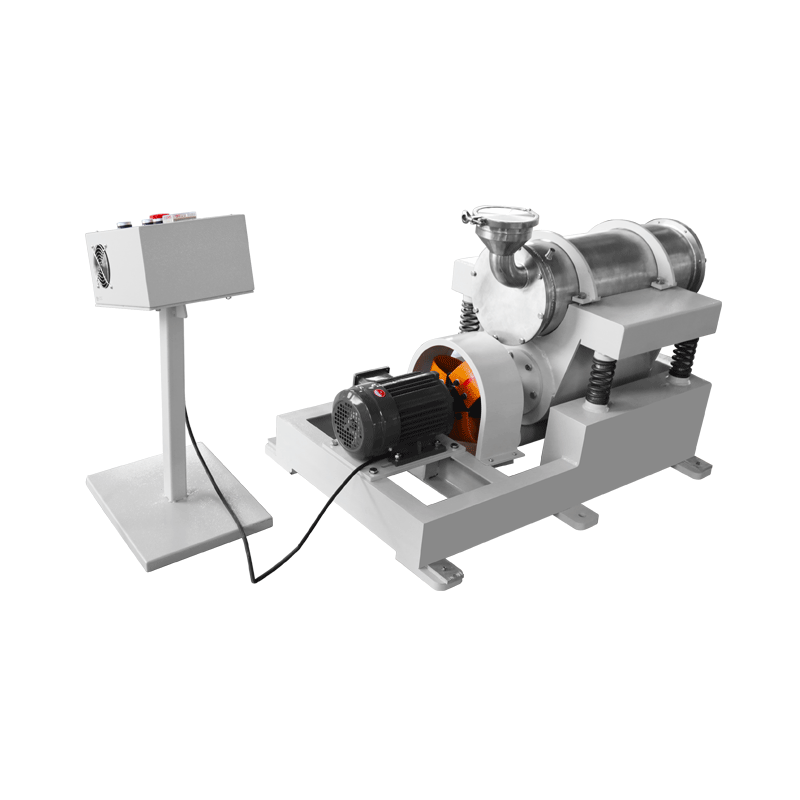
This creates three main forces:
- Impact – Direct ball-to-ball and ball-to-wall collisions crush coarse particles.
- Friction – Sliding and shear between balls and particles break down agglomerates.
- High-frequency fatigue – Repeated stress cycles fracture particles along internal defects.
Because the entire jar is shaken, there are no dead zones – every part of the sample gets milled uniformly. And since the vibration is uniaxial (or sometimes 3D), the grinding energy is extremely concentrated. Many users report achieving d₉₀ < 1 µm in just 10–30 minutes of milling.
Lightweight vs. Other Ball Mills: Which One Do You Need?
Let's compare three common lab ball mills from TENCAN's vibration series so you can make an informed choice.
Lightweight Vibrating Ball Mill vs. Lab Vibration Ball Mill
The standard Lab Vibration Ball Mill is a slightly larger unit with higher throughput. If you process batch sizes above 100 mL routinely, that model might suit you better. The Lightweight version is ideal when portability and bench space are priorities, and you work with samples under 50 mL per batch.
Lightweight vs. Heavy Duty Vibrating Ball Mill
The Heavy Duty Vibrating Ball Mill is built for continuous operation and larger volumes (up to several liters). It has a more robust frame and a higher-power motor. If you are doing pilot-scale production or need to mill tough materials like ferroalloys or cemented carbides, go heavy duty. But for routine lab work, the lightweight version offers excellent performance at lower cost and footprint.
Comparison with Planetary Ball Mills
Planetary ball mills also achieve high energy, but they are generally heavier, louder, and require more maintenance due to rotating belts or gears. The vibration mill wins in simplicity: fewer moving parts, no belt tension adjustments, and easy jar clamping. For the same grinding result, vibration mills are often 2–3 times faster on fine grind tasks.
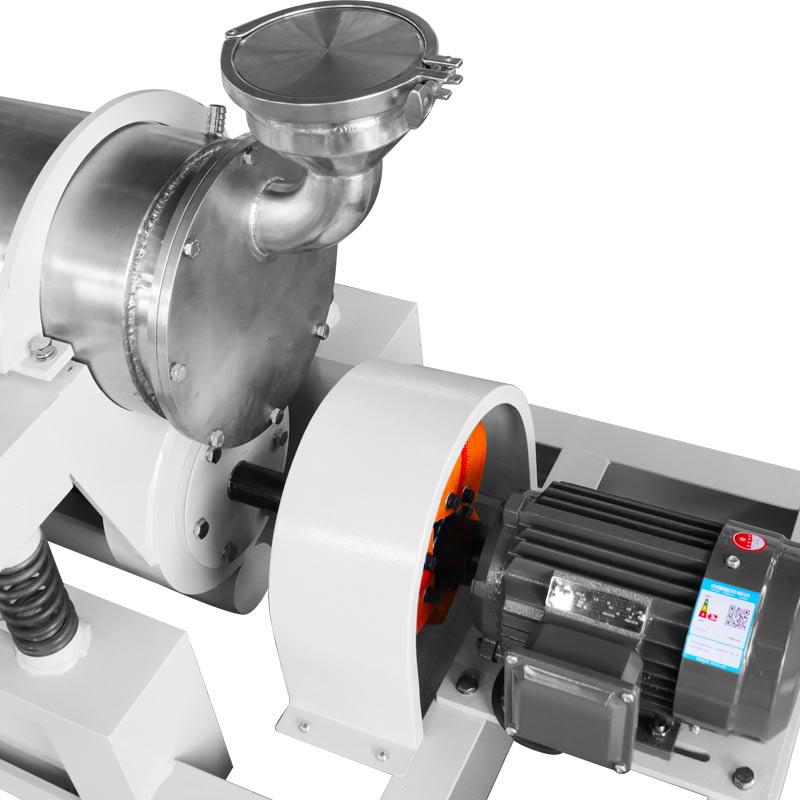
Practical Tips for Getting the Best Results
- Choose the right jar material. For most inorganic materials, stainless steel is fine. For trace element analysis, use agate or zirconia to avoid contamination.
- Optimize ball-to-sample ratio. A common starting point is 4:1 to 6:1 by weight. Too few balls reduce energy; too many create excessive heat.
- Wet grinding for sticky samples. Adding ethanol, isopropanol, or water can prevent caking and improve particle dispersion.
- Use cryogenic grinding for heat-sensitive materials. Simply precool the jar with liquid nitrogen before adding the sample. The vibration action helps maintain low temperature throughout.
- Run a cycle time test. Start with 5-minute intervals, then check particle size. Over-milling can lead to amorphization or contamination.
Common Applications of the Lightweight Vibrating Ball Mill
- Geology & Mining: Grinding ore samples for XRF, XRD, or ICP analysis.
- Materials Research: Preparing nano-powders of metals, oxides, and composites.
- Chemical Industry: Fine grinding of pigments, dyes, and catalysts.
- Biology & Agriculture: Disrupting plant tissues, seeds, or bones for DNA extraction.
- Pharmaceuticals: Micronizing active ingredients or excipients.
Why Choose TENCAN's Lightweight Vibrating Ball Mill?
As a professional powder equipment manufacturer, TENCAN (Changsha Tianchuang Powder Technology Co., Ltd.) has been designing and building ball mills for over a decade. Our lightweight vibrating ball mill features:
- High-quality sealed bearings for long life and low noise.
- Quick-lock jar clamping mechanism – no tools needed.
- Adjustable vibration amplitude for different material hardness.
- Safety interlock: machine stops when lid is opened.
- Available with a range of jar materials and sizes to match your budget.
We also offer Lab Sample Grinder Machines that use similar vibration principles but with specialized accessories for pulverizing small samples directly into analytical sieves.
Final Thoughts
If you need a compact, efficient, and versatile grinder for your lab, the lightweight vibrating ball mill from TENCAN is an outstanding choice. It combines the speed of high-energy vibration with the convenience of a benchtop form factor. Whether you are developing new battery materials, analyzing geological samples, or preparing pharmaceuticals, this mill will save you time and deliver reproducible results.
Explore the full product details and technical datasheets on the official product page. If you have questions about which model fits your application, the TENCAN team is always ready to help.
Related Products
Liên hệ
Đội ngũ chuyên nghiệp của chúng tôi sẽ phản hồi trong vòng một ngày làm việc. Vui lòng liên hệ với chúng tôi bất cứ lúc nào!