
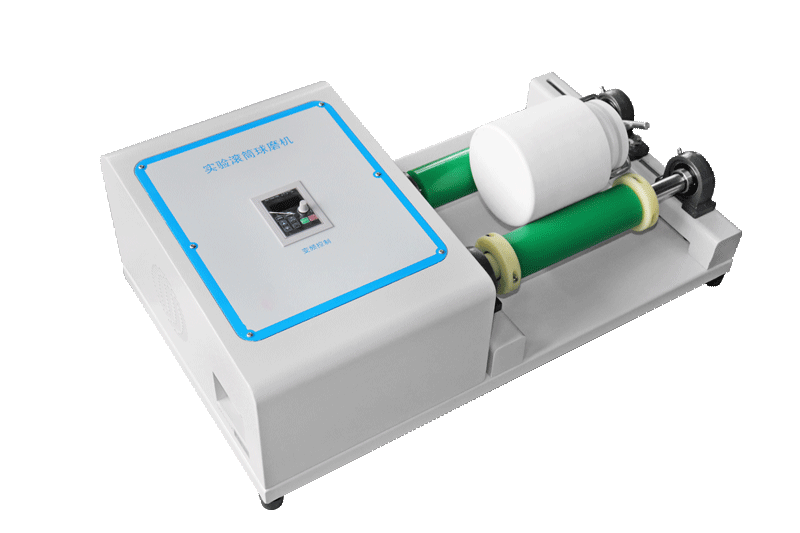
Lab Roll Ball Mill: The Workhorse for Small-Scale Grinding and Mixing

What Is a Lab Roll Ball Mill?
If you've ever needed to grind a few hundred grams of ceramic powder, mix pigments for a small batch of paint, or prepare a sample for X-ray diffraction analysis, you've probably wished for a machine that's both powerful enough to do the job and compact enough to fit on your bench. That's exactly where the lab roll ball mill shines.
Sometimes called a roller ball mill or jar mill, this piece of equipment is essentially a set of rotating rollers that spin a cylindrical jar filled with grinding media and material. The jar itself isn't driven by a direct shaft; instead, it rests on two or more rubber-coated rollers that rotate it via friction. It's a beautifully simple design that's been a staple in laboratories and small-scale production facilities for decades—and for good reason.
How Does It Work?
The principle is almost deceptively straightforward. You load your sample and grinding balls into a cylindrical jar—usually made of ceramic, stainless steel, or agate—and place the jar horizontally on the rollers. When the machine is switched on, the rollers turn, causing the jar to rotate. As it rotates, the grinding media are lifted by centrifugal force until they reach a certain height, then fall back down, crushing the material through impact and shearing action.
Unlike a planetary ball mill, where jars spin on their own axis while orbiting a central disc, the lab roll ball mill relies purely on the rotation of the jar itself. This means the grinding energy is gentler, making it ideal for materials that are temperature-sensitive or require careful particle size control. It's also excellent for mixing and blending—not just grinding.
Key Features and Specifications
Lab roll ball mills come in a range of sizes and configurations, but most share a common set of features that make them indispensable in any serious powder lab.
- Adjustable Roller Speed: Typically from 50 to 300 RPM, allowing you to fine-tune the grinding intensity for different materials.
- Multiple Jar Capacities: Compatible with jars from 0.5 L up to 20 L or more, so you can scale your process without changing machines.
- Jar Material Options: Alumina (ceramic), agate, zirconia, stainless steel, nylon, PTFE—essentially any non-reactive material that suits your application.
- Dry and Wet Grinding: The machine handles both modes effortlessly. For wet grinding, you just add a liquid like water or ethanol to the jar.
- Timer Function: Most models include a digital timer (from minutes to 99 hours) for unattended operation and reproducibility.
- Speed Control: Variable frequency drive for smooth, step-less speed adjustment.
- Noise Level: Typically below 70 dB, thanks to the rubber-coated rollers that reduce vibration.
Choosing the Right Lab Roll Ball Mill for Your Needs
Not all jar mills are created equal. Depending on your throughput, material type, and budget, you'll want to consider a few different options. Let me walk you through the most common categories so you can find your perfect match.
Light-Duty Roll Ball Mills
If you're mainly grinding small samples (a few hundred grams) and don't need extreme durability, a light-duty roll ball mill is a great starting point. These are compact, often cheaper, and perfect for education labs or low-frequency use. They typically handle jars up to 5 L and run on standard household power.
Standard Lab Roll Ball Mills
This is what most people picture when they think of a lab jar mill. The lab roll ball mill itself is a robust unit that can accommodate jars from 1 L to 10 L, with a more powerful motor and reinforced frame. It's ideal for routine sample preparation in materials research, quality control, and pilot-scale production.
Large Roll Ball Mills
Need to process tens of kilograms per batch? A large roll ball mill is built for heavier duty. These machines use thicker rollers and often come with a built-in speed controller and emergency stop. They're common in mineral processing labs, ceramic factories, and battery material preparation.
Multi-Station Jar Mills
Sometimes you need to grind multiple samples simultaneously—for example, comparing different compositions or performing statistical replicates. That's when a two working station jar mill or a four station jar mill becomes your best friend. Some models even offer 8 working stations for high-throughput environments. Each station works independently, so you can run different jars with different materials at the same time.
Specialized Models
Beyond the standard types, there are also purpose-built versions like the inner lined roll ball mill (with a rubber or polyurethane lining for wear resistance) and the screening ball mill (which integrates a sieve for in-line particle classification). These are niche but incredibly useful for specific industries.
Tips for Getting the Best Results
Based on years of experience working with these machines (and watching countless researchers wrestle with subpar results), here are a few practical tips:
- Match jar size to sample volume. Never fill a jar more than two-thirds full, and leave at least one-third empty for the grinding balls to tumble effectively.
- Choose the right ball size. For coarse grinding, use larger balls (10–20 mm). For fine grinding or mixing, smaller balls (3–5 mm) are more efficient. A mix of sizes usually works best.
- Ball-to-material ratio. A good starting point is 3:1 to 5:1 by weight (balls to material). Increase the ratio for harder materials.
- Wet vs. dry grinding. Wet grinding is faster and produces finer particles, but you'll need to dry the slurry afterward. Dry grinding is simpler but can generate heat—watch out for temperature-sensitive samples.
- Always use a safety lid. The jar should be sealed tightly to avoid spills. Many jars come with a gasket; use it.
- Balance the load. If you're using multiple jars on a multi-station mill, try to balance them with similar weights to avoid excessive vibration.
Applications Across Industries
Lab roll ball mills are used in an astonishingly wide range of fields. Here are just a few examples:
- Ceramics and Glass: Grinding frits, glazes, alumina, zirconia, and porcelain bodies.
- Paints and Pigments: Dispersing colorants and preparing small batches of ink or coating.
- Pharmaceuticals: Milling active ingredients, excipients, and herbal materials (with appropriate containment).
- Battery Materials: Preparing cathode and anode powders like LCO, NMC, graphite, and silicon.
- Geology and Mining: Crushing ore samples for assay or XRF analysis.
- Food and Agriculture: Grinding spices, grains, and soil samples for testing.
Why Choose a Lab Roll Ball Mill Over Other Mills?
You might wonder: why not just use a planetary ball mill or a high-energy shaker mill? Each has its place, but the lab roll ball mill offers distinct advantages:
- Gentler action: Less heat generation and mechanical stress on the material—important for biological or volatile samples.
- Scalability: From a single 0.5 L jar up to 20 L or more, you can use the same machine for different batch sizes without buying new equipment.
- Simplicity and reliability: Fewer moving parts mean lower maintenance and longer service life.
- Cost-effectiveness: A good lab roll ball mill is often cheaper than a planetary mill of comparable capacity.
- Versatility: You can switch between different jar materials and sizes in seconds, making it ideal for labs that handle many different materials.
Final Thoughts
The lab roll ball mill may not be as flashy as some newer grinding technologies, but it's a proven workhorse that delivers consistent, repeatable results day after day. Whether you're a researcher preparing samples for analysis, an engineer developing new materials, or a technician running small-scale production, this machine deserves a spot on your bench.
If you're still unsure which model fits your needs, start by considering your typical batch volume and the hardest material you'll grind. For most labs, a standard lab roll ball mill with a few different jar sizes is a perfect all-rounder. But if you're working with tougher materials or need higher throughput, look into the large roll ball mill or a multi-station configuration.
Feel free to reach out to the experts at TENCAN (长沙天创粉末技术有限公司) for personalized advice. They've been supplying quality grinding equipment for years and can help you zero in on the right setup.
Happy grinding!
Related Products
Свяжитесь с нами
Наша профессиональная команда ответит вам в течение одного рабочего дня. Пожалуйста, обращайтесь к нам в любое время!