

What Is a Vacuum Freeze-Drying Oven? A Low-Temperature Drying Device for Lab Use
What Is a Vacuum Freeze-Drying Oven?
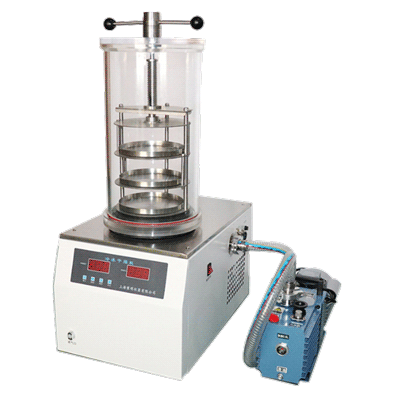
At its core, a vacuum freeze-drying oven is a specialized low-temperature drying system that removes water from a material while that water is frozen, combining a deep vacuum with carefully controlled heat. Laboratories, pharmaceutical developers, food technologists and materials researchers use it to turn wet or frozen samples — aqueous solutions, suspensions, biological tissues, fruit and vegetable pieces, ceramic slurries and moist powders — into dry, porous solids without the shrinkage, crusting and heat damage that ordinary hot-air drying causes. Because the water leaves by sublimation rather than evaporation, the product keeps its original shape, its internal pore structure and much of its chemical or biological activity. The vacuum freeze-drying oven offered by TENCAN belongs to this equipment family and follows the same basic architecture: an airtight chamber, temperature-controlled shelves or a manifold, a refrigerated cold trap and a vacuum pumping set.
Core Functions and Working Principle
The Basic Transformation: From Wet Sample to Dry, Porous Solid
The fundamental task of the equipment is to move a material from a wet or frozen state into a dry state while keeping the solvent — almost always water — below its freezing point for most of the cycle. In a conventional drying oven, heat evaporates liquid water; as the liquid leaves the surface, surface tension pulls the solid matrix inward and the sample shrinks, hardens or cracks. In a freeze-drying oven, the water is frozen in place first and only then removed as vapor. Because no liquid–vapor interface exists inside the material, there is nothing to pull the structure together. What remains is a dry cake that preserves the geometry of the frozen sample together with an open, interconnected pore network where the ice crystals used to be. Those pores are what make freeze-dried products so easy to rehydrate, dissolve or grind.
The Three Stages of a Freeze-Drying Cycle
Machines differ widely in size and level of automation, but virtually every freeze-drying cycle follows the same three-step sequence: freezing, primary drying and secondary drying. Each step has its own physics, its own control parameters and its own influence on the quality of the finished product.
1. Freezing
Freezing fixes the material in the shape it will keep for the rest of the process and decides how large the ice crystals — and therefore the pores — will be. Slow freezing produces large crystals and coarse pores; rapid freezing produces many small crystals and a fine, uniform pore structure. For biological samples, a controlled freezing rate helps limit damage to cell membranes, while for food pieces and ceramic slurries the usual goal is a fully frozen block with no liquid pockets left inside. A sample that is only partly frozen will boil and spatter once the vacuum is applied, which is one of the most common causes of a failed run.
2. Primary Drying (Sublimation)
Primary drying is the longest stage of the cycle. The chamber pressure is lowered far below the triple point of water — about 6.1 mbar — so that ice can pass directly into vapor without ever melting. Heat is then delivered through the shelves or the surrounding environment, and that heat drives the sublimation front slowly inward from the frozen surface. Energy must be supplied at a rate the material can tolerate: too much heat and the ice melts or the structure softens and collapses, too little and the cycle drags on for days. The water vapor released during this stage is not drawn straight through the vacuum pump; it is captured on a refrigerated condenser, usually called the cold trap.
3. Secondary Drying (Desorption)
Once the last ice has sublimated, the product still holds bound water that is physically or chemically attached to the solid matrix. Secondary drying removes this residual moisture by raising the shelf temperature gradually while the vacuum is maintained until the end of the cycle. Here the water is desorbed rather than sublimated, and the process is gentler and slower than primary drying. Residual moisture is one of the most important quality attributes of a freeze-dried product: too much water shortens shelf life and encourages caking or microbial growth, while excessive drying wastes energy and can degrade sensitive compounds. Target values are commonly in the range of one to three percent moisture, depending on the material and its intended use.
Key Process Parameters and Their Effect on the Product
A handful of parameters determine whether a batch turns out as a uniform, intact cake or as a collapsed, partially melted mass. All of them are set through the machine control system:
- Chamber pressure sets the driving force for sublimation. Lower pressure speeds up drying but also removes heat more slowly and increases the risk of foaming.
- Shelf temperature supplies the energy for sublimation and desorption and must stay below the collapse or melt temperature of the formulation at every moment.
- Freezing rate and final freezing temperature determine pore size, specific surface area and how easily the dried cake rehydrates.
- Ramp rates and hold times define how quickly the shelves move between setpoints and how long each step lasts; abrupt changes are a common cause of batch failure.
- Condenser temperature must stay well below the product temperature, otherwise vapor is not trapped efficiently and the vacuum deteriorates.
Main Types and Configurations
Manifold (Flask) Freeze Dryers
Manifold freeze dryers are the simplest and most affordable configuration. Pre-frozen samples are held in round-bottom flasks or small containers that attach to ports on a manifold connected to the cold trap, and vacuum is applied directly to the outside of each container. Because the flasks can be rotated in a chilled bath or left at room temperature while drying, heat input is largely uncontrolled, so this design suits aqueous solutions with a low solids content, bacterial and cell cultures, and quick screening of new formulations rather than delicate biological products that require a precise thermal profile.
Shelf-Type (Tray) Freeze Dryers
Shelf-type freeze dryers place the product in trays, vials or ampoules resting directly on temperature-controlled shelves inside the vacuum chamber. The same shelves can cool the product for in-situ freezing and then warm it in a programmed ramp for primary and secondary drying, which makes the whole cycle reproducible from batch to batch. Because heat reaches the product by conduction through the shelf, drying is faster and more uniform than on a manifold, and vials can be automatically stoppered under vacuum at the end of the cycle to protect the dried product from moisture. This is the configuration normally chosen for pharmaceutical, biological and high-value powder work.
Choosing Between Sizes and Configurations
Freeze dryers are also divided by scale. Benchtop units with a chamber volume of a few liters are intended for research and development, formulation screening and small sample preparation. Pilot-scale systems, usually in the tens of liters, bridge the gap between laboratory and production and are used for scale-up studies, clinical batches and small-volume manufacturing. Production units are built as larger cabinets or as continuous tunnel systems and are optimized for throughput, uniform shelf temperature and automatic loading and unloading. Scale matters because a cycle developed on a benchtop unit does not transfer to a production machine without adjustment.
Core Components and Key Technologies
Vacuum Chamber and Shelf System
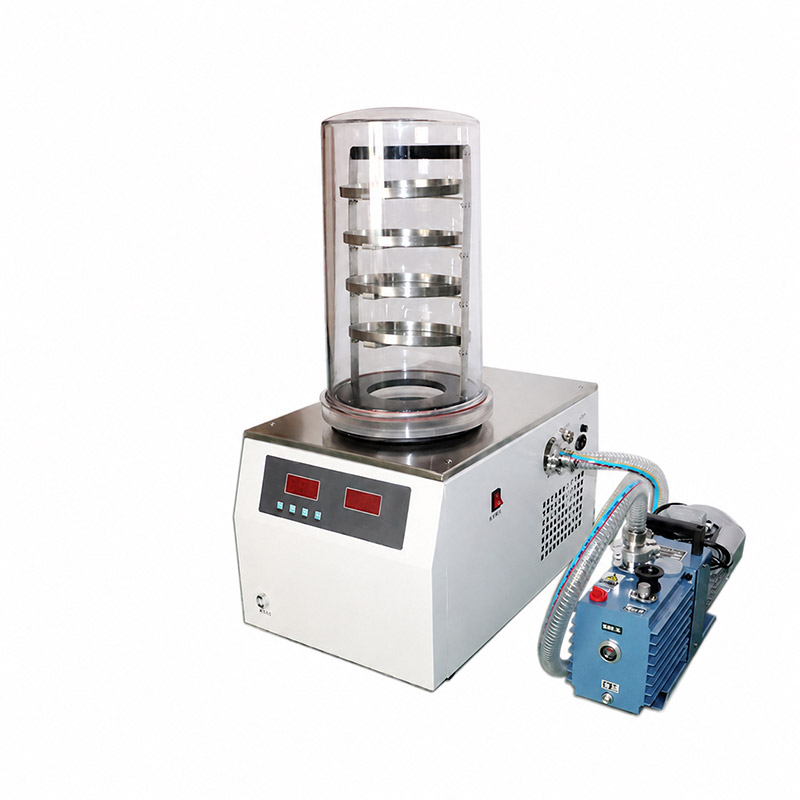
The vacuum chamber is the pressure vessel in which the whole process takes place. It is usually made of stainless steel, with a front or top door sealed by a gasket and fitted with a viewing window so the operator can watch the product. Inside, the shelves act as both the heat source and the support for trays, vials or dishes; they are hollow or contain embedded fluid channels through which a heat-transfer fluid circulates. Shelf flatness, spacing and surface finish all affect how evenly heat reaches each container, and therefore how uniform the finished batch is.
Condenser (Cold Trap) and Refrigeration Circuit
The condenser, or cold trap, is the component that makes continuous drying possible. Water vapor leaving the product is trapped as ice on coils or plates held at a temperature well below the product, typically between minus 40 and minus 85 degrees Celsius depending on the application. If the trap is not cold enough, vapor passes through to the vacuum pump, the pressure rises and drying stalls. Trap capacity, meaning how much ice it can hold before it must be defrosted, sets the practical limit on batch size, so a useful rule is to choose a trap whose ice capacity comfortably exceeds the total water content of the largest batch you intend to run.
Vacuum Pumping System
A rotary-vane or dry-scroll vacuum pump, sometimes backed by a Roots blower on larger systems, maintains the low pressure inside the chamber. The pump does not remove water vapor directly during primary drying; its job is to remove non-condensable gases that leak in and to hold the chamber at the setpoint. Oil-sealed pumps need regular oil changes and traps to prevent water and solvent contamination, while dry pumps avoid oil migration and are preferred where solvent vapors are present. The ultimate vacuum the pump can reach, together with the leak-tightness of the chamber, defines the lowest achievable pressure.
Control System, Programming and Data Logging
Modern freeze dryers are controlled by a microprocessor or PLC with a touch-screen interface. The operator builds a recipe of temperature and pressure setpoints with ramp rates and hold times, and the controller executes it automatically while logging shelf temperature, product temperature from thermocouples or resistance sensors, chamber pressure and elapsed time. Data logging matters for two reasons: it allows a failed batch to be diagnosed, and in regulated environments it provides the documentation needed to demonstrate that the cycle was run as specified. Some controllers also offer alarm limits, remote monitoring and user access levels.
Key Performance Indicators and Selection Points
Drying Capacity and Batch Volume
Drying capacity is usually expressed as chamber volume, the number of shelves or trays, or the total mass of water the machine can remove in one cycle. Chamber volume alone can be misleading, because useful capacity depends on how thick the product layer can be while still drying in a reasonable time. As a practical rule, a thicker fill slows drying considerably, so a machine with a large chamber and a small condenser may handle less product than its dimensions suggest.
Cold Trap Temperature and Ultimate Vacuum
Two numbers describe the vacuum side of the machine: the lowest temperature the cold trap can reach and the ultimate pressure the pumping system can hold. A colder trap captures more water vapor and shortens the cycle, while a lower ultimate pressure widens the range of solvents and formulations that can be processed. Both values should be quoted under working conditions, with the trap loaded, rather than as ideal figures. Fast pull-down to the setpoint and quick recovery after defrosting are also worth checking.
Shelf Temperature Range and Uniformity
Shelf temperature range and uniformity decide which formulations the machine can handle. A wide range, from roughly minus 40 degrees Celsius for freezing to well above ambient for secondary drying, gives the flexibility to process both frozen biological material and heat-tolerant food or ceramic products. Uniformity across the shelf area matters just as much: a gradient of a few degrees between the front and back of a shelf will dry some vials faster than others, producing a batch with inconsistent residual moisture. Independent shelf control or zoning is a useful feature on larger units.
Energy Consumption and Overall Efficiency
Freeze drying is energy intensive because refrigeration must run continuously for hours or days while the vacuum pump holds a low pressure. The main efficiency levers are the size and insulation of the cold trap, the efficiency of the refrigeration compressor, and the ability to run a shorter, better optimized cycle. A well-designed cycle that keeps the product just below its critical temperature uses far less energy than an overcautious one, which is one reason why cycle development and process monitoring pay for themselves over the life of the equipment.
Automation, Programmability and Maintenance
Automation and programmability separate a basic drying cabinet from a genuine process instrument. Look for recipe storage, multi-step ramps, automatic pressure control, data export, and alarm and interlock functions that protect the product if the vacuum or refrigeration fails. Maintenance requirements deserve equal attention: door seals and gaskets, shelves and the cold trap all need periodic cleaning and defrosting; the vacuum pump needs oil or filter service; and the refrigeration circuit should be checked for leaks. Machines with easy access to the condenser and shelves, removable shelf supports and clearly documented service intervals are simpler and cheaper to keep running.
Applications and Selection Advice
Typical Industries and Materials
Vacuum freeze-drying is used wherever a wet material must be dried without losing its structure or activity. In the pharmaceutical and biotechnology industry it stabilizes vaccines, antibodies, proteins, plasma products and diagnostic reagents, often in vials that are sealed under vacuum. In food processing it produces instant coffee, dried fruit, herbs, probiotics and ready meals that rehydrate quickly and keep their flavor. Materials science uses it to prepare ceramic and nanopowder precursors, aerogels and porous scaffolds for tissue engineering, while universities, research institutes and forensic laboratories rely on it for sample preparation, biological specimen preservation and archiving.
Which Configuration Suits Which User
The right choice depends on the user. Teaching and research laboratories are usually best served by a compact benchtop unit with a manifold for flasks and a small shelf set, which covers most sample preparation and formulation work while keeping the footprint and the price modest. Development groups that need reproducible, documented cycles should look for a shelf-type benchtop or pilot machine with programmable recipes, product temperature measurement and data logging. Production operations need larger condenser capacity, uniform shelf temperature across a wide area, automated loading and, in regulated industries, validation support and audit-friendly documentation. Buyers who want to compare chamber sizes, condenser ratings and control features in one place can review the Vacuum freeze-drying oven specification page before requesting a quote.
Frequently Asked Questions
Can any wet material be freeze-dried?
Most aqueous materials can be dried this way, but not all of them are easy. Very dilute solutions take a long time because the machine must remove a large amount of water, materials with a low collapse temperature require a colder shelf and a slower ramp, and products containing organic solvents need a condenser and pump rated for those vapors. Samples with a high fat or sugar content may also dry slowly or remain sticky. In practice, a small trial run on a benchtop unit is the most reliable way to find out whether a given formulation is suitable.
Why is the cold trap temperature so critical?
The cold trap is the only place where water vapor coming off the product can be turned back into ice. If the trap surface is not cold enough, the vapor pressure above it rises, the chamber pressure follows, and the driving force for sublimation disappears; drying effectively stops and the pump may become contaminated. As a general rule, the trap should be 15 to 20 degrees Celsius colder than the coldest product surface at any point in the cycle. This is why trap temperature is one of the first readings to check when a batch behaves unexpectedly.
How long does a freeze-drying cycle take?
Cycle length depends on the sample, the fill depth and the machine. A thin layer of an aqueous solution in a small benchtop unit may finish overnight, while a full shelf of vials several centimeters deep can take two to four days. Freezing itself may last one to several hours, primary drying takes the largest share of the time, and secondary drying adds a few more hours. Because the cycle is dominated by heat and mass transfer rather than by the machine alone, shortening it usually means optimizing the recipe rather than buying a bigger vacuum pump.
Related Products
Get In Touch
Our professional team will reply to you within one business day. Please feel free to contact us!