

What is a Tempered Nylon Planetary Mill Jar? A High-Toughness Grinding Vessel for Contamination-Sensitive Lab Applications
What is a Tempered Nylon Planetary Mill Jar? A High-Toughness Grinding Vessel for Contamination-Sensitive Lab Applications
From the core, a tempered nylon planetary mill jar is a high-performance polymer grinding vessel specifically designed for planetary ball mills, used by laboratories and research institutions to mill, mix, and homogenize soft to medium-hard materials that are sensitive to metal contamination. This jar combines the excellent toughness and wear resistance of reinforced nylon with the precise geometry required for planetary motion, enabling efficient particle size reduction while minimizing sample contamination and reducing operational noise.
Core Function and Working Principle
The fundamental purpose of a tempered nylon mill jar is to serve as the containment vessel for the grinding process in a planetary ball mill. The jar is securely mounted on the sun wheel of the mill, where it rotates on its own axis while simultaneously revolving around the central axis — the classic planetary motion that generates high centrifugal forces, often exceeding 10 times gravity.
Inside the jar, grinding media (such as steel, zirconia, or agate balls) and the sample material are subjected to intense impact and friction forces. The tempered nylon material offers a unique balance: it is significantly tougher and more heat-resistant than standard nylon, reducing deformation during high-speed grinding, while remaining chemically inert to avoid reactions with many organic and inorganic samples. The jar's high toughness also contributes to superior impact resistance, reducing the risk of cracking from accidental drops or stress during high-energy milling.
Key Properties and Performance Advantages
Enhanced Durability and Heat Resistance
The tempering process modifies the molecular structure of nylon, resulting in a jar that can withstand the elevated temperatures generated during prolonged grinding sessions — typically 10-20% better heat resistance than standard nylon. This prevents warping or softening, maintaining the jar's seal integrity and dimensional stability throughout the process.
Low Contamination Grinding
Unlike metal jars (e.g., 304 stainless steel), tempered nylon introduces virtually no metallic wear particles into the sample. This makes it the preferred choice for grinding materials used in pharmaceuticals, advanced ceramics, battery electrode materials, and food-grade products where trace metal contamination could alter properties or safety.
Reduced Noise and Vibration
Nylon's inherent damping properties significantly lower the operational noise level compared to metal jars. This is a practical advantage for lab environments where noise reduction contributes to a safer and more comfortable working space, especially during long-run milling cycles.
Selection Criteria and Key Specifications
When selecting a tempered nylon planetary mill jar, researchers should consider the following evaluation metrics:
- Capacity range: Typically available from 50 ml to 3 liters, allowing flexibility from small-scale R&D to larger sample preparation batches.
- Material compatibility: Ideal for soft to medium-hard materials with Mohs hardness up to 4-5. Not recommended for hard minerals, ceramics, or metal powders that could cause excessive wear.
- Chemical resistance: Excellent resistance to weak acids, alkalis, and organic solvents, but less suitable for strong oxidizing agents or high-temperature aggressive chemicals.
- Thermal limits: Maximum operating temperature typically around 80-100°C (176-212°F) during continuous operation; avoid exceeding this to prevent deformation.
- Weight and handling: Significantly lighter than ceramic or metal jars (e.g., zirconia or agate), reducing stress on the mill's drive system and making handling easier.
Application Fields and Recommendations
Tempered nylon mill jars are extensively used in:
- Battery material research: Grinding anode and cathode materials like graphite, lithium cobalt oxide, and LFP without metal contamination.
- Pharmaceutical formulation: Milling APIs, excipients, and herbal powders where purity is critical.
- Polymer and pigment processing: Fine grinding of organic pigments, resins, and coatings for uniform particle size distribution.
- Biochemical sample preparation: Homogenizing soft biological tissues, seeds, and organic matter.
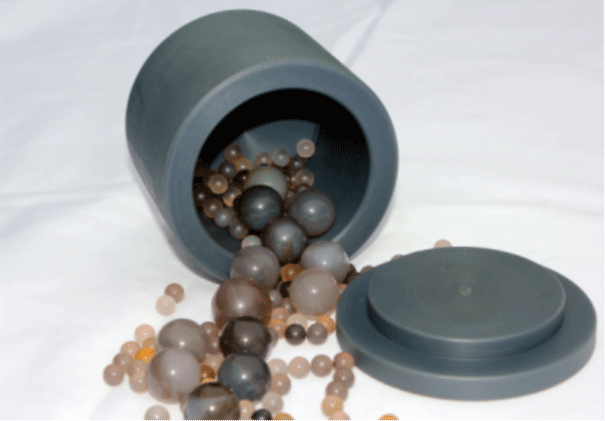 For researchers prioritizing purity, toughness, and noise reduction over maximum hardness grinding capabilities, the tempered nylon jar is an excellent choice. When paired with appropriate grinding media and a compatible planetary ball mill, it delivers consistent, contamination-free results for a wide range of advanced material processing applications.
Related Products
Get In Touch
Our professional team will reply to you within one business day. Please feel free to contact us!