
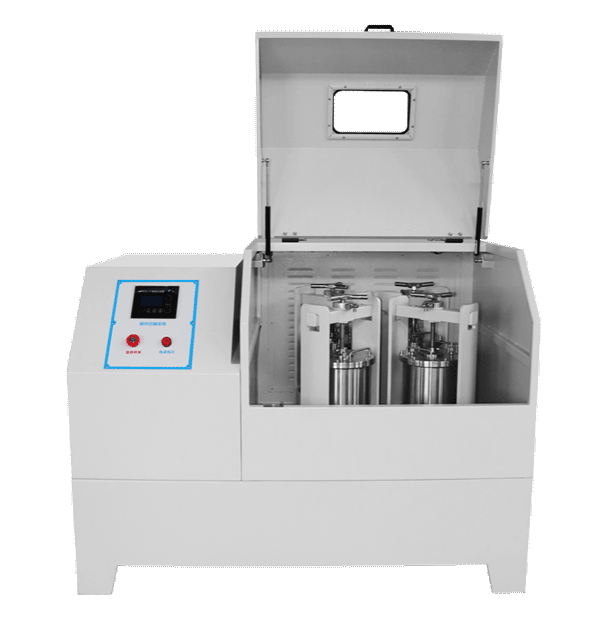
What is a Vertical Production Planetary Ball Mill? A Batch Production-Scale Grinding Equipment for Fine and Ultra-Fine Powder Processing

Introduction
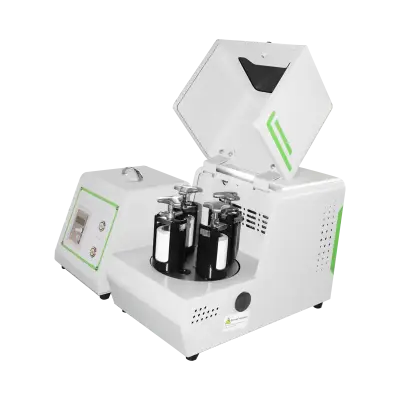
At its core, a vertical production planetary ball mill is a specialized batch-type grinding equipment that industrial sectors such as advanced ceramics, battery materials, powder metallurgy, and fine chemicals use to transform coarse granules or powders into fine or ultra-fine particles. Unlike smaller laboratory-scale planetary mills, this vertical production model is engineered with a robust frame, larger grinding jar capacities (typically ranging from 10L to 100L per jar), and a powerful drive system to handle continuous operation in a production environment. It is the go-to solution for scaling up successful lab formulations to pilot or small-batch production without compromising particle size distribution or purity.
Core Function and Working Principle
The primary function of this mill is to reduce the particle size of dry or wet materials through mechanical impact and friction. The working principle is based on the planetary motion: a main turntable (the sun wheel) rotates at a controlled speed, while four grinding jars mounted on the turntable also rotate in the opposite direction around their own axes. This combination of revolution and rotation generates high centrifugal forces, pressing the grinding balls and material against the inner walls of the jar. The resulting impact, compression, and shear forces break down the material efficiently.
Key parameters include the rotation speed of the sun wheel (typically 30–450 rpm), the jar rotation speed (up to 900 rpm), and the grinding time. The speed ratio between revolution and rotation can be adjusted to optimize the milling energy for different materials. The final particle size can reach below 0.1 μm (100 nm), making it suitable for even nano-scale applications. The vertical design saves floor space and allows for easy loading and unloading of heavy jars via a lifting mechanism, which is a critical feature for production-scale operations.
Key Components and Critical Technologies
Grinding Jars and Materials
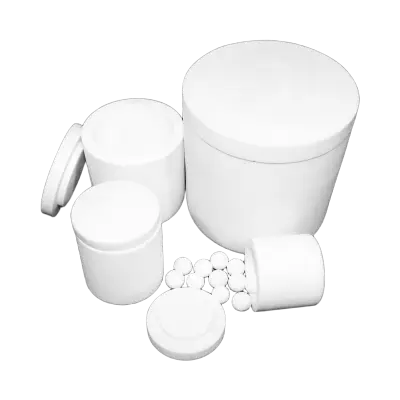
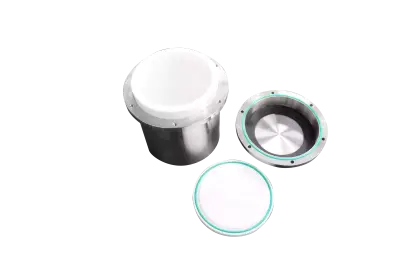
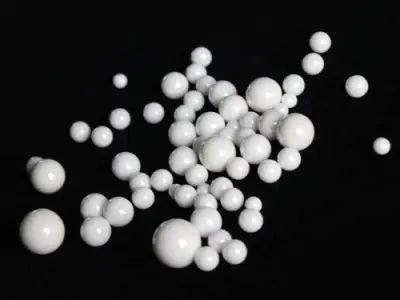
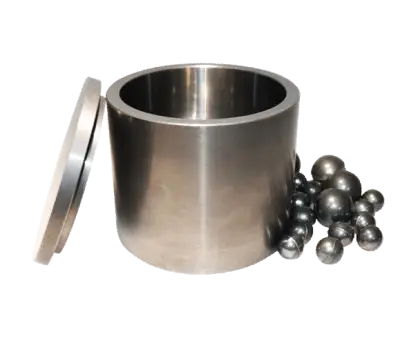
The vertical production planetary ball mill accommodates multiple jar sizes and materials. Common options include stainless steel, zirconia, agate, corundum, nylon, polyurethane (PU), and PTFE. The choice of jar material directly affects the purity of the final product, as minimal contamination from the jar is critical for high-purity applications such as battery materials or pharmaceutical ingredients. For example, zirconia jars are preferred for electronic ceramics, while agate jars are ideal for geological samples.
Drive System and Control
Industrial-grade motors and frequency converters provide precise speed control (accuracy within 0.2 rpm). The mill can be programmed for continuous operation, timed cycles, and bidirectional rotation (alternating direction) to improve grinding uniformity. Many models feature a touch-screen interface for easy parameter setting and real-time monitoring of power, speed, and temperature.
Atmosphere Control
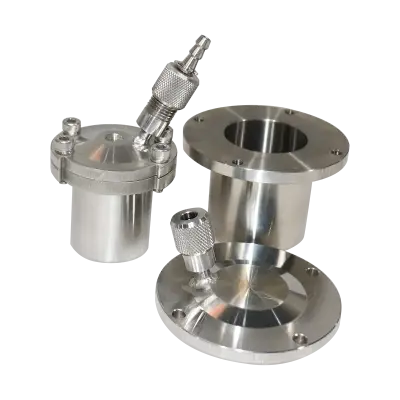
To prevent oxidation or moisture contamination, the mill can be equipped with vacuum or inert gas sealing systems. Special vacuum grinding jars allow the entire milling process to be carried out under a protective atmosphere (argon, nitrogen, etc.), which is essential for processing reactive metals, lithium battery materials, or air-sensitive compounds.
Key Performance Indicators and Selection Criteria
When selecting a vertical production planetary ball mill, consider the following parameters:
- Processing Capacity: Total jar volume (e.g., 10L, 20L, 50L, or 100L per jar). Choose based on your batch size. A 4-jar mill can process up to 400L per batch.
- Final Particle Size: Most models can achieve <0.1 μm. Verify if the mill can reach your required fineness with your specific material.
- Speed Range: Higher maximum speeds (e.g., 1600 rpm jar rotation) enable faster grinding and better energy input for hard materials.
- Material Compatibility: Ensure the jar and ball materials are chemically inert to your sample to avoid contamination.
- Automation: Programmable cycles, touch-screen controls, and remote monitoring (e.g., Wi-Fi/Bluetooth) can improve reproducibility and ease of use.
- Maintenance: Look for easy-access jar clamps, sealed bearings, and durable transmission belts to reduce downtime.
Application Areas and Selection Advice
Vertical production planetary ball mills are widely used in:
- Battery Materials: Grinding of cathode and anode materials (LiCoO₂, LiFePO₄, graphite, silicon) under inert atmosphere.
- Advanced Ceramics: Fine grinding of alumina, zirconia, silicon carbide, and other technical ceramics.
- Powder Metallurgy: Mechanical alloying of metal powders for aerospace and automotive components.
- Mineral Processing: Ultra-fine grinding of ores, kaolin, and industrial minerals.
- Pharmaceuticals: Micronization of active pharmaceutical ingredients (APIs) under controlled conditions.
For users who are moving from lab-scale to production, choosing a vertical production model with a capacity matching your batch size and a jar material that ensures purity is essential. For example, a manufacturer of lithium-ion battery materials should select a mill with vacuum-capable zirconia jars and a robust drive system for 24/7 operation. A ceramics R&D lab might prefer a smaller unit (10–20L) with variable speed and multiple jar sets for different materials.
References
Related Products
Get In Touch
Our professional team will reply to you within one business day. Please feel free to contact us!