

What Is a PTFE Planetary Mill Jar? An Inert Grinding Jar for Corrosive Materials
What Is a PTFE Planetary Mill Jar?
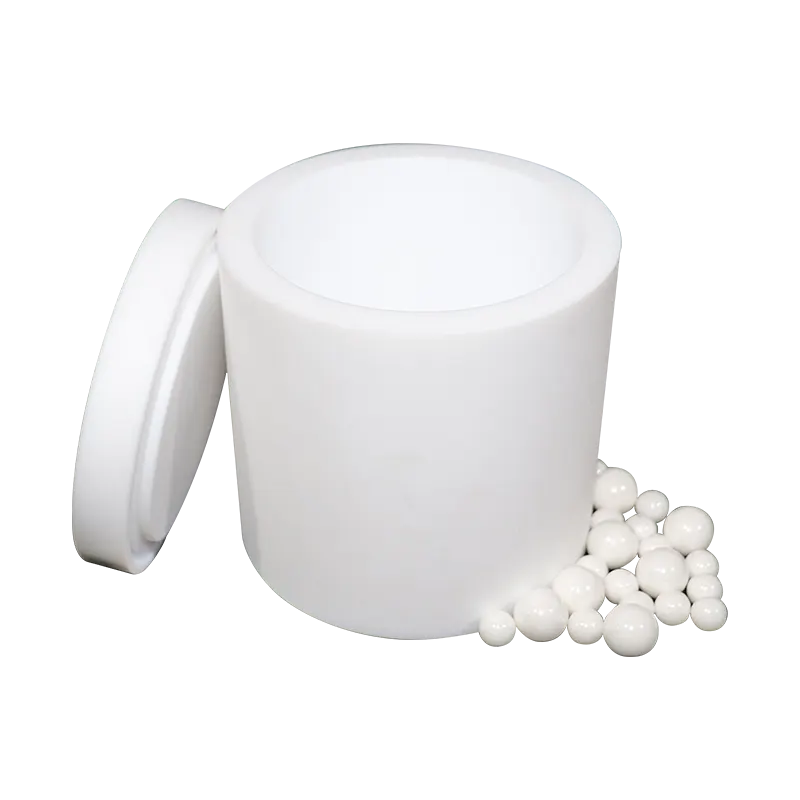
From a technical standpoint, a PTFE planetary mill jar is a grinding container made from polytetrafluoroethylene — the chemically inert fluoropolymer widely known as Teflon — and formed into the cylindrical shape required by the jar holders of a planetary ball mill. Research laboratories, quality-control departments, and small production lines use it to crush, grind, mix, and homogenize powders, pastes, and slurries without dragging iron, chromium, or other metals into the sample, and without the container wall reacting with aggressive chemicals.
"Planetary" refers to the machine, not to the jar. In a planetary ball mill, every jar spins around its own axis while the sun disc that carries the jars turns in the opposite direction. That combination produces a rapidly changing centrifugal field inside the jar, driving the grinding media against the sample and the wall at high energy. The PTFE jar is the chamber in which this collision process happens — but the material it is made from decides which samples can be processed safely, cleanly, and reproducibly.
Core Function and Working Principle
Turning Coarse Material into a Fine, Uniform Powder
The basic function of a mill jar is to change the physical state of a sample: coarse, uneven particles go in; fine, homogeneous powder comes out. Feed material is usually pre-crushed to a few millimetres or less, because a planetary mill is a fine-grinding and mixing tool rather than a primary crusher. Inside the jar, repeated collisions reduce particle size step by step — from hundreds of micrometres, down to tens of micrometres, and in favourable cases into the sub-micron or nanometre range after extended milling. At the same time, the constant tumbling motion blends different components together, so one operation can serve as grinding, mixing, mechanical alloying, or mechanochemical activation.
Because the process happens in a closed vessel, nothing is lost to dust and nothing enters from outside. That matters when the sample is expensive, toxic, hygroscopic, or sensitive to oxidation: the jar can be sealed, purged with argon, or evacuated before milling begins.
What Physically Happens Inside the Jar
A planetary mill jar contains three things: the sample, the grinding media, and empty space. As the disc turns, centrifugal acceleration pushes the media outward against the jar wall on one side and lifts them up the curved surface. As the jar rotates through the cycle, the media are released, cascade down, and strike the material trapped between them and the wall. Three mechanisms operate at once: high-energy impact, which fractures brittle particles; attrition, in which particles caught between two sliding balls are rubbed and broken; and friction at the wall, which shears and polishes the powder.
Geometry matters as much as energy. In a conventional drum mill, gravity sets the limit — the drum must rotate fast enough to lift the media but not so fast that they simply centrifuge against the wall. A planetary mill replaces gravity with a centrifugal field that can be dozens of times stronger, so much smaller jars can deliver much higher specific energy. PTFE jars take part in this process like any other jar; their low friction and non-stick surface, however, slightly change how material slides along the wall, which is one reason PTFE is often chosen for sticky, waxy, or paste-like samples that would smear onto a harder surface.
Process Parameters That Decide the Outcome
Whether a run produces a free-flowing micron powder or a compacted lump depends on a handful of adjustable parameters:
- Rotational speed and speed ratio. Higher disc speed increases impact energy and shortens milling time, but also raises temperature and wear on soft jar materials.
- Milling time. Particle size falls quickly at first and then levels off; over-milling can cause re-agglomeration or unwanted phase changes.
- Ball-to-powder ratio (BPR). More media per gram of sample usually means faster size reduction, at the cost of a smaller usable sample load.
- Media size and density. Large, dense balls deliver stronger impacts; small balls create more contact points and finer, more uniform grinding.
- Fill level. Jars are normally loaded so that media and powder occupy only part of the volume, leaving free space for motion. An over-filled jar stops behaving like a mill and starts behaving like a mixer.
- Dry or wet milling. A liquid medium such as ethanol, water, or an organic solvent suppresses dust, limits cold welding, and usually yields finer particles — provided the liquid does not attack the jar.
- Temperature and atmosphere. Cryogenic milling with liquid nitrogen keeps heat-sensitive or elastic materials brittle, while an inert or vacuum atmosphere protects oxygen-sensitive powders.
Types of Planetary Mill Jars and Where PTFE Fits
The Jar Material Family
Planetary mill jars are sold as a family of materials, each solving a different problem. Agate, zirconia, corundum, and tungsten carbide jars are hard and wear-resistant, so they suit abrasive ceramics, minerals, and hard alloys. Stainless steel jars are tough and relatively inexpensive but can shed iron and chromium. Nylon, polyurethane (PU), and tempered nylon jars are used for soft or metal-sensitive samples. Vacuum and lined variants add sealing or a protective inner sleeve for air-sensitive work.
PTFE sits at the "clean and chemically inert" end of this range. It is a soft fluoropolymer with an extremely low coefficient of friction, excellent resistance to acids, bases, and solvents, and very low extractables. The trade-off is mechanical: PTFE scratches and deforms more easily than ceramics or metals, so heavy media and long runs will wear it.
Comparing PTFE with Other Common Jar Materials
| Jar material | Wear resistance | Chemical resistance | Contamination risk | Typical use |
|---|---|---|---|---|
| PTFE | Low — soft polymer | Excellent | Very low | Corrosive, sticky, or metal-sensitive samples; cryogenic milling |
| Nylon / PU | Low to moderate | Moderate | Low | Soft, elastic materials; low-energy mixing |
| Agate | Moderate | Good (avoid HF) | Low | Minerals, soils, general laboratory grinding |
| Zirconia | High | Good | Low | Abrasive ceramics and powders needing minimal contamination |
| Corundum (alumina) | High | Good | Low | Hard, abrasive mineral samples |
| Stainless steel | High | Moderate | Metal ions | Tough samples and larger batches where trace metals are acceptable |
| Tungsten carbide | Very high | Good | Tungsten and cobalt traces | Extremely hard or abrasive materials |
In practice, the choice is decided by two questions: how abrasive is the sample, and how sensitive is the analysis to contamination? A trace-metal study of soil, or a catalyst that must not see iron, will usually be run in a PTFE, agate, or zirconia jar. A bulk ceramic that would shred a polymer jar belongs in corundum or tungsten carbide.
Size, Geometry, and Sealing Variants
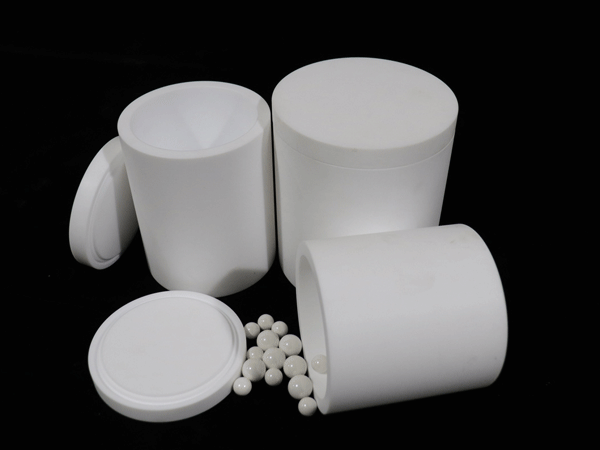
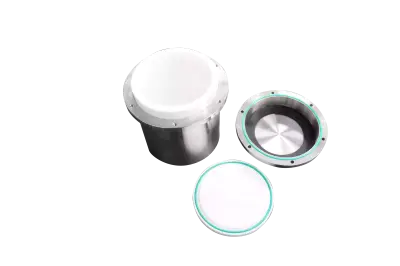
Jars come in a range of nominal volumes, from small units of roughly 50 mL used for method development up to around a litre or more for larger mills, and the correct size is dictated by the mill model and by the mass of sample the analysis requires. PTFE jars are frequently supplied as a complete set — body, lid, and sealing gasket — so the chamber can be closed tightly for wet milling or for handling under an inert atmosphere. Sealing quality is what makes inert-atmosphere milling possible: without a reliable gasket, argon escapes and the sample oxidizes anyway.
Key Components of a PTFE Mill Jar
Although a jar looks like a simple bucket, several details decide whether it performs well:
- Jar body. The grinding chamber itself. Wall thickness and internal finish affect wear life and how easily powder is emptied out, and the non-stick PTFE surface makes cleaning substantially easier than with porous ceramics.
- Lid and sealing gasket. A close-fitting lid with a chemically resistant seal keeps liquid media and fine dust inside, and keeps air out during inert-gas or vacuum operation.
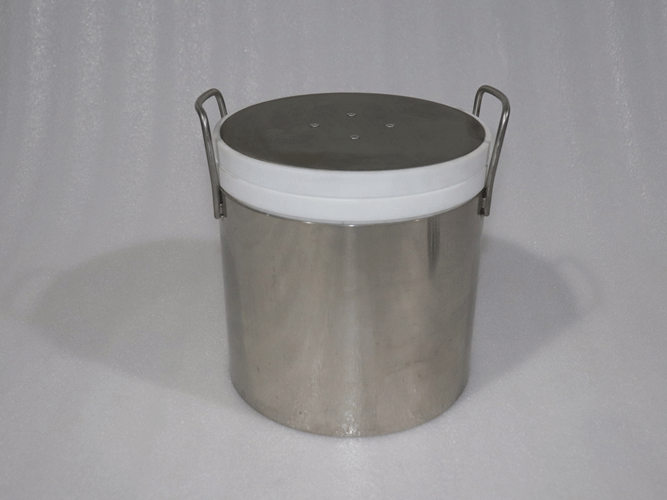
- Clamping and locating features. The jar must sit securely in its seat so it cannot slip at high speed; unbalanced or poorly seated jars cause vibration, noise, and accelerated wear.
- Grinding media. Balls of agate, zirconia, stainless steel, or coated material. Media should be at least as hard as the sample but no harder than necessary, and softer than the jar if the jar is to survive.
- Optional valves and ports. Some jar designs include gas inlet and outlet valves so the chamber can be purged or evacuated before milling.
Key Performance Indicators and Selection Points
Capacity and Throughput
The usable sample load is only a fraction of the nominal jar volume, since space must be left for media and motion. A rough planning rule is that powder plus media should not fill the jar completely; the exact figure depends on the mill and the material. Buyers should match jar volume to the mill's holder size and to the smallest sample mass their analytical method requires — running a small sample in a large jar wastes energy and gives poor mixing.
Particle Size Control and Reproducibility
What most users actually want is not just "fine" powder, but the same fine powder every time. Reproducibility comes from fixed speed, fixed time, a fixed ball-to-powder ratio, and consistent jar loading. PTFE's low friction helps in one specific way: sticky or fatty samples release from the wall instead of building up a dead layer, so the effective grinding volume stays constant from run to run.
Chemical Compatibility and Contamination
This is the main reason to select PTFE. The material resists attack by most acids, bases, and organic solvents, so it can be used with wet milling liquids that would corrode steel. It also contributes essentially no metal ions to the sample, which matters for trace analysis, catalyst preparation, and any application where a few parts per million of iron would change the result. Users should still check compatibility with the specific solvent or reagent at the milling temperature.
Thermal Behaviour and Cryogenic Milling
PTFE keeps its useful properties over a wide temperature span, remaining tough rather than brittle at very low temperatures. That makes it a natural partner for cryogenic milling, where liquid nitrogen is used to embrittle rubber, plastics, or biological material before grinding. Low thermal conductivity also means heat generated by impact does not conduct away instantly — useful when a gentle, cool process is wanted, but a reminder not to push speed too high in long dry runs.
Sealing, Cleaning, and Maintenance
A good jar is one that is easy to open, easy to empty, and easy to clean without cross-contamination between samples. PTFE's non-stick surface means most residues wipe or rinse away, and there is no porous structure to trap powder. Gaskets, however, are consumables: they should be inspected for cuts and deformation and replaced when they no longer seal. Jars should also be checked periodically for deep scratches, which both hold contamination and reduce wall thickness.
Compatibility with the Mill and the Media
Finally, the jar must physically fit: correct outer diameter, correct height, correct seat geometry, and correct clamping. A jar that rattles in its holder will not mill efficiently no matter how good the material is. Media choice follows the same logic — hard media in a soft PTFE jar will wear the jar quickly, so for abrasive samples a harder jar material is usually the more economical answer.
Applications and Selection Advice
Where PTFE Jars Are Used
PTFE planetary mill jars appear wherever cleanliness and chemical resistance matter more than brute force. Typical settings include:
- Chemical and catalyst research, where precursors react with metal and where a few trace ions would poison the reaction.
- Battery and energy materials, where electrode powders and solid electrolytes must be milled and mixed without metallic contamination.
- Pharmaceutical and food laboratories, where equipment must be easy to clean, non-reactive, and free of heavy-metal pick-up.
- Polymers, rubbers, and waxes, which are soft, elastic, and prone to smearing on harder surfaces; a non-stick wall helps, and cryogenic pre-treatment makes them brittle enough to grind.
- Environmental and geological samples that need acid-resistant containers and low blank values for trace-element analysis.
- Pigments, toners, and fine chemicals, where colour cross-contamination between batches must be avoided.
How to Choose the Right Jar for Your Work
Start with the sample, not the machine. If the material is hard and abrasive, choose a hard jar — agate, zirconia, corundum, or tungsten carbide — and accept the small amount of wear that comes with it. If the material is soft, sticky, corrosive, or analysed for trace metals, PTFE is usually the better match, precisely because it gives up so little to the sample. If the process needs argon, vacuum, or a solvent, prioritize sealing quality and gasket material. Then confirm size: choose the smallest jar that still holds enough powder for reliable analysis, because small jars mill faster and use less energy per run. Finally, match the media to the jar, since a soft jar combined with hard media means a short jar life.
Practical Operating Tips
- Pre-crush or pre-mill large pieces; planetary jars are fine-grinding tools, not crushers.
- Keep the ball-to-powder ratio consistent between runs so results are comparable.
- Do not overfill; leave free volume for media motion.
- Run a short trial at moderate speed before committing to a long, high-energy programme.
- Clean and dry jars and gaskets between samples, and store them closed to keep dust out.
- Inspect the jar wall for scratches and the gasket for damage at regular intervals.
Frequently Asked Questions
Can a PTFE jar be used for high-energy milling?
It can be used, but with limits. PTFE is a soft polymer, so prolonged high-speed runs with dense media will abrade the wall and eventually embed polymer fragments in the powder. PTFE jars work best at moderate energy with soft to medium-hard samples, or in cryogenic applications where the material is deliberately kept cool.
Will the jar contaminate my sample?
Compared with steel or tungsten carbide, contamination from PTFE is very low and, importantly, non-metallic. That is why it is a common choice for trace-metal work. Wear still occurs over time, so heavily used jars should be inspected and replaced once the inner surface becomes visibly scored.
Can I use stainless steel balls in a PTFE jar?
Yes, but the combination is unbalanced: hard steel balls in a soft polymer jar will wear the jar far faster than they wear themselves, and iron may enter the sample if the jar is damaged. Softer or better-matched media, or a harder jar material, will usually give better long-term results.
Is PTFE suitable for wet milling?
Yes. PTFE resists most acids, bases, and solvents, and its non-stick surface releases slurry easily. The limiting factor is normally the sealing gasket, which must be compatible with the chosen liquid, and the fact that some aggressive reagents at elevated temperature still need to be checked case by case.
How do I clean a PTFE jar?
Empty the media, wipe the interior with a soft cloth, and rinse with water or a compatible solvent. Avoid abrasive pads and sharp tools, which create scratches that trap powder. A short "clean run" with media and solvent is a good way to remove the last traces before a sensitive analysis.
How long does a PTFE jar last?
Service life depends almost entirely on the sample and the media. A jar used for soft polymers at moderate speed can last a long time; one used with hard ceramic media at high speed will wear visibly within a modest number of runs. Inspect regularly rather than relying on a fixed schedule.
Summary
A PTFE planetary mill jar is a small but decisive piece of laboratory equipment. It does not change how a planetary ball mill works — impact, attrition, and friction still break the sample down — but it changes what can safely be milled and how clean the result will be. By combining chemical inertness, non-stick surfaces, wide temperature tolerance, and negligible metal contamination, PTFE jars make it possible to grind corrosive, sticky, or trace-sensitive materials in a closed, reproducible way. Where abrasion resistance matters more, harder ceramic or carbide jars remain the practical choice. The right answer depends on the sample, the analysis, and the media — and for a large group of laboratory tasks, that answer is PTFE.
For specifications and available configurations, see the PTFE planetary mill jar product page.
Related Products
Get In Touch
Our professional team will reply to you within one business day. Please feel free to contact us!