

What Is a Production Type Stirred Ball Mill? A Wet Grinder for Slurry Production
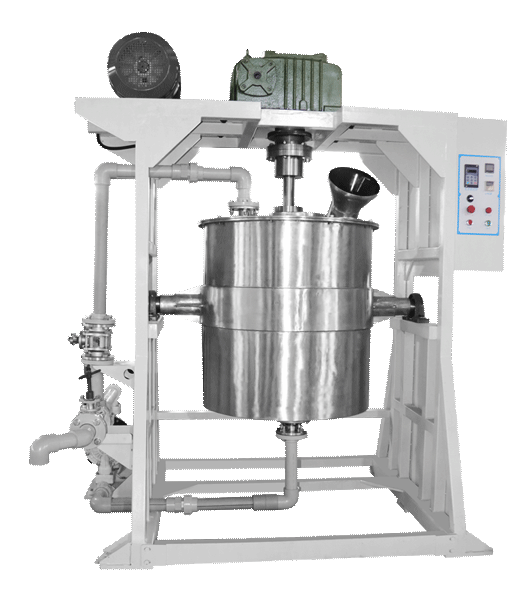
From a practical standpoint, a production type stirred ball mill is a wet grinding machine that uses agitated grinding media to reduce solid particles and disperse them in a liquid carrier. It is intended for slurry-based processing in which fine particles and uniform distribution matter. The machine differs from a conventional tumbling ball mill: instead of relying mainly on gravity to cascade media inside a rotating drum, a stirred mill keeps the media moving with an internal agitator and brings the slurry into repeated contact with that moving media. The commercial version referenced here can be viewed on the Production type stirred ball mill product page.
What “Production Type Stirred Ball Mill” Means
The name is descriptive rather than decorative. “Stirred” refers to the way the grinding media are energized: a rotating agitator, rotor, or paddle assembly transfers motion to the media bed. “Ball mill” refers to the use of loose grinding bodies, usually spheres or near-spherical media, as the working element. “Production type” signals that the equipment is conceived for manufacturing duty rather than only for small laboratory samples. That label should not be read as a guaranteed capacity or a fixed configuration, because real output depends on the formulation, target fineness, media, and process mode.
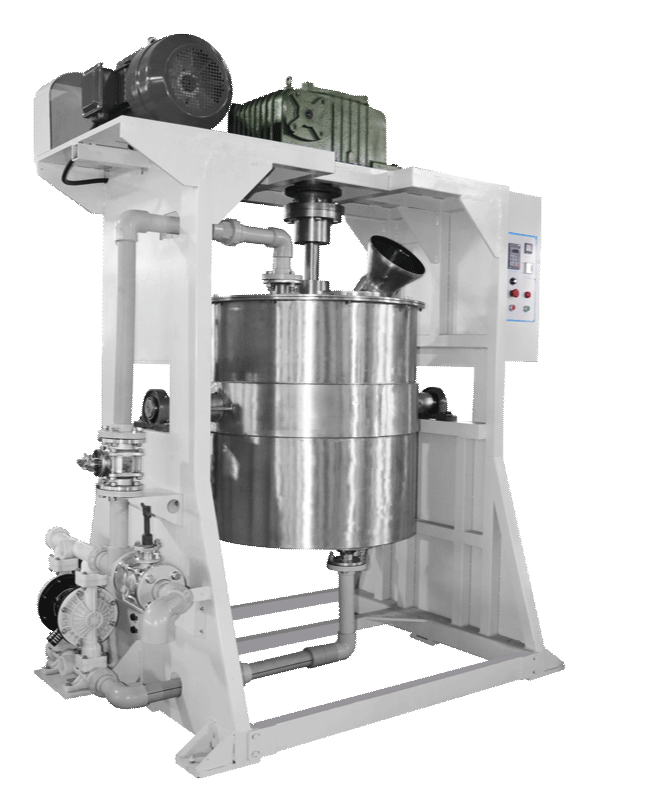
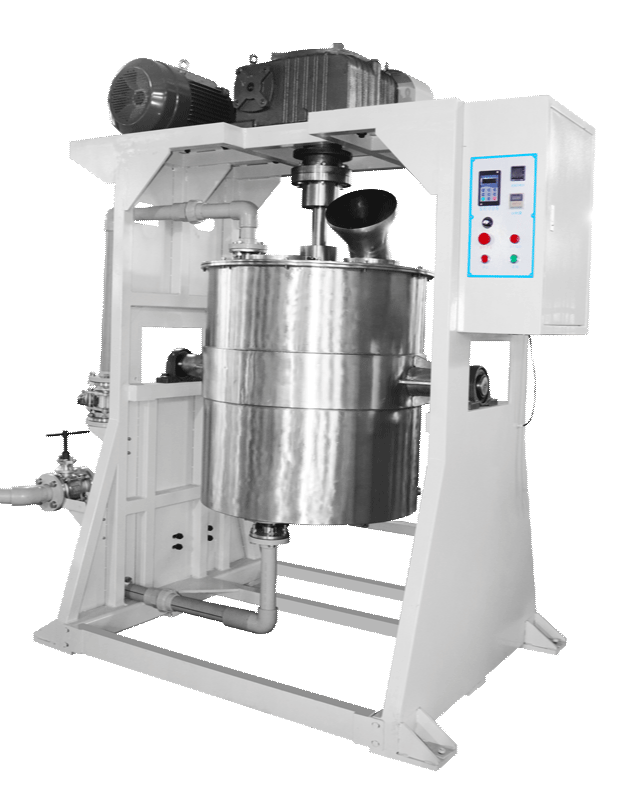
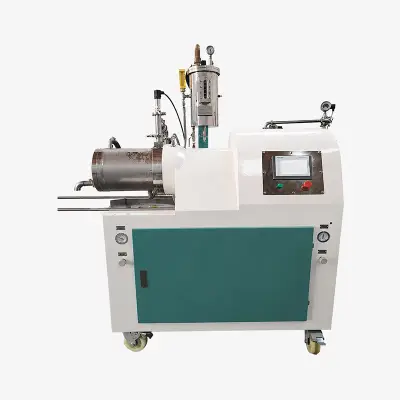
A production type stirred ball mill is therefore best understood as a system rather than a single chamber. It normally includes a feed system, a milling chamber, an agitator, a media charge, a separation device that keeps media inside the mill, a cooling arrangement, instrumentation, and controls. The mill’s value comes from combining particle-size reduction with dispersion and from doing so in a contained wet process that can be integrated into a larger production line. Buyers should confirm the available chamber sizes, materials, drive options, and control features on the product page rather than assuming a standard specification.
Core Function: Wet Grinding and Dispersion
The primary function of a stirred ball mill is to convert a coarse or agglomerated slurry into a finer, more uniform slurry. The feed may contain particles that are already small but clustered together, or it may contain larger particles that must be broken down. In either case, the mill applies mechanical energy to the liquid-solid mixture so that particle clusters are separated, particle size is reduced, and the solids become more evenly distributed in the liquid. In coating, ink, ceramic, mineral, battery, and chemical applications, this combination of grinding and dispersion is often more important than particle-size reduction alone.
Wet operation has practical consequences. It reduces dust generation, helps control the temperature of the material, and can make handling and transfer easier when the final product is a slurry. It also places demands on the formulation: solids loading, viscosity, stability, and chemical compatibility all influence how the mill performs. A slurry that is too viscous may not flow through the chamber evenly, while a slurry that is too thin may not provide enough residence time or may promote settling. The production type stirred ball mill is therefore not a standalone answer to every milling problem; it is a unit operation that must be matched to the surrounding process.
How the Mill Transfers Energy
A motor turns the agitator inside the milling chamber. The agitator pushes the media charge into motion and creates a complex flow field in the slurry. Particle breakage occurs through several mechanisms: collisions between media, shear generated in the liquid as media move past one another, and attrition as particles are caught between moving surfaces. The relative importance of these mechanisms changes with agitator speed, media size, media density, chamber geometry, and slurry rheology.
As particles become finer, the energy required to reduce them further usually increases. Very fine particles also tend to reagglomerate if the formulation and dispersion energy are not sufficient. For this reason, a stirred mill is often operated as part of a controlled process rather than as a single pass with unlimited energy input. Overgrinding can waste energy, alter particle shape, generate heat, and create an overly broad or unstable particle-size distribution. The practical goal is not simply the smallest possible particle size, but the narrowest useful distribution at an acceptable energy cost and production rate.
From Feed to Product: A Typical Process Path
Although layouts vary by installation, a production stirred milling circuit usually follows a recognizable sequence. The exact sequence should be confirmed for the chosen product and application, but the general logic helps buyers understand what a complete system requires.
- Pre-dispersion or premixing. Solids are combined with liquid and any additives to create a pumpable feed. Good premixing can reduce the load on the mill and improve consistency.
- Controlled feeding. The slurry is delivered to the milling chamber at a rate that matches the desired energy input and residence time. Stable feeding is essential for stable product quality.
- Grinding in the chamber. The agitator energizes the media, and the slurry passes through the active grinding zone. Energy is transferred from the drive to the media and then to the particles.
- Media separation. A screen, gap, or other separator retains the grinding media while allowing the product slurry to leave. Reliable separation protects downstream equipment.
- Cooling and monitoring. Because grinding energy becomes heat, the chamber and sometimes the product stream are cooled. Temperature, pressure, flow, and power data support repeatable operation.
- Discharge, recirculation, or classification. The product may be discharged after one pass, returned for multiple passes, or directed to a classification step before final collection.
The process path matters because a stirred mill performs differently in batch, recirculation, and continuous modes. Batch operation can offer flexibility and easier recipe changes. Recirculation can provide multiple passes through a smaller active volume. Continuous operation can support steady production when the feed and control strategy are well developed. The right choice depends on product volume, changeover frequency, cleaning requirements, and the sensitivity of the formulation to residence-time distribution.
Key Process Parameters and Their Influence
Stirred milling is a multivariate process. Two machines of the same nominal size can produce different results if they are operated with different media, speeds, flow rates, or solids loadings. Users should therefore think in terms of a process window rather than a single set of settings.
Agitator speed and tip speed
Higher agitator speed generally increases the energy intensity and the rate of particle breakage, but it also increases heat generation, media wear, and the risk of damaging shear-sensitive materials. Tip speed is often more useful than shaft speed alone because it reflects the actual velocity at the outer edge of the agitator. The correct value depends on the product, the media, and the mechanical limits of the machine. Very high speeds are not automatically better: they can compact the media bed, create uneven wear, or cause the slurry to bypass the most active grinding zone.
Media size, density, and fill level
Grinding media are the working tools of the mill. Smaller media create more contact points and are often useful for fine grinding, while larger or denser media can deliver more impact energy for coarser particles. Media density affects the energy that can be transferred, but it also affects wear, drive load, and the difficulty of keeping the media suspended. The fill level of the chamber influences how much media is available for contact and how freely the slurry can move. Too little media reduces grinding action; too much can restrict flow and raise temperatures.
Solids loading, viscosity, and formulation
The amount of solid material in the slurry changes both the grinding load and the flow behavior. Higher solids loading can improve productivity and reduce the amount of liquid that must later be removed, but it can also make the slurry difficult to pump and may cause media to settle or the chamber to clog. Viscosity is not a fixed property: it can change as particles are broken down, as temperature rises, and as additives are activated. A formulation that looks suitable in a beaker may behave differently under the high-shear conditions inside a stirred mill.
Flow rate, residence time, and classification
In recirculation or continuous operation, flow rate determines how long the slurry remains in the active grinding zone. A slower flow generally increases the energy dose per unit of product, but it may reduce throughput. A faster flow can improve output but may leave particles too coarse. If a classifier is used, its cut point and efficiency interact with the mill; the circuit should be evaluated as a whole rather than as a mill in isolation.
Temperature, pressure, and atmosphere
Grinding generates heat. If the product is heat-sensitive, cooling capacity and temperature control become central selection criteria. Seals and pressure management also matter when the process needs to exclude air, contain solvent vapor, or operate under a controlled atmosphere. These requirements should be discussed early, because they affect chamber design, materials, and instrumentation.
Core Components and Design Features
A production type stirred ball mill can be examined as a set of functional subsystems. The grinding chamber contains the media and provides the flow path. The agitator transmits energy to the media. The drive supplies torque and speed. The separator retains media while allowing slurry to pass. The cooling system removes heat. The seal package protects the product and the environment. The control system ties these elements together and records the variables needed for repeatable production. Each subsystem contributes to availability and product quality, so a low purchase price alone is not a sound basis for comparison.
Wear protection and contamination control
Because the chamber, agitator, and separator are exposed to moving media and abrasive particles, wear is a normal part of operation. The choice of construction material and wear protection should be matched to the product. Contamination is equally important in applications where trace metals, color, or chemical inertness affect the final product. Users should ask which wetted materials are available and how wear parts are inspected or replaced. A well-designed mill makes these tasks accessible without unnecessary dismantling.
Cooling, sealing, and instrumentation
Cooling surfaces, jacket design, and temperature sensors influence process stability. Seals must suit the slurry, solvent, pressure, and cleaning regime. Power monitoring, temperature monitoring, flow measurement, and interlock logic help operators detect abnormal conditions before they become production losses. For a production asset, the quality of this instrumentation can be as important as the grinding chamber itself.
Production Configurations and Scale-Up Choices
Stirred media mills are available in several general arrangements, and the product page is the appropriate place to confirm which options are offered for this specific model. A buyer should not assume that a laboratory result transfers directly to a production unit. Scale-up must account for energy per unit mass, residence-time distribution, media dynamics, cooling capacity, and the practical limits of pumping and separation.
Batch, recirculation, and continuous operation
Batch operation is useful when recipes change frequently or when a fixed volume must be processed under close supervision. Recirculation is common when a narrower particle-size distribution is needed and the product can be returned to a holding tank for multiple passes. Continuous operation suits stable recipes and higher volumes, but it demands consistent feed preparation and reliable flow control. Each mode has different cleaning and sampling requirements, which should be considered during selection.
Orientation and agitator style
Stirred mills may be arranged horizontally or vertically, and agitator geometry may include discs, pins, paddles, or other elements. The arrangement affects media suspension, flow patterns, wear distribution, and the footprint of the installation. Rather than treating orientation as a simple preference, users should link it to the product’s rheology, the required energy intensity, and the available plant space.
Media selection and circuit design
Media material, size, and density should be chosen together with the chamber material and separator design. The media must be chemically compatible with the slurry and physically suitable for the target particle size. The circuit should also include a plan for media addition, removal, cleaning, and inspection. A production mill that is difficult to service can lose more value through downtime than it gains through a lower initial price.
Key Performance Indicators Buyers Should Examine
Selection should be based on the product requirement, not on a single headline number. Throughput, fineness, particle-size distribution, energy consumption, wear rate, temperature rise, cleaning time, and automation level all interact. A mill that reaches a fine particle size at a low feed rate may be unsuitable for production, while a high-throughput unit may not achieve the required distribution. Pilot testing or application review is therefore more informative than comparing nominal chamber volumes alone.
| Selection area | Why it matters | What to verify |
|---|---|---|
| Throughput and energy | Production cost depends on output per unit of energy, not output alone. | Expected feed rate, solids loading, and specific energy at the target fineness. |
| Particle size and distribution | A fine median size is not enough if the distribution is broad or unstable. | Measurement method, target curve, and repeatability across batches. |
| Media and wear parts | Consumables affect operating cost and product contamination. | Media options, wear-part access, and inspection interval. |
| Temperature control | Heat can degrade the product or change slurry rheology. | Cooling capacity and temperature limits for the formulation. |
| Automation and records | Repeatability depends on controlled inputs and traceable data. | Recipe management, alarms, interlocks, and data logging. |
| Cleaning and changeover | Residue can cause contamination and lost batches. | Drainability, access, cleaning method, and validation support. |
It is also wise to ask how the supplier defines capacity. Is it a hydraulic limit, a media limit, a motor limit, or a demonstrated output for a specific formulation? The answer determines whether a quoted figure is relevant to the user’s own slurry. For a production type stirred ball mill, the most useful specification is a tested process result tied to a stated feed, target fineness, and operating mode.
Applications and Selection Advice
Stirred ball mills are used where fine particles must be produced or dispersed in a liquid. Typical fields include coatings, inks, pigments, ceramic slurries, mineral processing, chemical products, battery materials, and other specialty suspensions. The common thread is not a single industry but a process need: controlled particle-size reduction, good dispersion, and repeatable slurry quality. Materials with high viscosity, high abrasiveness, heat sensitivity, or strict contamination limits require more careful configuration.
For a user moving from laboratory work to production, the safest path is to define the target particle-size distribution, the acceptable temperature rise, the required throughput, and the cleaning regime before comparing equipment. A laboratory mill can establish a starting formulation, but production scale-up should consider the longer residence time, different cooling load, and practical pumping constraints of the larger circuit. Buyers with frequent recipe changes may prioritize access and cleaning flexibility, while buyers with a stable high-volume product may prioritize continuous operation and energy efficiency.
Frequently Asked Questions
Is a stirred ball mill the same as a rotary ball mill?
No. Both use grinding media, but a rotary ball mill relies mainly on the tumbling motion of a rotating drum, while a stirred ball mill uses an internal agitator to energize the media. This difference affects energy intensity, media motion, heat generation, and the range of suitable applications.
Why use wet grinding instead of dry grinding?
Wet grinding can reduce dust, improve dispersion, and make slurry handling easier. It is often preferred when the final product is a suspension or when the formulation benefits from liquid-phase mixing. The trade-off is that slurry rheology, pumping, and liquid removal must be managed.
How do I choose the grinding media?
Start with the target particle size, the acceptable contamination level, the slurry chemistry, and the energy available. Smaller media may help fine grinding, while denser or larger media may suit coarser feeds. Media choice should be confirmed with the equipment supplier because it affects wear, separation, and drive load.
What information should I prepare before asking for a quote?
Prepare the feed composition, solids loading, initial particle size, target particle size or distribution, required throughput, temperature limits, cleaning requirements, available utilities, and material-contact restrictions. These inputs allow a more meaningful discussion of chamber size, materials, controls, and process mode. Product-specific details should then be checked against the supplied product documentation and the Production type stirred ball mill product page.
Where to Learn More
For available configurations, product imagery, and the current commercial description, refer to the Production type stirred ball mill. Use the page to confirm model details, then evaluate the mill against the process requirements described above: target fineness, throughput, slurry behavior, cooling, wear, and maintenance access.
Related Products
Get In Touch
Our professional team will reply to you within one business day. Please feel free to contact us!