
What is a Muffle Furnace? A Professional High-Temperature Sintering and Heat Treatment Equipment for Laboratory and Industrial Use

What is a Muffle Furnace? A Professional High-Temperature Sintering and Heat Treatment Equipment for Laboratory and Industrial Use
At its core, a muffle furnace is a specialized high-temperature heating device used across materials science, ceramics, metallurgy, and chemical industries to sinter, ash, anneal, or heat-treat solid samples in a controlled, isolated environment. The term “muffle” refers to the internal chamber (muffle) that separates the heating elements from the sample, ensuring uniform heating and preventing contamination. By reaching temperatures typically ranging from 1000°C to 1800°C (and even up to 2200°C in some models), a muffle furnace transforms raw powders, green bodies, or pre-formed materials into dense, durable end products with precise thermal properties.
Core Function and Working Principle
The primary function of a muffle furnace is to convert materials from their initial state—such as loose powder, pressed compacts, or dried gels—into a final state with enhanced mechanical, electrical, or thermal characteristics through controlled heating. The working principle is straightforward: the furnace housing contains high-quality resistance heating elements (often made of silicon carbide, molybdenum disilicide, or Kanthal) that radiate heat into the muffle chamber. The chamber is typically made of ceramic fiber or refractory bricks, which provide excellent thermal insulation and minimize heat loss.
Temperature control is achieved via a microprocessor-based PID controller, which maintains the setpoint with accuracy of ±1°C to ±5°C depending on the model. The heating rate can be programmed from 0.1°C/min to 20°C/min or more, allowing users to design complex sintering profiles (e.g., slow ramp-up, dwell at peak temperature, and controlled cooling). The atmosphere inside the chamber is usually ambient air, but some advanced muffle furnaces can be equipped with gas inlet/outlet ports for inert or reducing atmospheres (e.g., nitrogen, argon) to prevent oxidation or decarburization.
Main Types of Muffle Furnaces
1. Laboratory Box Muffle Furnace
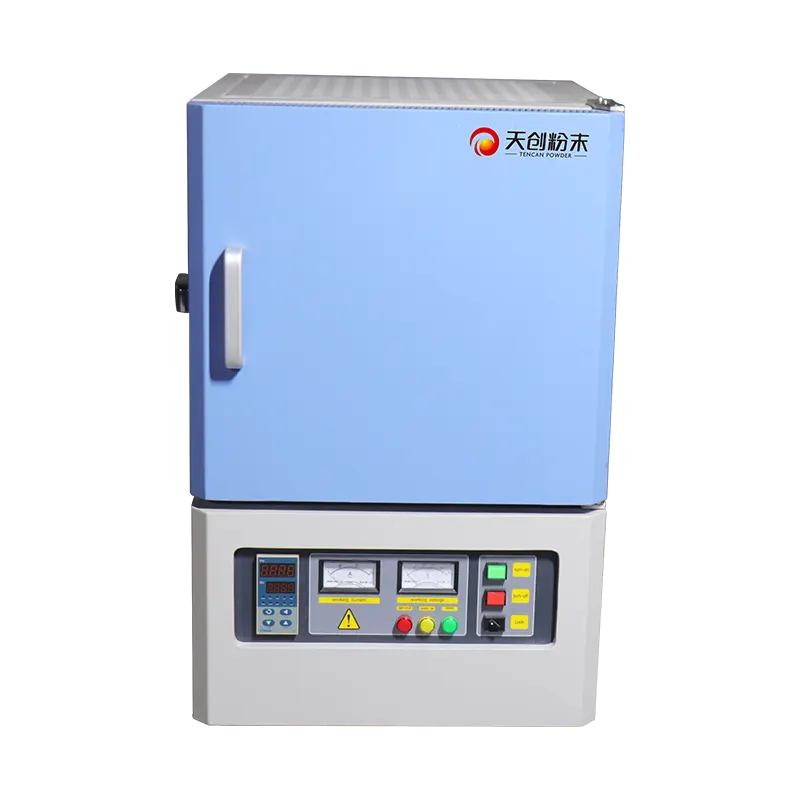
This is the most common type, designed for bench-top use in R&D labs. It features a compact footprint, digital temperature control, and a straight-through opening for easy loading. Typical temperature range: 1000°C–1200°C. Ideal for ashing, calcination, and small-scale sintering of ceramic samples, metal powders, or glass.
2. High-Temperature Muffle Furnace (1300°C–1800°C)
Equipped with molybdenum disilicide (MoSi₂) heating elements, these furnaces can reach 1700°C or even 1800°C. They are used for advanced ceramics (e.g., alumina, zirconia), refractory materials, and high-temperature alloy heat treatment. The insulation is typically made of dense ceramic fiber boards to reduce heat loss and improve energy efficiency.
3. Ultra-High-Temperature Muffle Furnace (Up to 2200°C)
Some specialty models use graphite or tungsten heating elements under vacuum or protective atmosphere to achieve 2200°C. These are essential for sintering high-performance materials like silicon carbide, silicon nitride, or tungsten carbide, and are often used in aerospace and defense research.
4. Programmable Muffle Furnace with Multi-Step Control
Many modern muffle furnaces come with multi-segment programmable controllers, enabling users to set up to 30 or more temperature steps (ramp, hold, and cool). This is crucial for processes like binder burnout, sintering, and annealing that require precise thermal profiles.
Key Performance Indicators and Selection Criteria
When selecting a muffle furnace, the following technical parameters should be carefully evaluated:
- Maximum Temperature: Choose a furnace that exceeds your highest required process temperature by at least 50°C to ensure headroom. Common ranges: 1100°C, 1200°C, 1500°C, 1700°C, 1800°C.
- Temperature Uniformity: Look for uniformity of ±2°C to ±5°C across the chamber. Uniformity is critical for consistent sintering results, especially for large batches.
- Heating Rate: Faster heating rates (e.g., 10–20°C/min) improve productivity but may cause thermal shock in sensitive materials. Adjustable rate is preferable.
- Chamber Volume: Available in sizes from 1 liter (for small samples) to over 100 liters (for industrial use). Match the chamber size to your typical batch volume.
- Energy Efficiency: Modern ceramic fiber insulation reduces heat loss by 30–50% compared to traditional refractory brick, lowering electricity consumption and improving cooling speed.
- Control System: A PID controller with programmable segments and data logging (e.g., USB or RS-232) is highly recommended for reproducibility and documentation.
- Safety Features: Over-temperature protection, door interlock, and emergency stop are essential for safe operation.
Application Areas and Selection Advice
Muffle furnaces are indispensable in the following fields:
- Ceramics & Glass: Sintering of ceramic powders, glazing, and glass melting.
- Metallurgy: Heat treatment of metals (annealing, quenching, tempering) and powder metallurgy (sintering of metal compacts).
- Materials Research: Calcination of catalysts, synthesis of nanomaterials, and thermal analysis.
- Pharmaceutical & Chemical: Ashing of organic samples, ignition loss testing, and drying of solids.
- Geology & Mining: Fusion of rock samples for XRF analysis, and preparation of mineral specimens.
For researchers who need a reliable, easy-to-use furnace for routine ashing or low-temperature sintering, a standard 1100°C box muffle furnace with a 3-L chamber is a cost-effective choice. For advanced ceramics or high-temperature alloys, a 1700°C model with programmable controls and optional atmosphere capability is recommended. Always check the power supply requirements (usually 220V or 380V) and ensure your lab has adequate ventilation and fire safety measures.
References
Related Products
Get In Touch
Our professional team will reply to you within one business day. Please feel free to contact us!